You don’t need a riot of color to make a statement. In fact, a quiet, neutral palette can be your greatest asset, pushing you to explore the most powerful element in embroidery: texture.
When you limit your colors to shades of cream, sand, gray, and black, your focus shifts. Suddenly, the direction of a stitch, the thickness of a thread, and the space between your lines become the main story. This is where your work transforms from simple stitching into sophisticated fiber art.
In these patterns, you’ll discover how to create depth with shadows, movement with line, and emotion with texture alone. It’s about making every single stitch count, turning neutral into impactful, and quiet into unforgettable.
1. Sculptural Depth with Punch Needle and Yarn
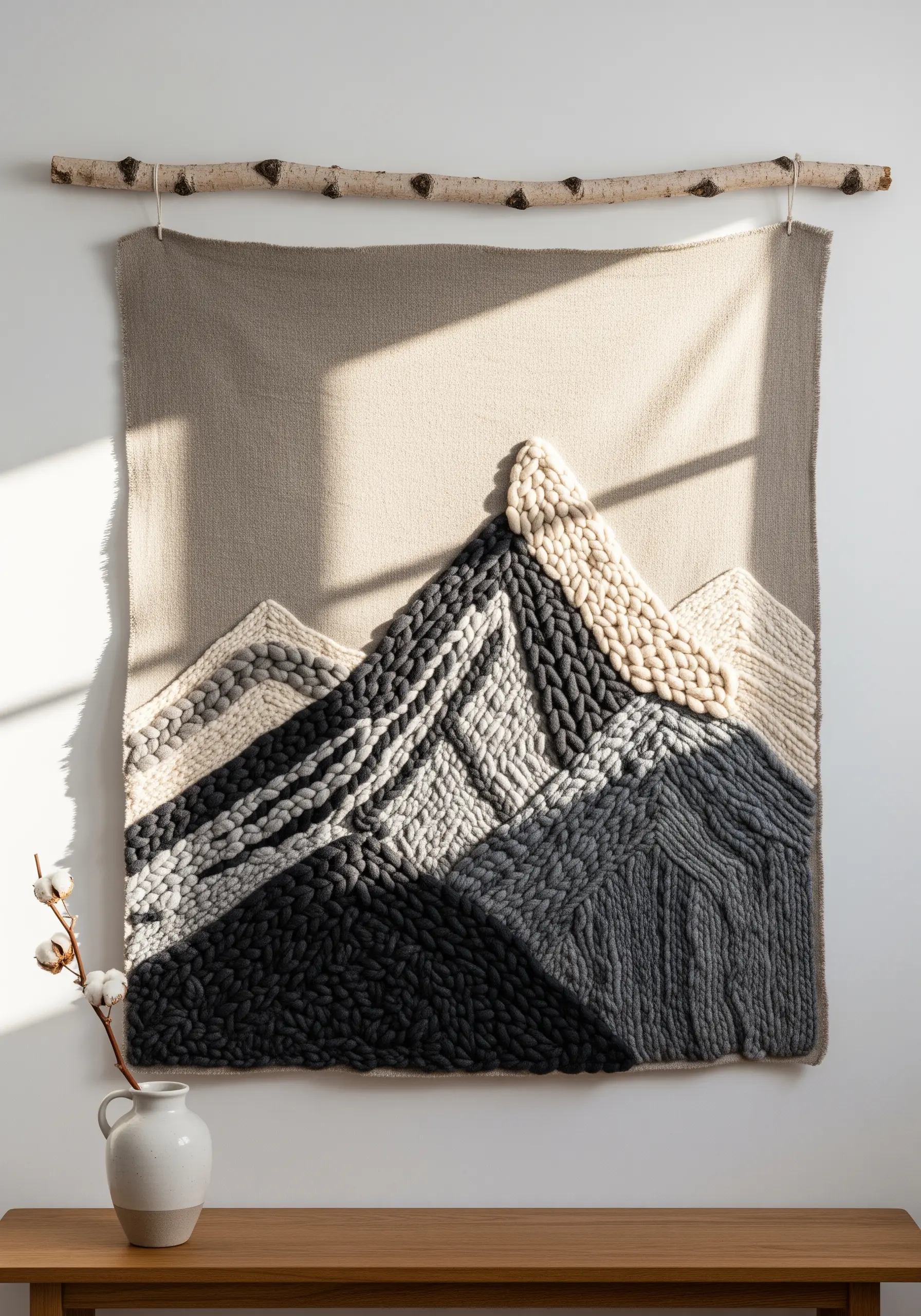
Transform a simple wall hanging into a topographical masterpiece by using punch needle techniques with chunky yarn.
Instead of uniform loops, vary their height and density to mimic the shadows and highlights of a mountain range.
Use a tight, low loop for the sunlit peaks and a taller, denser loop for the deep valleys to build dramatic, touchable texture.
This approach emphasizes form and structure, proving that you don’t need color to create a powerful landscape.
It’s one of the most effective ways to create depth in your embroidery using natural textures and form.
2. The Art of the Angled Satin Stitch
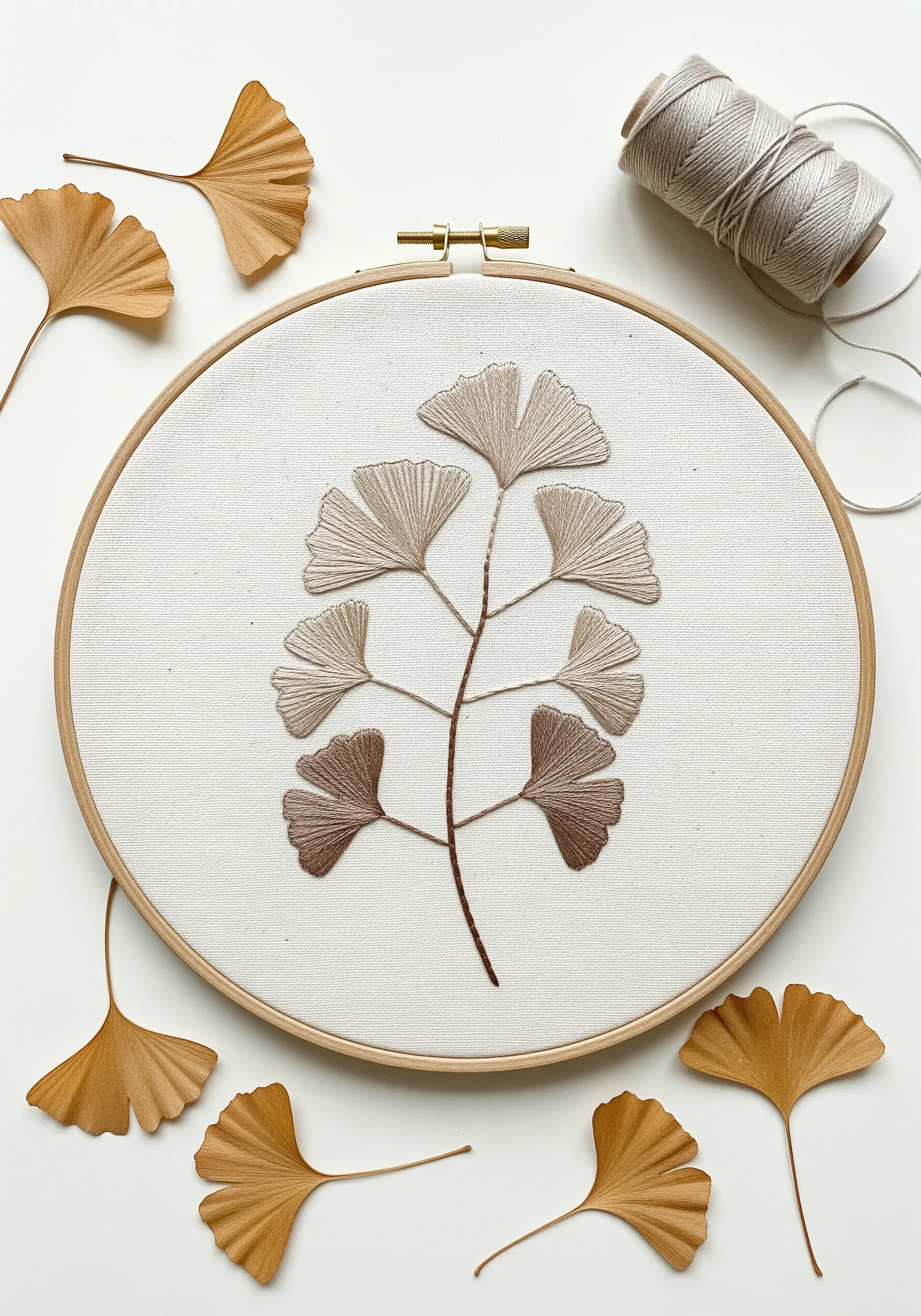
To capture the delicate structure of ginkgo leaves, perfect your angled satin stitch.
Instead of stitching straight across, direct all your stitches from the outer edge of the leaf toward a single point at its base, creating a fan effect.
This technique gives the illusion of veins and captures how a real leaf catches the light.
Work with just two or three strands of floss for sharp definition, and use a gradient of neutrals—from pale sand to warm taupe—to add subtle, organic variation.
Grouping several motifs together in tiny botanical embroidery frames creates a cohesive, gallery-worthy display.
3. Create Movement with a Triptych Display
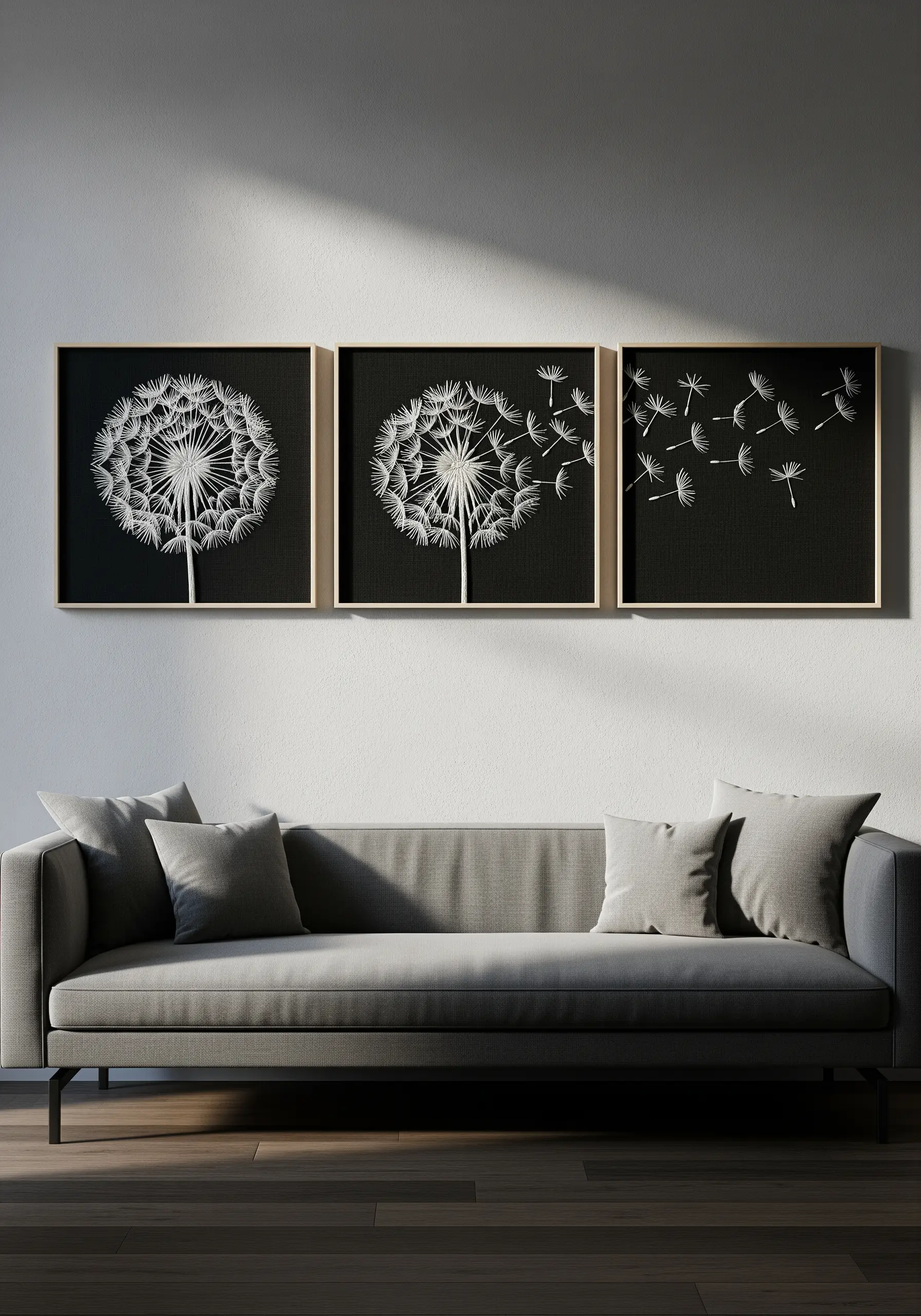
Tell a story across multiple frames to give your embroidery a sense of motion and time.
For a dandelion design, fill the first hoop with a dense head of straight stitches and French knots.
In the second, release a few seed stitches, letting them float into the negative space.
By the third frame, the seeds have fully dispersed, leaving just a few stray threads behind.
Stitching with bright white thread on black fabric creates a stark, graphic impact, turning simple stitches into dynamic art that is perfect for circle frame minimal embroidery compositions.
4. Elevate Basics with Raised Geometric Motifs
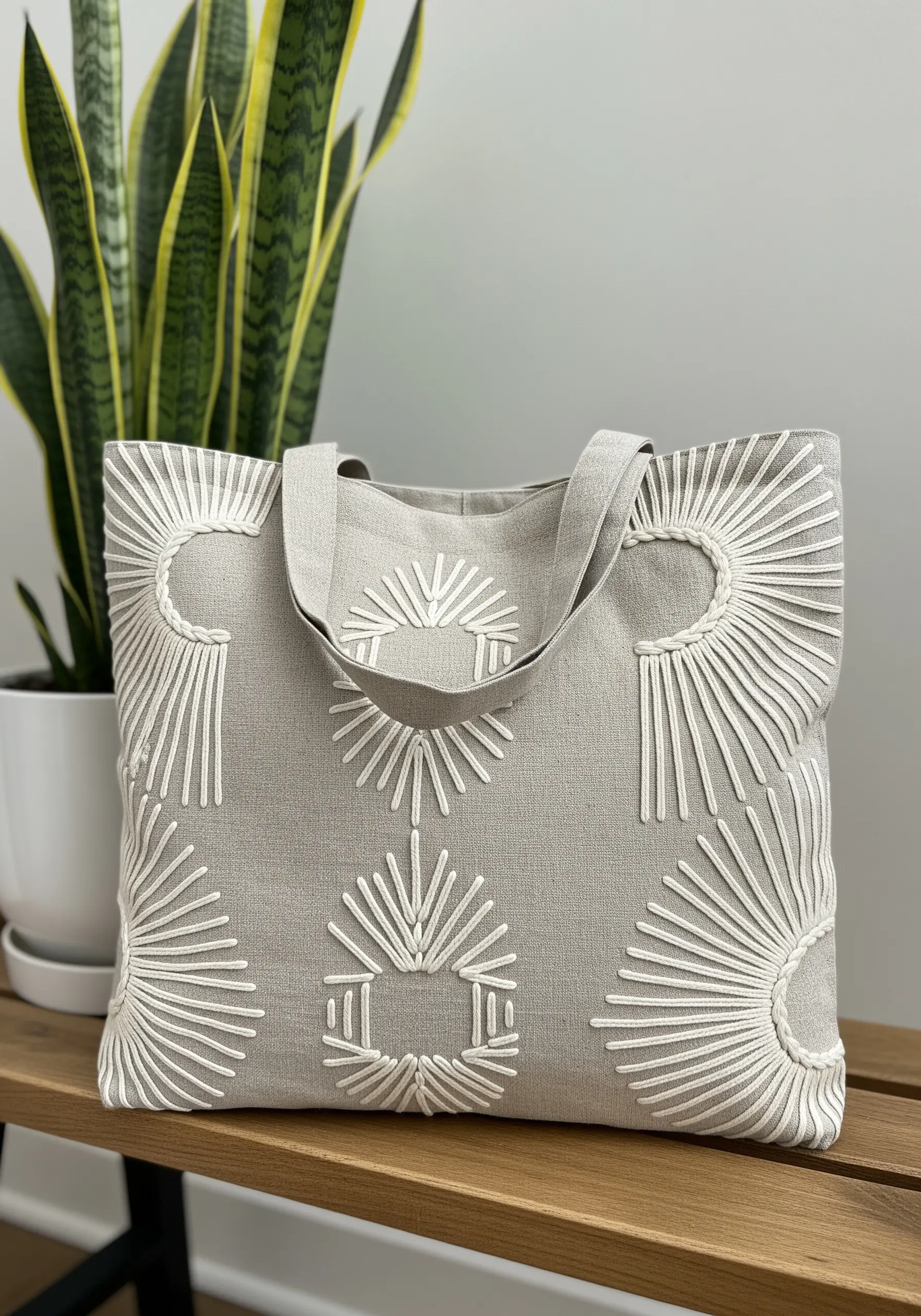
Turn a plain canvas tote into a designer accessory using bold, raised line work.
Create your sunburst patterns with a whipped backstitch or a heavy three-ply chain stitch to give the lines a clean, cord-like finish.
This technique adds a subtle three-dimensional quality that feels more luxurious than a simple backstitch.
Using a high-contrast thread, like crisp white on stone gray linen, makes the geometric shapes pop, resulting in one of those minimalist line art embroidery patterns that turn plain tote bags into chic everyday fashion.
5. Thread Painting for Lunar Texture
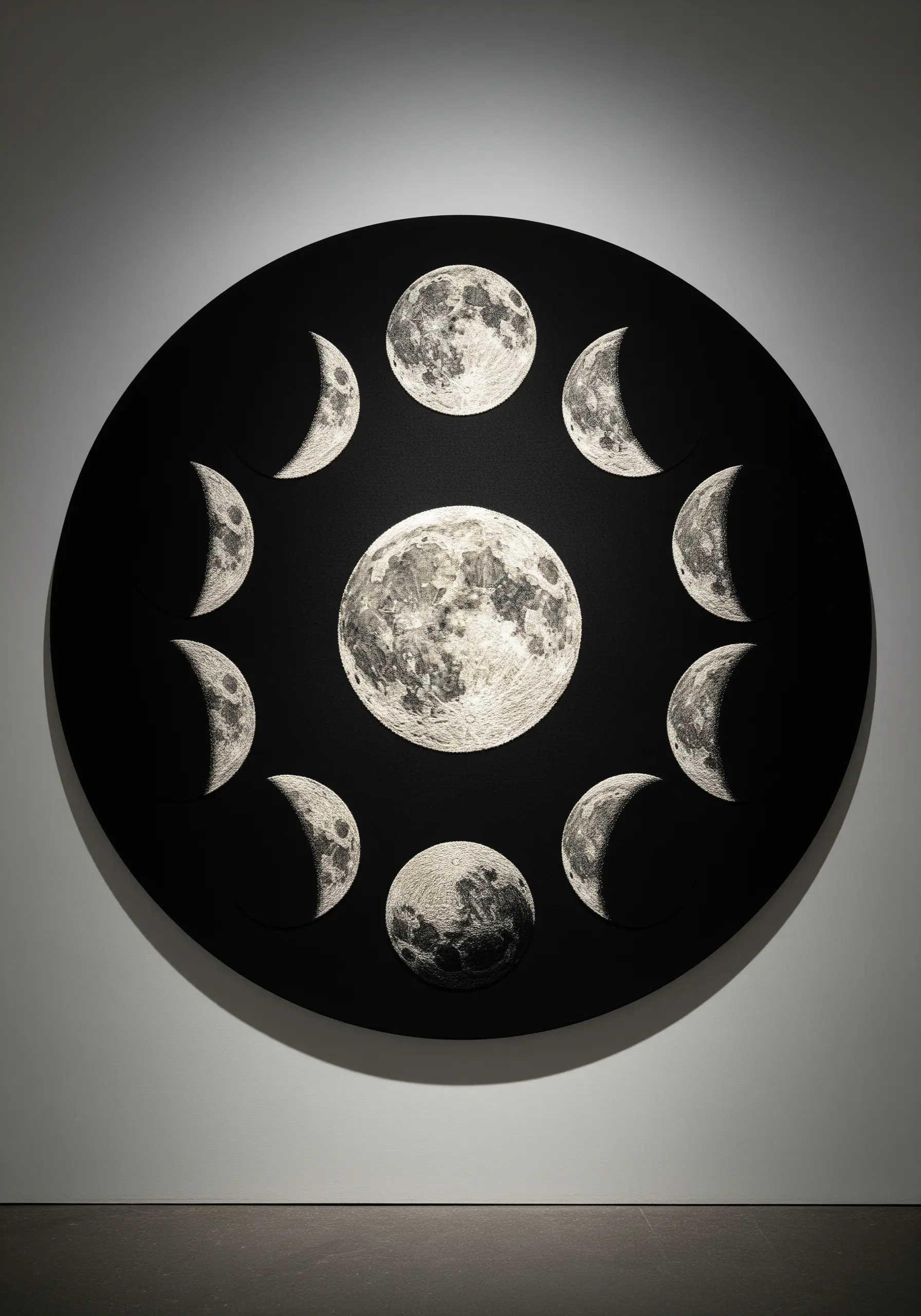
Recreate the moon’s cratered surface by thread painting with a limited palette of grays, creams, and whites.
Forget perfect satin stitches; the key here is building organic texture.
Fill the shape with a dense combination of seed stitches, French knots, and tiny, overlapping straight stitches placed in random directions.
Using a single strand of floss allows for fine detail, while the black background makes your celestial body appear to glow.
This technique is ideal for creating tiny night sky embroidery designs with realistic depth and luminosity.
6. Capture Softness with Turkey Work
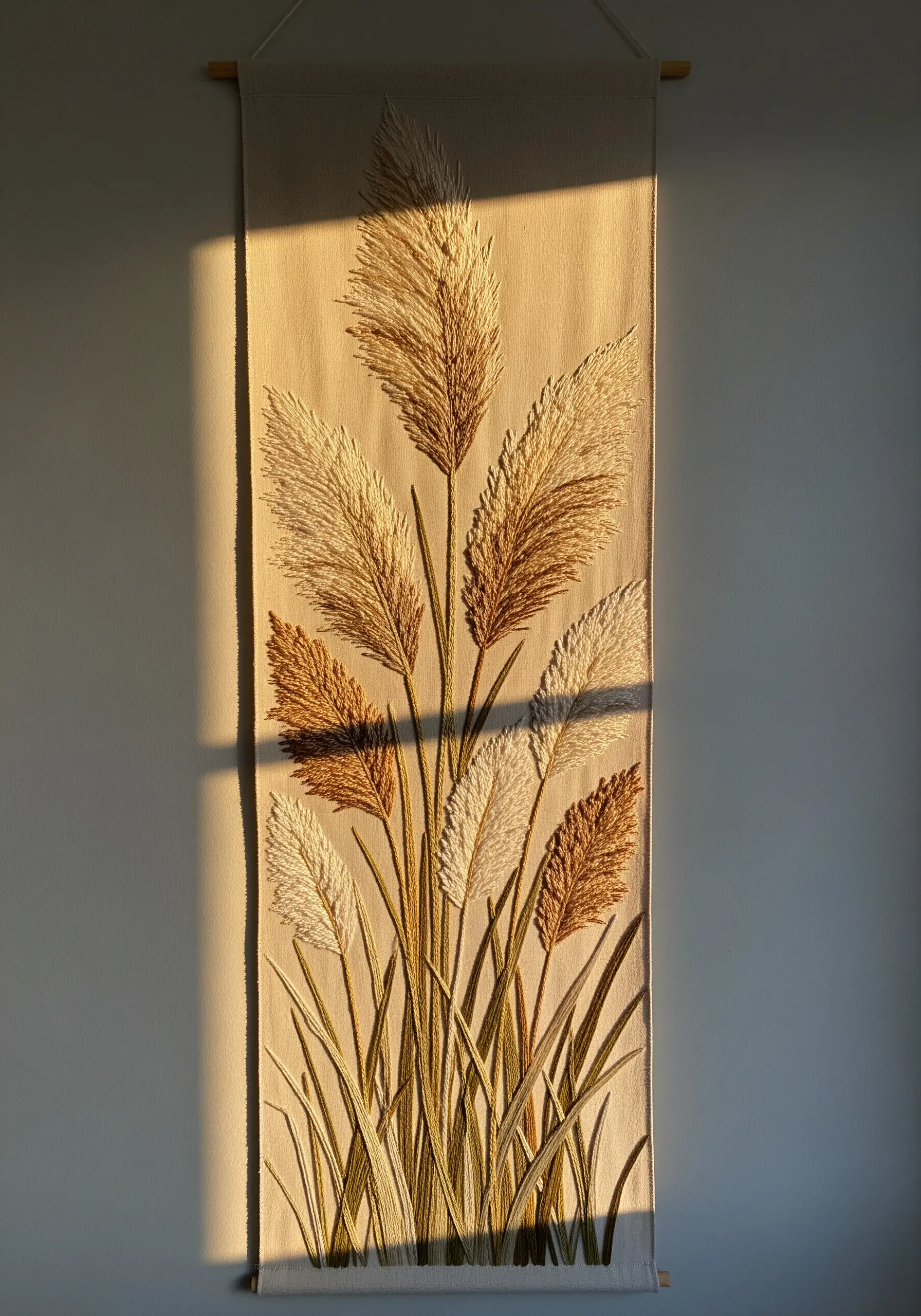
To achieve the fluffy, airy texture of pampas grass, the turkey work stitch is your best tool.
Create rows of loops and then snip them open, trimming them to shape the plumes for a soft, three-dimensional effect.
Blend several shades of beige, cream, and taupe thread within each plume to give it natural-looking depth and dimension.
Contrast the soft tops with clean stem stitches for the stalks, creating a beautiful textural balance in your embroidered textile wall hangings.
7. Refined Lines on Everyday Objects
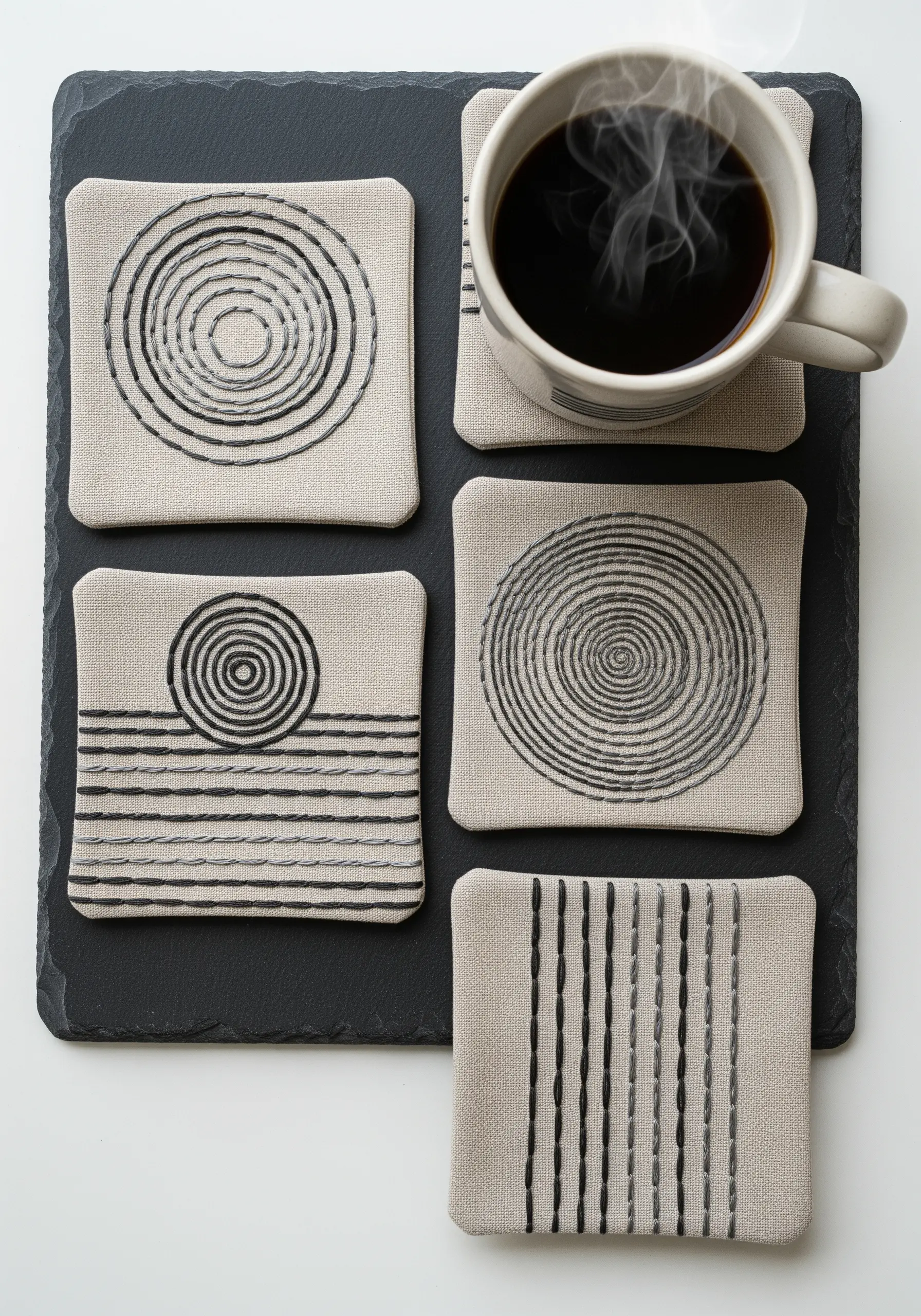
Add a touch of modern artistry to functional items like coasters with minimalist line work.
Use a single, continuous backstitch or stem stitch to create clean, organic spirals and stripes.
Choose a contrasting thread, like charcoal gray on oatmeal linen, for a design that is both subtle and striking.
The beauty of this approach is in its imperfection; the slight variations in your hand-stitching add warmth and character, turning simple household items into simple embroidery accents to refresh your coffee table this week.
8. Statement Art with Thick Cord Couching
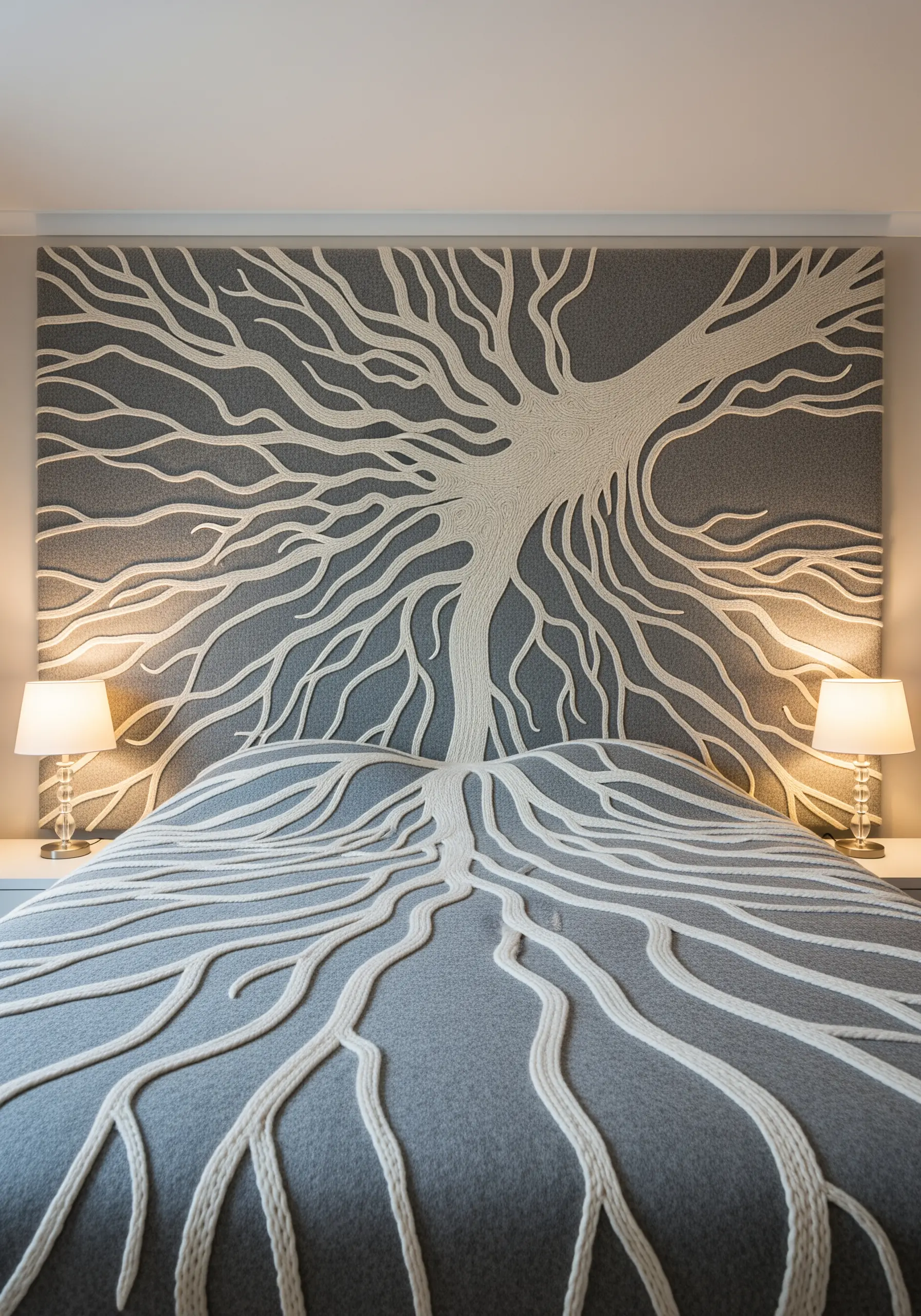
For a design that makes a significant impact, move beyond thread to thick, soft cords.
The couching technique allows you to attach heavy fibers to a fabric base with small, discreet tacking stitches.
This method turns your lines into bold, sculptural elements that command attention, perfect for a headboard or a large-scale wall piece.
By using a neutral cord against a slightly darker fabric, you create a design defined by its powerful texture and form, making it one of those large-scale embroidery tapestries that defines a room.
9. Mosaic Effects with Directional Satin Stitch
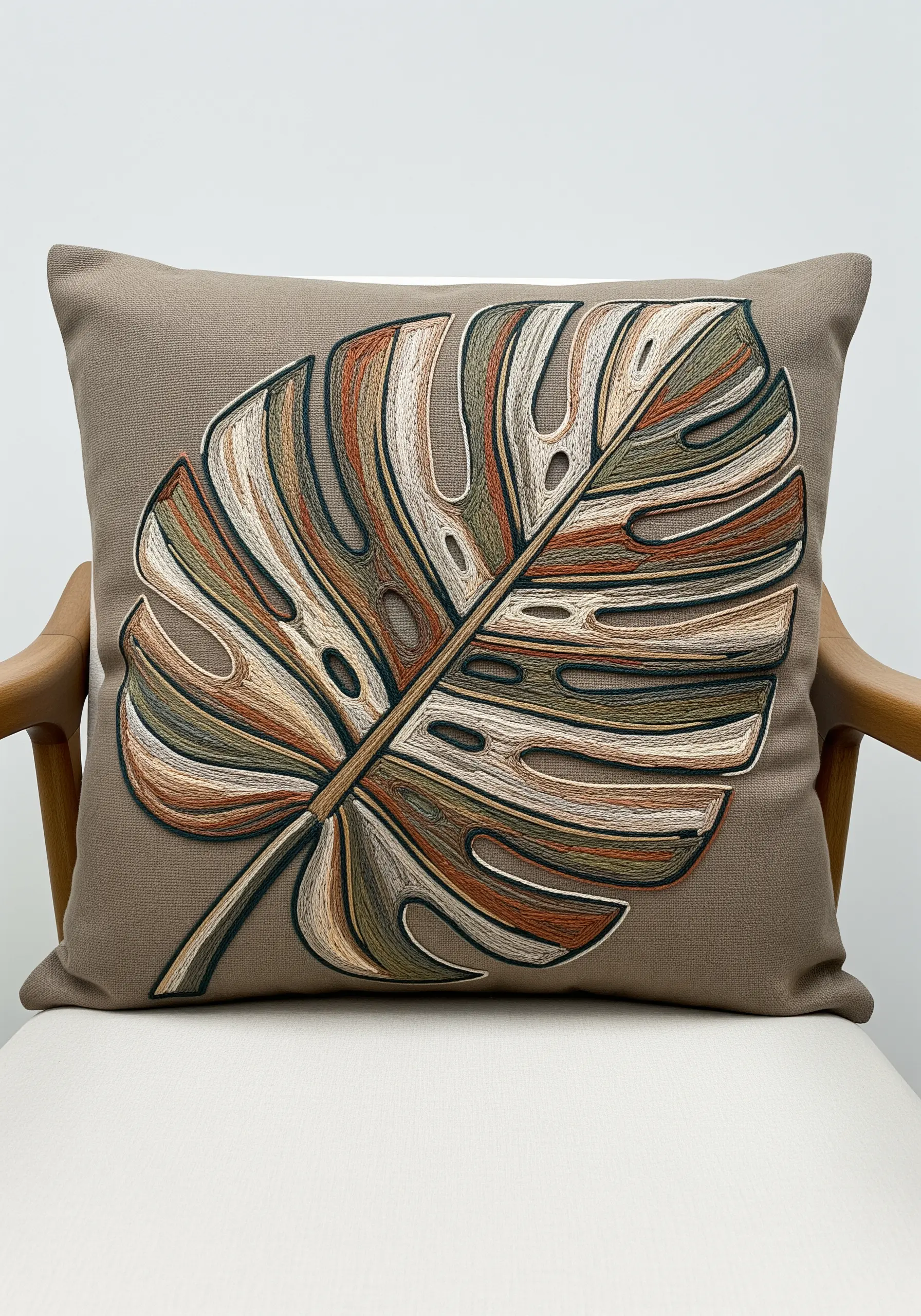
Give a simple leaf silhouette intricate detail by dividing it into smaller sections and varying your stitch direction.
Instead of filling the entire shape in one go, treat each segment as its own mini satin-stitch block.
Alternate the angle of your stitches in neighboring sections to create a subtle, mosaic-like effect that plays with light.
Using a palette of earthy, neutral threads enhances this textural effect, making it a perfect technique for tropical leaf embroidery designs on pillows or cushions.
10. Dimensional Displays with Shadow Box Framing
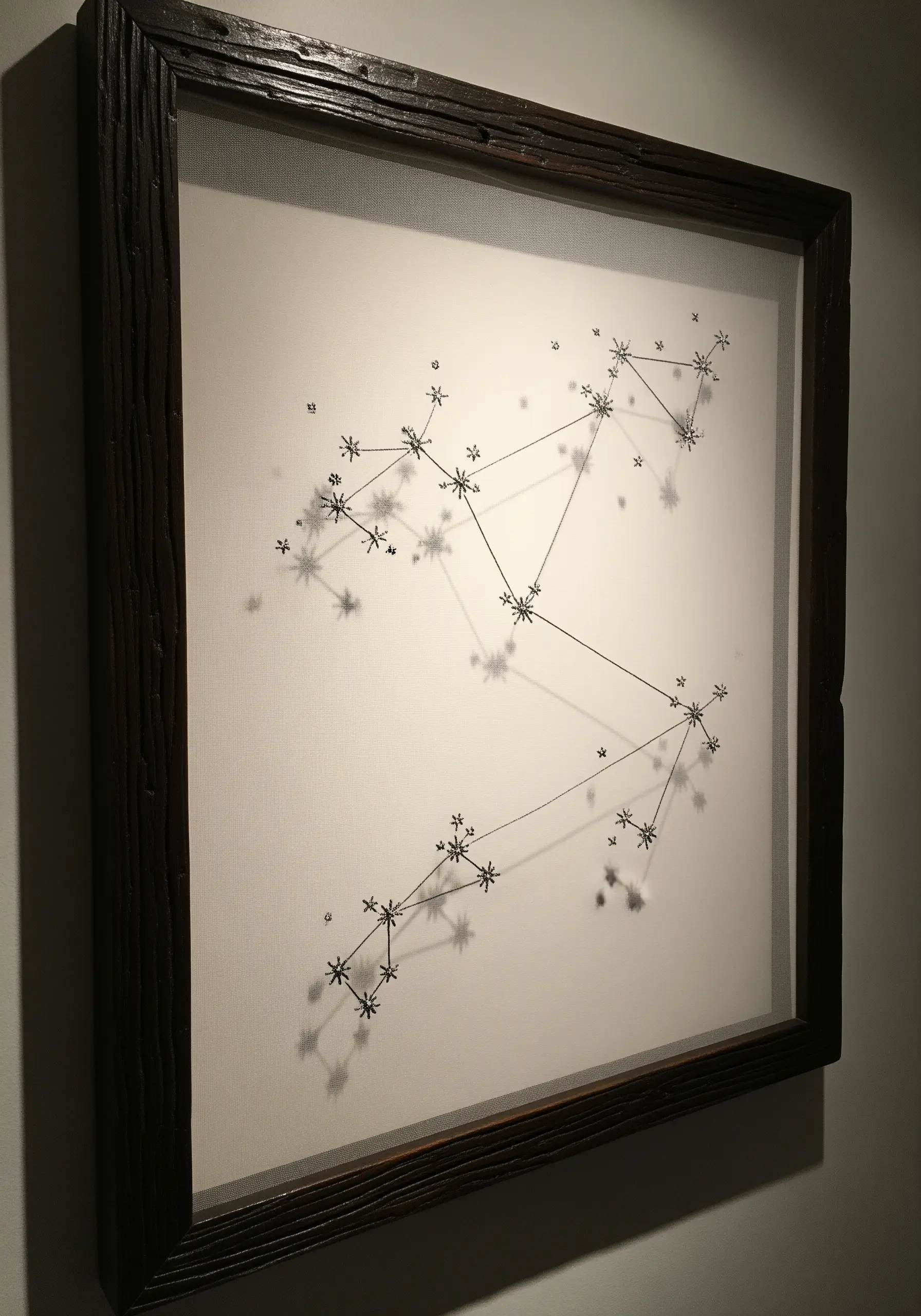
Elevate your embroidery from a flat piece to a sculptural object by creating distance between the art and its backing.
Mount your stitched linen onto a foam core board, then use small spacers to lift it away from the back of a deep shadow box frame.
This technique allows your stitches—especially textural ones like French knots or star stitches—to cast their own delicate shadows.
The resulting depth adds a layer of sophistication and mystery, perfect for framed embroidery ideas that go beyond the hoop.
11. The Illustrated Patch with Fine-Line Detail
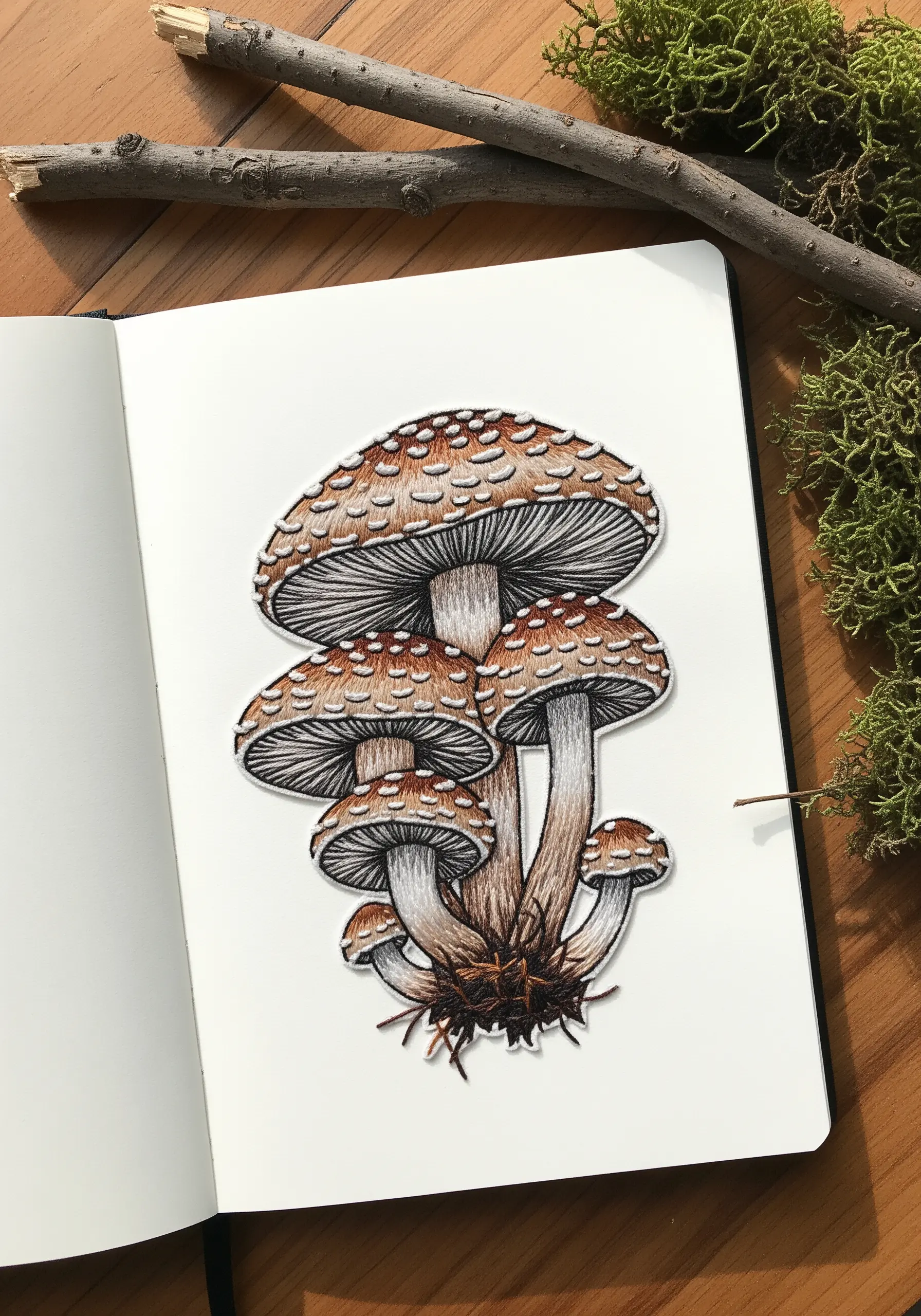
Create embroidered patches that look like scientific illustrations by focusing on precise line work and subtle shading.
Use a single strand of black floss and a sharp needle to execute clean split stitches for the outlines.
For the shading, use a long-and-short stitch with closely matched neutral tones to build soft, realistic gradients on the mushroom caps and gills.
This meticulous technique is what makes your finished piece look less like a craft project and more like a wearable work of art, and it’s perfect for creating botanical patch ideas to repair clothes with leafy beauty.
12. Weaving and Couching for Abstract Forms
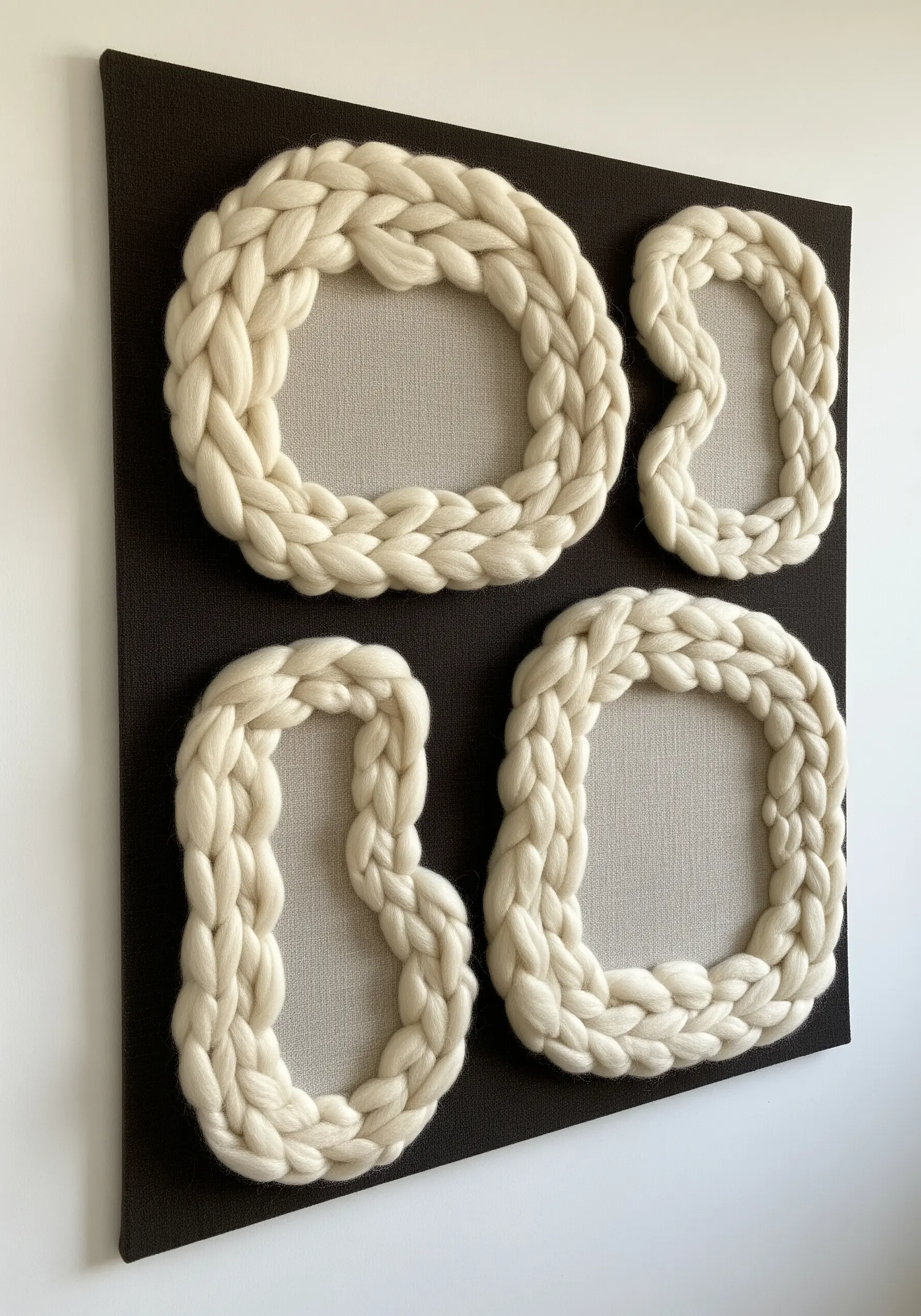
Combine weaving and embroidery to create uniquely textured abstract art.
First, braid or plait chunky, unspun wool roving into thick, organic shapes.
Then, arrange these forms on a stretched canvas and couch them down using a strong, matching thread, hiding your tacking stitches within the fibers.
This method allows you to play with negative space and bold, soft-sculptural lines, pushing the boundaries of traditional embroidery.
These are the kinds of abstract embroidery stitches that turn plain fabric into bold wall sculptures.
13. Classic Elegance with Tone-on-Tone Stitching
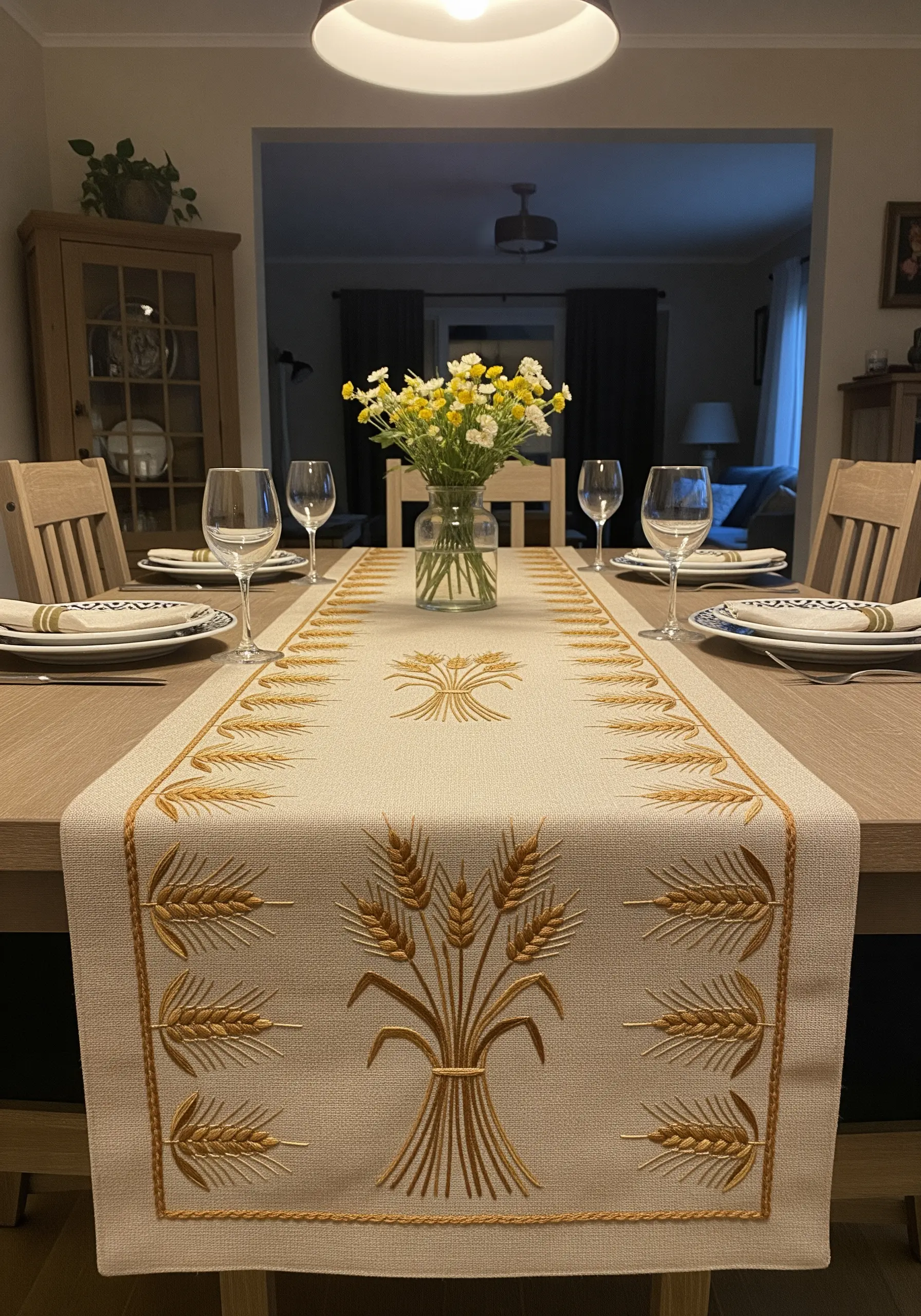
Achieve a look of timeless sophistication by stitching with thread that is only a few shades darker than your base fabric.
On a natural linen table runner, use a golden ochre or warm beige to embroider classic motifs like wheat sheaves.
Focus on pristine execution: use a smooth stem stitch for the outlines and a perfectly angled satin stitch for the fills to create a subtle sheen.
This tone-on-tone approach creates an elegant, high-end feel, making it one of the best modern minimalist table linen embroidery ideas.
14. Mixing Realism and Geometry in a Series
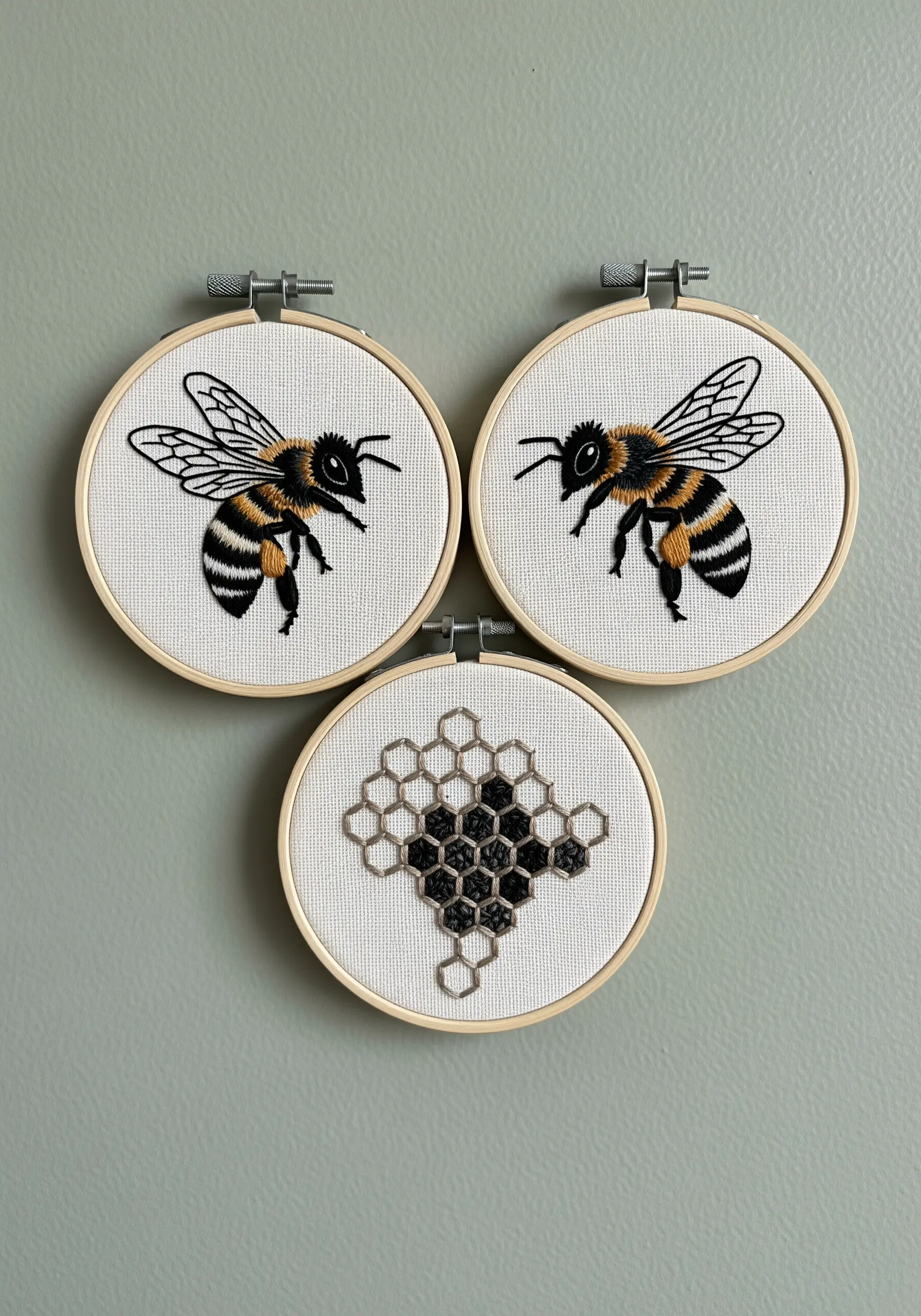
Create a visually compelling trio by combining a detailed, realistic subject with its abstract, geometric counterpart.
For the bees, use long-and-short stitch with black, gold, and cream threads to create a soft, fuzzy texture.
For the honeycomb, switch to a clean, graphic fill using satin stitch or simple outlines in black and gray.
This contrast between organic and structured forms makes the collection dynamic and modern, showcasing how even small hoop embroidery ideas that turn minimal stitching into maximum style can be thoughtfully curated.
15. Layered Couching for Fluid Motion
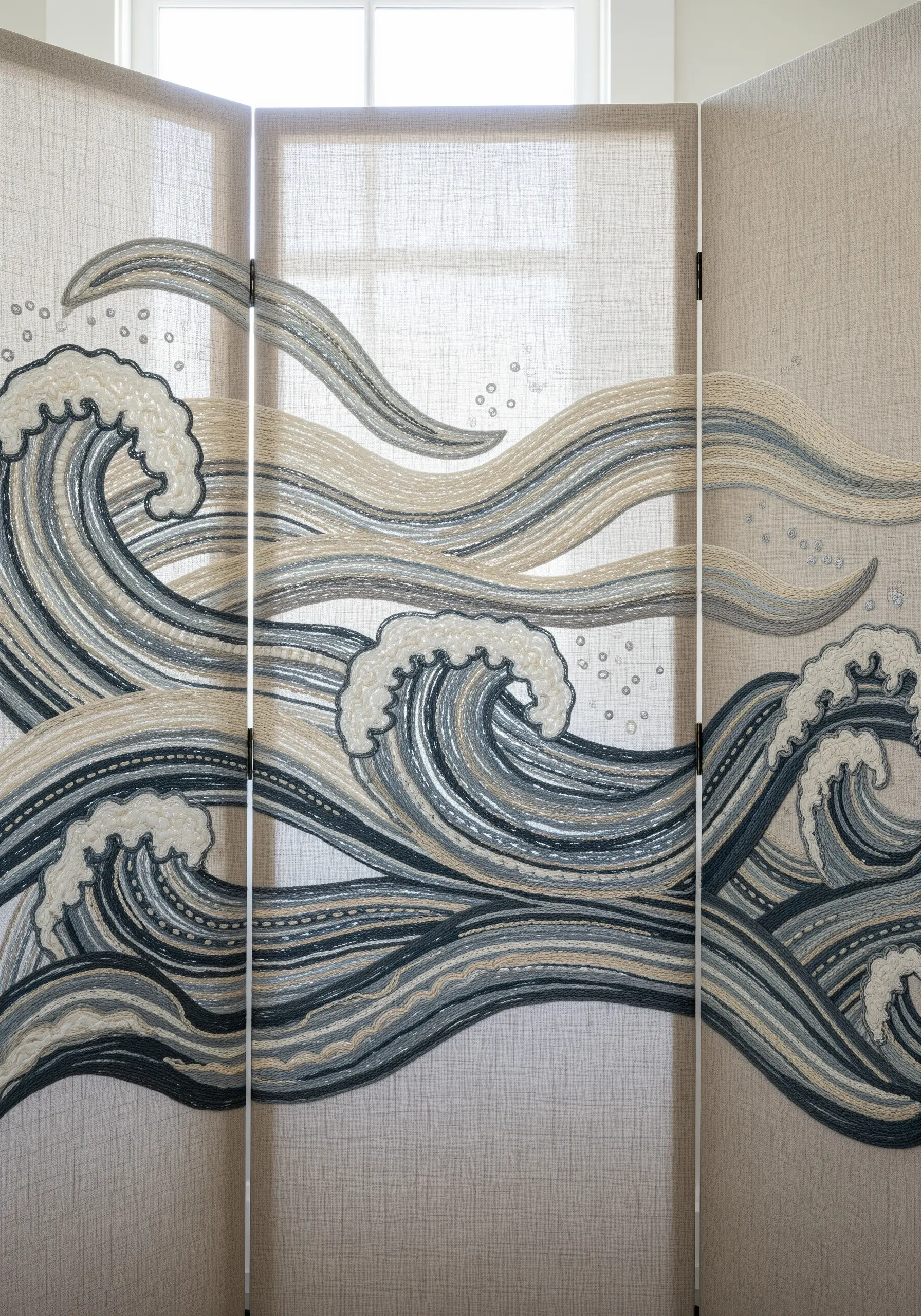
To capture the movement of water on a large scale, like a room divider, use layered couching with various threads and yarns.
Lay down thicker yarns in dark neutrals to establish the primary flow of the waves.
Then, couch finer threads in lighter shades of gray, blue, and cream over the top to represent seafoam and highlights.
This layering technique builds incredible depth and texture, allowing you to create abstract thread waves swirls to capture motion and flow in your embroidery.
A few scattered French knots in white can suggest the finishing touch of sea spray.
16. Raised Chain Stitch for Tactile Mandalas
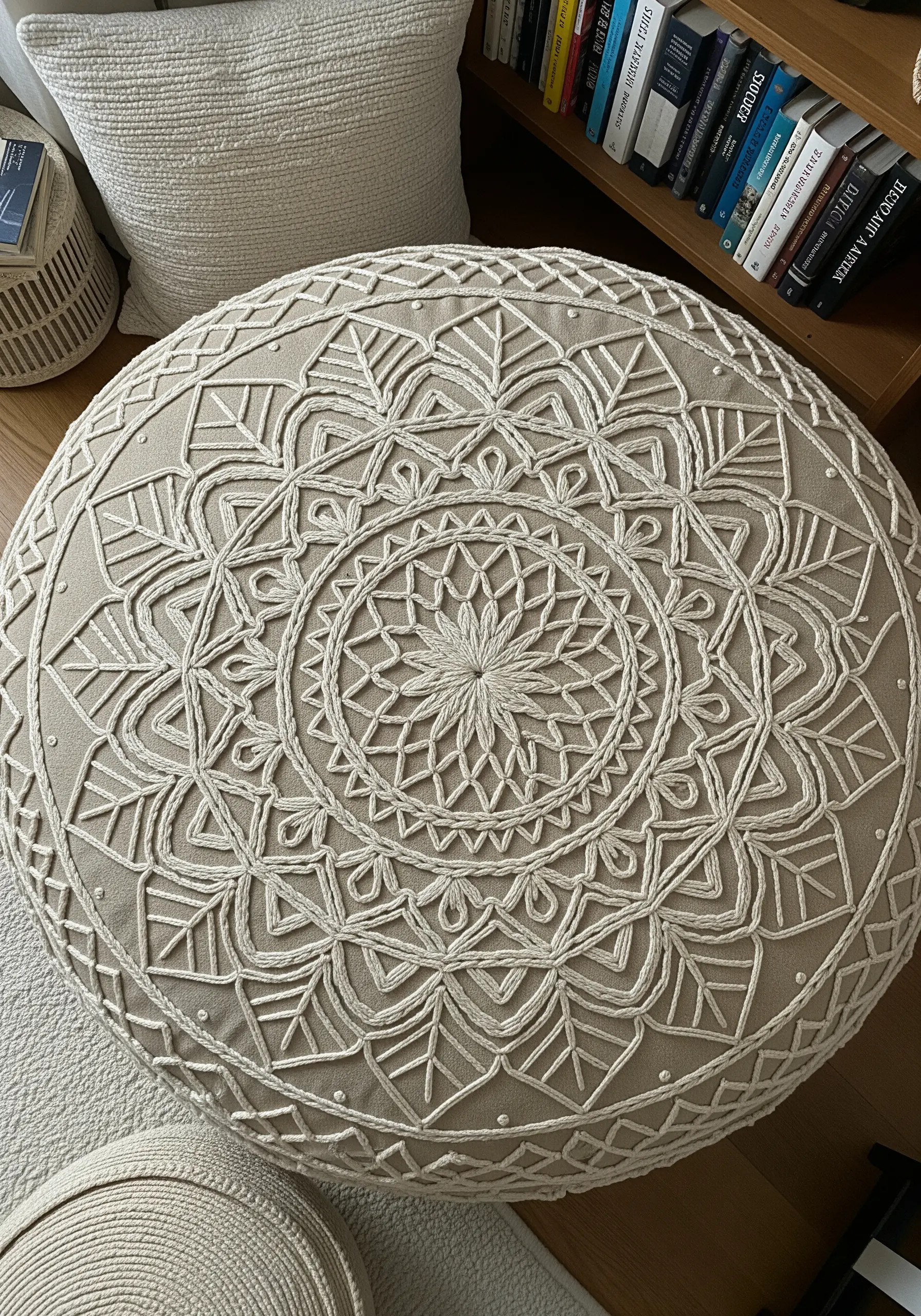
Give a mandala design a satisfying, tactile quality by working it entirely in raised stitches.
Instead of a simple backstitch, use a heavy chain stitch or a whipped stem stitch to create lines that you can feel.
This works especially well for functional items like a pouf or cushion, where texture is just as important as the visual design.
Start from the center and work your way out to ensure the pattern remains symmetrical and the fabric tension stays even across the entire piece.
This technique is perfect for the modern thread mandala ideas for people obsessed with calming meditative embroidery.
17. Dense French Knots for Crystalline Textures
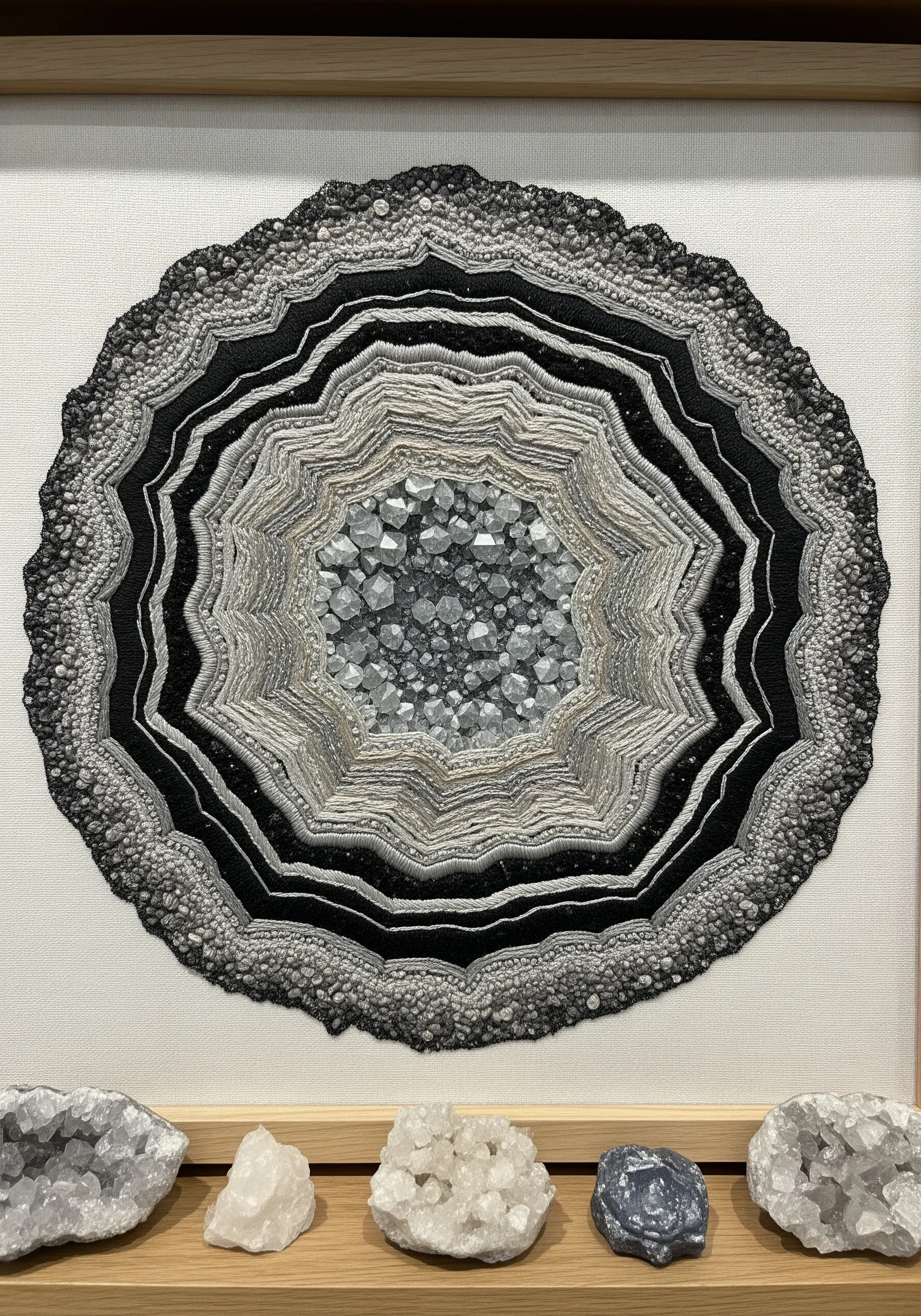
Mimic the sparkling, crystalline structure of a geode with a dense application of French knots.
Vary the size of your knots by changing the number of times you wrap the thread around the needle—use single wraps for a fine, sandy texture and double or triple wraps for larger crystalline clusters.
Group shades of gray, silver, and white to create a shimmering center, then contrast this with smooth, concentric rings of satin stitch or whipped backstitch.
This mix of rough and smooth is key to creating compelling, nature-inspired texture patterns that look expensive but are easy to make.
18. The Power of a Single, Continuous Line
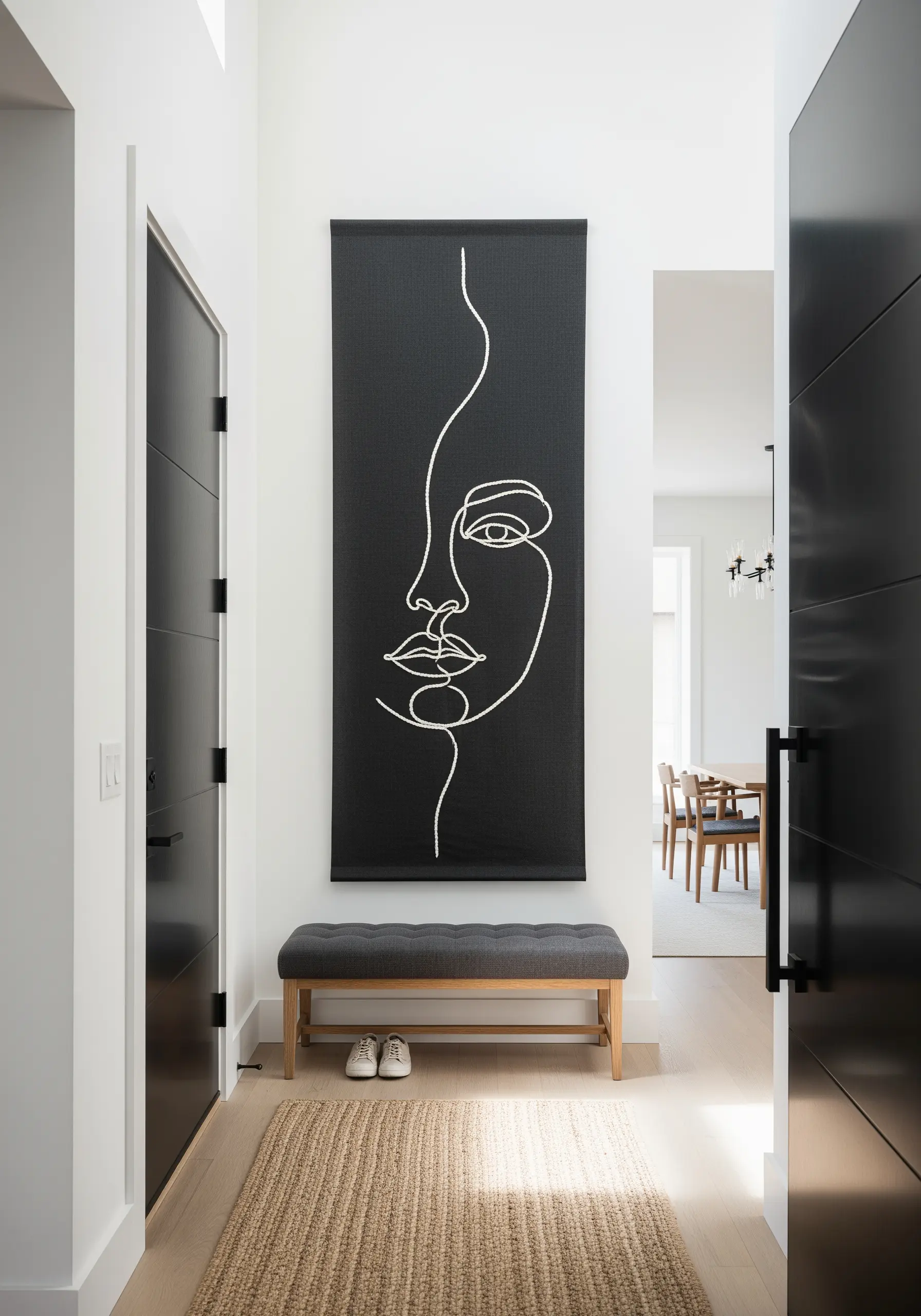
For an abstract portrait, the goal isn’t realism but fluid, expressive energy.
Achieve this by creating the illusion of a single, unbroken line.
Use a whipped backstitch or a thick corded chain stitch to ensure your line is smooth, raised, and consistent from start to finish.
The high contrast of a white thread on a black canvas amplifies the impact, making the negative space just as important as the stitched line itself.
This is the essence of minimalist line art nature embroidery for modern home walls, where simplicity creates the strongest statement.