There’s a universe of possibility waiting in your thread box, far beyond traditional motifs. When you look to the cosmos for inspiration, you’re not just stitching stars—you’re playing with light, texture, and the powerful allure of the unknown. These ideas are designed to help you do just that.
Here, we move past simple patterns and into technique. You’ll discover how to blend fibers to create nebulous clouds, how to use beads and metallic threads to capture the cold fire of distant stars, and how string art can map the elegant geometry of the universe. It’s about translating something vast and intangible into a tactile piece of art.
Forget the idea that embroidery has to be flat or contained. Let these concepts encourage you to build layers, to mix materials, and to see your fabric not as a background, but as the deep, silent space where your creation comes to life. Your needle is the vessel; the cosmos is the destination.
1. The Galactic Spiral: Weaving Depth with Thread
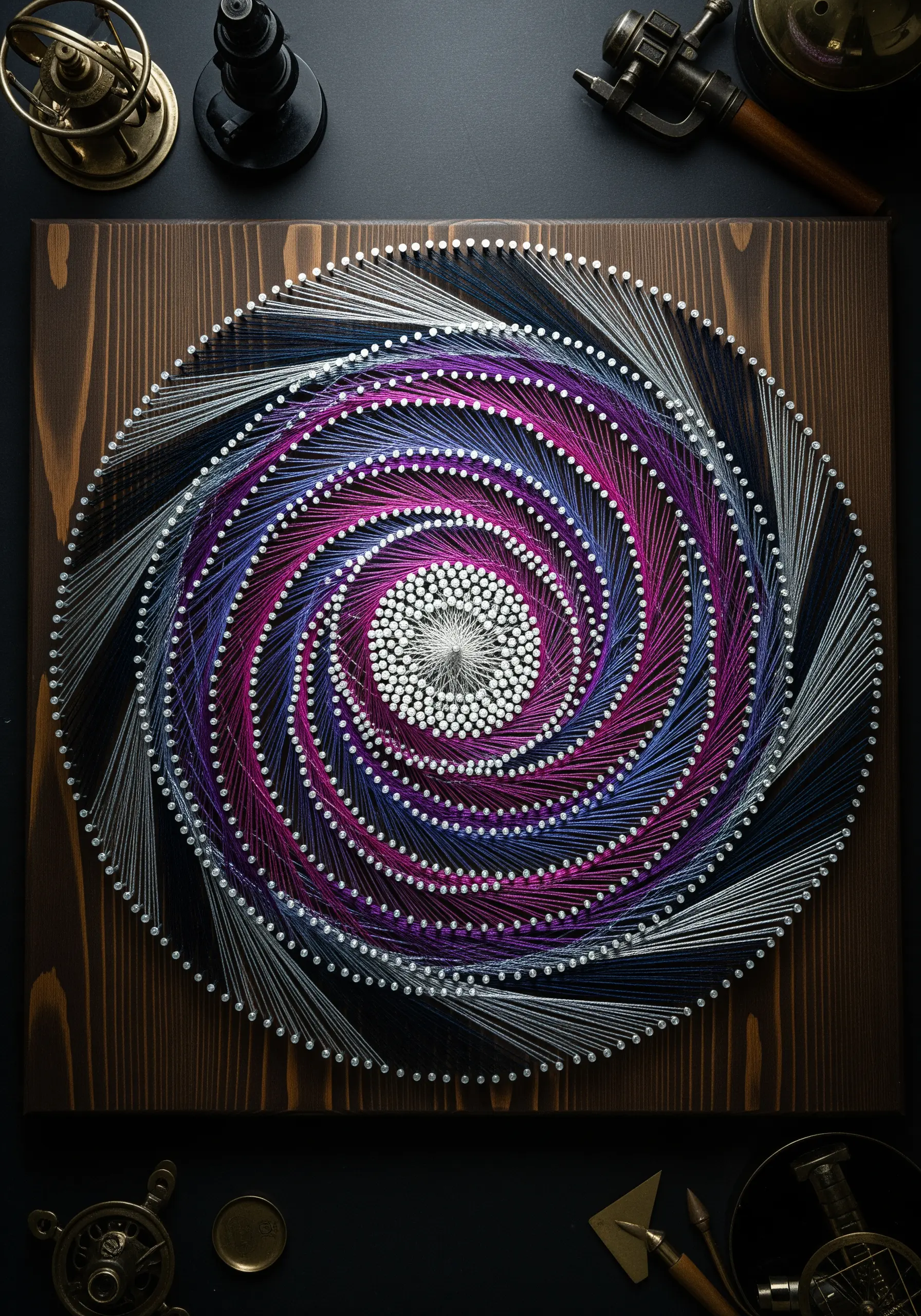
Create a hypnotic spiral by focusing on controlled thread tension and strategic color layering in your string art.
Start with a dense cluster of pins at the center, radiating outwards, and add an outer circle of evenly spaced pins.
Work from your lightest color at the core to the darkest at the edges to create the illusion of depth.
By alternating between two or three colors in the middle sections, you can generate a sense of swirling movement without complicating the pattern.
The precision of the straight lines forms a curve, proving that simple geometric principles can yield profoundly organic results.
2. Sculptural Nebulae: Combining Roving and Stitches

Achieve cloud-like nebula textures by couching chunky wool roving onto your fabric before adding any fine details.
Use a single strand of matching embroidery floss to tack down the roving in subtle, invisible stitches, shaping it into soft, voluminous clouds.
Contrast this soft texture with sharp, bright starbursts made from metallic thread and scatter tiny seed stitches or French knots for distant stars.
Sequins catch the light beautifully against the matte finish of the wool, adding a necessary touch of celestial shimmer.
This abstract thread layering turns your hoop into a tactile, multi-dimensional piece.
3. Minimalist Constellations: The Art of Negative Space

Elevate simple constellations by presenting them as a triptych, which turns a simple motif into a cohesive piece of gallery wall art.
Use a dark, matte fabric to maximize contrast and allow the star formations to command attention.
Instead of simple knots, try using small, star-shaped beads or metallic-finish bugle beads to connect your points; this adds a subtle, light-reflecting quality.
The power of this design lies in its use of negative space, where the unstitched canvas becomes as important as the embroidered elements themselves.
4. Crystalline Supernova: Radiating Lines and Gemstones
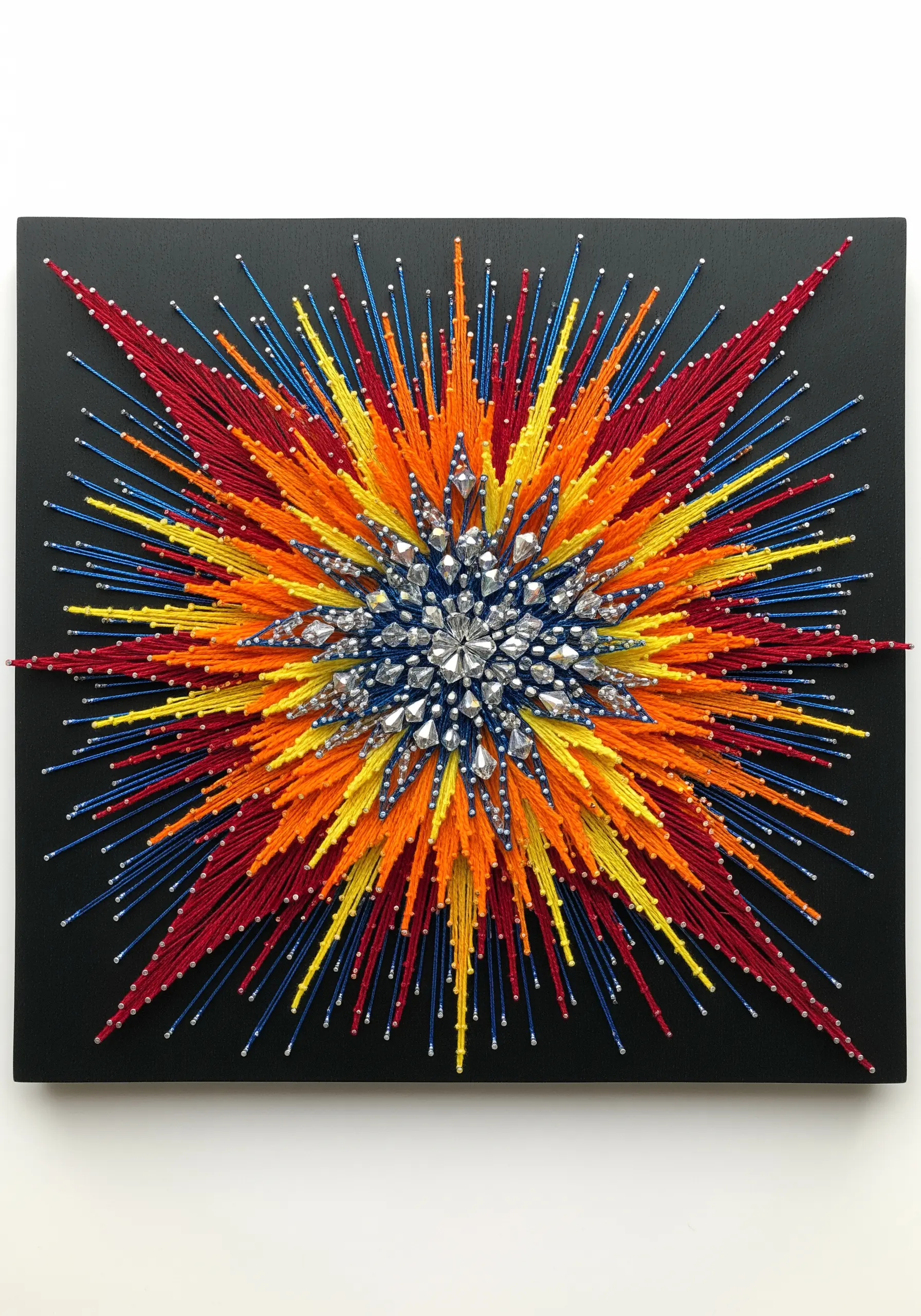
Create an explosive supernova effect by anchoring your string art with a dense, multi-faceted center.
Use a cluster of flat-backed crystals or gemstones as your starting point to create a brilliant, light-refracting core.
Radiate your threads outwards in a vibrant, high-contrast palette—like reds, oranges, and yellows against a black background—to convey intense energy.
By slightly varying the length of each thread, you introduce a dynamic, less uniform edge that feels more organic and explosive.
5. Embellished Galaxy Tapestry: Layering Beads and Fibers

For a large-scale galaxy, work on a fabric with a visible weave like linen or burlap, which provides a beautifully rustic and tactile base.
Build up the galactic arms with soft wool roving first, creating the foundational shapes and textures.
Then, densely apply seed beads, sequins, and French knots, concentrating them along the roving to mimic the densest star clusters.
Allow the embellishments to scatter more sparsely towards the edges of the fabric—this gradient creates a more realistic and less rigid composition.
6. Saturn’s Embrace: Mastering Wrapped Stitches
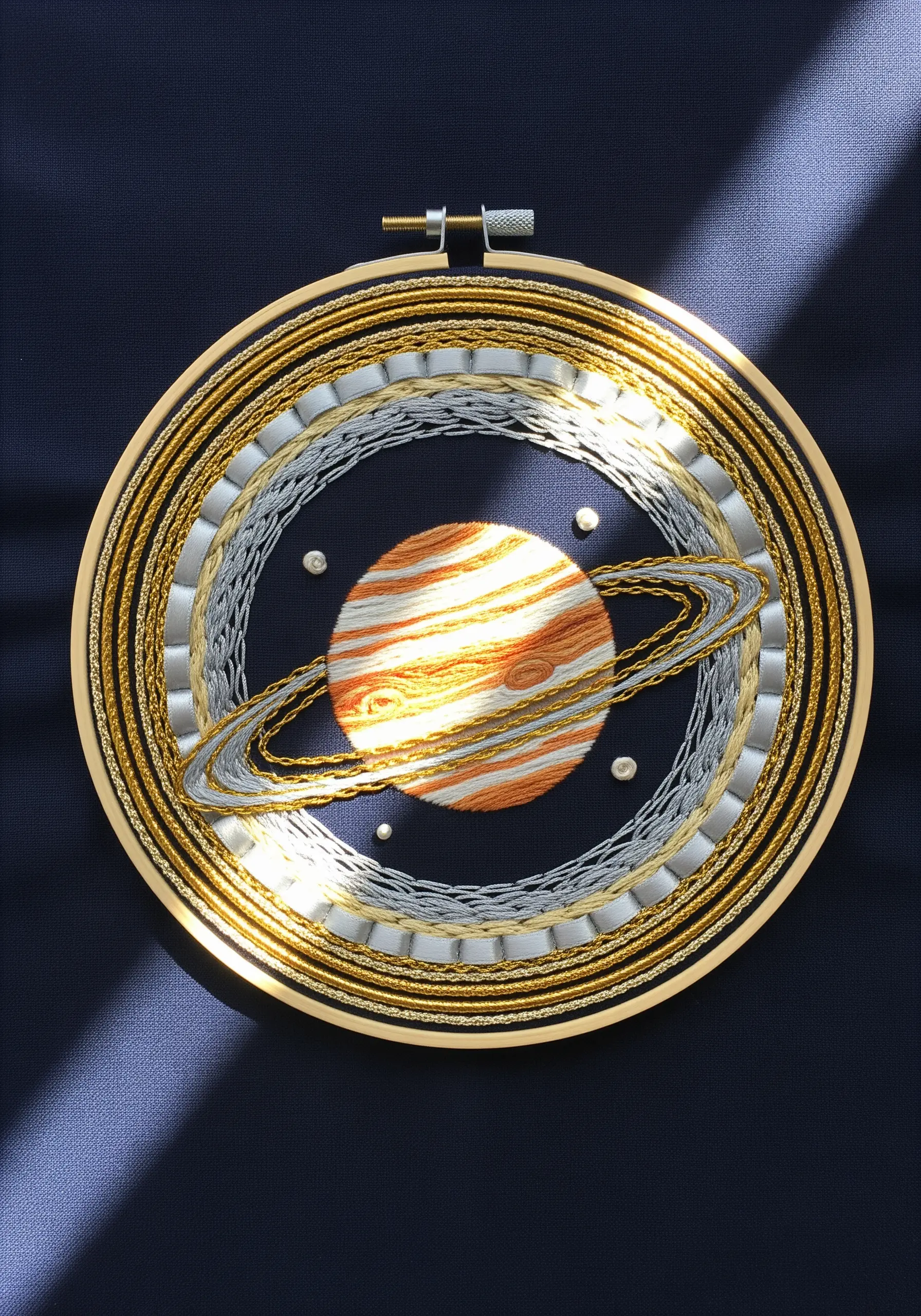
To create perfectly smooth and defined planetary rings, use a whipped backstitch or couch multiple strands of metallic floss together.
Wrapping or couching prevents the twisting and unevenness that can occur when using satin stitch for long, curved lines.
For the planet itself, use a directional satin stitch, ensuring all your stitches follow the curve of the sphere to create a sense of roundness.
Incorporate different materials for the rings—like thin ribbon or metallic cord—to add subtle variations in texture and sheen against the dark fabric.
7. Celestial Seas: Merging Cosmic and Terrestrial
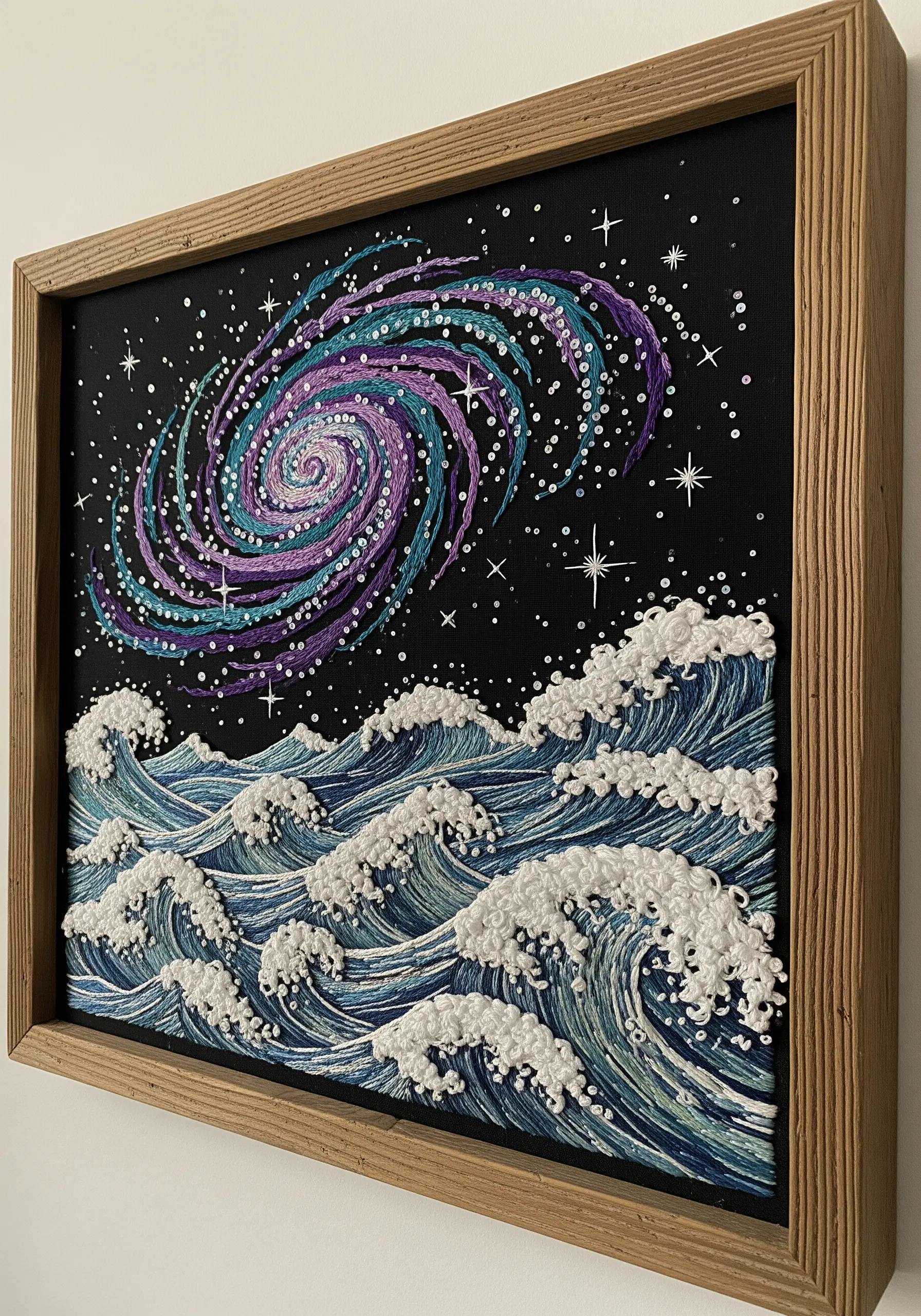
Create a stunning narrative piece by contrasting the textures of a swirling sky and structured ocean waves.
Use a dense collection of French knots in variegated purples, teals, and blues for the spiral galaxy, giving it a soft, chaotic texture.
For the ocean, stitch disciplined rows of layered backstitch or chain stitch, using different shades of blue and white to define the crests of the waves.
The white seafoam, created with tight clusters of French knots, directly mirrors the texture of the stars, creating a beautiful visual harmony between the two elements.
8. Event Horizon: Defining Emptiness with Thread
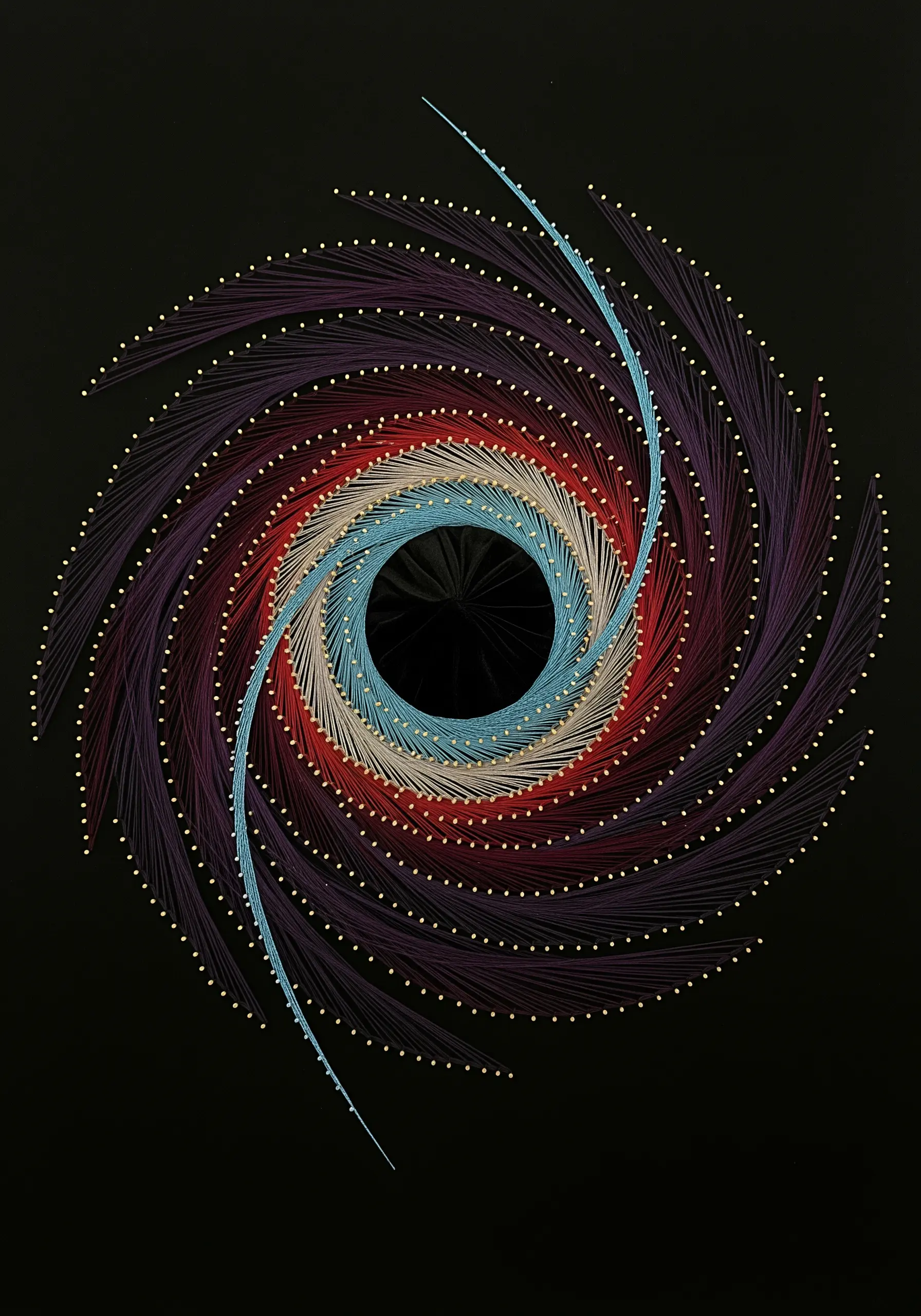
Illustrate the immense pull of a black hole by leaving the absolute center of your string art empty.
Arrange your pins in a spiral, but instead of working towards a central pin, make your innermost threads connect to a small, empty circle of pins.
Use a color gradient that transitions from deep, dark purples and reds on the outer edges to bright, energetic teals and whites closer to the center.
This reversal of a typical color gradient—light on the inside, dark on the outside—creates a powerful visual effect of light being drawn into the void.
9. Lunar Cycle Study: Mapping Texture with Thread Painting
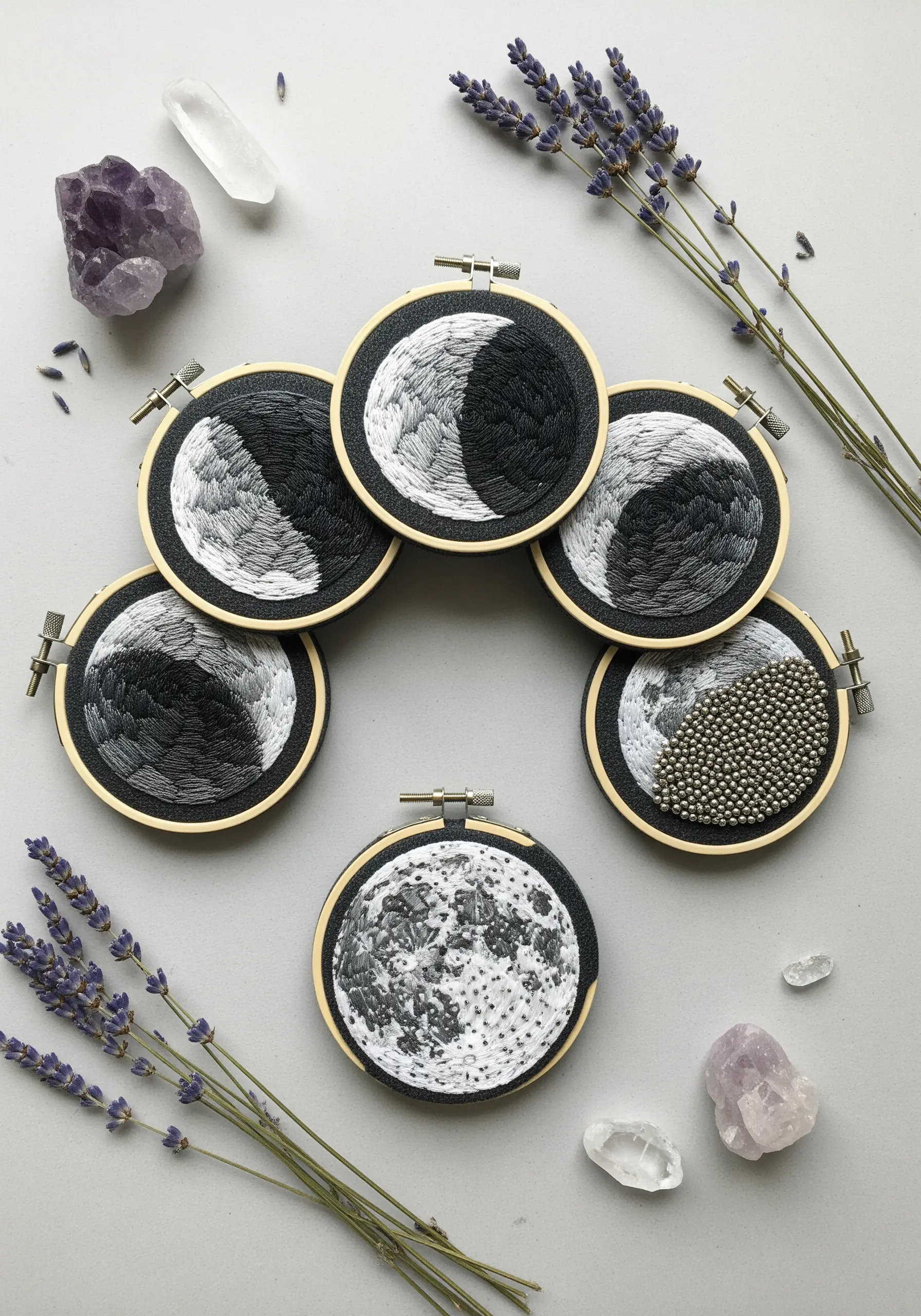
Explore the moon’s surface in a series of hoops, dedicating each one to a different phase.
Use a tight, dense satin stitch or long-and-short stitch with shades of grey, white, and black to mimic the texture of craters and maria.
For a full moon, consider filling the entire surface with silver beads instead of thread to capture its bright, reflective quality.
Displaying the hoops together creates a powerful narrative of celestial movement, making it a perfect example of how monochrome embroidery wall art can make a statement.
10. Solar Flare: Capturing Light with Sheer Organza

Incorporate sheer, colored organza to replicate the ethereal glow of a solar flare—a material that thread alone cannot imitate.
Cut the organza into flame-like shapes and layer them, securing each piece with a single, strategically placed bead.
The core of the sun can be a dense cluster of French knots in bright yellow and white, providing a solid anchor for the translucent flares.
This technique of combining embroidery and mixed media on a dark, satin fabric creates a dramatic interplay of light, texture, and color.
11. Geometric Asteroid Field: Sculpting with Thread
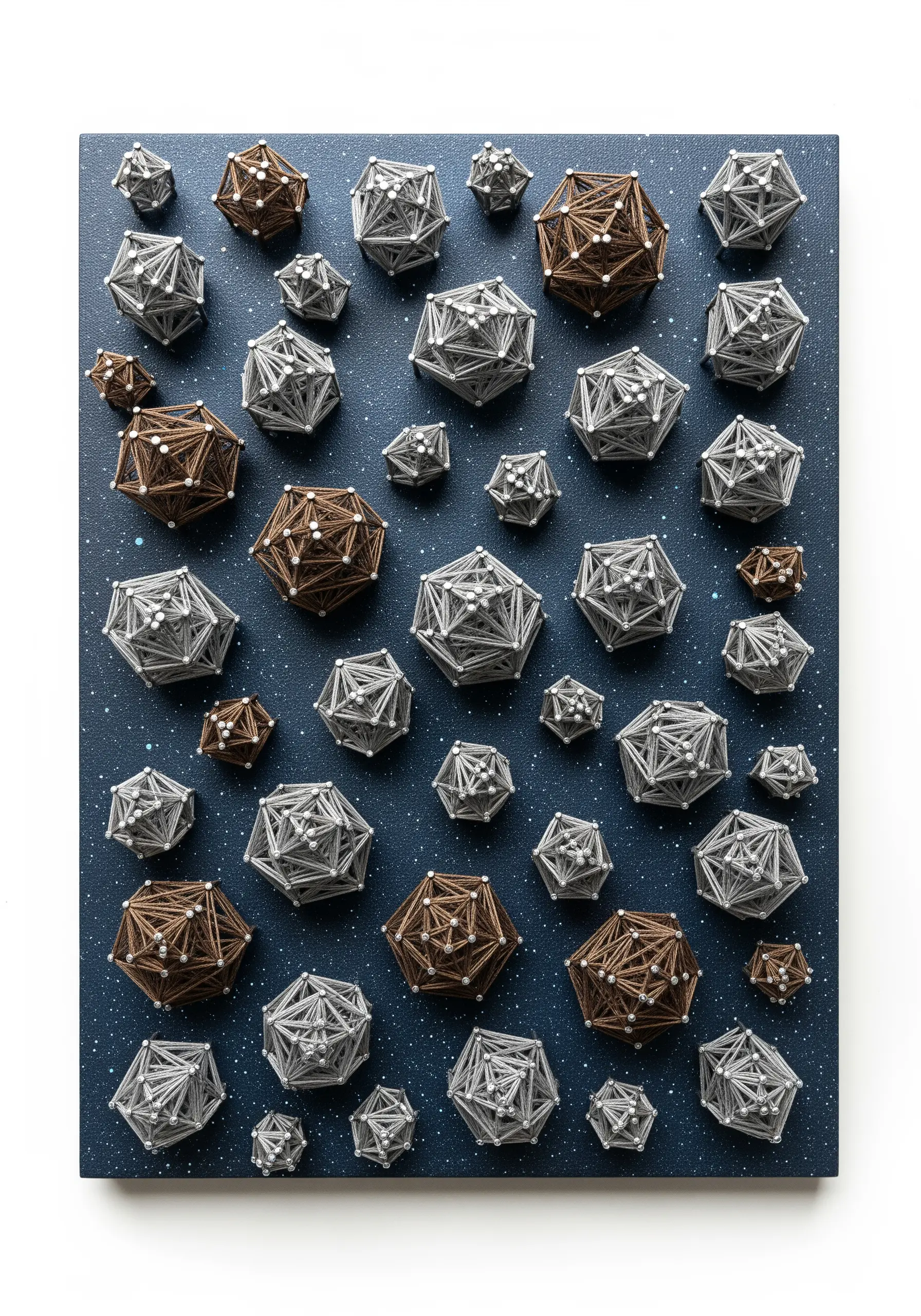
Move beyond flat planes by creating three-dimensional geometric shapes for a dynamic asteroid field.
Map out nail patterns for polyhedra (like icosahedrons) of varying sizes across your board.
Wrap each shape with a single color, such as off-white or brown, to give it solid form.
By varying the scale and density of your geometric “asteroids,” you create a compelling sense of depth, perspective, and movement on a static surface.
12. Embroidered Aurora: Blending Colors with Vertical Stitches

Capture the fluid movement of the Northern Lights using long, vertical straight stitches that blend into one another.
Work with a single strand of floss for each color to achieve a delicate, watercolor-like effect.
Vary the length of your stitches, allowing some colors to sweep down further than others, mimicking the curtain-like dance of the aurora.
Place your stitches close together but don’t overcrowd them; letting the dark fabric show through slightly adds depth and contrast, making the colors appear more vibrant.
13. Cosmic Portrait: Filling Silhouettes with a Universe

Create a powerful statement piece by containing a vibrant, detailed galaxy within a simple silhouette.
First, outline your chosen shape with a clean, precise backstitch or stem stitch using a single color like silver or white.
Fill the interior with a rich tapestry of techniques: thread painting for nebulae, French knots for star clusters, and straight stitches for shooting stars.
This method transforms a basic shape into a window to another world, much like hand-stitched portrait wall art captures personality.
14. A Comet’s Trail: Creating Motion with Threads and Sequins
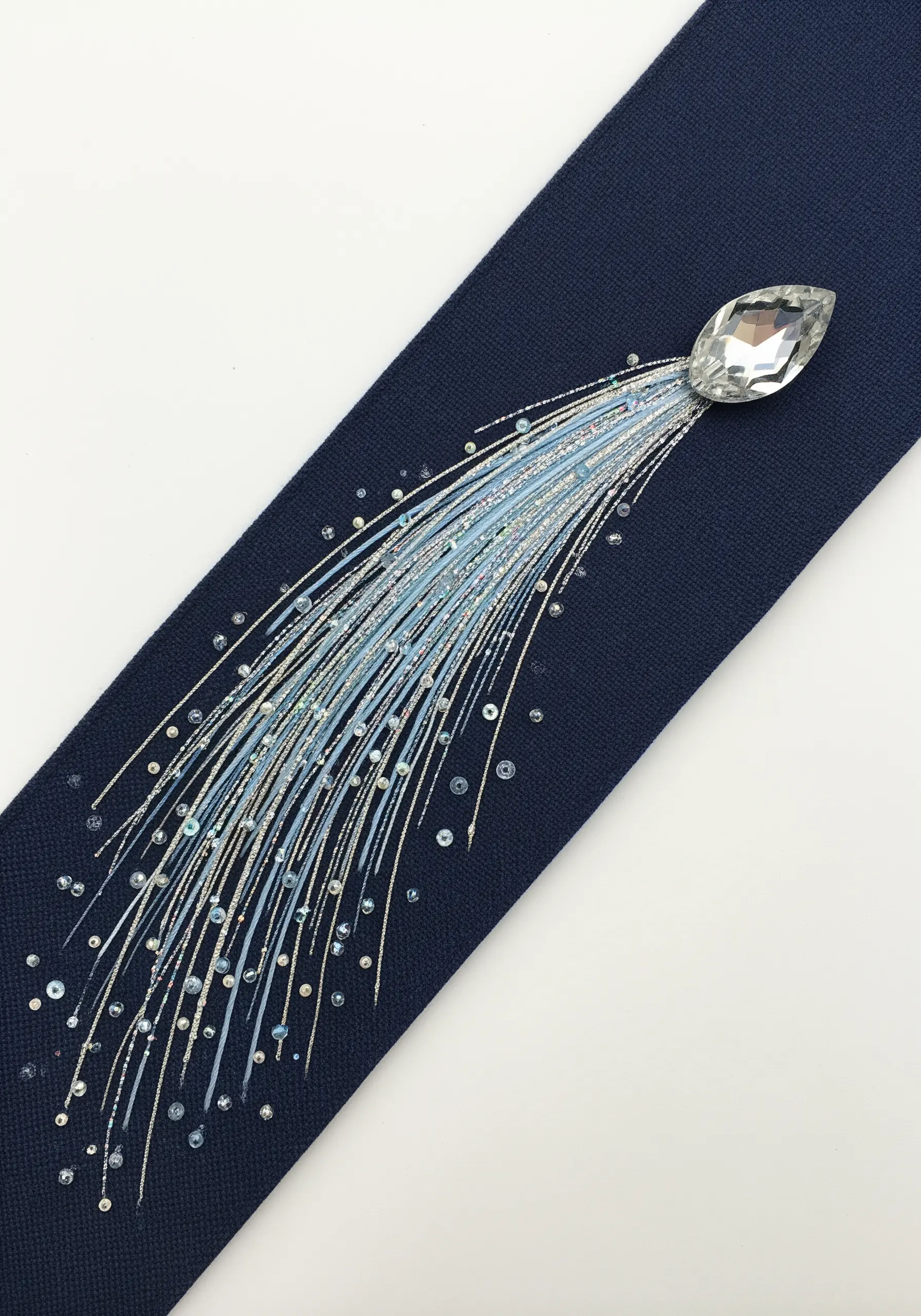
Evoke the speed and sparkle of a comet by combining a solid anchor with a dynamic, scattered tail.
Use a large, teardrop-shaped crystal as the comet’s head; its facets will catch the light and create a strong focal point.
For the tail, use long, fanned-out straight stitches with a mix of threads—try silver metallic, iridescent blending filament, and a simple light blue floss.
Scatter tiny silver sequins and seed beads throughout the tail, concentrating them closer to the head and dispersing them towards the end to create a sense of fading energy and movement.
15. Planetary Patches: A Solar System in Appliqué
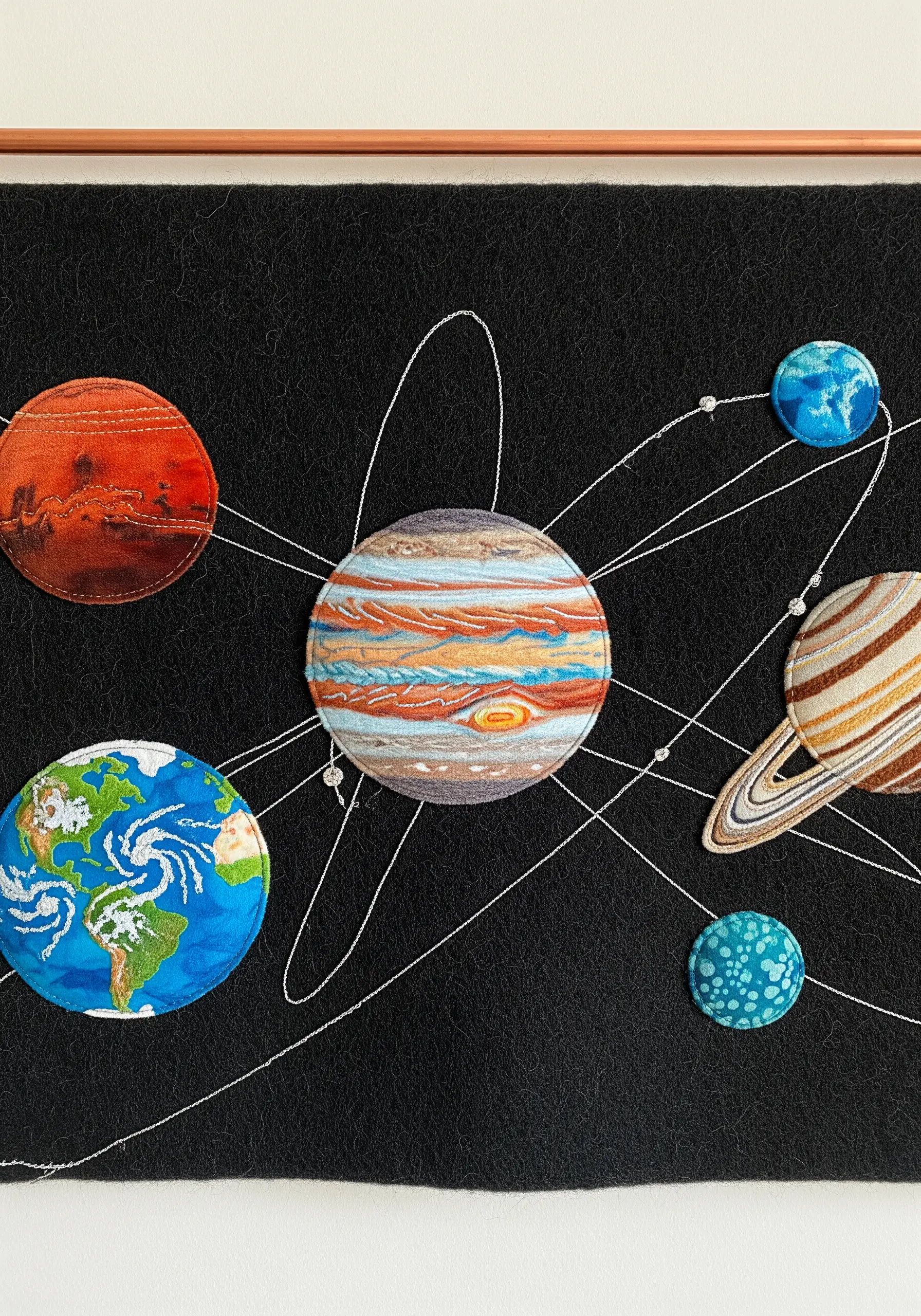
For a clean and graphic solar system, create each planet as a separate embroidered patch before attaching it to your final background.
This appliqué technique allows you to perfect the intricate details of each planet, like Jupiter’s stripes or Earth’s continents, without worrying about the surrounding composition.
Stitch your planets on felt or a double layer of cotton with stabilizer for a sturdy patch.
Finish the raw edges with a tight satin stitch border, then arrange and attach them to a dark felt background with a few discreet stitches, adding orbital lines last.
16. Starfield on Tulle: Suspending Beads in Space

Stitch on black or navy tulle to create the illusion of stars and beads floating in empty space.
Because tulle is so delicate, use a lightweight stabilizer that you can tear or wash away after you’re finished stitching.
Use a mix of metallic seed beads, star-shaped sequins, and tiny bugle beads, securing each one with a sturdy knot on the back.
The magic of this technique is in its transparency; when hung, the background wall becomes part of the art, enhancing the feeling of deep space.
17. Celestial Lotus: Outlining the Infinite
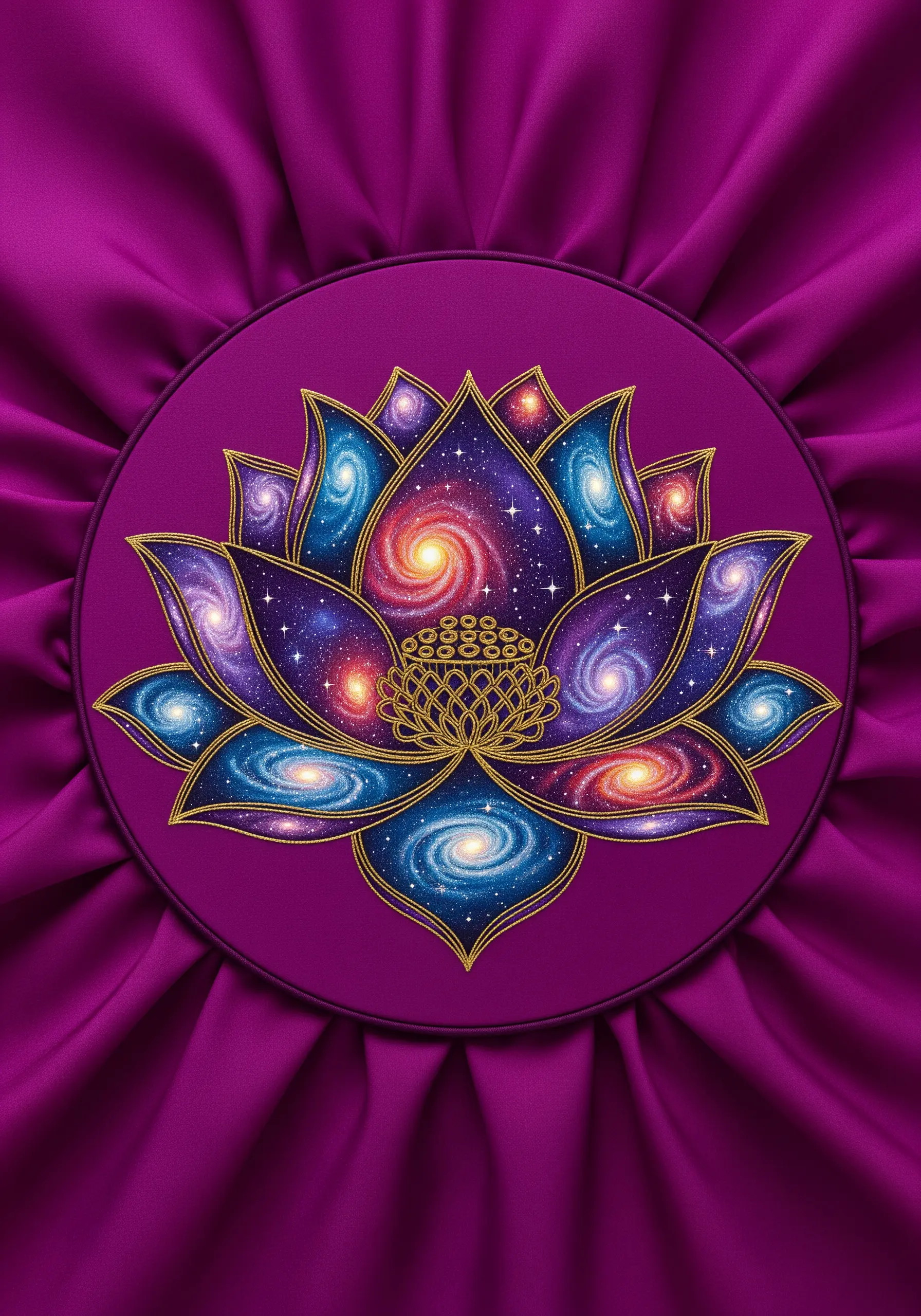
Combine a spiritual symbol with a cosmic texture for a piece that is both grounded and expansive.
Define the petals of the lotus with a strong, clean outline. A couched gold thread or a thick, raised stem stitch provides the necessary structure and elegance.
Fill each petal with a unique, miniature galaxy using a blend of satin stitches and French knots.
This juxtaposition of a sharp, defined border and a soft, nebulous interior creates a beautiful visual tension and harmony.
18. Interacting Galaxies: Weaving Cosmic Collisions
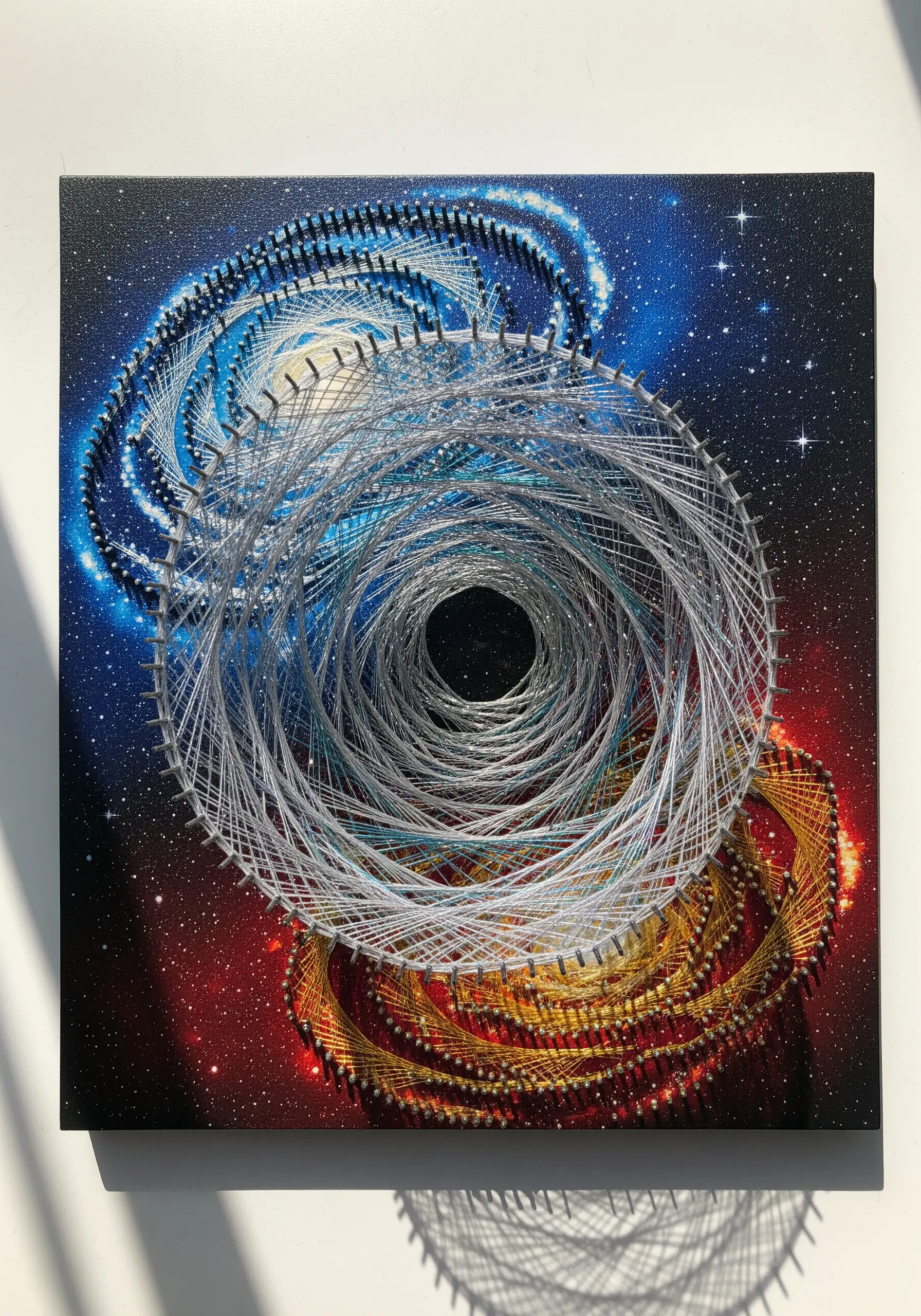
Depict the dramatic beauty of colliding galaxies by overlapping two or three string art spirals on a single canvas.
Assign a distinct color palette to each galaxy—for example, one in warm reds and golds, the other in cool blues and silvers—to maintain their individual identities.
Let the threads from each spiral intermingle where they overlap, creating new color combinations and a sense of dynamic fusion.
Place your background art (a painted or printed nebula) before adding pins, allowing the thread to interact with the 2D image for even greater depth.
19. A Woven World: Building Planets with Yarn

Instead of stitching, try weaving with thick, colorful yarn to create a highly tactile and sculptural planet.
Create a simple circular loom or work directly onto a sturdy canvas, laying down vertical warp threads first.
Weave your colored yarns (the weft) through the warp threads, changing colors to create the planet’s atmospheric bands and storms.
For the rings, braid several strands of yarn together into a thick cord and attach it around the woven circle. This is one of the most accessible yarn wall art techniques for creating bold, graphic pieces.
20. Illuminated Geometry: Integrating LEDs into String Art
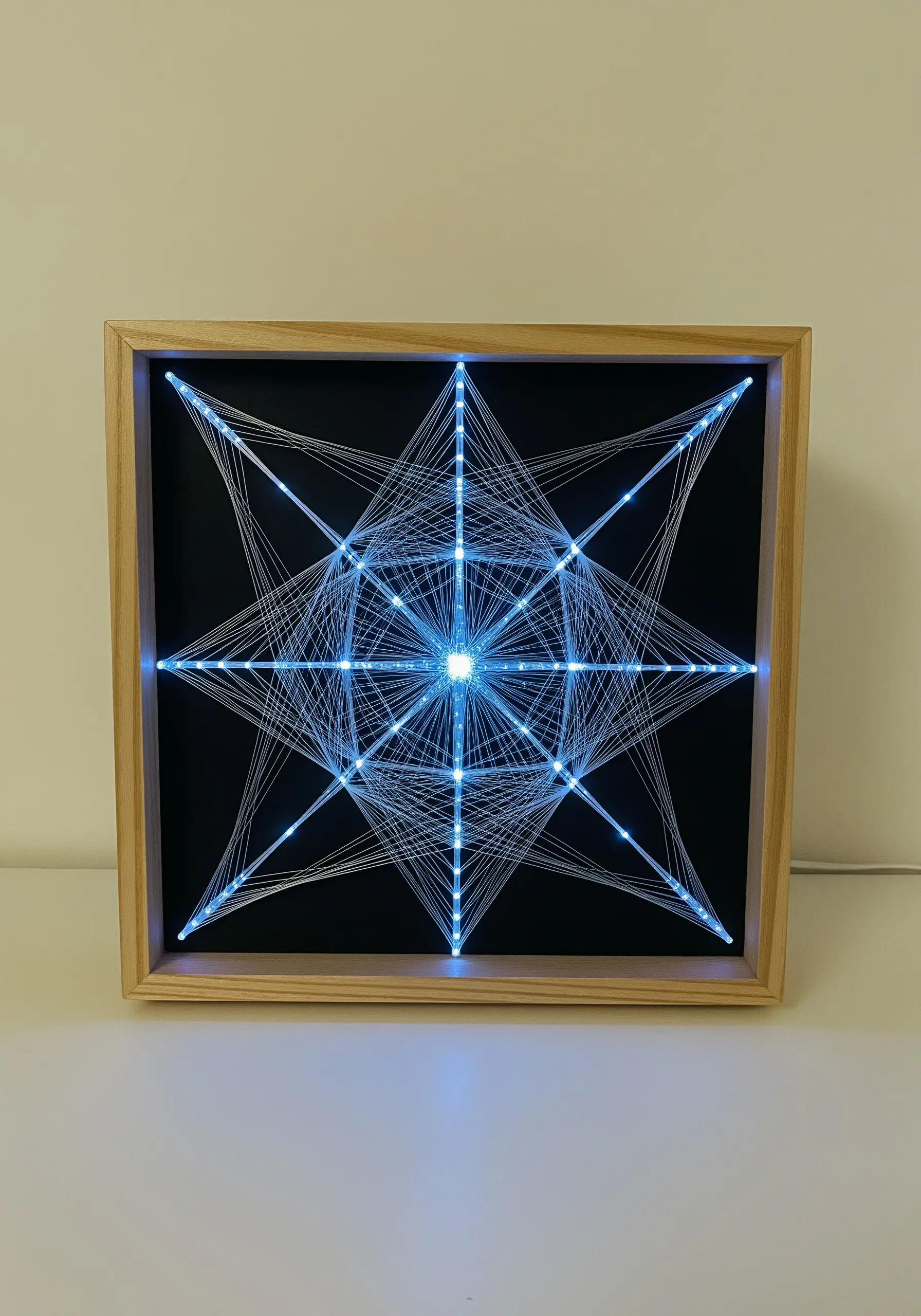
Integrate a string of micro LED lights into your string art to give your cosmic design a literal glow.
Plan your pin layout first, then carefully wrap the LED wire around the pins before you begin adding your thread.
Use a light-colored or metallic thread, as it will catch and diffuse the light most effectively.
This is one of the most impactful modern neon on black thread art ideas, transforming your piece from a static object into a dynamic light installation, especially in a dimly lit room.
21. Supernova Burst: Mastering Chaotic Stitches
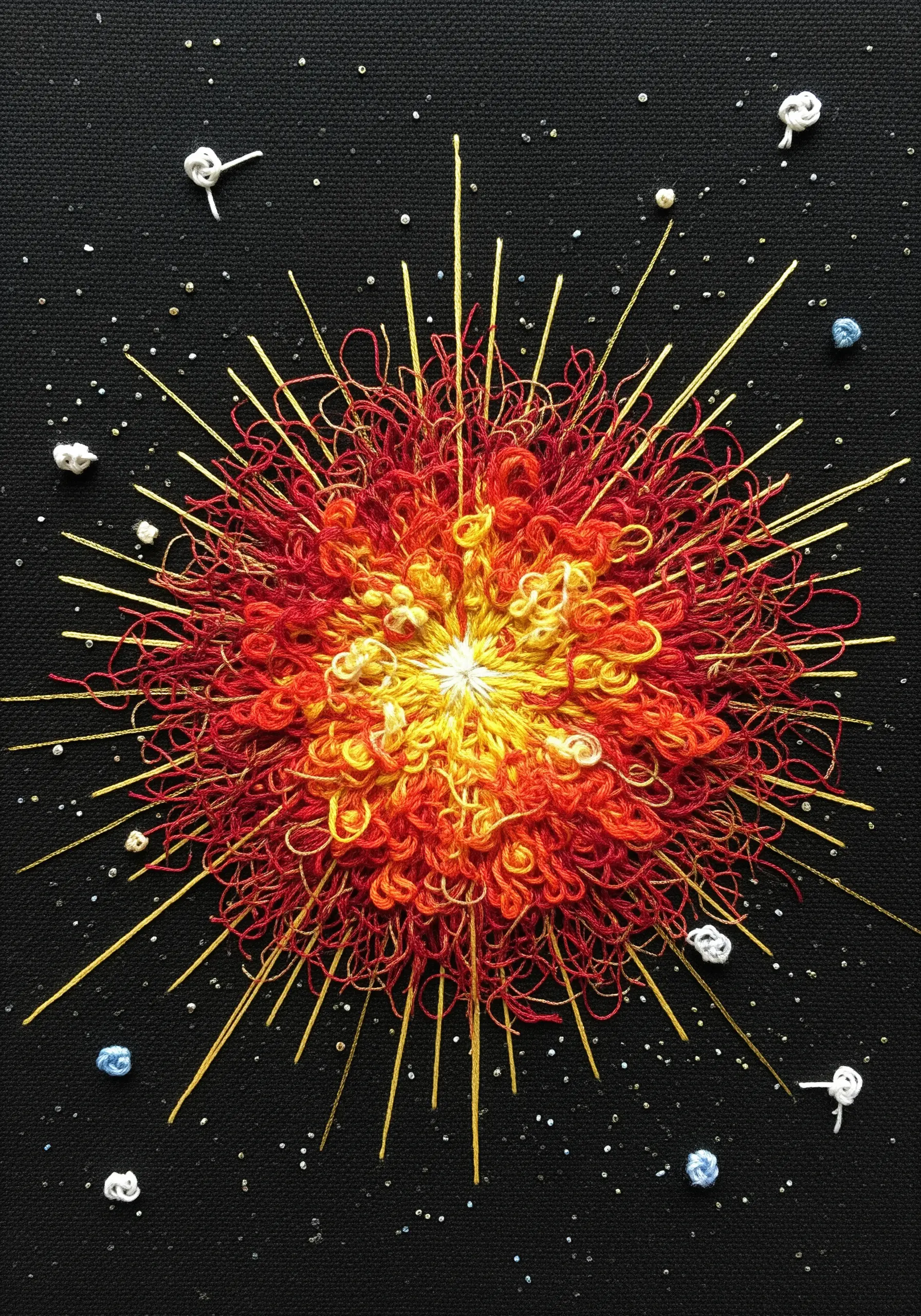
Capture the raw, untamed energy of a star’s explosion with a foundation of turkey work stitches.
Create a dense mound of loops in fiery reds, oranges, and yellows, then trim them at varying heights to build a jagged, spherical shape.
From this textured core, stitch long, radiating straight stitches in gold or yellow metallic thread to represent explosive rays of light.
The contrast between the soft, chaotic texture of the trimmed loops and the sharp, clean lines of the rays is what gives this design its powerful impact.
22. Otherworldly Landscape: Stitching a Narrative
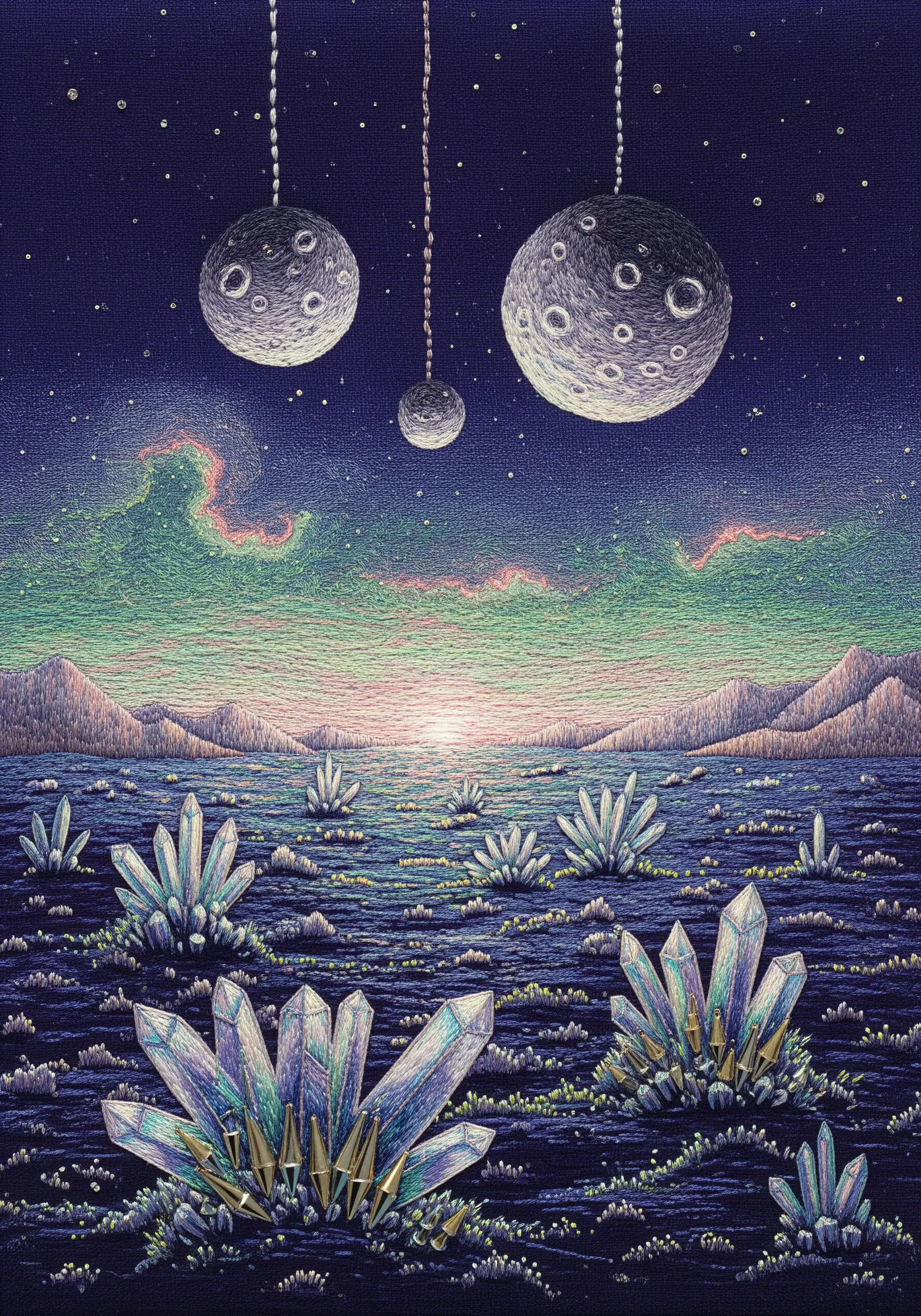
Go beyond single motifs and build an entire alien world using dense, textural stitches.
Use directional seed stitch or split stitch to create the ground and mountains, changing the angle of your stitches to define different planes and create perspective.
For the glowing crystals, use satin stitch with a lustrous rayon or silk thread, which will catch the light differently than the matte cotton floss of the landscape.
This detailed, full-coverage technique, known as thread painting, allows you to tell a complex visual story, turning your canvas into a portal to another world.