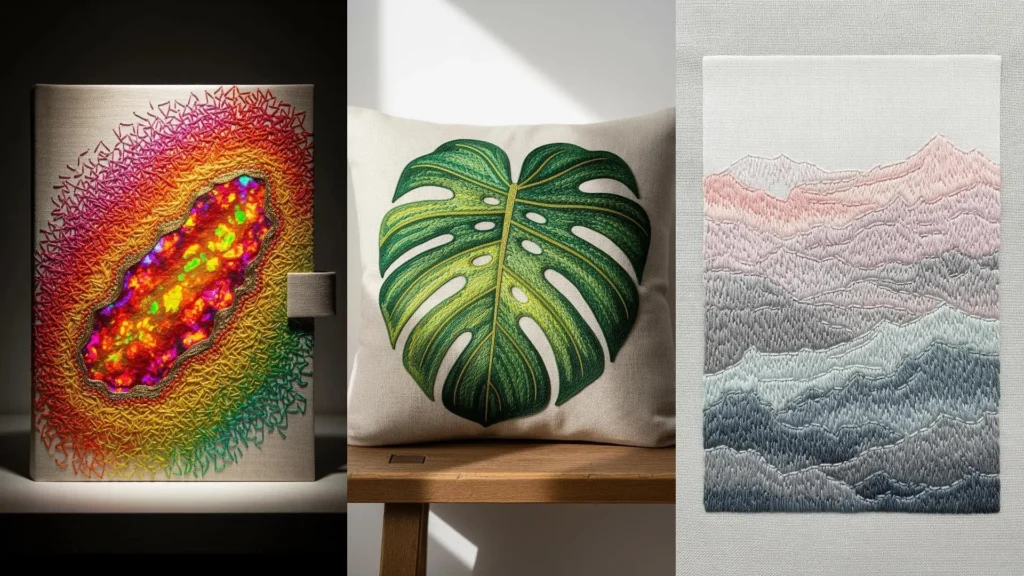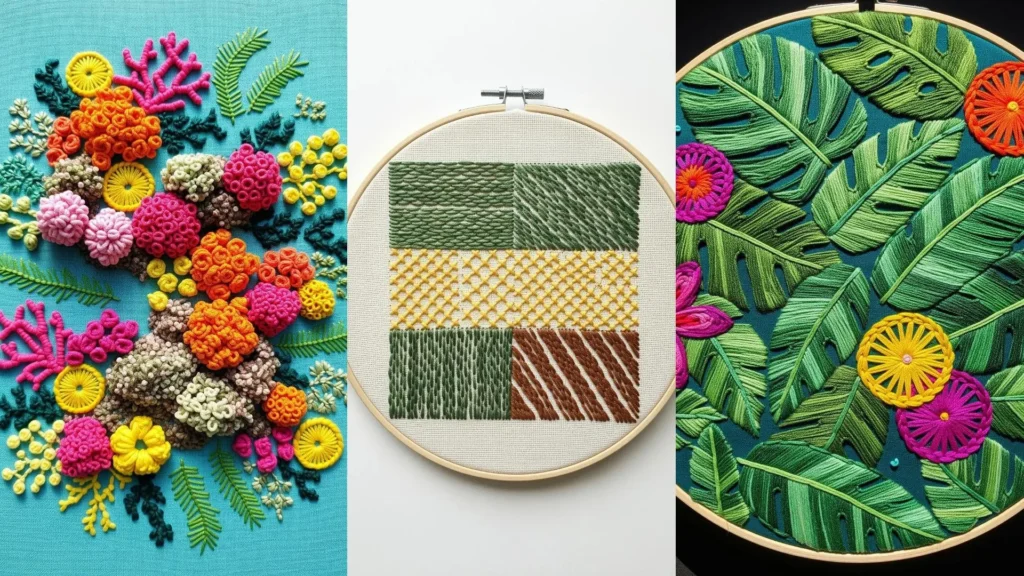
You have the threads, the fabric, and the desire to create something that feels truly yours. But perhaps you find yourself hesitating, wondering how to translate the landscapes in your mind—or your heart—into stitches without just copying a pattern.
Abstract embroidery isn’t about stitching a perfect replica of a mountain or a sea. It’s about capturing its essence. It’s the feeling of a cold, misty morning, the warmth of a low sun, or the chaotic energy of a storm. It’s a way to tell a story with texture and color, where a French knot can become sea foam and a single straight stitch can become a ray of light.
Here, you won’t find rigid rules. Instead, you’ll find techniques that invite you to play with stitch direction, thread weight, and color blending to convey emotion. Think of your needle less like a tool for precision and more like a paintbrush. Let’s explore how to create landscapes that feel as personal and profound as the memories that inspire them.
1. Sculpting a Storm with Dimensional Stitches
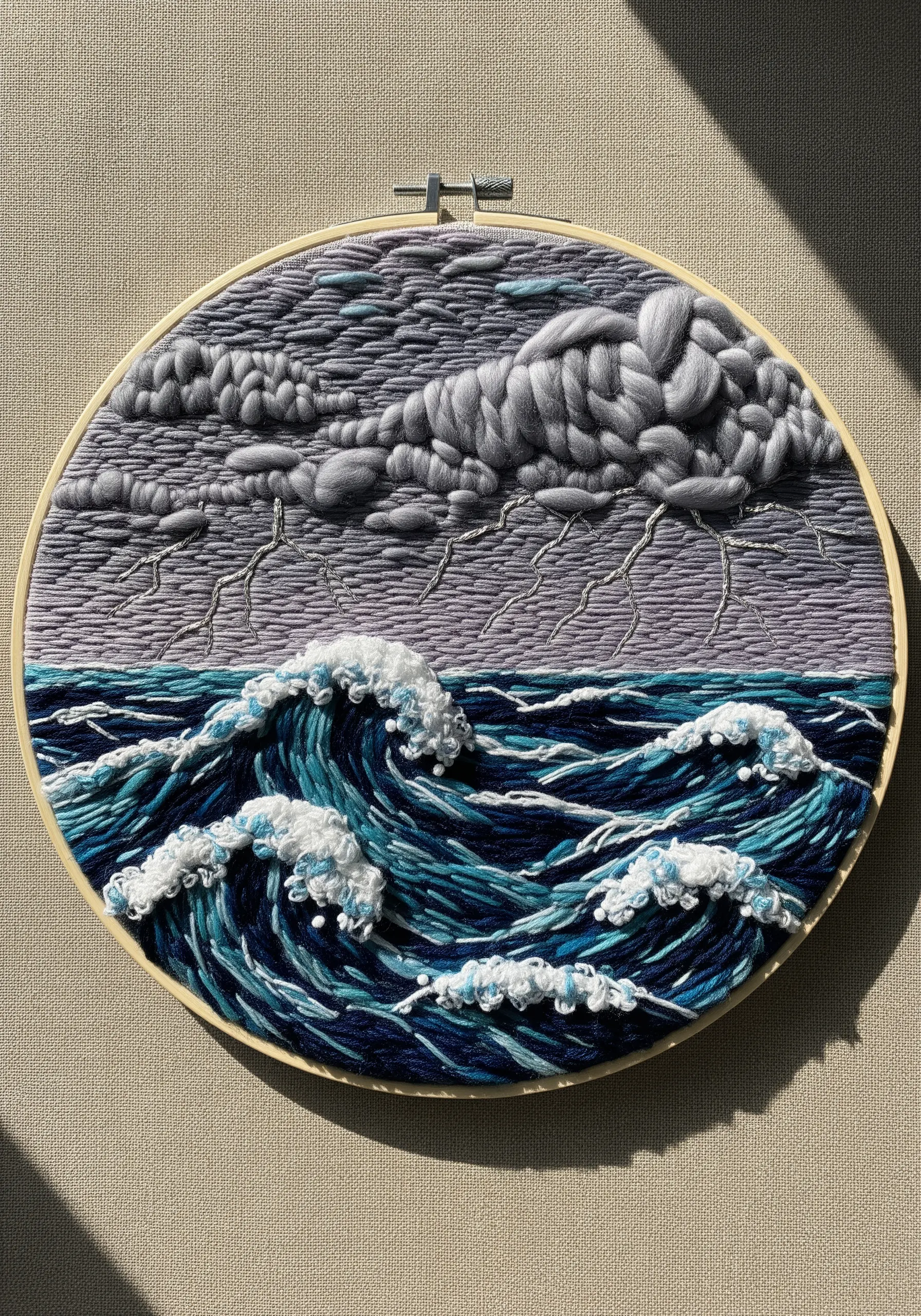
To build dramatic, churning waves, combine traditional six-strand floss with thicker wool or tapestry yarn.
Use a couching stitch to anchor the thick yarn for the cloud outlines, which adds a powerful, sculptural effect that stands out from the fabric.
Create sea foam by clustering French knots in varying sizes and shades of white and pale blue—this gives the water a sense of chaotic, natural movement.
For the stormy sky, use a dense long-and-short stitch in muted grays and purples to create a solid, oppressive backdrop for the bright lightning.
The lightning itself can be rendered with a fine metallic thread using a simple backstitch, creating a sharp contrast against the soft texture of the clouds.
2. Building Atmosphere with Directional Satin Stitch
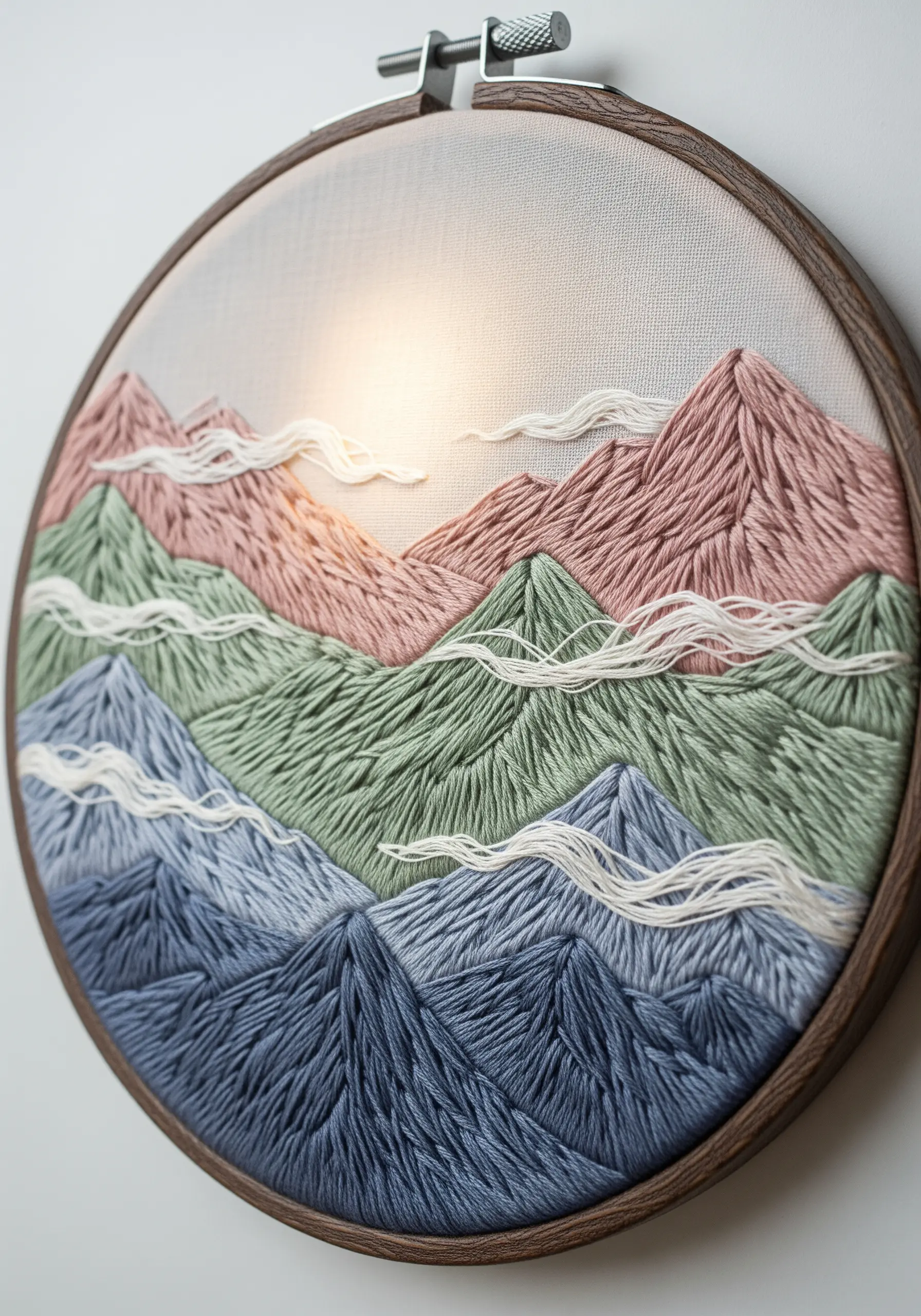
Give your mountain ranges a sense of depth and perspective by varying the direction of your satin or long-and-short stitches for each layer.
Keep the stitches on the farthest mountains more uniform and horizontal, while making the stitches on closer mountains more angled and dynamic. This simple shift tricks the eye into seeing distance.
The wispy clouds are created with just a few untwisted strands of white floss, laid loosely across the peaks and tacked down with tiny, invisible couching stitches.
This technique is about letting the thread do the work—focus on smooth, even tension to let the light catch the sheen of the floss.
3. Composing a Tactile Forest Floor
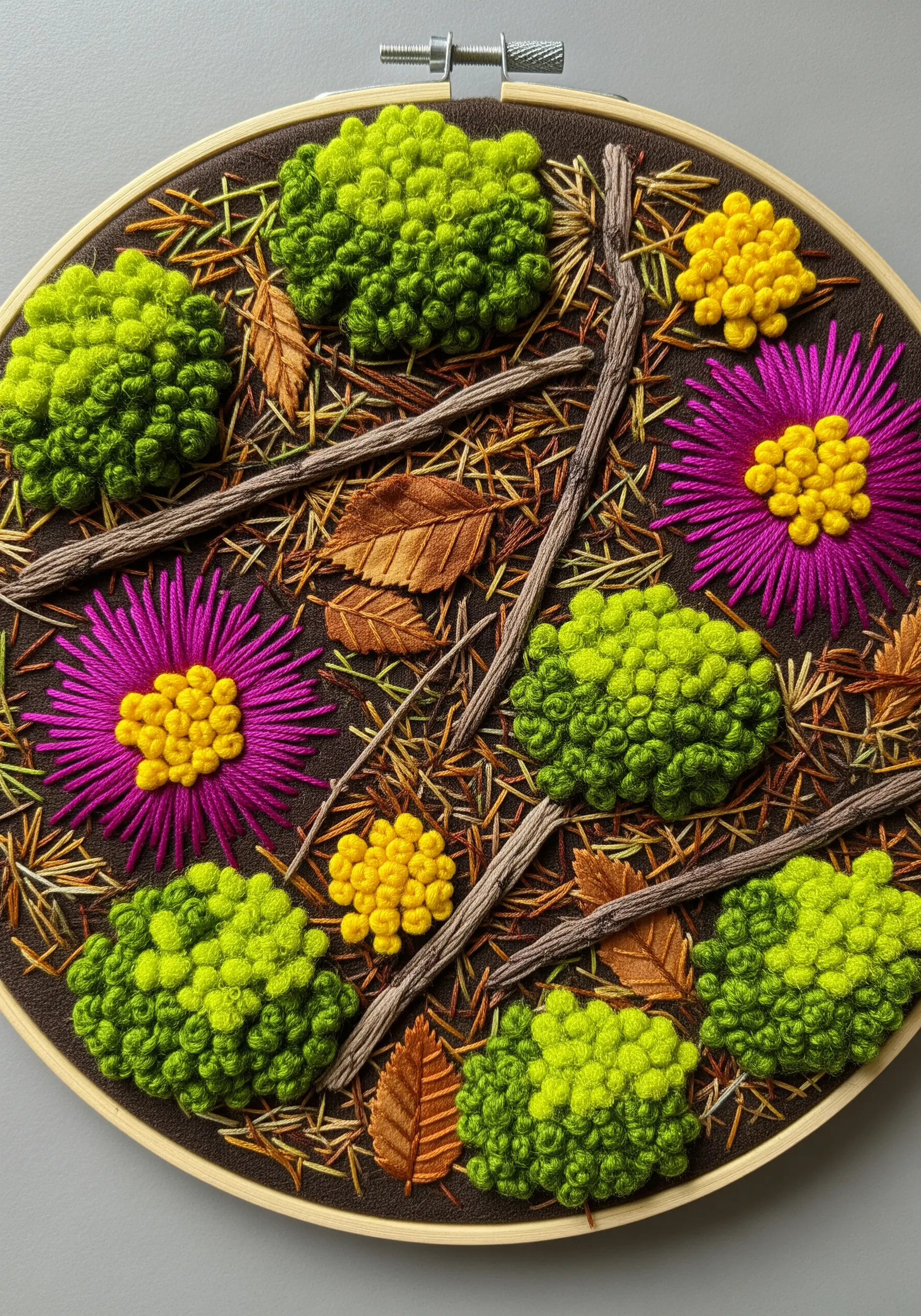
To achieve that lush, mossy texture, fill dense clusters with French knots using two or three shades of green floss. Varying the tightness of the knots adds organic irregularity.
The vibrant magenta flowers come to life with straight stitches radiating from a center packed with yellow French knots, giving them a distinct floral shape.
Create realistic twigs by wrapping a darker brown thread around a foundation of long straight stitches—a technique called padded satin stitch, which gives them a rounded, 3D form.
The entire composition feels rich because it contrasts high-texture elements with flat, smooth ones, inviting both the eye and the hand to explore the nature texture embroidery projects.
4. Stitching the Cosmos with Dynamic Curves
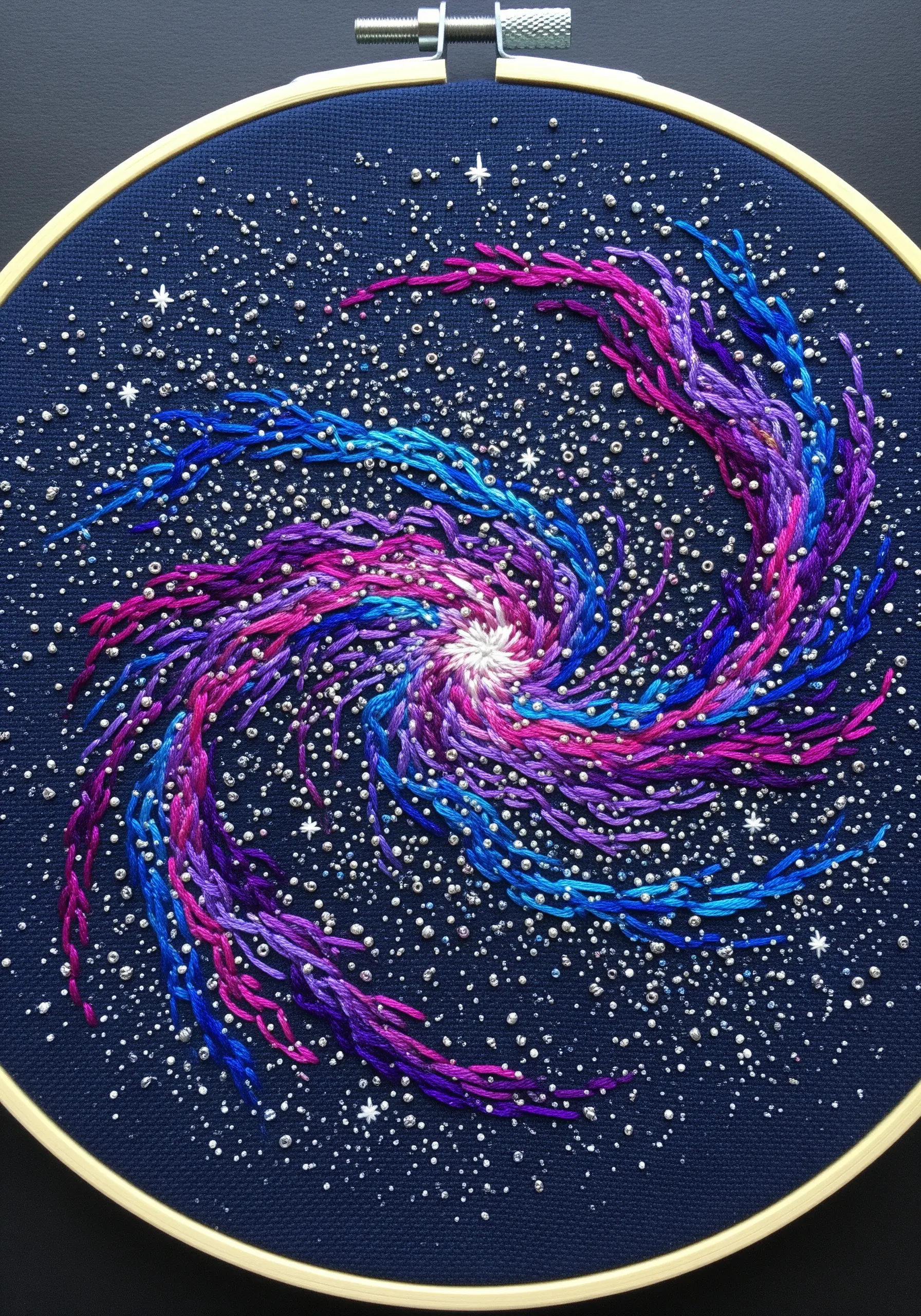
Capture the motion of a spiral galaxy by using a curved stem stitch or outline stitch for the arms. This creates a smooth, rope-like line that guides the eye toward the center.
Blend colors within each arm by switching threads every few stitches. Don’t worry about perfect transitions; the slight color shifts will look more natural and cosmic.
Create a dense, bright galactic core with tightly packed satin stitches in white or pale yellow.
The surrounding stars can be a mix of tiny French knots and randomly placed seed stitches using white or metallic thread. Varying their size and density creates a convincing illusion of a starfield.
Working on a dark navy or black fabric is key—it makes the vibrant floss colors pop and enhances the feeling of deep space.
5. Painting a Sunset with Thread Gradients

Achieve that smooth, painterly sunset effect using the long-and-short stitch technique, often called thread painting.
Work in horizontal bands of color, allowing the stitches of one row to overlap and blend into the stitches of the row below it.
Choose a harmonious palette of at least five or six shades, moving from deep oranges to warm browns and yellows to create a realistic gradient.
The sun is a perfect opportunity for a dense, smooth satin stitch. Ensure your stitches are perfectly parallel to create a solid, glowing orb.
Stitching onto a pre-dyed or gradient fabric can enhance the effect, giving your thread color blending an even richer atmospheric base to build upon.
6. Defining an Arctic Scene with Geometric Precision
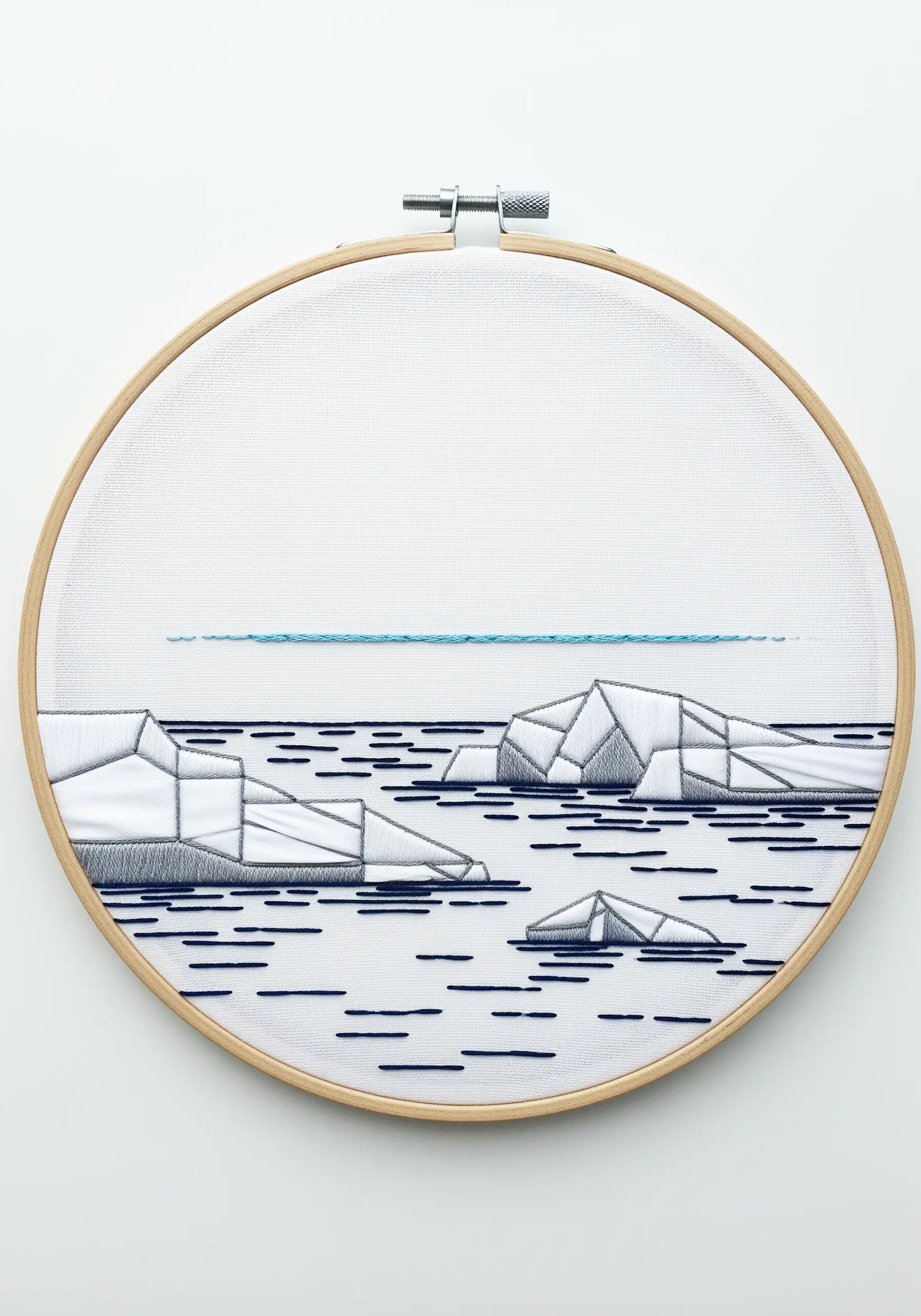
This design relies on the power of negative space and clean lines. Use a high-quality, even-weave white linen or cotton for a crisp background.
Create the geometric icebergs with a sharp, precise satin stitch. Use a single strand of gray floss to outline each shape first, then fill it in to ensure a razor-sharp edge.
The dark blue water is suggested with simple, horizontal straight stitches. Their sparseness is intentional, creating a sense of calm, cold stillness.
The single, thin horizon line in pale blue is a masterstroke of minimalism. It anchors the entire composition and establishes the vast, empty expanse.
Tension is critical here; any pulling or puckering will disrupt the clean, architectural feel of the piece.
7. Cultivating a Wildflower Meadow in Thread
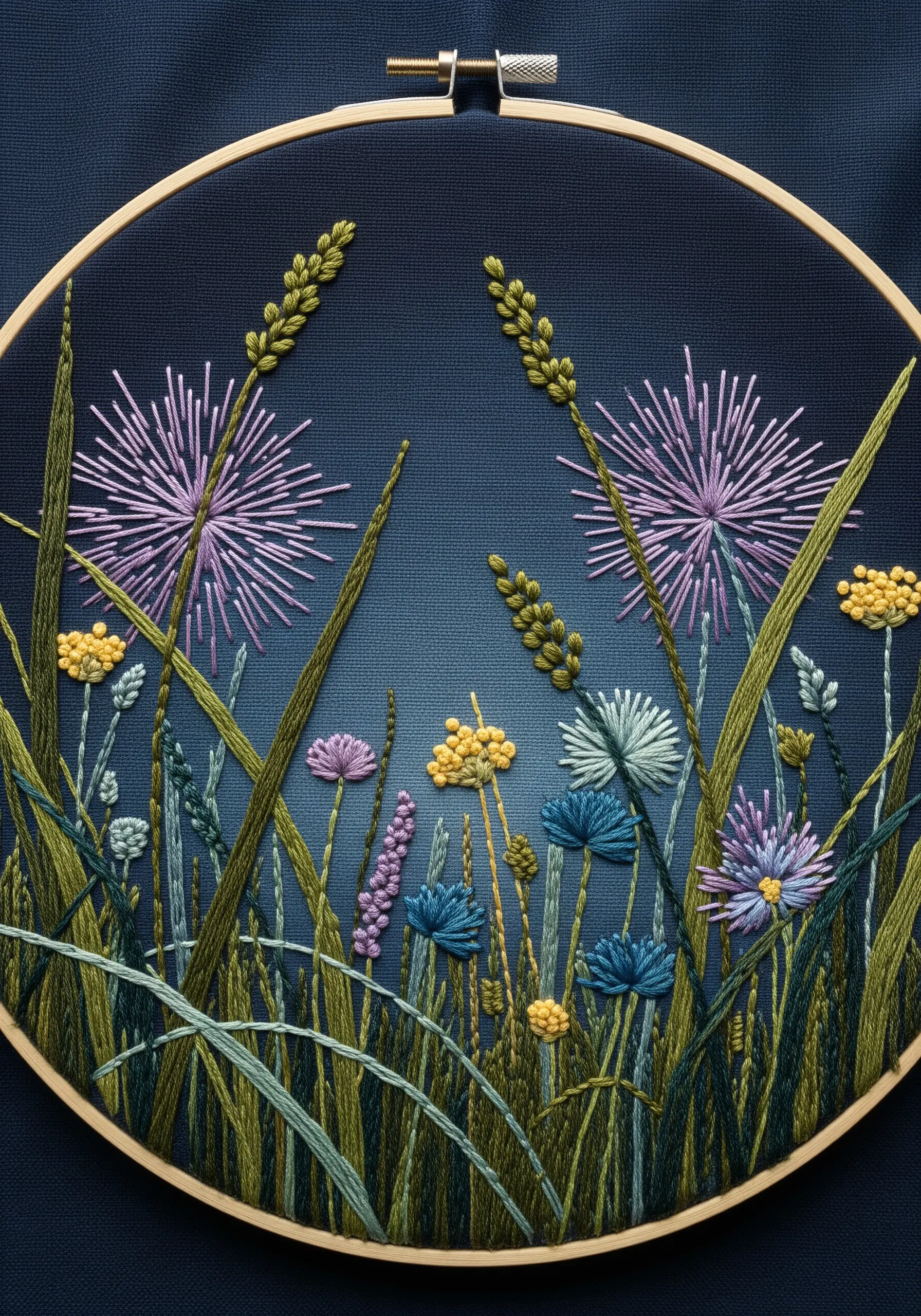
Give your meadow depth by varying the height and density of your stitches. Place taller, more detailed flowers in the foreground and simpler, shorter ones behind them.
The explosive purple flowers are simply clusters of long straight stitches radiating from a central point. It’s an incredibly effective stitch that takes minutes to learn.
Create the fluffy yellow flower heads by packing French knots closely together. For the wheat-like stalks, use a series of detached chain stitches stacked vertically.
Use multiple shades of green for the grasses and stems—this is the secret to making botanical embroidery look realistic rather than flat.
Dark blue or navy fabric provides a dramatic backdrop that mimics twilight, making the soft lavenders, yellows, and blues of the flowers glow, resulting in abstract floral embroidery hoops that look like fine art.
8. Capturing a City’s Glow with Light and Reflection

Use vertical satin stitches to construct the buildings, alternating between white, gray, and black thread to create architectural definition.
The glowing windows are perfect, uniform French knots in a vibrant yellow. Arrange them in neat grids to suggest lighted office floors.
The magic of this piece is in the water’s reflection. Mirror the building shapes below the skyline using horizontal satin stitches.
Break up the reflection with threads of the same colors as the buildings, but keep the stitches looser and more varied in length to mimic the movement of water.
Adding a few threads of dark blue into the water enhances the realism of the reflection and grounds the entire scene.
9. Sculpting a Coral Garden with 3D Stitches
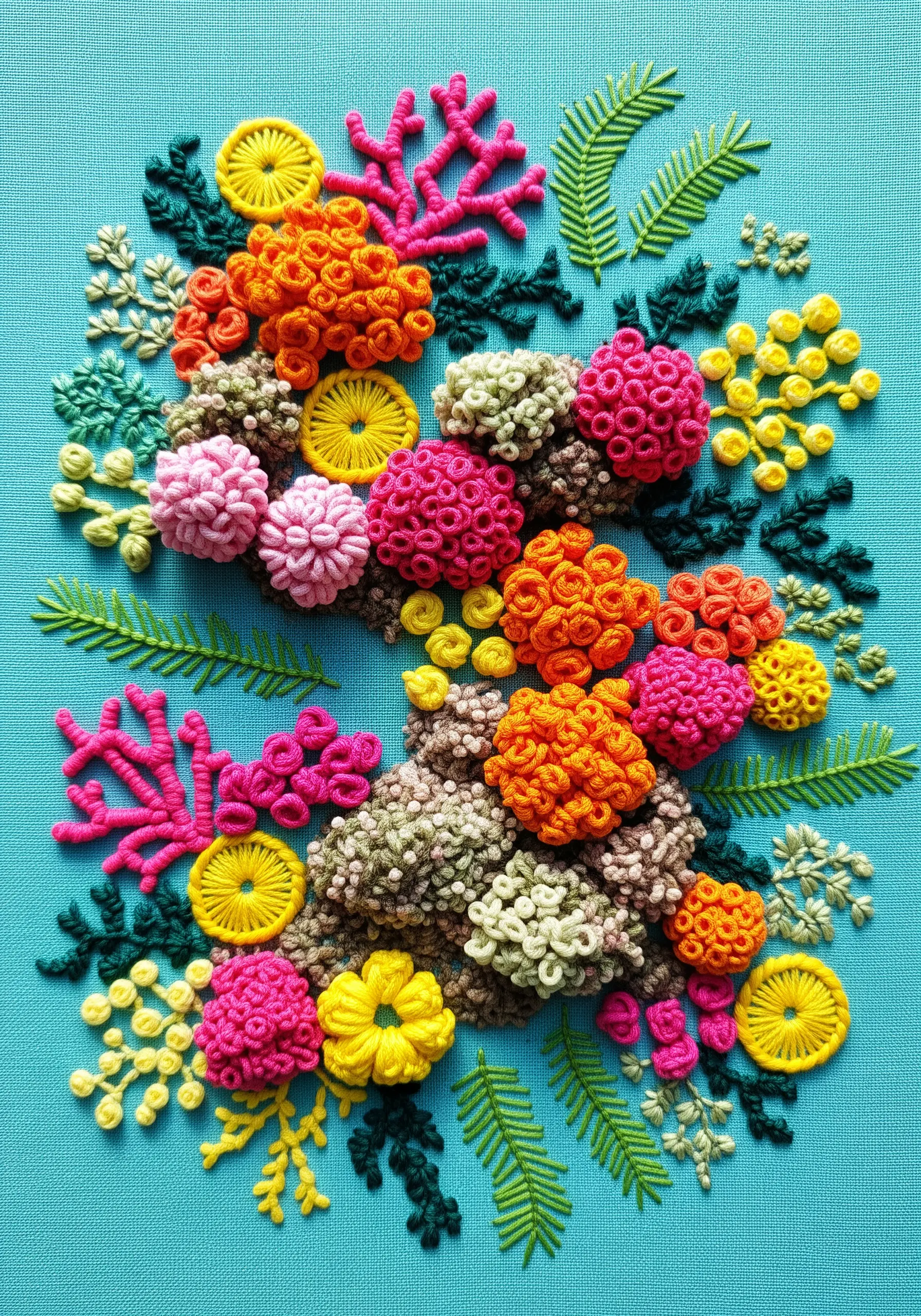
This underwater scene is a playground for dimensional stitches. Use bullion knots and cast-on stitches to create the worm-like coral shapes.
Build up the brain coral textures by packing French knots of different sizes and colors tightly together. This technique is incredibly forgiving and visually effective.
The bright pink, branching coral can be made with a series of connected detached chain stitches, creating a delicate, tree-like structure.
The flat, circular shapes are made with woven wheel stitches, which add a beautiful, radial pattern that contrasts with the knottier textures.
Don’t be afraid to mix vibrant, almost clashing colors like hot pink, orange, and turquoise. Unexpected embroidery techniques can make your coral reefs look naturally bold.
10. Creating an Autumn Canopy with Pointillist Knots
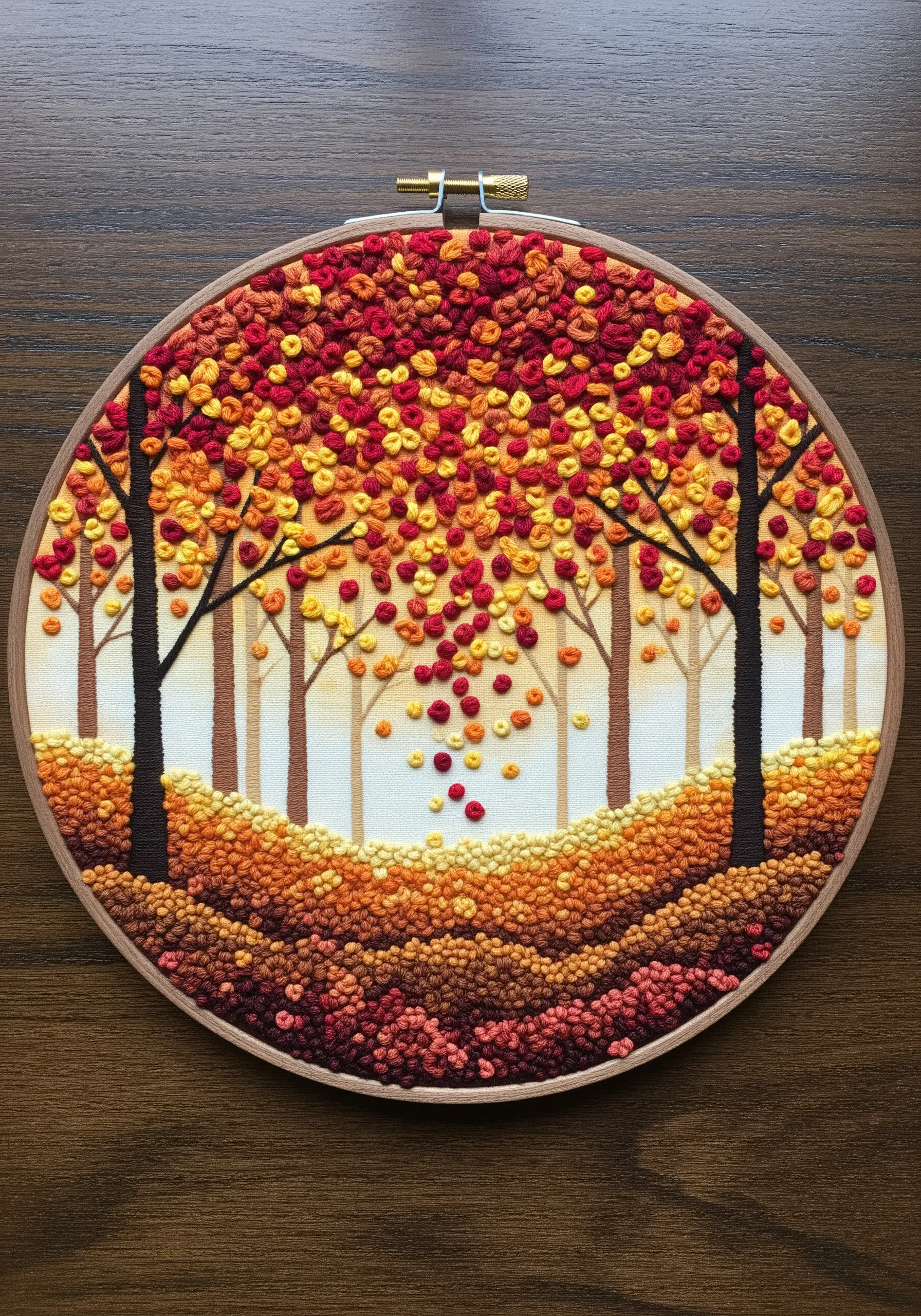
Capture the dense, colorful canopy of an autumn forest by filling the space with thousands of French knots.
Use a rich palette of reds, oranges, and yellows, randomly distributing the colors to create a natural, dappled effect, much like a pointillist painting.
Vary the number of wraps for your French knots to create leaves of different sizes, adding to the organic feel.
Allow some knots to ‘fall’ from the main canopy, drawing the viewer’s eye downward and creating a sense of gentle movement.
The tree trunks are simple satin stitches, while the forest floor uses the same French knot technique in darker, earthier tones to ground the composition.
11. Capturing Volcanic Energy with Mixed Fibers
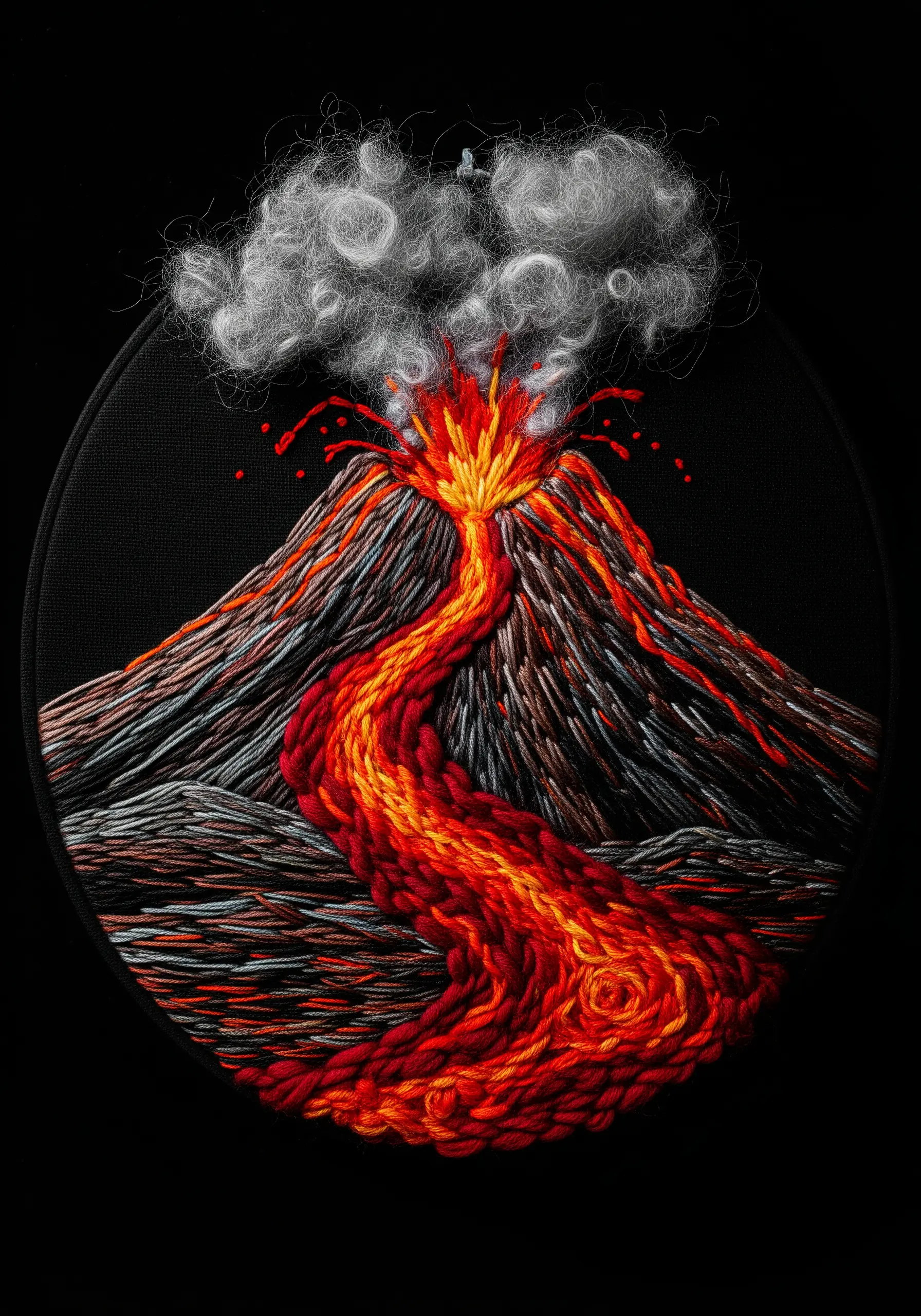
For a truly dramatic smoke plume, incorporate a non-thread material like wispy wool roving or felted wool.
Needle-felt the wool directly onto your fabric to create a soft, ethereal cloud, then add a few swirling stitches in gray thread to define its shape.
The flowing lava is achieved with directional long-and-short stitches. Follow the path of the lava flow, blending fiery reds, oranges, and yellows to show heat and movement.
The volcanic rock is created with shorter, choppier satin stitches in shades of gray and black, providing a hard, jagged contrast to the fluid lava.
This piece demonstrates how merging embroidery threads with mixed media textures can elevate a design from flat to sculptural.
12. Weaving a Dreamscape with Blended Colors
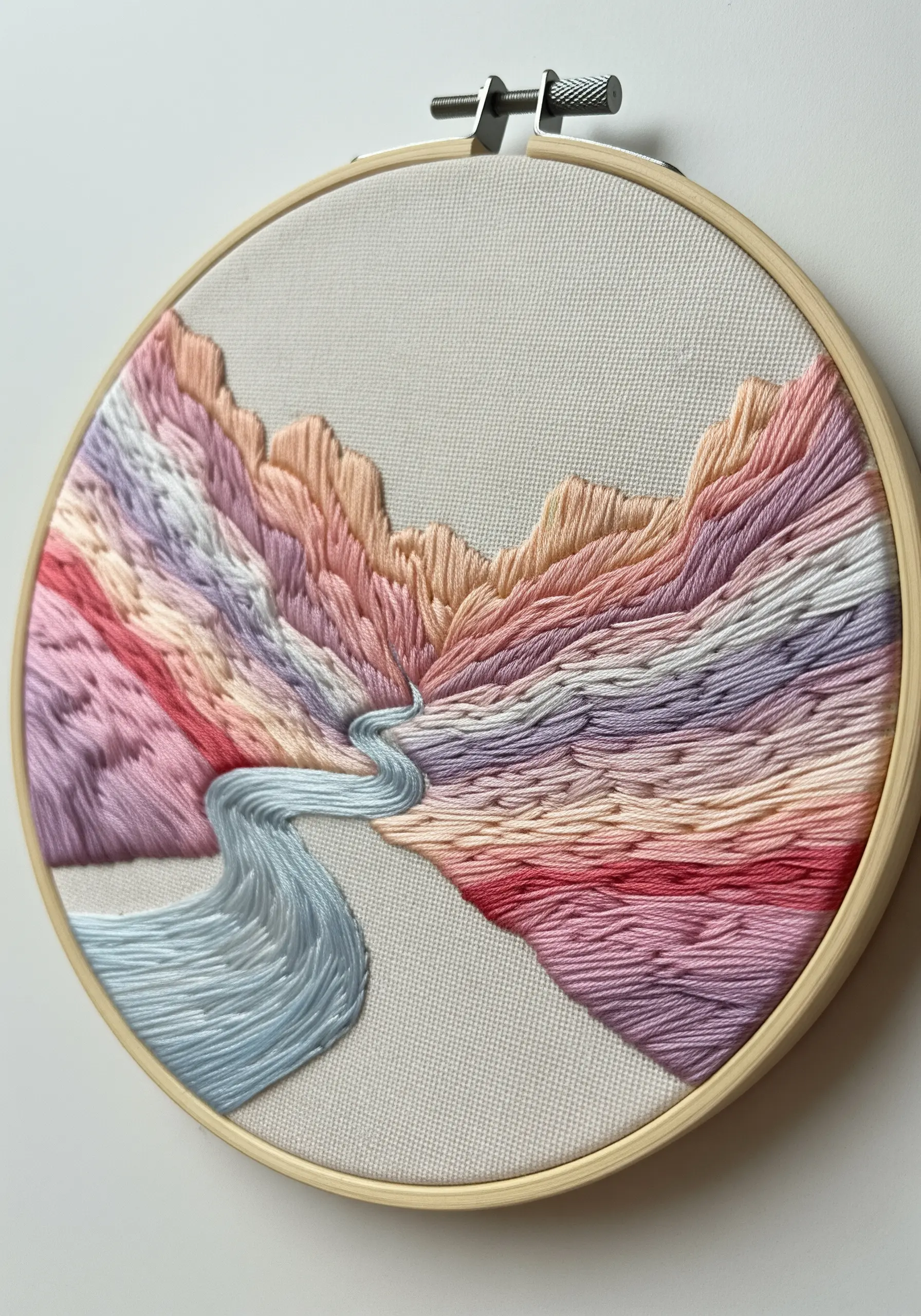
This dream-like landscape uses encroaching satin stitch to create soft, organic shapes and seamless color transitions.
Instead of hard lines, the colors of the mountains blend into one another. You can achieve this by having the stitches of one color section slightly interlock with the stitches of the next.
The river is created with smooth, horizontal satin stitches in a contrasting cool blue, creating a clear visual path through the warm-toned mountains.
The key to this style is maintaining a consistent stitch direction within each color block, which gives the piece a woven, tapestry-like quality.
Choose a palette that feels imaginative and emotional rather than realistic—soft lavenders, dusty pinks, and warm peaches work beautifully together as part of your soft pastel textile wall decor.
13. Illustrating a Rainy Day with Appliqué and Line

Combine stitching with fabric appliqué for a bold, graphic look. Cut a cloud shape from a piece of gray satin or silk.
Tuck the raw edges under and secure the cloud to your background fabric with tiny, nearly invisible whip stitches around the border. The sheen of the satin adds a lovely contrast.
The rain is made of simple, angled straight stitches using a silver metallic thread. This choice gives the rain a subtle glimmer and a modern feel.
Create the lush grass with overlapping straight stitches in various lengths and shades of green. This layering builds texture and avoids a flat, uniform look.
This is a perfect example of how minimalist embroidery ideas can tell a story with just a few well-chosen elements.
14. Painting the Aurora with Vertical Stitches
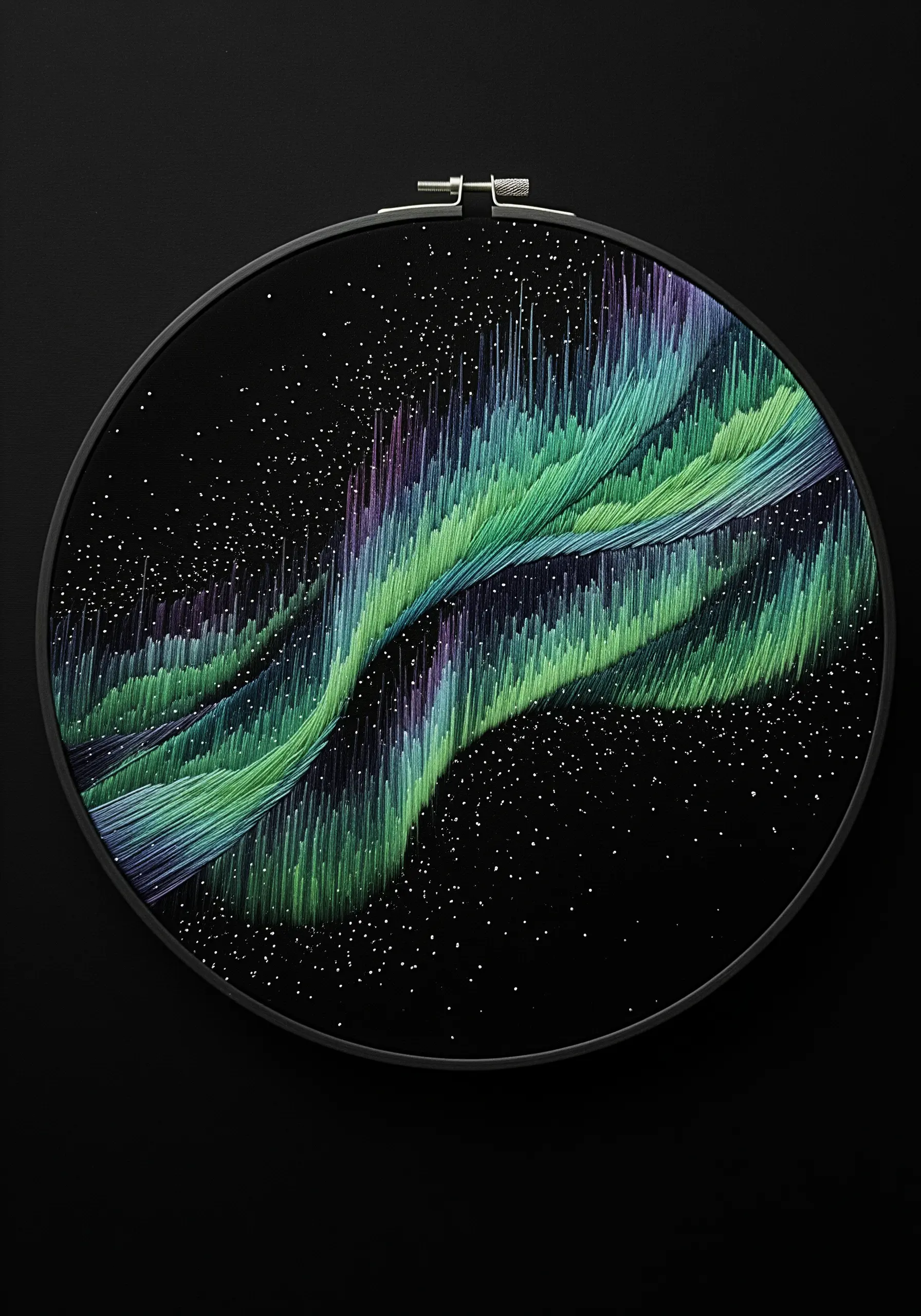
Recreate the dancing columns of the Northern Lights using only vertical straight stitches. The magic is in the color blending and stitch length.
Work with several needles threaded at once with different shades of green, blue, and purple. Place stitches close together, allowing the colors to blend optically.
Vary the length of your stitches dramatically to create the aurora’s signature flowing, curtain-like shape.
Scatter tiny white or silver French knots across the sky to represent stars, adding depth to the night scene.
The dark fabric is essential, providing the perfect canvas for the vibrant, glowing threads to stand out, transforming simple stitches into a breathtaking natural phenomenon.
15. Cultivating Calm with Zen Garden Textures
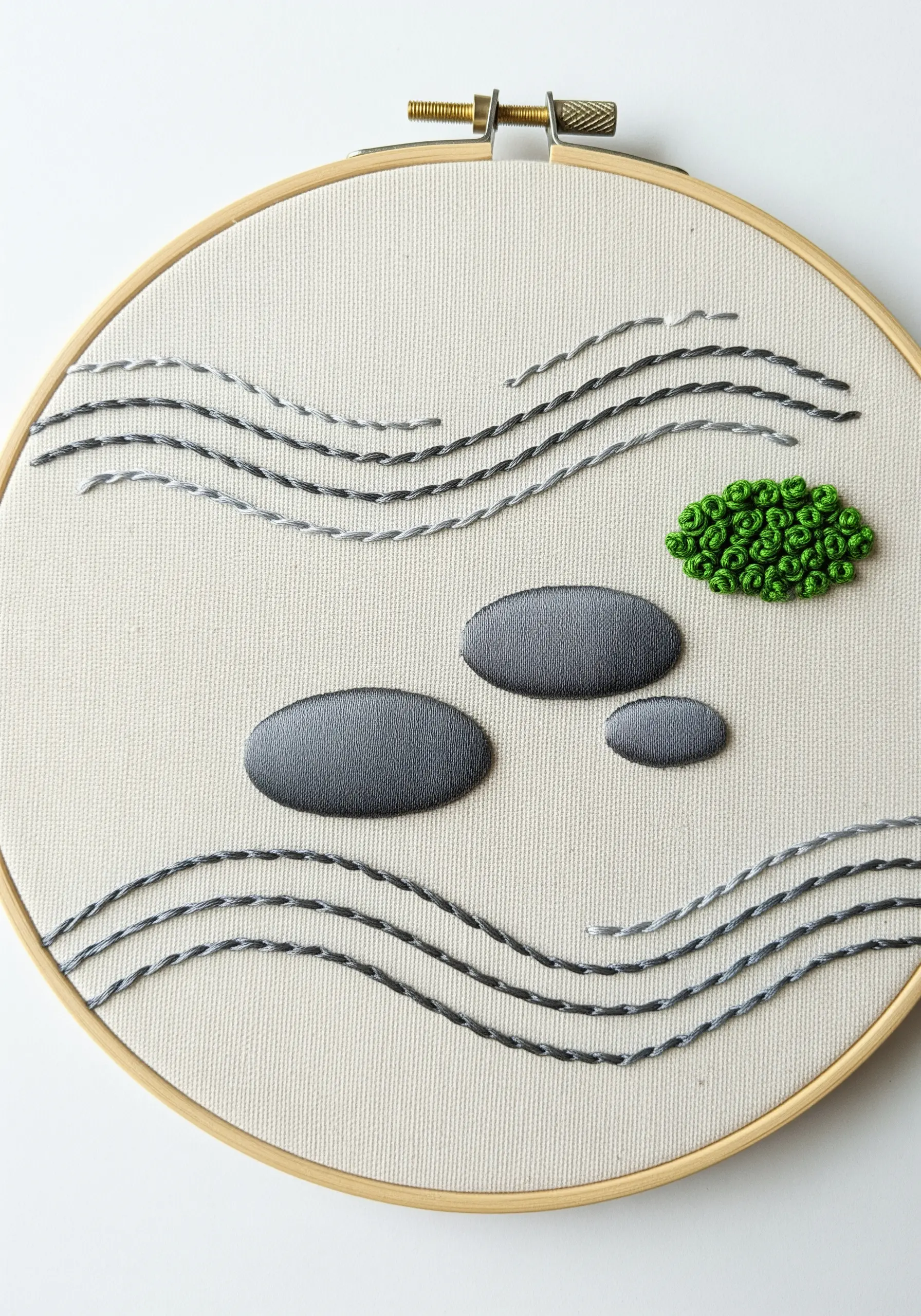
Create perfectly smooth, raised stones using a padded satin stitch. First, fill the stone shape with small seed stitches, then cover that padding with neat, horizontal satin stitches.
The padding lifts the stones off the fabric, giving them a satisfying three-dimensional quality and a smooth, pebble-like finish.
The flowing lines in the sand are made with a whipped backstitch or stem stitch. Using a variegated gray thread gives the lines a subtle, natural color shift.
For the small patch of moss, use tightly packed French knots in a vibrant green, which provides a wonderful textural contrast to the smooth stones.
This design is an exercise in restraint and precision, proving that minimalist embroidery wall art ideas can have a powerful, calming presence.
16. Illuminating a Pond with Glow-in-the-Dark Thread
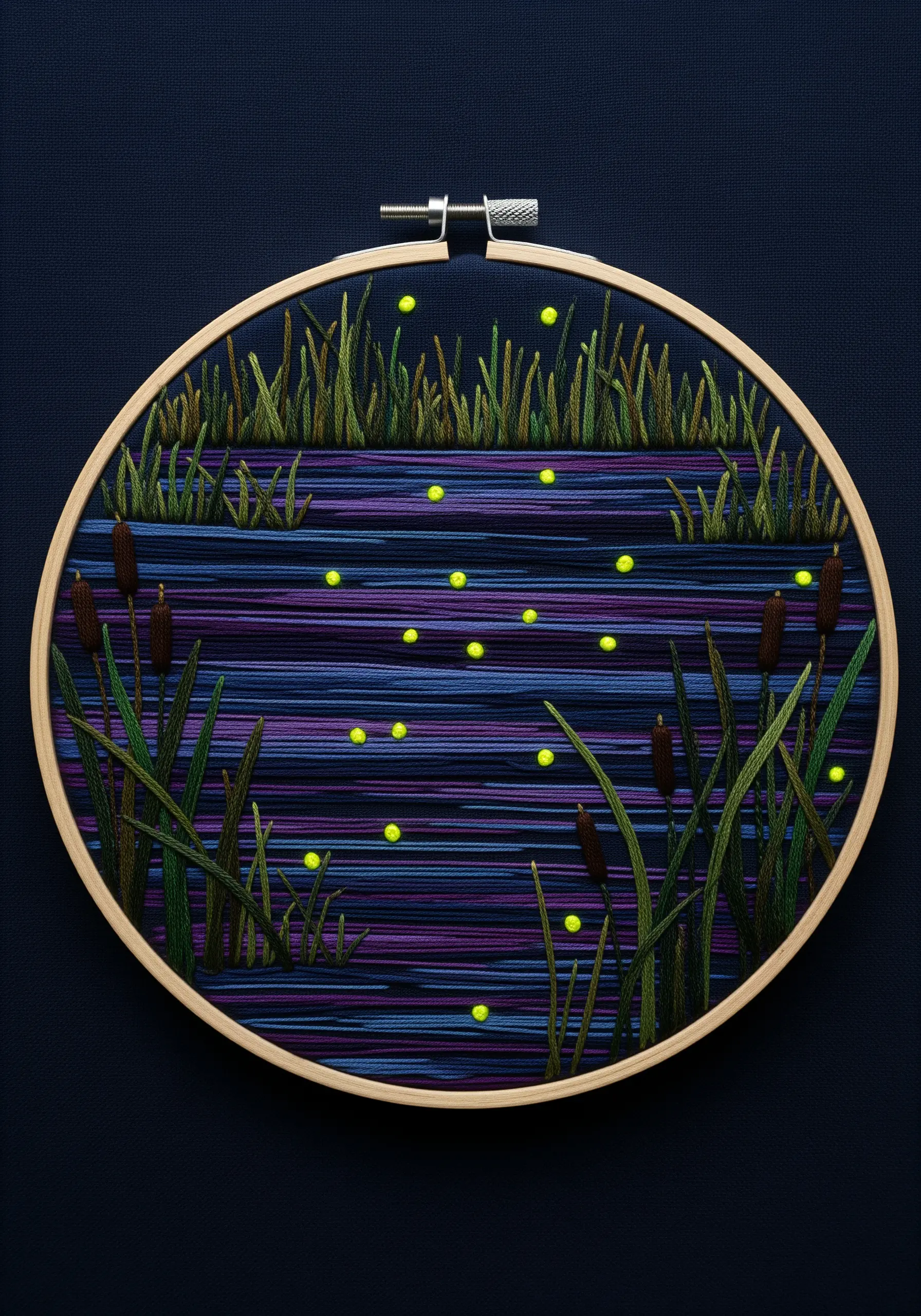
The secret to the magical glow of the fireflies is using a specialty fluorescent or glow-in-the-dark thread.
Create each firefly with a single, bold French knot. When charged under a light, these knots will emit a soft glow in the dark, bringing the scene to life.
The water’s surface is created with long, horizontal satin stitches. Using a mix of dark blues and purples gives the water depth and a sense of night.
The reeds and cattails are stitched with simple straight stitches and satin stitch, framing the scene and adding a natural element.
This design shows how a single, clever material choice can transform a simple composition into an interactive and enchanting piece of art.
17. Exploring Landscapes Through a Texture Sampler

Think of this not as a finished landscape, but as a visual dictionary of textures you can use in your future work.
Divide your hoop into sections and fill each one with a different stitch to see how it behaves. Try darning stitch, seed stitch, cross-hatch patterns, and couching.
The top left green block uses a dense seed stitch, while the top right uses angled straight stitches for a different directional feel.
The yellow block features a lattice created with long straight stitches, tacked down at the intersections—a technique called couched filling.
This is an invaluable practice for understanding different ways to create depth in your embroidery using natural textures, light, and shadow.
18. Weaving a Dense Tropical Canopy

To create the illusion of a dense jungle, you must layer your elements. Stitch the leaves in the background first, then add the foreground leaves and flowers on top.
Use a split stitch to outline each leaf before filling it with satin stitch. This creates a clean, raised edge that helps each leaf stand out.
For the variegated leaves, use two similar shades of green in your needle at the same time. The colors will blend randomly, creating a natural-looking stripe.
The woven wheel stitch is perfect for creating vibrant, circular flowers that pop against the green foliage.
This composition works because it fills the entire hoop, creating an immersive, lush feeling with no single focal point, just pure, vibrant pattern.
19. A Minimalist Sunrise with Radiating Lines
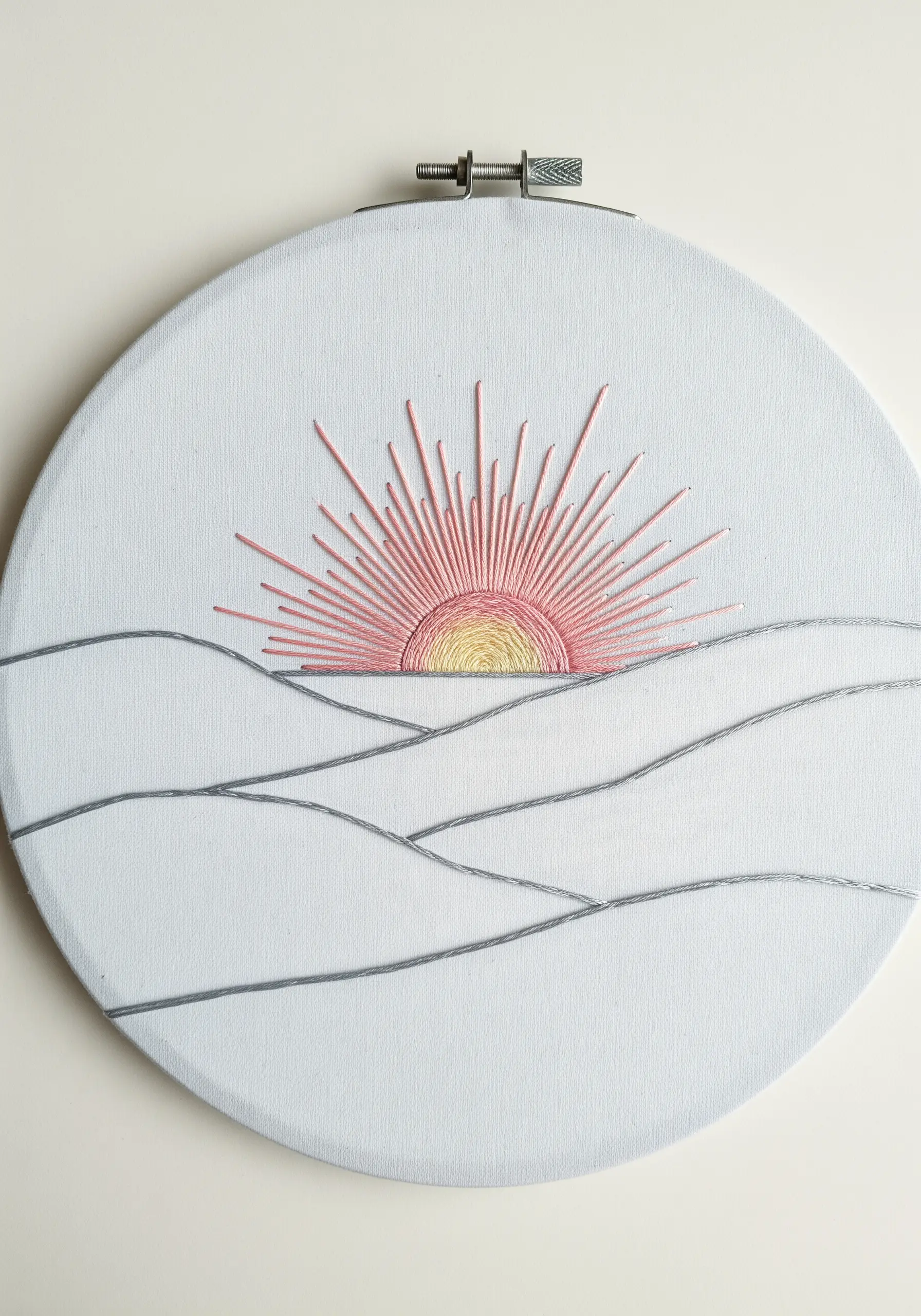
Capture the essence of a sunrise with the simplest of elements: radiating lines and clean curves.
The sun’s rays are just straight stitches of varying lengths, all originating from the central arc. Using a light pink gives it a soft, dawn-like quality.
Fill the sun’s core with a small patch of satin stitch in a contrasting yellow to create a focal point of warmth.
The rolling hills are defined by a simple, elegant backstitch or stem stitch in a neutral gray. The clean lines provide a calm foundation for the vibrant sun.
This piece is a testament to the power of delicate line art embroidery ideas, proving you don’t need complex stitches to create an evocative scene.
20. Capturing Movement with Contour Stitching
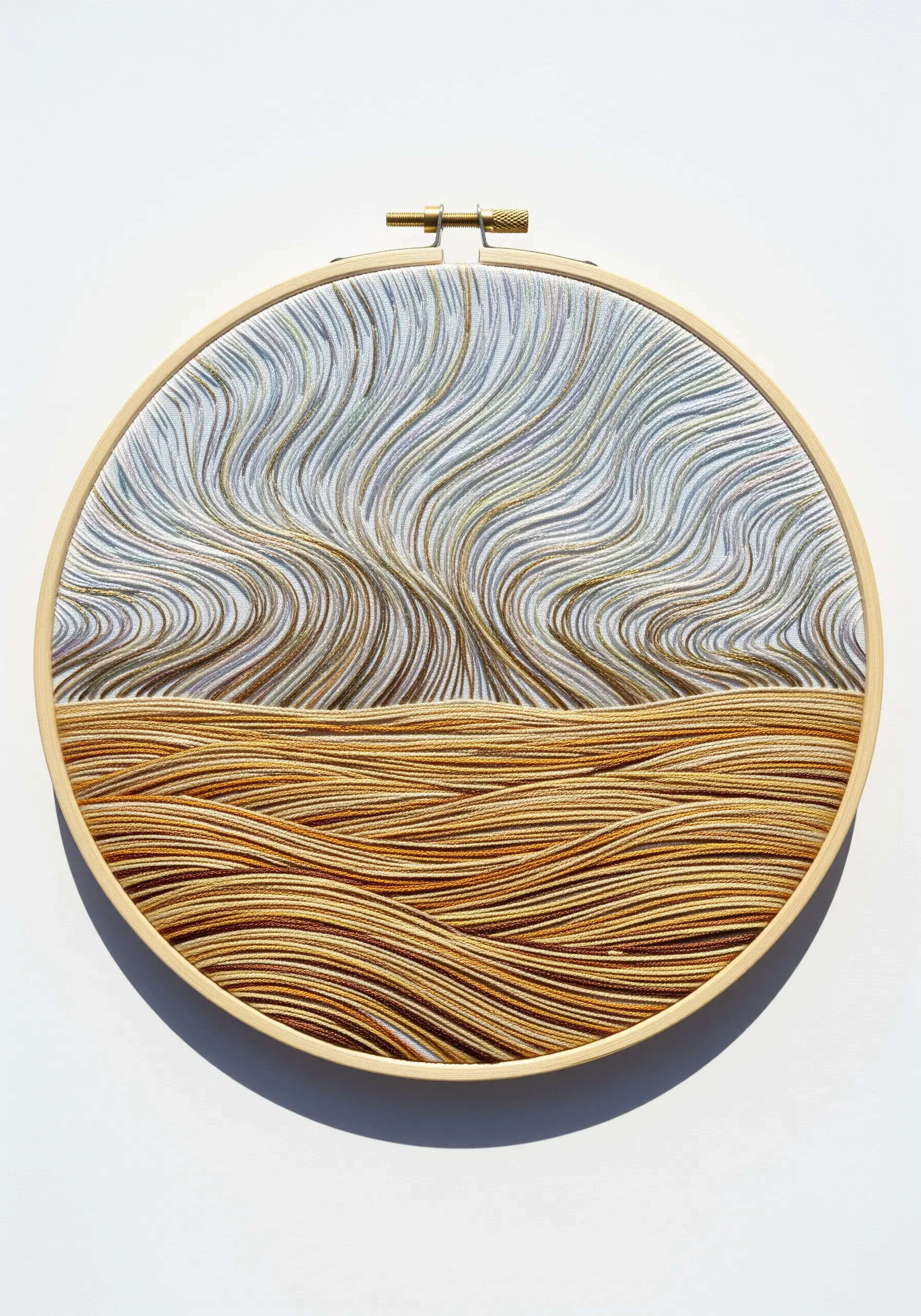
This piece uses a single stitch—likely a stem stitch or split stitch—to create the entire texture, but the magic is in its application.
Instead of filling shapes with straight lines, let your stitches follow the contours of your design. This creates a powerful sense of flow and movement.
In the upper ‘sky’ section, the lines are wavy and organic, suggesting wind or clouds. In the lower ‘earth’ section, they are more horizontal and grounded.
Using variegated thread, which has multiple colors in one strand, is a brilliant way to achieve subtle color shifts without constantly changing your thread.
The density of the stitching creates a rich, tapestry-like surface that feels both abstract and deeply connected to the natural world.
21. Illuminating an Underwater Grotto
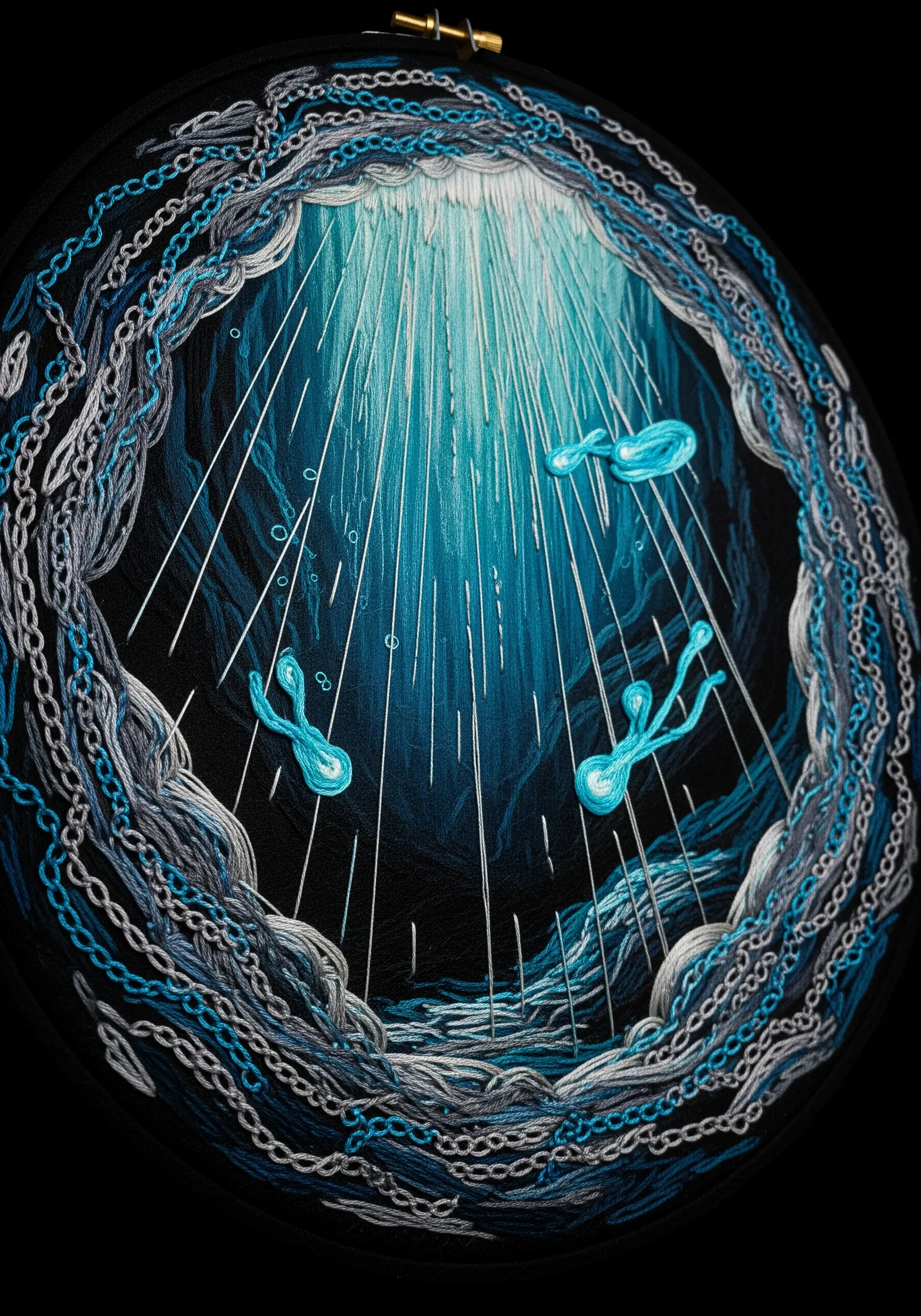
Create ethereal beams of light filtering through the water with long-and-short stitch. Start with white thread at the top and gradually blend in shades of turquoise and blue as you move down.
Keep the stitches long and vertical to enhance the feeling of light rays piercing the darkness.
The rocky texture of the cave walls is built up using layers of chain stitch in grays, whites, and blues. This stitch creates a bumpy, rugged surface perfect for stone.
The glowing creatures are outlined and filled with a bright, contrasting aqua thread, making them the clear focal point in the dark environment.
Working on black fabric is crucial here, as it provides the deep, mysterious backdrop needed for the light effects to truly shine.
22. A Pointillist Lavender Field at Dawn

This entire landscape is built from just two simple stitches, proving that technique is more important than complexity.
The rows of lavender are composed entirely of French knots. Create depth by using darker shades of purple in the foreground and lighter, paler shades in the distance.
Arrange the knots to follow the perspective lines of the field, which draws the viewer’s eye into the scene.
The sky is a beautiful blend of yellow and white short straight stitches, creating a soft, hazy sunrise that contrasts with the dense texture of the field.
This is a wonderful, meditative project that relies on the repetitive, calming motion of creating hundreds of knots to build a beautiful scene, perfect for exploring abstract concept art embroidery ideas inspired by feelings of peace.