I know that feeling. You love the rhythm of pulling thread through fabric, but you sense there’s another level to your art that feels just out of reach. You want your work to feel more intentional, more polished, more *you*—without having to learn dozens of complicated new stitches.
The secret might not be in a new stitch, but on a new surface. Imagine swapping your linen for the crisp, clean plane of paper. It’s not a lesser substitute; it’s a creative partner that offers a completely different voice. Paper invites precision, holds a clean line like nothing else, and allows color and texture to interact in surprising new ways.
Here, we’ll explore how this simple shift can transform your embroidery. These aren’t just crafts; they are thoughtful explorations of how thread and paper can elevate one another. You already have the skill. Now, let’s give it a new place to shine.
1. Stitching on Watercolor: A Delicate Fusion

Begin by using a heavyweight watercolor paper—at least 140 lb—as your canvas to prevent buckling.
Gently prick your stitching holes with a fine needle *before* painting; this protects the soft watercolor wash from being disturbed later.
Use a single strand of embroidery floss for delicate florals like lavender, which allows the thread to blend seamlessly with the painted background.
The watercolor creates an ethereal glow and soft-focus effect that adds depth and context in a way that plain fabric cannot.
2. Celestial Texture: Layering Metallics and Appliqué

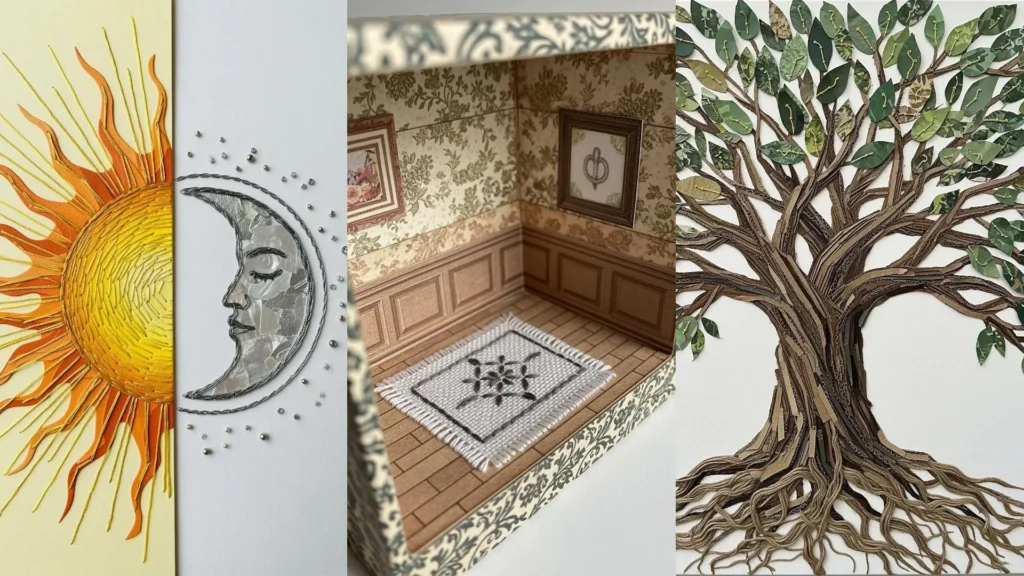
Create a dimensional moon by first applying a piece of silver lamé or faux leather as an appliqué base.
Stitch over the appliqué with various metallic threads and add tiny silver beads to emulate the texture of craters, giving the motif a raised, tactile quality.
For the surrounding stars and constellation lines, use different weights of metallic thread to establish a clear visual hierarchy and create the illusion of depth.
This layering method transforms a flat design into a rich, multi-textured celestial scene that invites touch.
3. The Radiating Stitch: Graphic Lines on Cardstock

Transform a simple card with a radiating straight stitch pattern that turns geometry into art.
First, use a compass and protractor to mark evenly spaced points around a central hole, ensuring a symmetrical design.
Always pre-punch the holes with a sharp awl or a thick needle; this creates clean entry points and prevents the cardstock from tearing under tension.
This method turns a basic straight stitch into a sophisticated design element, perfect for DIY embroidered cards and modern wall art.
4. Featherlight Stitches: Detailing Paper Cutouts

Elevate simple paper cutouts by introducing delicate stitched details for structure and interest.
Use a simple running stitch or backstitch along the center of each paper feather to mimic the feather’s supportive rachis.
The key is to use a very fine needle and a lightweight, single strand of thread to avoid overpowering or tearing the paper.
This technique allows you to craft lightweight, airy decorations that move beautifully and would be too fragile to achieve with heavier textiles.
5. Paper Collage Landscapes with Thread Accents

Build a landscape using layers of torn watercolor paper, allowing the feathered edges to create soft, organic horizons that mimic rolling hills.
Once your paper collage is set, anchor the composition with small, textural stitches that add both detail and stability.
Use French knots or bullion knots for foreground flowers; these raised stitches create three-dimensional pops of color that contrast beautifully with the flat paper.
This mixed-media technique masterfully blends painterly textures with tactile thread work, drawing the eye into the scene.
6. Bookbinding Embroidery: Journal Cover Embellishment

Personalize a journal by embroidering directly onto its cardstock cover, transforming a functional item into a bespoke piece of art.
Use a satin stitch with a subtle color gradient—like dark gold fading to pale yellow—to give the bee’s stripes a realistic, fuzzy dimension.
For the delicate wings, outline with a single strand of metallic thread and fill with an open lattice stitch to suggest translucency and intricate veining.
Remember to use a sharp needle and work slowly to ensure each puncture in the paper is clean and precise.
7. Pierced Paper Luminaries: Stitching with Light

Create ethereal luminaries by stitching designs onto vellum or another translucent paper.
It is crucial to pre-punch your entire design before shaping the paper into a cylinder to maintain its structural integrity.
Use a simple backstitch with a shimmering metallic thread that will catch the light even when unlit.
When you place an LED tealight inside, the pierced holes glow, turning your stitch work into a captivating pattern of light and shadow.
8. Abstract Thread Drawing on a Painted Canvas

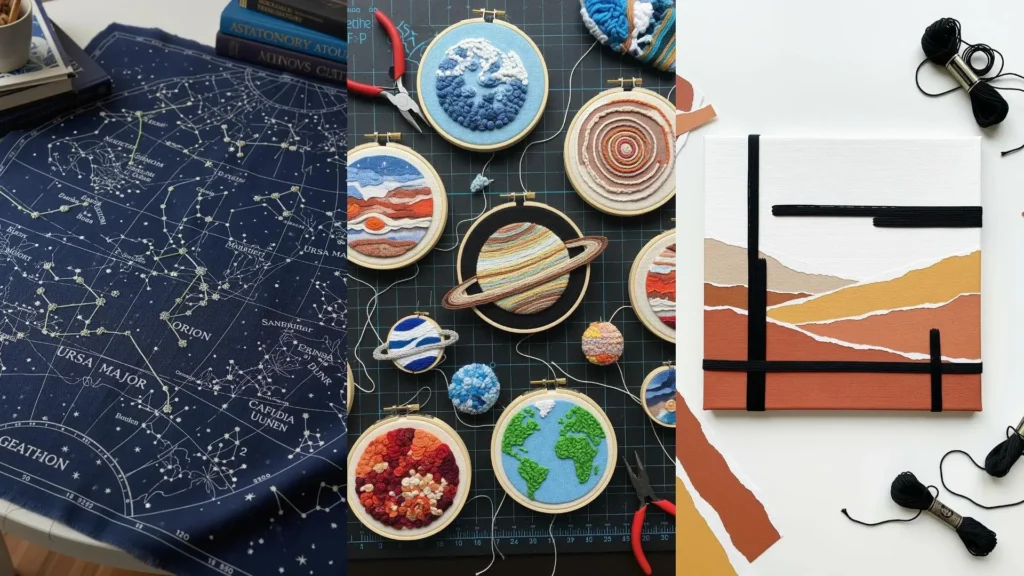
Move beyond traditional embroidery and use thread as a sculptural line that interacts with a painted surface.
After painting a color-blocked background, couch a thick, contrasting thread or yarn onto the paper.
Tack it down at key intersections with a finer, near-invisible thread, which allows the main thread to loop and curve freely above the page.
This technique creates a dynamic, three-dimensional drawing that floats above the color, making it a perfect entry into abstract thread sculpting.
9. Mixed-Media Gift Tags: Combining Thread and Botanicals

Elevate your gift-giving by creating multi-layered tags that become part of the present itself.
Combine simple backstitch borders or tiny stitched motifs with delicate pressed flowers for a beautiful textural contrast.
On dark cardstock, a high-contrast thread like cream or copper creates a striking graphic frame.
On lighter paper, let the pressed botanicals be the star and use a subtle running stitch as a quiet, elegant border.
10. The Hybrid Botanical: Finishing Pressed Flowers with Thread

Create a stunning mixed-media piece by letting a natural element take center stage.
Secure a single, beautiful pressed flower to heavy paper with a tiny, archival adhesive dot hidden under the center.
Then, use embroidery floss to create the stem and leaves, stitching directly into the paper.
A whipped backstitch or stem stitch will give the stem a rounded, dimensional quality that contrasts elegantly with the flat, delicate petal.
11. Weaving and Stitching: A Textural Grid

Combine paper weaving and embroidery to build a surface with extraordinary texture and graphic appeal.
After weaving your paper strips into a grid, use a simple cross stitch at various intersections to secure the structure.
This stitch not only adds stability but also introduces a contrasting textural element that breaks up the flat planes of paper.
Choose a thick, matte thread to stand out against the paper’s smooth surface for the most impactful result.
12. Thread as Ink: Expressive Portraits

Use thread to capture the essence of a line drawing, focusing on expressive contours rather than dense filling.
A whipped backstitch or a stem stitch works perfectly to create a bold, consistent line weight that mimics an ink pen.
You can create visual interest by varying the thread thickness for different features—a thicker thread for eyelashes or lips adds depth and focus.
This technique is a beautiful way to translate modern line art into a tactile medium, whether on paper or fabric.
13. Festive Garland: Stitching Colorful Paper Shapes

Create a vibrant, reusable garland by adding stitched details to simple paper cutouts.
Embellish each shape with decorative borders using a simple running stitch or backstitch *before* you string them together.
Use a large-eyed tapestry needle and a sturdy twine or yarn to assemble the final garland, which makes the process quick and easy.
This project is a wonderful way to use up colorful paper scraps and introduce basic stitching in a celebratory context.
14. Sculptural Seascapes: Thread on Painted Paper

Build an abstract ocean scene by layering thread textures onto a fluid watercolor background.
Use hundreds of tightly packed French knots in varying shades of white and ecru to simulate the chaotic, bubbling texture of sea foam.
For rain or sea spray, use long, straight stitches with metallic thread, leaving the ends intentionally loose to add a sense of movement and delicacy.
This advanced technique turns a flat painting into a multi-sensory artwork with incredible depth and tactility.
15. Architectural Stitching: Highlighting Lines on Illustrations

Enhance a printed architectural drawing by selectively tracing key lines with embroidery thread.
Use a simple backstitch in a contrasting color—like black on brownstone—to outline window frames, brickwork, or cornices.
This technique adds a subtle layer of texture and dimension, drawing the viewer’s eye to the details you choose to highlight.
It’s a sophisticated way to merge graphic design with textile art, transforming a flat print into a unique, handcrafted piece.
16. Stitching on Embossed Surfaces

Add a layer of subtle color and definition to intricately embossed paper without overwhelming its design.
Use a single strand of floss and a delicate backstitch to trace the raised lines of the botanical pattern.
The thread will naturally settle into the debossed grooves, creating a beautifully integrated design that feels intentional and elegant.
This technique is an exercise in subtlety, enhancing an existing texture rather than creating a new one from scratch.
17. Beaded Constellations on Cardstock

Map out the night sky on dark cardstock, using iridescent beads or tiny sequins to represent your stars.
Pre-punch all holes for both the thread and the bead’s center to ensure a clean finish and avoid bending the paper.
Connect the beaded “stars” with a crisp backstitch in silver or white thread to form the constellation’s graphic shape.
The beads catch the light and provide a focal point, making this a simple yet elegant way to create beautiful celestial art.
18. Embroidered Foliage: Paper Patch Appliqués

Create durable, appliqué-style autumn leaves by stitching directly onto sturdy cardstock instead of fabric.
Use a fishbone stitch or long-and-short stitch to fill the leaf shapes, blending autumnal reds, oranges, and golds for a realistic gradient.
Once the stitching is complete, carefully cut out each leaf, leaving a small paper border to frame your work.
These textured elements are perfect as gift tags, garland pieces, or tablescape scatter for seasonal decor.
19. The Paper Quilt: Lacing and Stitching Collage

Emulate the charming structure of a quilt block using patterned paper and a rustic twine.
Arrange your paper “fabric” pieces on a cardstock base to create your desired quilt pattern.
Instead of sewing traditional seams, use a wide running stitch or a couching stitch with twine to frame the design and secure the pieces.
This approach combines the visual language of quilting with paper craft, resulting in a charming, layered piece.
20. Chromatic Mandala: Stitching a Color Wheel

Use black cardstock as a dramatic, high-contrast backdrop for a stitched color wheel mandala that makes every hue vibrate.
Work with simple straight stitches radiating from a central point, arranging your thread colors according to the rainbow spectrum for a harmonious flow.
Create visual density and secondary patterns by overlapping layers of stitching as you move outwards from the center.
This project is an excellent exercise in color theory and precision, turning one simple stitch into a stunning explosion of color.
21. 3D Collage and Stitch Embellishment

Build a whimsical scene using layered paper collage, then introduce stitched details for definition and charm.
Use a simple running stitch to outline the colored panels of the hot air balloon and to create the basket’s woven texture.
Attach small dimensional elements, like paper flowers or cotton ball clouds, with a single French knot in the center for a secure and decorative finish.
This delightful mix of paper craft and embroidery creates a tactile, storybook feel that is impossible to achieve with just one medium.