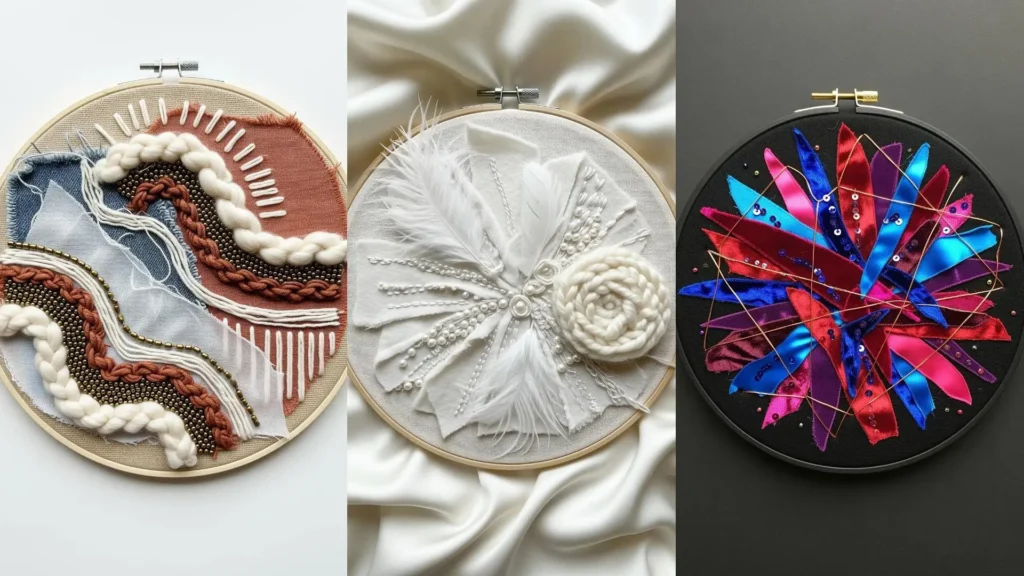
Have you ever felt that your embroidery, while neat, is missing a certain energy or emotion? You follow the patterns, perfect your stitches, yet the final piece feels static—beautifully made, but quiet.
This is where the power of the broken shape comes in. It’s a conscious design choice to embrace fragmentation, deconstruction, and the spaces in between. Instead of stitching a perfect circle, you stitch the pieces of one. Instead of a solid form, you stitch its echo, its memory, or the moment it bursts apart.
These designs invite you to see fractures not as flaws, but as opportunities for storytelling. You’ll learn how to use texture, stitch density, and negative space to convey movement, feeling, and time. This is how you transform thread and fabric from a simple craft into a form of visual poetry.
1. Shatter Your Composition with Controlled Chaos

Create energy by contrasting densely filled shapes with sparse, trailing lines.
First, outline your geometric fragments using a single-strand split stitch for a crisp edge.
Fill each shape with a perfectly smooth satin stitch, making sure to vary the angle of your stitches from one shape to the next—this subtle shift enhances the illusion of scattered light.
For the trailing ‘motion lines,’ use a contrasting silver or gray thread in simple straight stitches, varying their length and spacing to suggest dissipation.
This composition works because it balances the weight of the clustered shapes against the lightness of the negative space, guiding the viewer’s eye across the hoop.
2. Stitch a Gradient of Dissolution

To capture a sense of fading or dissolving, move from solid texture to delicate, fragmented pieces.
Use a long-and-short stitch to create the soft, painterly gradients within the larger shapes, blending shades of blue, gray, and lavender for a stormy, atmospheric feel.
For the crumbling fragments, use fewer strands of thread and smaller, scattered satin stitches.
The dripping effect is achieved with a single, untwisted strand of silver metallic or silk thread, finished with a tiny, weighted bead or a single seed stitch at the end to mimic a droplet.
This design beautifully expresses melancholy or transformation, contrasting solid form with ephemeral details.
3. Embrace the Beauty of Kintsugi-Inspired Texture

Evoke the Japanese art of repairing broken pottery by combining raw texture with refined metallic lines.
Use a punch needle or a dense field of French knots to fill the large sections, creating a highly tactile, earthy surface.
Define the ‘cracks’ by leaving channels of unstitched fabric, then sharpen their edges with a clean backstitch in black or dark brown.
Finally, lay down a line of gold metallic thread alongside the cracks using a couching stitch—this frames the brokenness as a beautiful, intentional feature rather than a flaw.
This technique elevates a simple break into a powerful statement about resilience and history.
4. Weave a Burst of Electric Energy

Create a dynamic focal point by weaving threads directly onto your fabric and surrounding it with explosive energy.
First, lay down a grid of long vertical stitches in one color—these are your warp threads.
Next, use a tapestry needle to weave your horizontal weft threads over and under the warp, alternating colors to build a checkerboard pattern.
The magic happens when you surround this stable center with radiating straight stitches and tiny seed stitches in neon colors.
This contrast between the structured, woven core and the chaotic, energetic burst creates a vibrant sense of contained power being released.
5. Capture Fragility with Stitched Glass on Tulle

For an ethereal, barely-there effect, stitch the illusion of shattered glass onto a transparent fabric like tulle or organza.
Use a single strand of white, off-white, or silver thread to maintain a delicate, skeletal look.
The entire design is composed of simple straight stitches, but the key is to make them irregular and sharp, radiating from a central point just like real broken glass.
Vary the length and angle of each stitch to create an authentic, jagged pattern.
When held against a window, the light passes through the sheer fabric, making your stitches appear to float in mid-air and highlighting the beauty of the fracture itself.
6. Illustrate Movement with Scattered Stitches

Suggest a gentle breeze or flowing water by breaking up solid lines into scattered, leaf-like shapes.
Create the main directional flow with whipped backstitch or stem stitch, using multiple strands for a bolder line.
The sense of movement comes from the tiny, detached stitches—use a mix of single detached chain stitches (lazy daisies) and small, angled satin stitches to represent leaves or petals caught in the wind.
Group these tiny floral motifs loosely around your main lines, allowing plenty of negative space to give them room to ‘breathe’ and float across the fabric.
7. Deconstruct a Symbol for Emotional Impact

Tell a story of duality by splitting a familiar shape and rendering each half with a completely different texture and technique.
For the chaotic, full side of the heart, couch thick, twisted red yarn in a dense, overlapping pattern to convey turmoil and passion.
For the fractured, empty side, use a single strand of black thread to create a skeletal framework of straight stitches, suggesting fragility or loss.
Allowing a few threads to hang loose at the bottom adds a raw, unfinished quality that amplifies the emotional weight of the piece.
This contrast in texture, color, and density makes the design immediately compelling.
8. Fade into Memory with Stitch Density

Create the visual effect of a memory fading by varying the density of your satin stitches.
Start at the most vibrant part of your shape with closely packed satin stitches using 3-4 strands of floss for solid coverage.
As you move away from this focal point, gradually begin to space your stitches further apart and reduce the number of strands to two, then one.
This technique, known as ‘scumbling’ in painting, makes the form appear to dissolve into the fabric itself.
Enhance the effect by lightly tinting the fabric with watercolor paint or a dye wash before you begin stitching, creating a soft, ethereal background.
9. Engineer a Galactic Explosion

To create a design that feels like it’s bursting off the fabric, combine sharp, geometric shapes with a textured center and sparkling accents.
The radiating shards are long satin stitches; stitch each one at a slightly different angle so the facets catch the light and create dimension.
For the core, use a highly textural stitch like bullion knots or a dense cluster of French knots in a contrasting metallic thread to draw the eye inward.
Finally, scatter tiny beads and single seed stitches throughout the ‘blast zone’ to mimic starlight or cosmic debris, adding another layer of depth and shimmer.
10. Reveal Hidden Layers with Fabric Appliqué

Add depth and a story to your work by layering fabrics and then ‘breaking’ the top surface to reveal what’s beneath.
Start by tacking down small pieces of colored fabric onto a felt base.
Cover these with your main top fabric, leaving some edges raw or folded.
Stitch a cracked pattern over the entire patch using a textured stitch like a heavy chain stitch or whipped backstitch.
Carefully use tweezers and small, sharp scissors to distress and peel back parts of the top layer, exposing the hidden colors and creating a realistic decaying or weathered effect.
This is a perfect technique for visible mending on denim.
11. Mimic Natural Striations with Blended Threads

Capture the look of polished stones or sea glass by filling organic shapes with blended horizontal stripes.
To achieve this effect, thread your needle with multiple colors at once—for example, one strand of dark blue, one of teal, and one of light gray.
As you fill each shape with horizontal satin stitches, the colors will lay down in a beautifully randomized, variegated pattern that looks entirely natural.
Vary the color combinations from shape to shape to create a harmonious collection.
Scatter tiny seed stitches between the larger shapes to represent sand or pebbles, completing the serene, ocean-inspired scene.
12. Stitch a Joyful Confetti Burst

This design is pure celebration and an excellent way to practice a variety of textural stitches without the pressure of a complex pattern.
The broken shapes are simply short bars of satin stitch, while the squiggles are whipped backstitch or stem stitch.
Intersperse these with tight French knots and couched loops to create a dynamic, party-like atmosphere.
The key to success is a truly random arrangement and a bright, high-contrast color palette.
This is one of the most cute and colorful embroidery projects for using up leftover thread and injecting pure fun into your hoop.
13. Create Optical Movement with Contrasting Braids

This design creates a mesmerizing, almost hypnotic effect by pairing opposite textures and colors in a swirling pattern.
For the black half, use a raised chain stitch or couch down a thick, braided cord to create a heavy, dimensional line.
For the white half, use a flat, wide satin stitch that lies flush against the fabric.
By arranging these contrasting textures in fragmented, concentric arcs, you create an optical illusion of spinning and warping.
This technique demonstrates how texture, not just color, can be used to create powerful visual dynamics on a flat surface.
14. Design a Modern Accent Pillow with Thread-Wrapped Forms

Elevate a simple pillow with a clean, modern design that focuses on form and subtle color shifts.
Cut elongated, stone-like shapes from a sturdy material like felt or a double layer of linen.
Tack the appliqué shapes onto your pillow cover, then use a single strand of thread to wrap each shape, creating concentric outlines like a topographical map.
Use a long-and-short stitch to blend colors within each shape, moving from light to dark to create depth.
A single, contrasting vertical line stitched beside the column of shapes provides a strong graphic element that balances the organic forms.
15. Stitch Glowing Embers with Strategic Color Blending

Make your shapes appear to glow from within by using a specific color progression and a touch of metallic thread.
Start stitching at the center of each ’ember’ with the brightest yellow or orange, using small, chaotic seed stitches to create a hot core.
Work your way out with long-and-short stitch, blending into darker reds and then deep browns or purples at the edges.
This gradient mimics the way real embers cool.
Outline each shape with a fine, couched gold thread to contain the ‘light’ and add a crisp edge that makes the colors pop even more.
16. Visualize a Thought Process with a Single Thread

This minimalist design uses a single, continuous line of thread to tell a story of focus, fragmentation, and resolution.
Begin with a smooth, flowing line using a simple backstitch or stem stitch.
At the center, let the line ‘explode’ into a cluster of tiny, sharp-angled geometric shapes—triangles, squares, and shards—made with single straight stitches.
Then, have the line emerge from the chaos and continue on its smooth path.
It’s a powerful metaphor for a creative spark, a moment of confusion, or the process of solving a problem, all conveyed with elegant simplicity.
17. Cultivate Mossy Growth in Fabric Crevices

To create the illusion of organic matter growing in the cracks of stone, focus on building up three-dimensional texture.
Choose a gray felt or heavy wool fabric for a convincing stone-like base. Stitch the cracks with a dark gray whipped backstitch.
Fill the crevices with a dense carpet of French knots in several shades of green, from lime to forest.
For extra dimension, make some knots with a looser tension so they stand up higher, and add trailing ‘vines’ using a detached chain stitch with a long, dangling tail.
This is a perfect example of how to use earth-inspired embroidery textures to bring your work to life.
18. Create Rhythmic Patterns on Functional Items

Transform a simple tote bag into a piece of wearable art by using broken shapes to create a repeating, rhythmic pattern.
This design uses sections of a circle, each filled with clean, concentric rows of satin stitch or backstitch.
The key to a polished look is precision: use a compass to draw your guides and ensure your stitches are uniform in length and tension.
By breaking the circles apart and scattering them in a balanced composition, you turn a simple geometric form into a dynamic, modern design that feels both playful and sophisticated.
19. Capture the Shimmer of Ice Shards

To embroider something that looks like sharp, reflective ice, you need to focus on light and shadow, not just shape.
Use a variegated thread that blends white, silver, and light gray. Fill each shard with long satin stitches angled to create facets.
Add shadows and depth by stitching a few lines of dark gray or black along one edge of each shard.
Incorporate a high-sheen silver metallic thread for bright highlights along the opposite edge.
Finally, stitch small, white pearl beads between the shards to represent frozen droplets, completing the frosty illusion.
20. Stitch the Raw Beauty of a Broken Branch

Convey the tension and texture of splintered wood by paying close attention to stitch direction and color.
Use a vertical long-and-short stitch in shades of brown to create the bark texture on the main branches.
For the ‘break’ itself, switch to a lighter, raw-wood color like tan or pale orange.
Use sharp, aggressive straight stitches that radiate out from the break, mimicking the splintered fibers of real wood.
This small but critical detail transforms a simple image of branches into a dynamic scene, telling a story of force and nature.
21. Play with Depth Using Intersecting Lines

Create a sense of three-dimensional space by having lines weave in front of and behind solid objects.
First, stitch your solid shapes—in this case, the vases—using a dense, flat satin stitch in a single bold color.
Next, use a contrasting thread to stitch long, flowing lines across the composition.
When a line needs to pass ‘behind’ a vase, simply stop your stitch at the edge of the shape and restart it on the other side.
This simple trick of breaking the line creates an immediate and sophisticated illusion of depth and layers, turning a flat design into a dynamic interaction between form and space.
22. Add a Starburst Accent to Denim

A broken starburst is the perfect high-impact design to quickly customize a piece of clothing like a denim jacket or jeans pocket.
Use a thick thread, like all six strands of embroidery floss or even perle cotton, for a bold look that stands out against the heavy fabric.
The entire design is made of tapered satin stitches—long, triangular stitches that radiate from a central point.
Vary the lengths and colors of the rays to create a more dynamic, explosive effect.
This is one of the easiest easy stitches that bring your plain denim jackets to life, proving that broken shapes can be incredibly powerful and stylish.