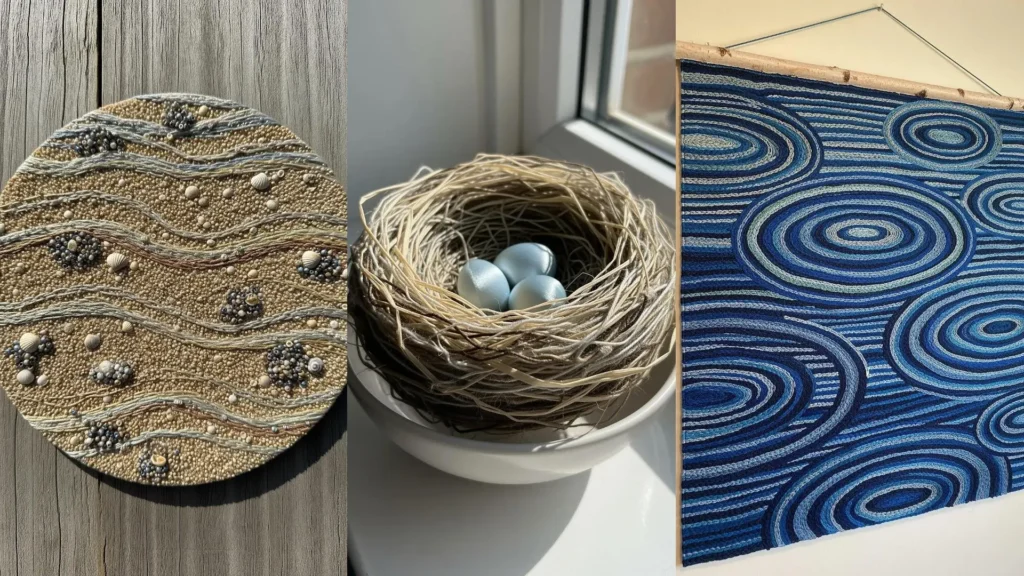
You have the threads, the fabric, and the desire to create something beautiful. But perhaps you find your stitches, while neat, are missing a certain life or depth. You’re ready to move beyond just following a pattern and start making deliberate artistic choices.
This is where texture comes in. By focusing on how your stitches and materials interact—the contrast between a smooth satin stitch and a nubby French knot, the weight of wool versus the sheen of silk—you can infuse your work with the quiet, complex beauty of the natural world.
Here, we won’t just look at pretty pictures. We will analyze the techniques that make these pieces breathe. You’ll learn how to replicate the roughness of bark, the softness of moss, and the delicacy of a frost-covered branch. It’s about thinking like a sculptor, but with a needle and thread as your tools.
1. Weave a Birch Forest Tapestry

Combine weaving and embroidery to create a large-scale textile with incredible depth.
For the tree trunks, use vertical satin stitches with varied thread weights—a chunky wool for texture and a standard cotton floss for smoother sections.
Create the signature black markings of birch bark with short, horizontal straight stitches, varying their length and placement for an organic feel.
The raised, branch-like elements are achieved through couching, where you lay thick, braided yarn on the surface and tack it down with smaller, coordinating stitches.
2. Sculpt a Mossy Terrarium in Thread

To achieve that lush, three-dimensional moss, fill areas with densely packed French knots.
Use at least three different shades of green floss—from chartreuse to deep forest green—and vary your knot tightness to mimic the texture of real moss clumps.
For the smooth, rounded stones, create a base of felt padding before covering them with perfectly even satin stitches in soft gray tones.
This contrast between the fluffy knots and the sleek satin stitch is what gives the composition its hyper-realistic quality.
3. Curate a Botanical Gallery Wall

Develop a cohesive series by uniting different motifs with a consistent style.
Choose a single fabric type and frame style to tie the collection together, even when the subjects and techniques vary.
For the mushrooms, use long-and-short stitch to create smooth gradients on the caps.
Replicate delicate fern leaves with fishbone stitch, and for the forest floor, incorporate small felt appliqués and seed beads to add textural complexity.
4. Stitch a Meditative Tree Ring Mandala

This design uses repetition to build texture, mimicking the growth rings of a tree.
Alternate stitch types for each concentric circle—try a smooth split stitch, a ropy chain stitch, and a simple backstitch to create subtle shifts in texture.
Incorporate different thread finishes, like matte cotton, shiny rayon, and a single metallic thread, to catch the light in unique ways.
This technique turns a simple circular pattern into a sophisticated piece of abstract thread embroidery that draws the eye inward.
5. Capture Autumnal Light with Thread Painting

Bring warmth to your table linens by mastering color gradients in your leaves.
Instead of filling each leaf with a flat color, use long-and-short stitch to blend 3-4 autumnal shades—from golden yellow to deep crimson—within a single shape.
Vary the direction of your stitches to follow the natural lines of the leaf veins, which adds realism and a sense of movement.
This thread painting technique makes each leaf look unique, as if it were lit by dappled sunlight. It’s a beautiful example of leaf, bark, and stone-inspired embroidery designs.
6. Replicate Delicate Lichen with Dimensional Knots

To capture the intricate texture of lichen, cluster bullion knots and French knots of varying sizes.
Use a palette of chartreuse, pale blue, and soft gray, blending the knots together randomly to avoid a uniform look.
For the tree branch itself, couch down a thick, dark wool or chenille thread to create a rough, bark-like foundation.
This project is a masterclass in building up layers of small, detailed stitches to create a complex and realistic natural surface.
7. Define Pinecone Scales with Graphic Precision

Create the crisp, geometric pattern of a pinecone by outlining each scale with a dark brown split stitch before filling it.
Use a directional satin stitch for the fill, angling your stitches toward the center of the scale to create a subtle sense of dimension.
For the pine needles, use simple straight stitches in varying lengths and directions, overlapping them slightly to build a lush, natural cluster.
This technique elevates a simple motif into a sophisticated design for handmade pillow and cushion embroidery patterns.
8. Create Abstract Energy with Radiating Stitches

For a dramatic, large-scale piece, focus on movement rather than precise representation.
Use long, radiating straight stitches in metallic and variegated threads, pulling them from a central point outward to create an explosive effect.
Incorporate mixed media in the center, such as fabric appliqué, stumpwork, or even plaster, to build a highly textured focal point.
Allowing some threads to hang loose or loop randomly adds a chaotic, organic energy that makes the piece feel alive, showing off effective abstract thread texture hacks.
9. Sculpt Tree Roots with Couching

Add dramatic, sculptural texture to a throw blanket or wall hanging using thick, braided yarn.
This effect is achieved with couching—lay the thick yarn on your fabric surface in an interwoven root pattern and then use a thinner, matching thread to tack it down invisibly.
Plan your design first by lightly sketching the paths of the main roots.
This technique is surprisingly simple and transforms a flat surface into a tactile, three-dimensional statement piece.
10. Achieve Hyper-Realism with Single-Thread Painting

To embroider a realistic feather, the key is using a single strand of floss for ultimate control.
Work with long-and-short stitches, angling them slightly outward to mimic the delicate structure of the barbs.
Create the soft, wispy after-feather at the base by using shorter, less dense stitches that don’t have a hard outline.
Using a dark, tightly woven fabric like navy cotton makes the whites and grays of the feather appear more luminous and detailed.
11. Evoke Winter’s Frost with Beads and Knots

Capture the quiet beauty of a winter landscape by focusing on frosty textures.
To create snow-dusted pine needles, first stitch the branch in brown backstitch, then add tiny white seed beads and French knots along the tops of the needles.
For abstract snow drifts, experiment with Turkey work loops or couched wool roving to create soft, mounded shapes.
Presenting these artistic tiny decor pieces as a triptych on small, stretched canvases turns simple studies into a sophisticated wall display.
12. Give Mushrooms Dimension with Stumpwork

Elevate your botanical embroidery by moving into three dimensions with stumpwork techniques.
Create the mushroom caps as separate elements by embroidering over a small piece of felt or wire-edged fabric.
Use directional satin stitch to give the caps a smooth, rounded appearance before carefully cutting them out and attaching them to your main fabric.
This method allows the mushrooms to lift off the surface, creating realistic shadows and depth, perfect for forest floor botanical stitch ideas.
13. Embody a Waterfall with Mixed Fibers

Capture the dynamic movement of water by combining threads and yarns of different textures and weights.
Use thick, loopy wool or chenille for the frothy, turbulent areas, and fine, shiny rayon or silk floss for the smoother, flowing sections.
Incorporate couching to secure heavier yarns, and allow thinner threads to hang loose at the bottom to simulate spray.
This multi-fiber approach turns a simple subject into a complex, tactile experience, making it one of the most fiber art installations that turn ordinary spaces into magical experiences.
14. Create Depth with Atmospheric Perspective

To make your embroidered landscapes feel deep and expansive, use thread to mimic atmospheric perspective.
Stitch background elements, like distant trees, with fewer strands of floss (just one or two) and in more muted, grayish colors.
As you move to the foreground, increase the strand count and use brighter, more saturated colors for elements like mushrooms and grass.
This simple adjustment instantly creates a convincing illusion of distance, drawing the viewer into the scene.
15. Stitch Durable Motifs for Functional Art

When embroidering functional items like coasters, choose your stitches for durability.
A dense satin stitch or a tightly worked chain stitch fill will hold up better to wear than looser, more decorative stitches.
For clean outlines, a simple backstitch or split stitch is strong and precise.
Using a high-quality, colorfast cotton floss ensures your minimalist designs remain crisp and vibrant even with regular use, turning everyday items into minimalist embroidery projects perfect for modern home decor.
16. Sculpt Topography with Punch Needle

Create an abstract, moss-like landscape using punch needle embroidery to build sculptural texture.
By varying the height of your yarn loops, you can create a topographical map effect with hills and valleys.
Use a monochromatic gradient of green yarns, moving from dark to light, to enhance the illusion of depth and contour.
This technique is faster than traditional embroidery for covering large areas and produces stunningly tactile organic texture embroidery designs.
17. Add Delicate Growth to Sheer Fabrics

Embroidering on lightweight curtains requires a delicate touch to prevent puckering.
Use a simple stem stitch for the trailing ivy vines, keeping your tension loose and even.
For the leaves, a single detached chain stitch (lazy daisy) or a small fishbone stitch provides shape without adding too much weight.
Limit yourself to two or three strands of floss at most; this ensures the design remains airy and integrated with the delicate fabric.
18. Illustrate Geology with Varied Stitches

Translate the layers of the earth into thread by assigning a different stitch or technique to each geological layer.
Use long-and-short stitch with variegated brown and gray floss to create the smooth, stratified layers of soil.
For the rocky layers, scatter French knots and small, padded satin-stitched ovals to mimic pebbles and stones.
The visual and textural contrast between these sections is what makes the final piece so compelling and unique.
19. Build Hyper-Realistic Bark with Layered Textures

Achieve the deeply grooved texture of old bark by layering multiple techniques.
Start with a base of appliqué fabric pieces to establish the main shapes and shadows.
Cover these with dense, directional straight stitches to simulate the grain and fissures of the wood.
Finally, add patches of moss using Turkey work or French knots, and stitch fine, branching roots over the top. This layering creates unparalleled realism.
20. Capture Dewdrops with Thread and Beads

This elegant design relies on the perfect material choice for a minimalist yet striking effect.
Use a single strand of fine, silvery metallic thread to stitch the spiderweb; its subtle sheen will catch the light beautifully against a dark background.
For the dewdrops, stitch tiny, clear seed beads at the intersections of the web.
Stitching on black velvet enhances the contrast, making the delicate structure appear to float in the darkness.
21. Embellish a Journal with a Perfect Fern

Transform a simple notebook with a single, elegant botanical motif.
Use a central line of stem stitch for the fern’s rachis to give it a sturdy, raised spine.
Create the individual leaflets using fly stitches worked closely together, which perfectly mimics their shape.
For the curled fiddlehead at the top, work a tight spiral of stem stitch or a dense cluster of French knots. These small, sweet embroidery ideas for your journal covers add a personal, handmade touch.
22. Create a Sculptural Pebble Surface

To replicate this highly textural, three-dimensional surface, you can adapt stumpwork techniques.
Create dozens of small, padded oval shapes using felt as a base.
Cover each “pebble” with satin stitch, using variegated gray, blue, and beige threads to give them a natural, water-worn appearance.
Finally, arrange and stitch these individual components tightly together onto your pillow cover for a stunning, sculptural effect.
23. Use Appliqué for Bold Silhouettes

For crisp, graphic shapes like these tree silhouettes, fabric appliqué is more effective than fill stitching.
Cut your tree shapes from black felt and use a small, neat whip stitch with matching thread to secure them to your background fabric.
Create the atmospheric moonlight and rain with long, sparse vertical stitches in a fine metallic thread.
This combination of bold appliqué and delicate line work creates a powerful sense of mood and contrast.
24. Decorate 3D Objects with Thread

Take your embroidery off the hoop by working on dimensional forms like these decorative stones.
Tightly wrap a smooth, sturdy fabric (like linen or cotton canvas) around a stone or a styrofoam ball, securing it on the bottom.
You can then stitch directly onto the curved surface.
Use a whipped backstitch or chain stitch to create clean, geometric patterns that hug the object’s contours, turning simple shapes into unique art pieces.