Your linen holds stories—in its weave, its softness, its history in your home. Before you decide it’s old, I want you to see it as a canvas, waiting for a quiet, intentional mark from your own hands.
Embroidery is not about filling every inch of fabric. It’s about placement, texture, and the simple elegance of a single, well-executed stitch. The most impactful designs are often the simplest, transforming a napkin corner or a pillowcase into a small piece of personal art.
Here, you won’t just find ideas. You will find the specific techniques that create a refined finish—how to make a line feel like a rope, how to make a leaf curve with light, and how to add dimension without complexity. These are the small adjustments that elevate your work from craft to art.
So, gather your favorite threads and your softest linens. It’s time to add a new chapter to their story, one stitch at a time.
1. The Art of Directional Satin Stitch

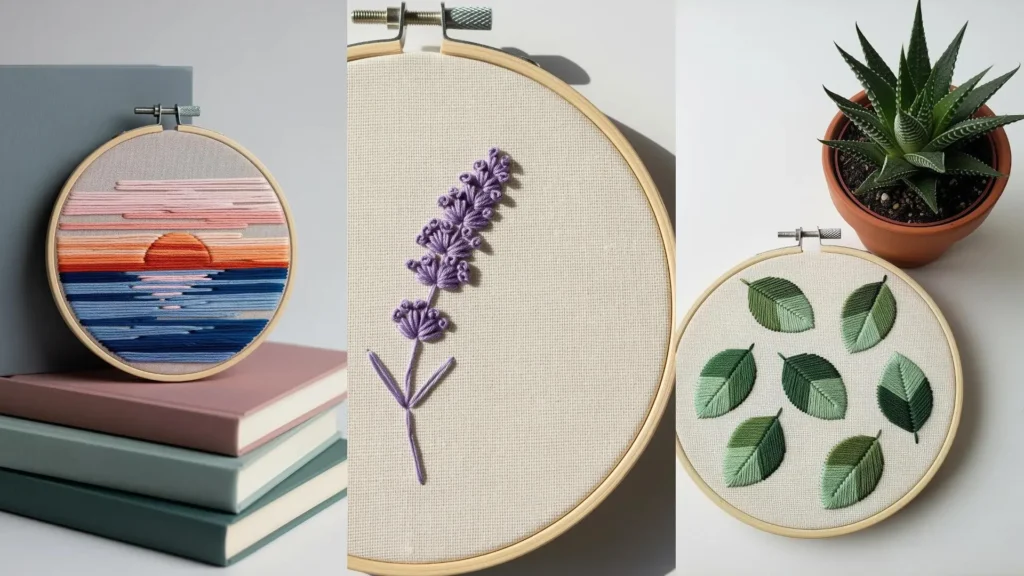
To give botanical leaves a realistic curve and sheen, focus entirely on the direction of your satin stitches.
Mentally divide each leaf into two halves along a central vein, then angle your stitches from the outer edge inward toward that imaginary line.
This simple adjustment creates the illusion of light and shadow, giving the flat stitches a subtle, three-dimensional quality.
For delicate linen, use just two or three strands of floss to keep the design from feeling heavy.
2. Whipped Backstitch for Raised Outlines

Transform a basic backstitch into a rope-like, dimensional line perfect for modern monograms or abstract motifs.
First, create a standard backstitch outline of your interlocking rings.
Then, using the same color floss, pass your needle under each backstitch without piercing the fabric. This action, called whipping, wraps the base stitch and gives it a rounded, sculptural finish.
3. Perfecting the Scalloped Chain Stitch Border

Instead of a simple line, use a chain stitch to create this fluid, scalloped border that adds a bespoke touch to a shirt cuff.
The key to a professional result is absolute consistency in stitch length and tension, which ensures each curve is perfectly uniform.
Use a water-soluble pen to draw your path before you begin—it is the most reliable way to achieve precision.
A slightly thicker thread, like all six strands of floss or a Perle cotton, gives the design more presence on crisp fabric.
4. Grid-Based Fill for a Graphic Look

For a unique, woven texture that modernizes a classic fruit motif, use cross stitch as a fill stitch.
First, define the shape of the lemon with a clean backstitch outline.
Then, fill the interior with neat rows of cross stitches, treating the fabric as your grid. This technique imparts a graphic, almost pixelated quality.
Contrast this texture by using a smooth satin stitch for the leaves, which makes the entire design more visually dynamic.
5. The Minimalist Power of a Woven Knot

This tiny, sophisticated detail is a precisely woven knot that adds immense texture without overwhelming the fabric.
To create a similar effect, you can form a triangular foundation with three straight stitches.
Then, weave your working thread over and under these foundation stitches until you build a small, raised shape.
It’s a perfect example of how a single, well-placed textural element can elevate an entire piece of linen.
6. Combining Bold Outlines and Delicate Veins

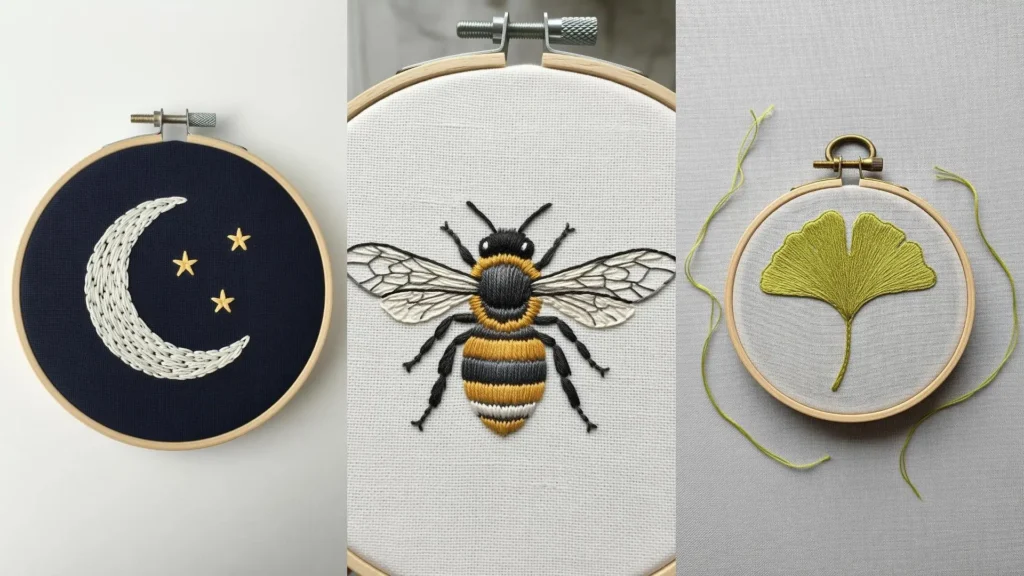
Create a strong, graphic silhouette by outlining the ginkgo leaf with a stem stitch or a tight chain stitch for a bold edge.
The artistry here lies in the use of negative space. Resist the urge to fill the shape completely.
Instead, add a few sparse straight stitches to suggest the leaf’s delicate veins. This minimalist approach allows the fabric’s natural texture to become part of the design, keeping the final look light and modern.
7. The Radiating Straight Stitch Starburst

This energetic starburst is composed entirely of straight stitches of varying lengths, all radiating from a single central point.
For added dimension and a clean focal point, stitch a small cluster of French knots at the very center before adding the rays.
The secret to a crisp, professional finish is ensuring every single straight stitch begins or ends at that precise center point. Use a thicker thread, like cotton Perle, for a bolder effect on napkins or placemats.
8. Creating Texture with Directional Fill Stitches

Instead of a simple outline, fill this mountain range with dense straight stitches to give it weight and texture.
The key is to vary the angle of your stitches within each peak to mimic the rugged, varied surfaces of a rock face.
Avoid keeping all your stitches perfectly parallel; a little irregularity is what brings the simple shape to life. This technique makes the simple silhouette far more dynamic and visually interesting.
9. Mastering a Flawlessly Smooth Satin Stitch

For a beautifully smooth satin stitch surface, the secret is not just tension, but preparation.
Before you begin filling the shape, outline the entire crescent moon with a split stitch. This creates a slightly raised edge that acts as a perfect guide for your needle.
Your satin stitches can then rest neatly against this border, resulting in a clean, contained shape with no gaps or uneven edges. Keep your stitches parallel and close together for a finish that looks like liquid silk.
10. Dimensional Wheat with the Fishbone Stitch

The individual grains of wheat are created using the fishbone stitch, which gives them a naturally raised and veined appearance.
Start each grain with a single straight stitch down its center. Then, bring your needle up on one side of the outline and cross over the center line. Alternate sides as you work your way down.
This woven structure is what creates the convincing texture. Pair it with a simple stem stitch for the stalk to maintain a cohesive, elegant look.
11. The Decorative Power of Herringbone Stitch

This open, crisscrossing line is a wide herringbone stitch, an excellent choice for a decorative border that feels airy, not heavy.
To keep the stitch perfectly straight and even, use a water-soluble marker to draw two parallel guide lines before you start.
The beauty of this stitch is its rhythm. Focus on making each diagonal stitch the same length and angle for a result that looks polished and intentional.
12. A Subtle Outline with Split Stitch

For tiny embroidery patterns that make your clothes look custom-made, a split stitch offers superior control and refinement.
It creates a finer, smoother line than a backstitch, resembling a miniature braid. To execute it, you bring the needle up through the middle of the previous stitch, splitting the thread.
Use just two strands of floss to keep this heart motif delicate and understated. Its placement on the collar transforms a simple garment into something personal.
13. A Layered Sunburst for Added Depth

Create this radiant sun by layering straight stitches rather than using a single layer.
Begin by stitching a circle of longer stitches to form the outer rays. Then, add a second, inner circle of shorter stitches, positioning them in the gaps of the first layer.
This simple layering technique adds instant visual depth and texture, making the motif feel more substantial and dynamic. The slight irregularity in stitch length enhances its handcrafted appeal.
14. Enhancing Appliqué with Border Stitches

This beautiful design combines fabric appliqué with hand embroidery for a rich, textural result.
Start by cutting your wave shapes from different colors of linen, then secure them with an iron-on adhesive for stability.
To elevate the piece, stitch along the top edge of each wave with a simple backstitch or a decorative chain stitch. This not only secures the fabric permanently but also adds a hand-finished, textural line that defines the shapes and adds character. This is one of many abstract mixed media embroidery ideas that feels both simple and sophisticated.
15. The Woven Fill for High-Texture Shapes

To achieve this dense, woven texture, adapt the woven wheel stitch for a non-circular shape.
First, create a foundation of straight stitches running vertically inside your teardrop outline. These are the “spokes” of your weave.
Then, using a blunt tapestry needle, weave your working thread over and under these spokes without piercing the fabric. Continue until the shape is completely filled. The result is a highly tactile surface that stands out beautifully.
16. A Modern Pattern with Seed Stitches

This minimalist pattern is created with simple seed stitches, which are small, straight stitches arranged to form crosses.
The key to its modern aesthetic is the intentionally random placement. Avoid arranging the crosses in a perfect grid; a scattered, organic layout feels more sophisticated.
Varying the orientation of each cross slightly also adds to the gentle, hand-drawn feel. It’s a fast and effective way to update a plain pillow cover with a touch of understated detail.
17. Delicate Foliage with the Fly Stitch

The tiny leaflets on this branch are perfect candidates for the fly stitch. This stitch naturally forms a V-shape, which, when worked in a series, perfectly mimics delicate foliage.
Anchor each ‘V’ with a small straight stitch to create the leaf’s center.
Use a smooth stem stitch for the main branch to create a graceful, curved line. Using only two strands of floss makes these botanical stitch ideas look exceptionally light and elegant on fine linen.
18. Defining Detail with Single-Strand Outlines

When working on miniature designs with fine details, reducing your thread count is the most important step for achieving clarity.
Switch to a single strand of embroidery floss and use a tiny backstitch or split stitch to outline the book’s pages and cover.
Fill the pages with two strands of white floss in a satin stitch. This subtle difference in thread weight is what makes the tiny details legible and crisp, preventing them from becoming muddy.
19. Bold Graphic Lines with Couching

To achieve a perfectly smooth, bold outline for these geometric shapes, use the couching technique.
Lay down a thicker thread (like all six strands of floss or Perle cotton) along your design line. Then, using a second, finer thread, make small, discreet tacking stitches over the thick thread to hold it in place.
This method gives you flawlessly smooth curves and sharp corners that are often difficult to achieve with other outline stitches.
20. 3D Flower Buds with Bullion Knots

These delicate, dimensional flower buds are created using bullion knots.
This stitch involves wrapping the thread around the needle several times before pulling it through the fabric, which creates a small, raised coil.
To create the bud shape, keep the wraps tight and the resulting knot short and plump. Combine them with a gracefully meandering stem stitch for the vine to complete this elegant, three-dimensional design.
21. Blending Petal Colors with Long & Short Stitch

This pansy’s realistic color graduation is achieved with the long and short stitch, a form of needle painting perfect for gradient color floral embroidery ideas.
Fill each petal section with interlocking rows of straight stitches in varying lengths. For the first row, alternate between long and short stitches.
Subsequent rows use stitches of a more uniform length to fill in the gaps, allowing you to blend new colors seamlessly and create a painted effect.
22. The Padded Satin Stitch for a 3D Effect

To give this bee a raised, sculptural quality, use a padded satin stitch.
First, fill the interior of the bee’s body with a layer of small, underlying straight stitches. These padding stitches should run perpendicular to the direction of your final satin stitches.
Then, cover this padding completely with your top layer of satin stitches. The hidden layer lifts the surface, creating a subtle, three-dimensional effect that catches the light beautifully.
23. A Woven Fill and French Knot Combination

Create the rich, tactile surface of the strawberry with a woven fill stitch.
Lay down a foundation of parallel vertical straight stitches across the shape. Then, use a blunt needle to weave your thread horizontally over and under them, filling the shape completely.
This creates a delightful basket-like texture. Scatter tiny white French knots on top to represent the seeds, which adds another layer of dimension and realism to the design.
24. Adding a Beaded Border with Pekinese Stitch

This intricate line, which looks like a row of tiny beads, is a decorative stitch called the Pekinese stitch.
First, lay down a simple line of backstitch. Then, with a second thread (often in the same color), loop it up and down through the backstitches without ever piercing the fabric.
This creates raised, interlocking loops, forming a highly decorative, textured border that adds a couture finish to hems or cuffs.
25. Creating Fine Detail with Split Stitch Shading

The incredible realism of this feather comes from using split stitch as a shading tool.
Work with only a single strand of white floss for maximum delicacy. The key is the direction of your stitches—angle them outwards from the central shaft (rachis), mimicking the natural growth of a feather’s barbs.
For the softer, fluffier base, use shorter, more loosely placed stitches to create a distinct change in texture.
26. Shading with Open Fill Stitches

To capture the soft, dusty texture of a moth’s wings, use an open fill technique rather than a dense satin stitch.
Fill the wing shapes with straight stitches or a sparse long and short stitch, but don’t pack them tightly together. Allowing some of the background fabric to show through creates a lighter, more delicate effect.
For the body and antennae, switch to a denser satin stitch to provide a contrasting focal point.
27. The Star Stitch for Celestial Motifs

The small, textured points in this constellation are made with the star stitch, also known as an Algerian eyelet stitch.
It’s created by working eight straight stitches into a single central hole, radiating outwards like the spokes of a wheel. This forms a tiny, dense star that catches the light.
Connect these star stitches with simple backstitches to form the constellation’s lines. The contrast between the linear stitches and the clustered stars is what makes the design so effective.
28. Blending Realistic Color with Thread Painting

This mushroom cap is a beautiful example of thread painting, using the long and short stitch to blend multiple shades of brown and rust.
Start at the outer edge with your darkest color and work inwards, row by interlocking row, gradually introducing lighter shades.
Always angle your stitches to follow the natural curve of the cap. For the gills underneath, use vertical straight stitches in a light color to create contrast and texture. This is how you embroider realistic shadows under leaves and other natural forms.