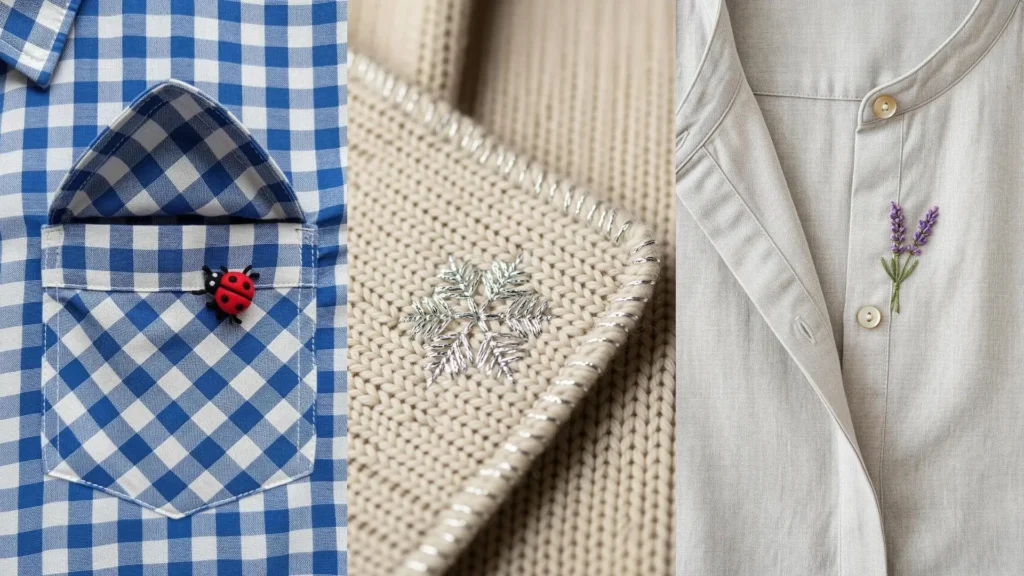
That sweater you love, the one that’s become soft with wear, is the perfect canvas. Before you begin a new project, I want you to think less about filling a space and more about how a single, well-placed detail can change the way a garment feels entirely.
It’s not about complexity, but intention. The direction of a stitch can mimic the texture of a petal. The weight of a thread can make a line feel delicate or bold. The space you leave empty is just as important as the space you fill.
These ideas are more than just decoration; they are studies in texture, color, and form. Let them be a guide to help you develop your own eye for detail, so every piece you stitch feels thoughtful, modern, and uniquely yours.
1. Frame the Neckline with a Lavender Garland

Create an elegant, necklace-like effect by centering a symmetrical botanical design around the collar.
Use a fishbone stitch for the leaves to create a central vein and gentle texture, which contrasts beautifully with the smooth satin stitch of the lavender buds.
To keep the design from looking flat, vary the angle of your satin stitches on each lavender floret slightly, mimicking natural growth.
Use a water-soluble stabilizer on the knit fabric to prevent puckering and ensure your stitches lie flat and even.
2. Add Dimension with Raised Satin Stitch Butterflies

Achieve a stunning 3D effect by stitching the butterflies using a stumpwork technique.
Embroider the wings on a separate piece of felt or stiff fabric, using long-and-short stitch to blend pastel shades seamlessly.
Carefully cut out the wings, leaving a small border, and then attach them to the sweater by stitching down only the embroidered body.
This allows the wings to lift away from the fabric, creating realistic shadows and a sense of movement as you wear the garment.
3. Combine Ribbon and Thread for Realistic Cherry Blossoms

Introduce silk ribbon embroidery to give your cherry blossoms a soft, dimensional quality that thread alone cannot replicate.
Use a simple ribbon stitch for the petals, allowing the ribbon to twist slightly to create natural folds and highlights.
Anchor the center of each blossom with a cluster of French knots using standard embroidery floss, which adds a focal point and textural contrast.
The combination of matte thread for the branches and lustrous ribbon for the flowers creates a dynamic and sophisticated composition.
4. Embellish Cuffs with a Dense Daisy Border

Transform your sleeves by creating a bold, graphic cuff with tightly packed satin-stitched daisies.
The key to this look is density and repetition—keep the petals uniform in length and direction to form a clean, cohesive pattern.
Use a vibrant yellow for the French knot centers to create a strong focal point that makes the white petals pop.
Always use a stabilizer with heavy fill stitches on knits to prevent the fabric from stretching and distorting the circular shape of the flowers.
5. Master Fur Texture with Thread Painting

Create a realistic, fuzzy bumblebee by using long-and-short stitch to blend yellow, black, and white threads.
Vary the length and angle of your stitches to mimic the natural texture of fur, avoiding a perfectly smooth finish.
For the delicate wings, outline the shape with a fine backstitch and fill it with sparsely placed straight stitches to suggest translucency.
This technique, known as thread painting, turns a simple motif into a detailed piece of textile art.
6. Stitch a Dainty Forget-Me-Not Necklace

Add a subtle, jewelry-like detail to a high-necked sweater with delicate forget-me-nots.
Use lazy daisy stitches for the petals, keeping them small and tight for a refined look. A single yellow French knot in the center completes each tiny blossom.
Connect the flowers with a fine stem stitch in a soft green, creating two symmetrical sprays that frame the collarbone.
The success of this design lies in its scale; using only two strands of floss will ensure the embroidery remains delicate and doesn’t overwhelm the fine-gauge knit.
7. Create a Cascading Ivy Vine with Appliqué

Combine appliqué and embroidery for a textured, dimensional ivy vine that gracefully climbs your cardigan.
Cut the leaf shapes from felt or cotton fabric in several shades of green to create depth and visual interest.
Secure each leaf with a central line of stem stitch, then connect them with a wandering, couched thread vine for a natural look.
This mixed-media approach is faster than filling each leaf with satin stitch and adds a unique tactile quality to the design.
8. Weave a Textured Landscape with Directional Stitches

Translate a landscape onto your sweater by assigning different stitches to each element to build texture.
Use a dense seed stitch or long-and-short stitch for the rolling hills, ensuring your stitches follow the contours of the land.
Contrast this with a clean satin stitch for the sky and radiating straight stitches for the sun’s rays.
The variation in stitch direction and density is what defines the shapes and brings the minimalist scene to life.
9. Stitch Art Deco Sunbursts for a Graphic Yoke

Elevate your sweater’s yoke with geometric sunbursts created entirely with precise straight stitches.
The power of this design comes from its clean lines and symmetry. Use a fabric marker and a ruler to draw accurate guidelines before you begin.
Varying the lengths of the stitches creates the radiating fan effect, while the sharp, graphic quality offers a modern alternative to floral motifs.
This technique is deceptively simple but requires precision for a polished, high-impact result.
10. Illustrate a Tulip Bouquet with Polished Outlines

Give your floral bouquet a clean, illustrative quality by first outlining each shape with a crisp backstitch or split stitch.
This defined edge acts as a perfect container for your satin stitch fill, ensuring sharp, neat shapes that pop against the dark background.
Use a long-and-short stitch to add a subtle gradient to each tulip, giving it volume without sacrificing the graphic style.
This method prevents colors from bleeding into one another and results in a polished, almost patch-like appearance.
11. Capture Ephemeral Movement with a Dandelion Seed Head

Stitch a design that tells a story by capturing the delicate moment a dandelion releases its seeds.
Use radiating straight stitches for the main seed head, anchored by a satin-stitched center. For the floating seeds, use a single straight stitch for the stem and a detached chain stitch for the parachute.
Placing the seeds in a gentle, sweeping arc across the back of the cardigan creates a beautiful sense of motion.
The minimalist color palette of grey and white allows the texture and movement of the stitches to take center stage.
12. Achieve Iridescence with Strategic Thread Blending

Mimic the iridescent sheen of a hummingbird’s feathers by using the long-and-short stitch technique with carefully chosen colors.
Instead of abrupt color changes, blend shades of green, blue, and purple by overlapping your stitches. Use just one or two strands of floss for the smoothest gradients.
Ensure your stitches follow the direction of the bird’s body and wings to create a sense of form and realism.
These tiny hummingbird embroidery ideas work beautifully on clothing, adding a jewel-like detail.
13. Cultivate a Wildflower Meadow in a Pocket

Turn a simple chest pocket into a contained, miniature wildflower garden for a surprising and charming detail.
Use a variety of simple stitches—lazy daisies, French knots, straight stitches, and bullion knots—to create different floral shapes and textures.
Create a sense of depth by varying the height of the stems and slightly overlapping some of the blossoms.
The pocket acts as a perfect natural frame, transforming a functional element into the focal point of your sweater.
14. Frame a V-Neck with Elegant Eucalyptus and Ferns

Complement a V-neckline with a sophisticated arrangement of foliage that follows its natural lines.
Create textural variety by using different stitches for each type of leaf: a fishbone stitch for the feathery ferns and a smooth satin stitch for the round eucalyptus leaves.
Using a tonal palette of greens, blues, and greys keeps the design feeling modern and serene, not overwhelming.
These leaf & plant embroidery ideas demonstrate how texture can create interest even with a limited color scheme.
15. Create a Swirled Rainbow Shell with Couching

Instead of tedious satin stitching, achieve a perfectly smooth, swirled rainbow effect using the couching technique for the snail’s shell.
Lay down a variegated or several strands of pastel floss in a spiral shape. Then, use a single, contrasting strand to tack down the bundle with small, evenly spaced stitches.
This method is not only faster but also creates a raised, cord-like texture that beautifully defines the shell’s shape.
Explore more contemporary rainbow blend stitches to add vibrant, smooth color transitions to your work.
16. Execute a Painterly Peony with Thread Painting

Treat your sweater as a canvas and create a large, painterly peony on the back or shoulder using detailed thread painting.
Map out the light, mid-tone, and shadow areas on each petal before you begin stitching with long-and-short stitch.
Use a single strand of floss to achieve the most seamless color blending, and direct your stitches to radiate outwards from the center, following the flower’s natural form.
Finish with a dense cluster of French knots or seed beads in the center to create a realistic, textured stamen.
17. Add Whimsy with Fluffy Clouds and Beaded Rain

Combine needle felting, embroidery, and beading for a playful, multi-textured design.
Form the soft, fluffy clouds by needle-felting wool roving directly onto your cardigan. This creates a wonderful 3D effect that’s impossible to achieve with thread alone.
For the falling rain, use single strands of iridescent thread to stitch straight lines, accenting them with tiny, colorful seed beads.
The mix of soft wool, delicate thread, and sparkling beads makes this a truly unique and tactile piece.
18. Achieve Crisp Edges in Geometric Color Blocking

Create a modern, abstract design with geometric shapes filled with flawless satin stitch.
The secret to perfectly sharp edges is to first outline each shape with a split stitch. This creates a slightly raised border that your satin stitches can press up against.
Keep your fill stitches parallel and consistent in tension to achieve a smooth, woven appearance.
This technique turns simple shapes into a bold, graphic statement that feels intentional and expertly crafted.
19. Integrate Lettering with Botanical Elements

Elevate embroidered text by weaving delicate floral vines through the letters for a cohesive, storybook feel.
First, stitch your letters using a padded satin stitch—a foundation of short straight stitches underneath adds volume and makes the text pop.
Then, use a fine stem stitch to wrap vines around the letters, adding tiny lazy daisy flowers and French knots as accents.
This technique transforms a simple quote into a complete illustration, where text and nature are beautifully intertwined.
20. Create a Rhythmic Border with Art Deco Seashells

Embellish the hem of a sweater vest with a repeating pattern of stylized seashells for a touch of Art Deco elegance.
Use satin stitch for the main body of the shell, then add radiating straight stitches from the base to define the iconic ridges.
The beauty of this design lies in its rhythm and repetition. Alternating between just two or three soft pastel colors creates a harmonious and visually striking border.
The flat, graphic nature of the shells makes them a perfect fit for layering over a collared shirt.
21. Craft a Statement Luna Moth with Metallic Accents

Transform a simple sweater with a large, intricately embroidered Luna Moth, elevated with subtle, luxurious details.
Use long-and-short stitch to blend the soft greens, yellows, and purples of the wings, creating a painterly effect.
Introduce goldwork thread for the antennae and body details to add a touch of shimmer that catches the light.
For a final touch of elegance, add a delicate sprig of wired pearls next to the moth, turning your garment into wearable art.
22. Fuse Line Art and Florals for a Surrealist Portrait

Create a striking, modern design by combining minimalist line art with a burst of dense floral embroidery.
Use a simple backstitch or stem stitch in a single, bold color to create the clean lines of the face profile. Focus on maintaining a smooth, continuous line.
Then, fill a designated area—like the hair or an abstract shape—with a tightly packed cluster of small flowers using lazy daisy stitches and French knots.
This contrast between sparse lines and rich texture is what gives the piece its artistic and contemporary edge. These single-line face profiles are perfect for this technique.
23. Stitch a Playful Pattern with Plump Strawberries

Create a sweet, scattered pattern of strawberries by focusing on texture and dimension.
Give the berries a plump, rounded look by using a padded satin stitch—add a layer of small seed stitches as a base before covering with red floss.
Add tiny white straight stitches or French knots on top of the satin stitch for the seeds; this makes them appear to sit on the surface, just like a real strawberry.
A few lazy daisy stitches in bright green for the leaves complete this simple yet incredibly charming motif.
24. Design Storytelling Pockets with Floral Envelopes

Turn your cardigan pockets into a whimsical scene by embroidering them to look like envelopes overflowing with flowers.
Use a simple backstitch in a contrasting color to create the clean lines of the envelope and flap.
Then, fill the top portion of the pocket with a vibrant bouquet of small-scale flowers like daisies, lavender, and bluebells.
Adding a small, satin-stitched heart as a ‘seal’ provides the perfect finishing touch to this narrative design.
25. Create a Celestial Scene with Appliqué and Sparkle

Combine fabric appliqué and embroidery to create a celestial design with varied textures and sheens.
Cut the crescent moon and larger stars from a non-fraying fabric like felt, silver lamé, or fine glitter vinyl.
Secure the shapes to your sweater with a neat whip stitch or a tight backstitch around the edge. Then, scatter smaller embroidered stars around them using straight stitches or sparkling metallic thread.
This mixed-media approach adds depth and a magical shimmer that thread alone cannot achieve.
26. Integrate Tiny Mushrooms into a Cable-Knit Texture

Work with your sweater’s existing texture by placing small motifs within the natural frames of a cable knit.
Use the diamond shapes created by the cables as a guide for placing your tiny mushrooms. This makes the embroidery feel intentional and integrated, not just placed on top.
Fill the mushroom caps with French knots or satin stitch for a pop of color and texture that contrasts with the surrounding knit pattern.
Explore more realistic mushroom forest floor embroidery projects to bring whimsical nature scenes to your textiles.
27. Form a Delicate Lily of the Valley Collar

Achieve the delicate, bell-like shape of Lily of the Valley flowers by combining ribbon embroidery with detached chain stitches or beads.
Use green silk ribbon for the leaves; its width and sheen create realistic, broad leaves with a single stitch.
For the tiny white blossoms, you can use detached chain stitches pulled tight to create a bell shape, or simply attach small, teardrop-shaped pearl beads.
The three-dimensional quality of the flowers and the luster of the ribbon leaves create an exceptionally elegant and lifelike collar piece.
28. Capture Fluidity and Motion in an Embroidered Goldfish

Bring a goldfish to life by ensuring the direction of your stitches follows the natural curves of its body and fins.
Use long, flowing satin stitches for the tail and fins, allowing the threads to sweep and curve to create a sense of movement through water.
For the body, create scales with an overlapping fishbone stitch or small, crescent-shaped satin stitches, layered like real scales.
The elegance of this design comes entirely from directional stitching, which transforms a flat image into a dynamic creature.
29. Build Dynamic Waves with Layered Stitch Textures

Create a vibrant ocean scene along the hem of your sweater by using different stitches and colors for each layer of waves.
Outline the crest of each wave with a textured stitch like a chain stitch or couched pearl cotton to represent sea foam.
Fill the body of the waves with directional satin stitches in varying shades of blue to create depth and movement.
Adding tiny satin-stitched shells along the ‘shoreline’ is a final detail that completes this beautiful, textural seascape.
30. Frame a Classic Monogram with a Miniature Floral Wreath

Personalize a cardigan with a sophisticated monogram, beautifully framed by a dense, circular floral wreath.
Stitch the initial first, using a padded satin stitch to give it a raised, prominent look. Then, build the wreath around it.
Use a variety of stitches for textural interest: bullion knots for tiny roses, lazy daisy stitches for simple blossoms, and French knots for fillers and buds.
These mini monogram embroidery frames add a timeless, bespoke touch to any garment.
31. Scatter Abstract Confetti Using Perfect Satin Stitch Dots

Create a playful, modern look with a cascade of colorful satin stitch dots descending from the neckline.
To achieve perfectly round, neat circles, first outline each dot with a tiny split stitch. This raised edge will act as a guide and prevent your satin stitches from pulling unevenly.
Arrange the dots in a random, scattered pattern that becomes denser near the collar, creating a sense of movement and energy.
This design proves that even the simplest shape can have a major impact when executed with precision and thoughtful color choices.
32. Create Sheer Dragonfly Wings with Open Fill Stitches

Suggest the delicate, transparent quality of dragonfly wings by using an open fill stitch rather than a solid one.
After outlining the wing shape with a backstitch, fill the interior with a lattice or web stitch. This creates a net-like pattern that allows the sweater’s color to show through.
Using a metallic or iridescent thread for the fill will enhance the shimmering, gossamer effect.
This technique is a beautiful way to create a sense of lightness and delicacy in your insect embroidery.
33. Replicate a Stained Glass Effect with Bold Outlines

Achieve a striking stained-glass look by combining bold, dark outlines with smooth, vibrant color-blocking.
Use a thick black thread (or multiple strands of floss) and a heavy stem stitch or chain stitch to create the ‘leading’ that separates each color section.
Fill each segment with flawless, dense satin stitch. The contrast between the dark lines and the bright pastel fills is what creates the dramatic graphic effect.
The key to success is keeping your fill stitches perfectly smooth and contained within the bold outlines.
34. Stitch Soft Pussy Willow Catkins with Turkey Work

Capture the unique, fuzzy texture of pussy willow catkins by using the dimensional turkey work stitch.
First, create the branches with a simple stem stitch in a contrasting brown. Then, at each bud point, work a few turkey work stitches.
This stitch creates loops that stand up from the fabric. Once you’ve made the loops, trim them carefully with small, sharp scissors to create a soft, velvety pile.
This tactile technique is perfect for bringing natural textures to life in your embroidery.
35. Create a Sweet Scatter of Cross-Stitched Hearts

Add a charming, slightly nostalgic touch to a cardigan with a pattern of tiny, cross-stitched hearts.
To make perfect cross stitches on a knit garment, use a piece of waste canvas. Baste it to your sweater, stitch your design through the grid, and then carefully pull out the canvas threads one by one.
The gridded nature of cross stitch gives the hearts a sweet, pixelated look that provides a lovely textural contrast to the soft knit.
This method allows you to apply any gridded pattern to non-gridded fabrics like sweaters.