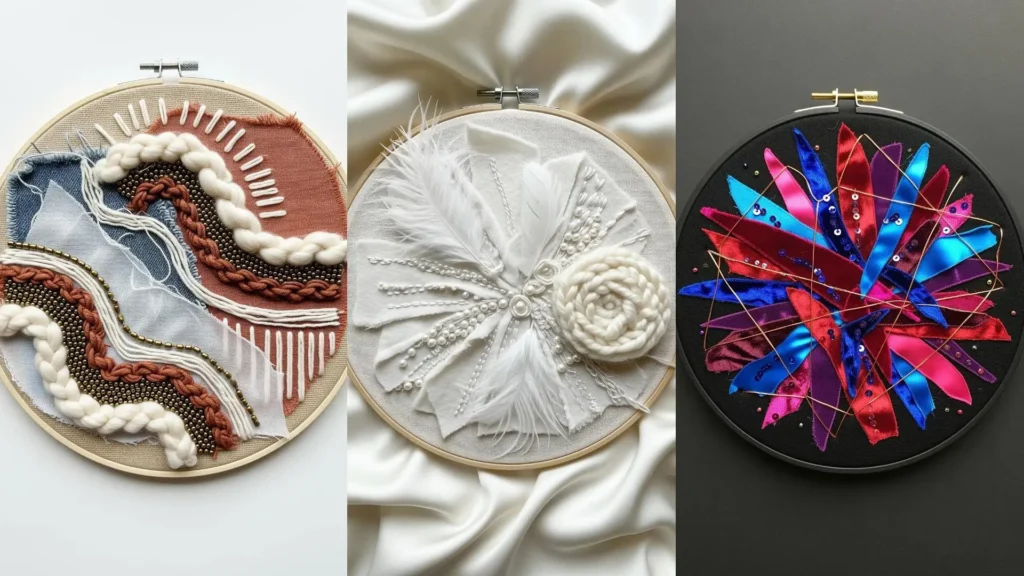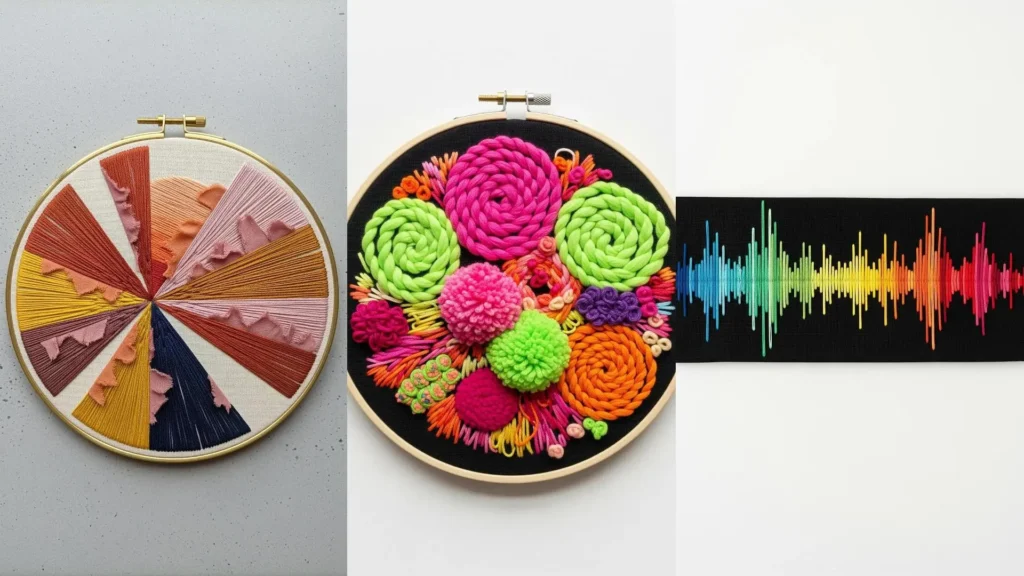
Look at that collection of leftover thread—the short ends, the odd colors, the impulse buys. It’s not a box of scraps; it’s a palette waiting for permission to play. So often, we wait for the perfect pattern to use our favorite threads, but abstract embroidery invites you to lead with intuition, to let the color and texture guide your needle.
Forget the pressure of perfectly rendered designs. Abstract art is about exploring relationships—between color, shape, and texture. It’s about how a thick, matte yarn feels next to a thin, metallic thread, or how a dense cluster of French knots creates a different energy than a smooth field of satin stitch.
These concepts are your starting point. They are exercises in composition, invitations to experiment, and a way to transform those beautiful leftover threads into small, intentional works of art that feel uniquely yours. Trust your eye, embrace imperfection, and stitch something that doesn’t just look beautiful, but feels authentic.
1. Sculptural Forms with Mixed-Fiber Tentacles
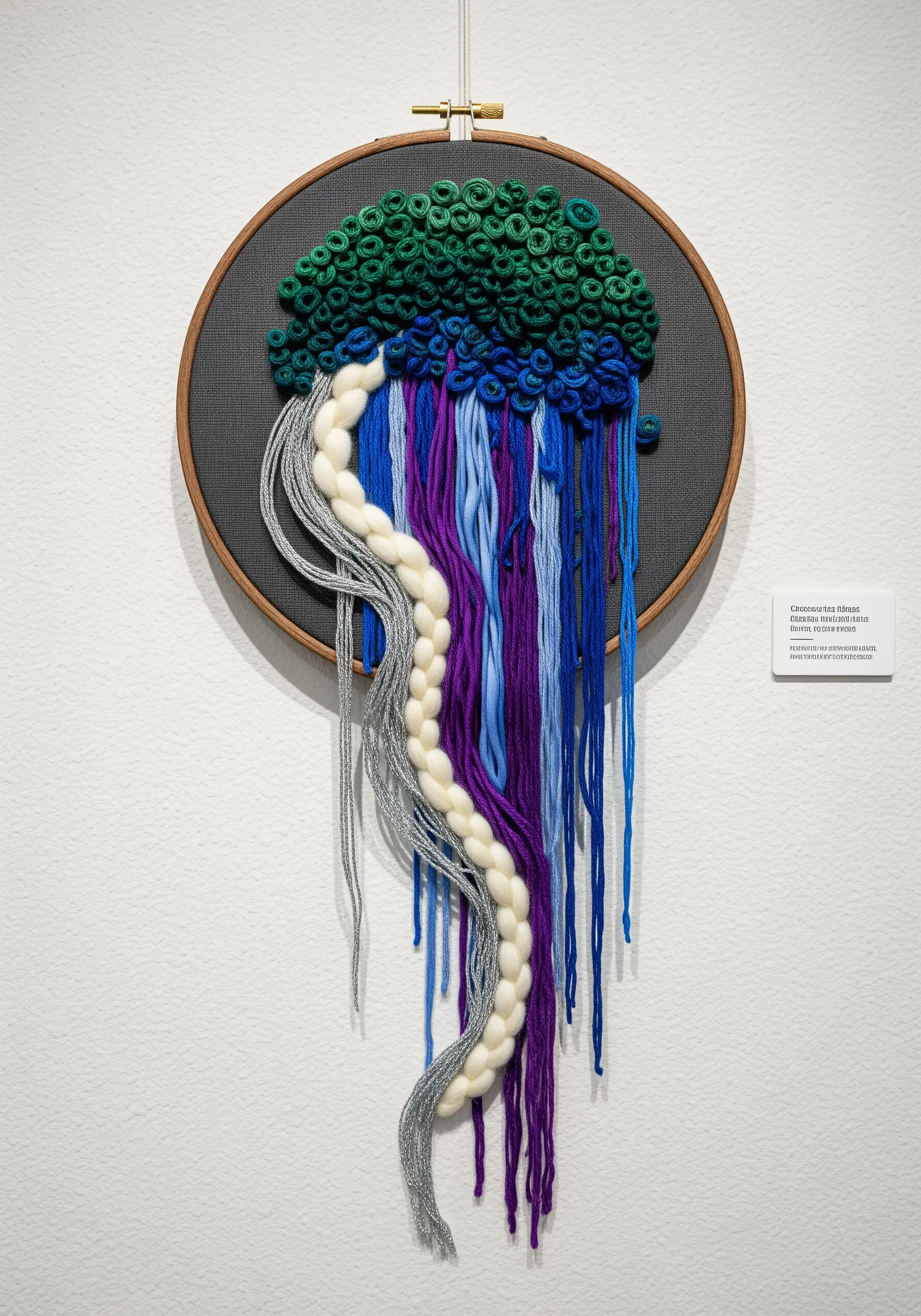
Build three-dimensional shapes by combining radically different fiber textures.
For the solid top section, create a dense surface with tightly packed bullion knots or colonial knots, varying their size for an organic, bubbled effect.
Contrast this solid mass with free-hanging ‘tentacles.’
Here, you can braid thick wool roving for soft volume, use shiny metallic cords for light-catching detail, and let simple strands of embroidery floss drape naturally.
This combination of textures creates a dynamic sculpture that moves beyond the flat plane of the fabric, turning your hoop into a frame for a stunning mixed-fiber project.
2. Interrupted Geometry with Fabric Appliqué
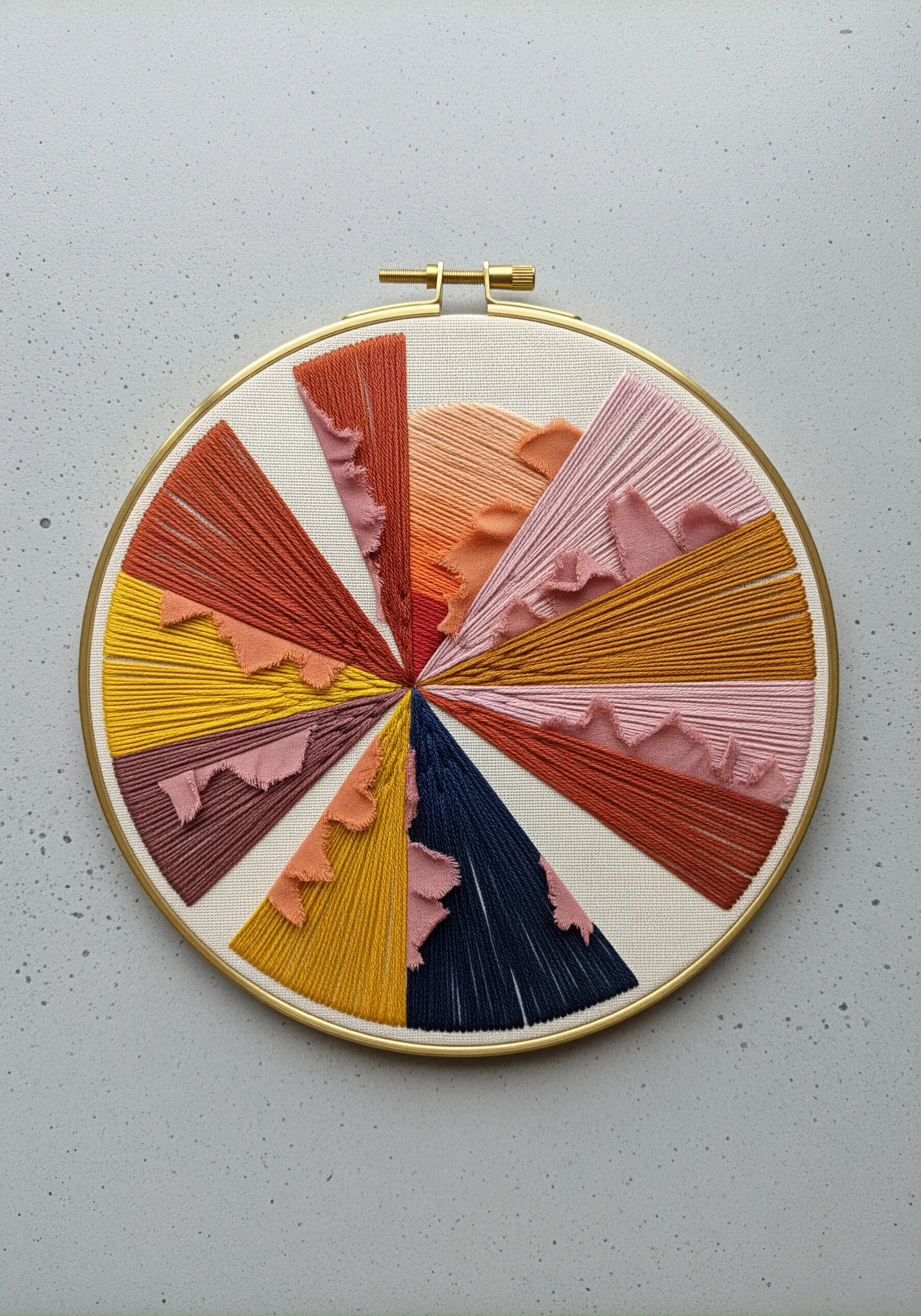
This design creates a powerful visual tension between clean, geometric order and soft, organic disruption.
Begin by dividing your hoop into triangular segments, filling each with long, taut satin stitches that converge at the center.
To introduce texture, interrupt these perfect lines by tucking in and stitching down small, frayed scraps of fabric.
The raw edges of the fabric soften the hard geometry of the thread, adding a tactile dimension that makes the entire piece more engaging and complex.
This is a brilliant way to incorporate leftover fabric into your abstract framed embroidery patterns.
3. High-Impact Neon with Dimensional Yarn Work
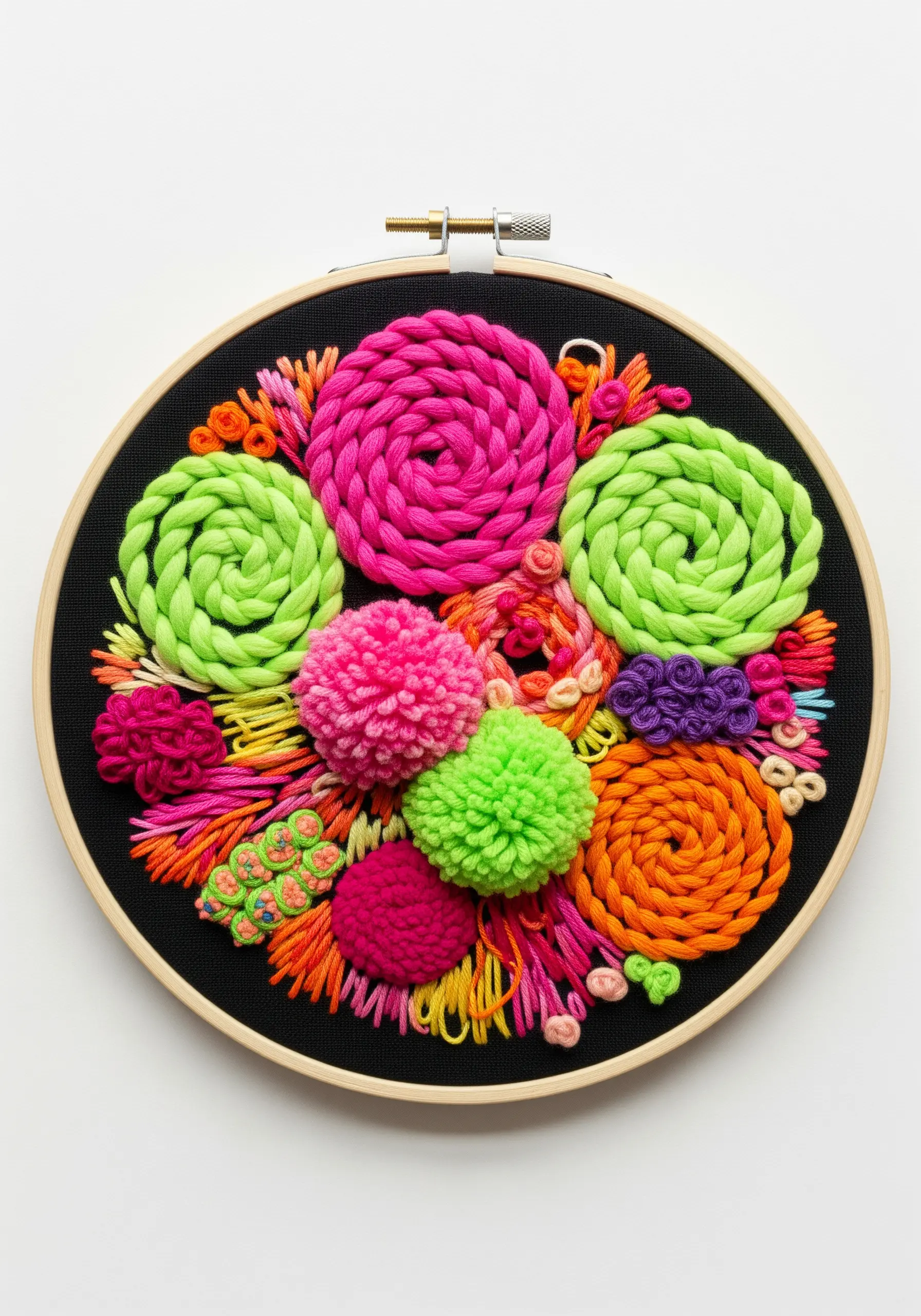
To make leftover neon threads feel intentional and sophisticated, you need two things: a dark background and bold texture.
A black or deep charcoal fabric will make those vibrant colors vibrate with energy.
Instead of simple stitches, use thick yarn to create coiled spirals, securing them with a couching stitch.
Introduce handmade pom-poms for explosive softness, and use straight stitches in radiating bursts to fill empty spaces.
This fearless combination of form and color turns simple materials into a fiber art installation that uses color and texture to evoke emotion.
4. The Monochromatic Texture Sampler
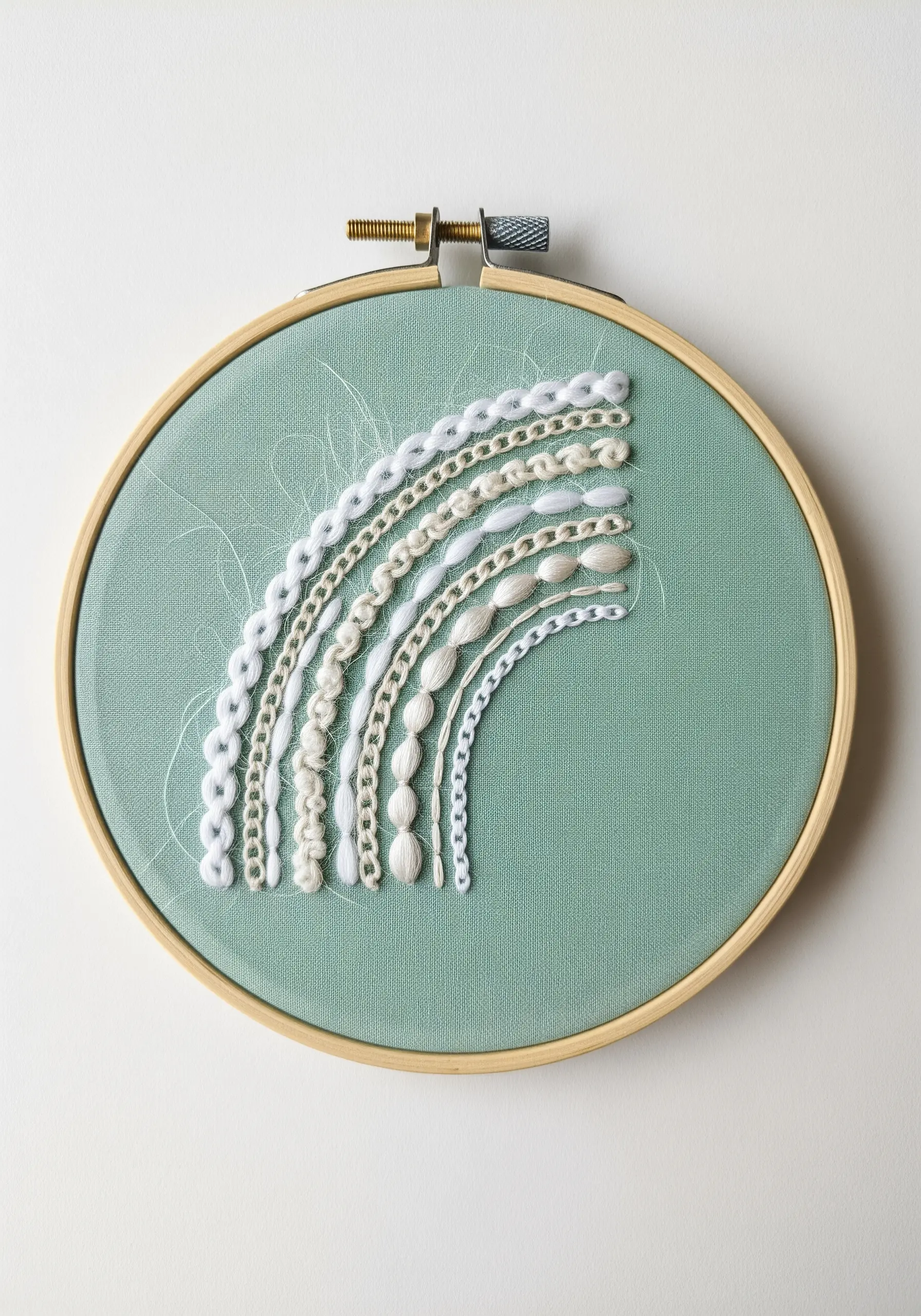
By limiting your palette to a single color family—like whites, creams, and grays—you shift the focus entirely from hue to form.
This exercise challenges you to create visual interest using only texture.
Arrange your stitches in clean, parallel arcs, dedicating each line to a different dimensional stitch: a thick chain stitch, raised stem stitch, bullion knots, or Palestrina knots.
The result is not just a sampler, but an elegant, monochrome thread embroidery idea that highlights the subtle beauty of light and shadow across different stitch types.
5. Layered Threads to Mimic Geode Formations
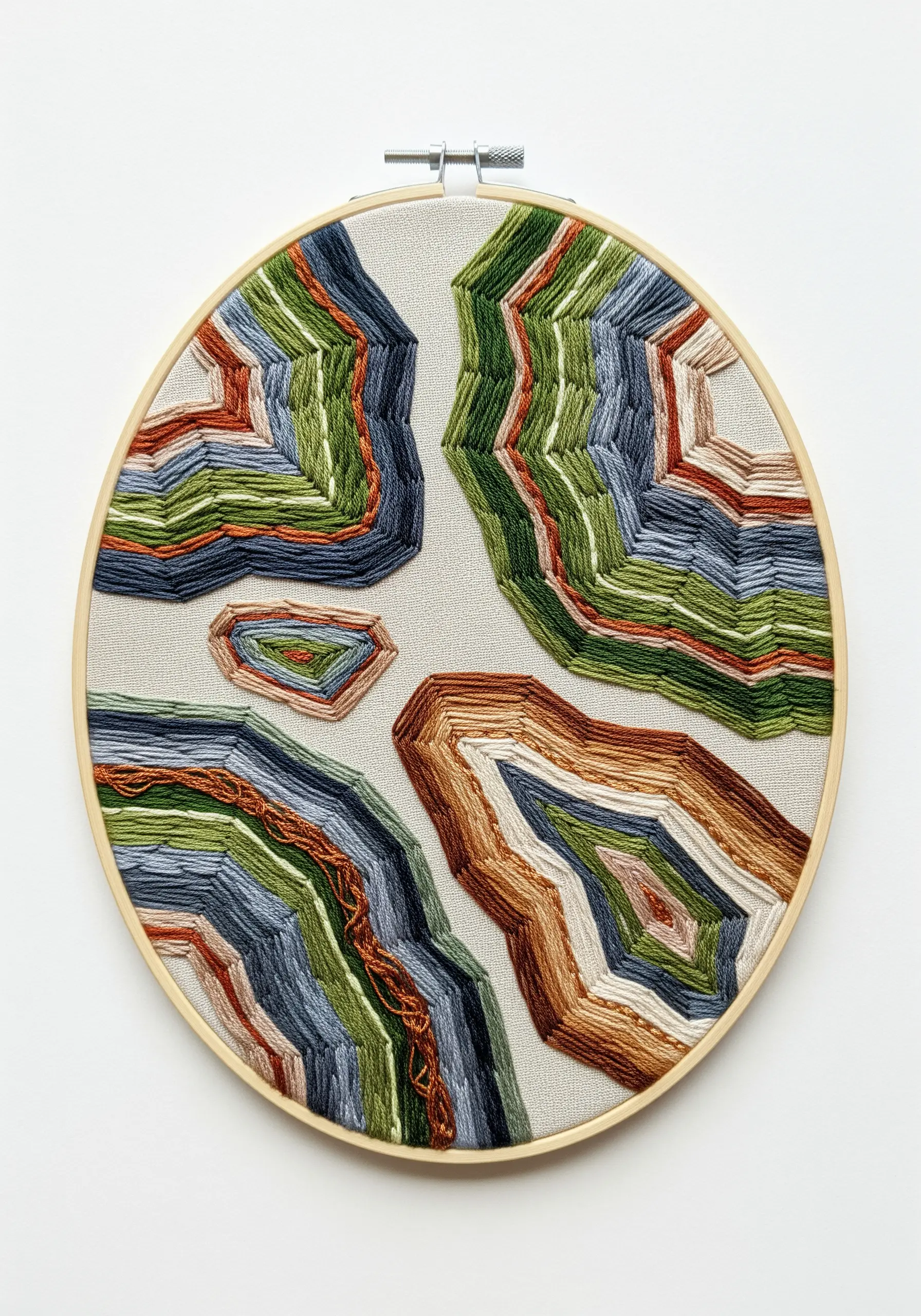
Capture the organic, layered beauty of a geode by using concentric rows of straight stitches.
Start by drawing several irregular, rounded shapes on your fabric.
Fill them by working from the outside in, laying down rows of long stitches that follow the contour of the shape.
Change your thread color every two or three rows, using an analogous or earthy palette to mimic mineral deposits.
Introduce a single, bright, contrasting color as a thin vein to add a pop of energy and realism, showing you know ways to capture nature’s textures.
6. A Composition of Contrasting Textural Blocks
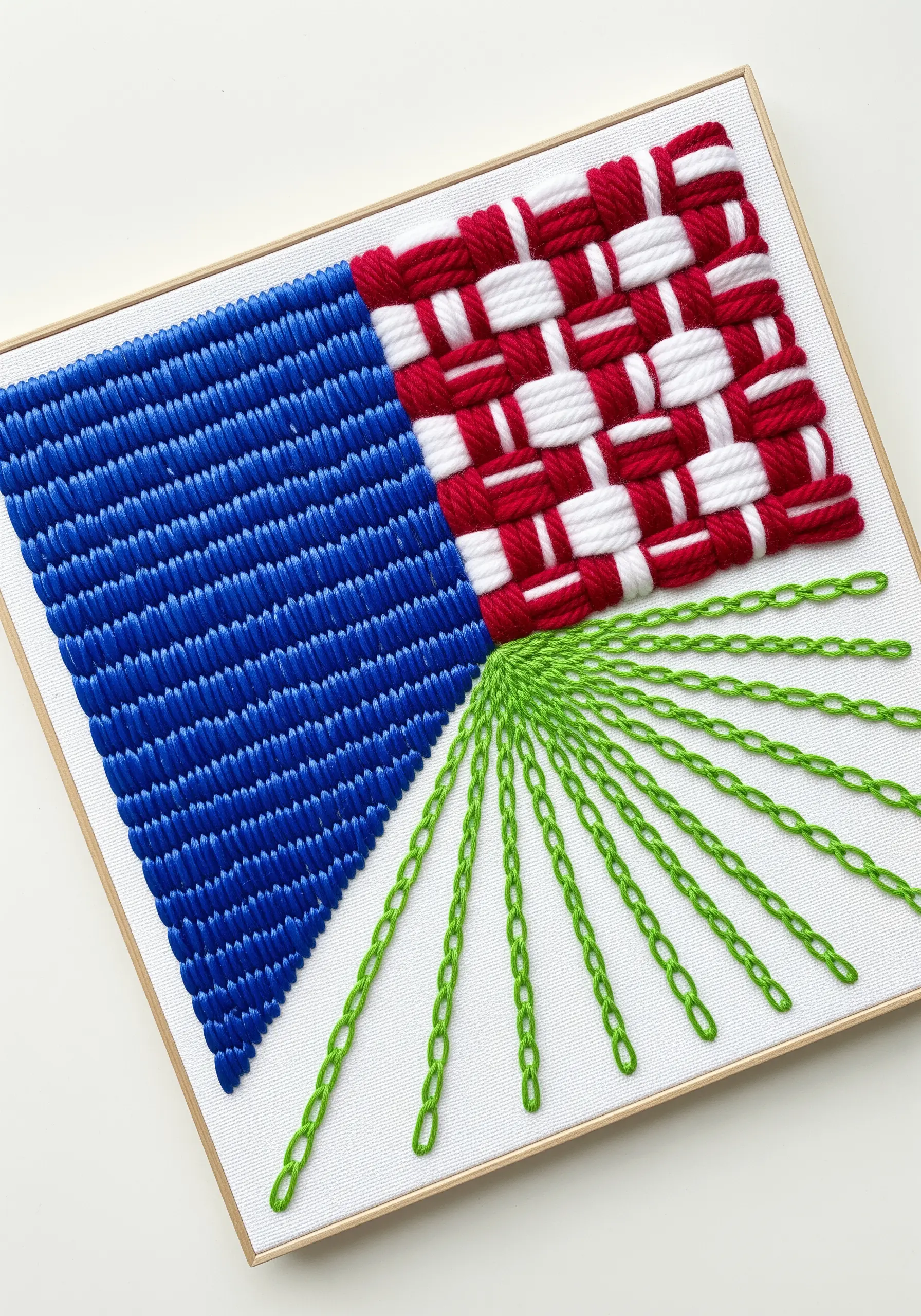
Elevate a simple geometric design by assigning a distinct, high-texture stitch to each block of color.
This approach transforms a flat composition into a tactile study.
Combine a field of dense satin stitch with a section of bold chain stitch, and then add an area of weaving.
To create the woven effect, first lay down a grid of long vertical stitches (the warp), then weave a thicker yarn or ribbon horizontally through them (the weft).
This juxtaposition of flat, looped, and woven textures makes the entire piece feel dynamic and deliberately designed, perfect for yarn wall art projects inspired by geometric patterns.
7. Asymmetrical Elegance on Sheer Fabric
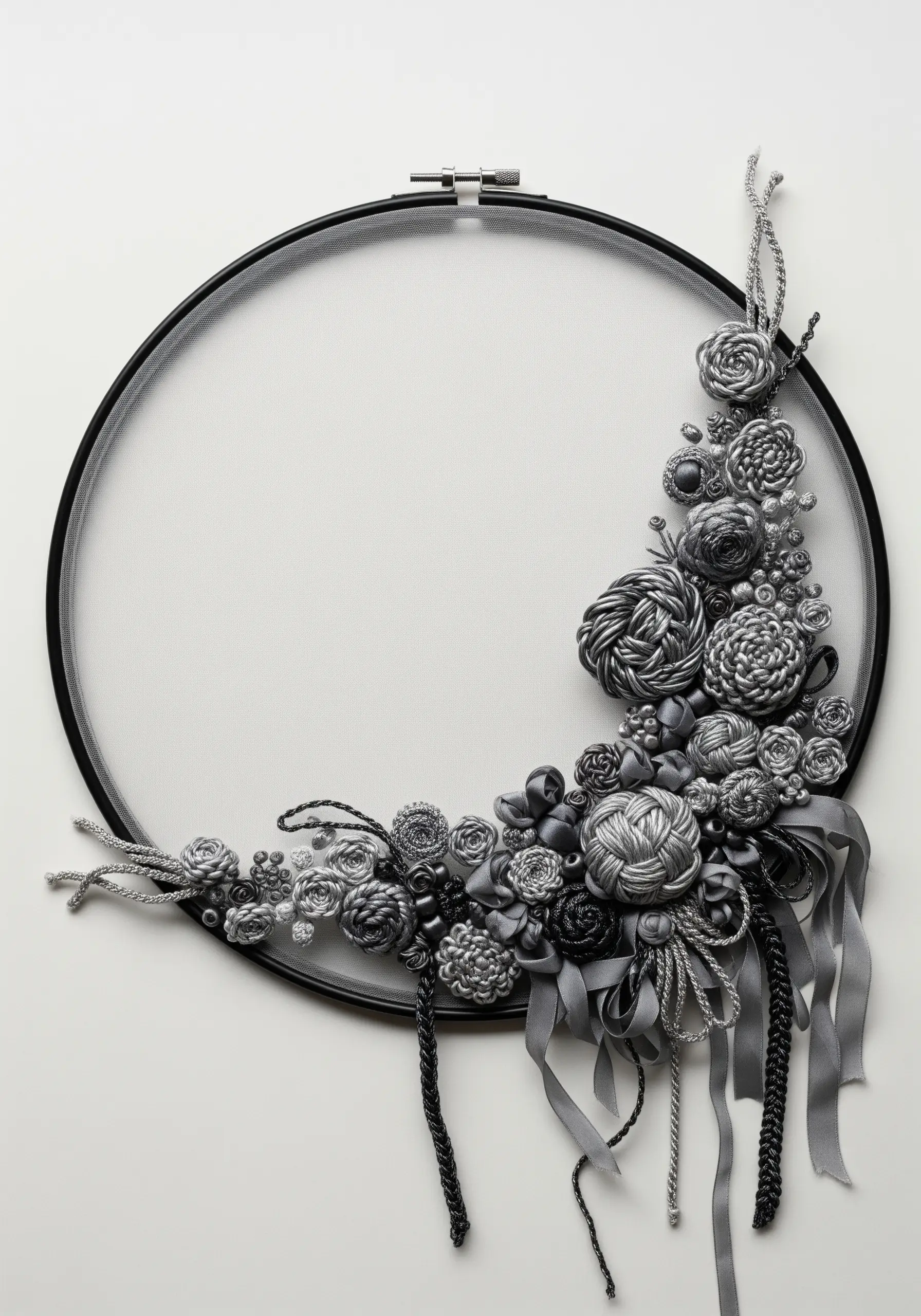
Create a sophisticated, gallery-worthy piece by embracing negative space.
Cluster your textural elements—like ribbon roses, woven picot flowers, and couched metallic cords—into an asymmetrical arrangement along one side of the hoop.
This allows the empty space to become an integral part of the composition, giving your work room to breathe.
Stitching on a sheer fabric like organza or tulle enhances this effect, making your dimensional stitches appear to float weightlessly.
This technique turns a simple floral concept into one of those stunning framed embroidery pieces to make your walls pop.
8. Meditative Spirals with Heavy Chain Stitch
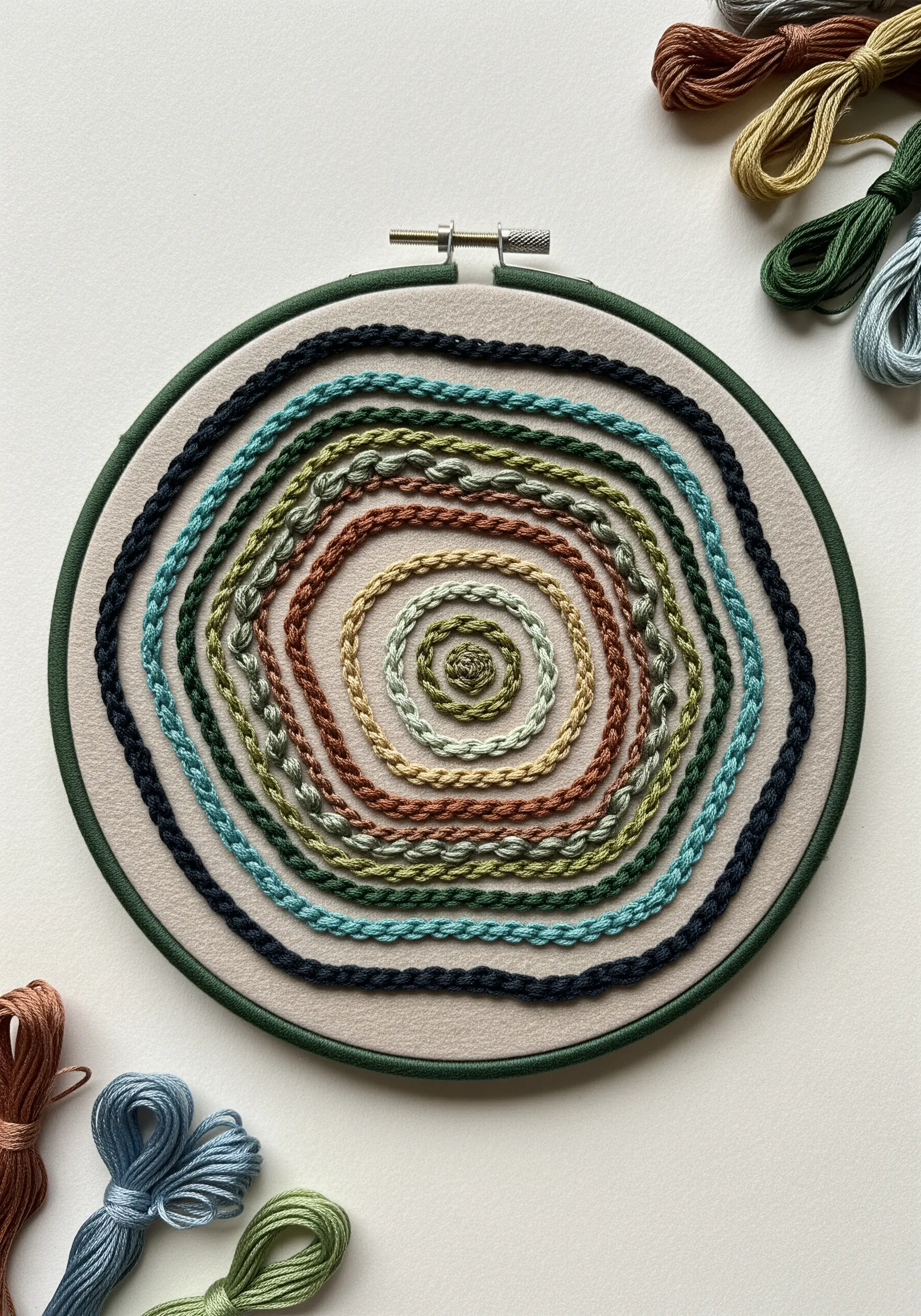
The simple act of repetition can create incredibly powerful designs.
Using a thick thread—such as all six strands of floss, perle cotton, or even fine yarn—work a heavy chain stitch in a continuous, spiraling shape.
Start from a small central point and work your way outwards, changing your thread color periodically to create concentric rings.
The result is a beautifully textured, mandala-like piece that is both calming to create and mesmerizing to look at, especially when using thoughtful earth-tone patterns.
9. Pointillist Clouds with French Knot Clusters
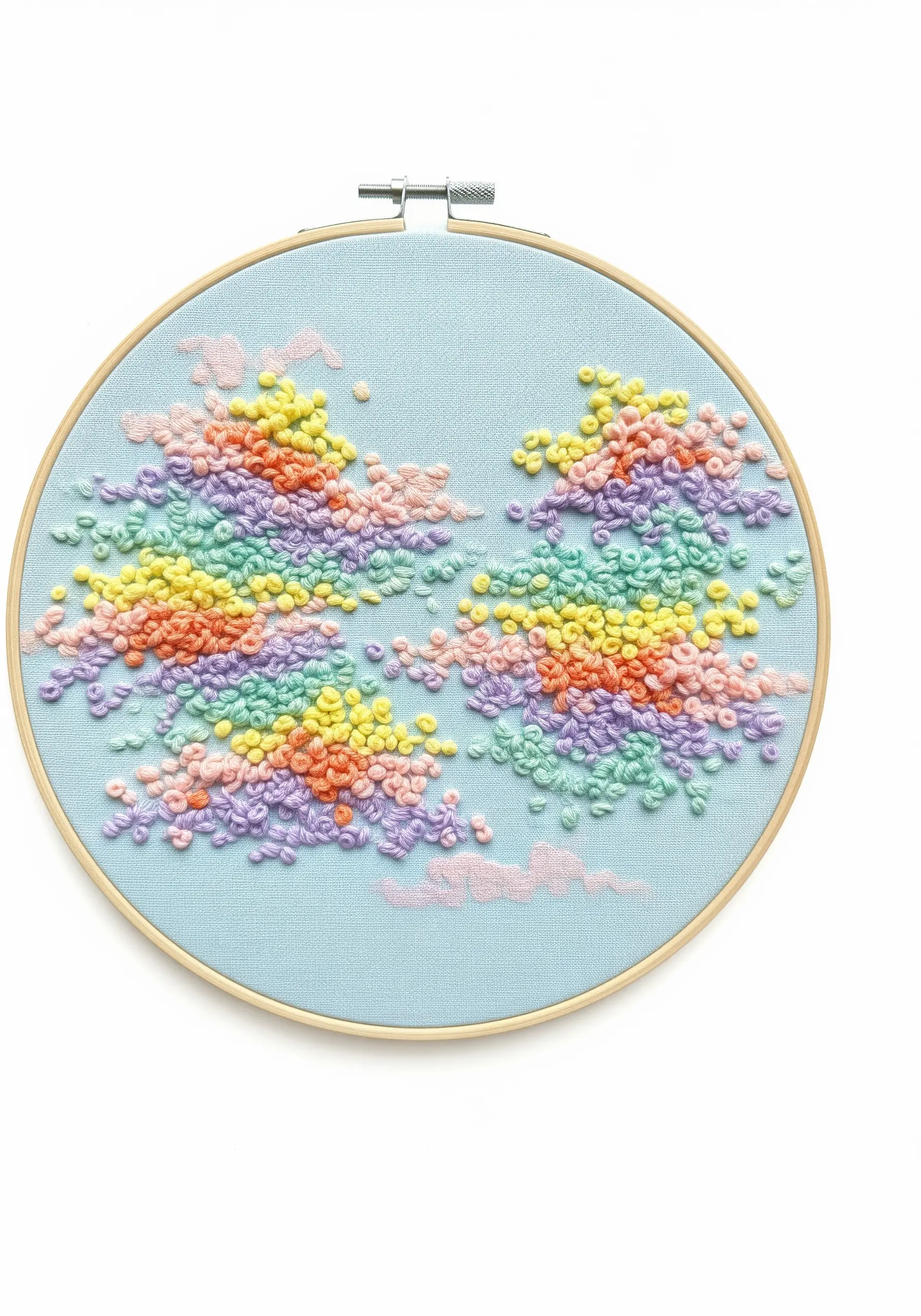
Use French knots not as individual accents, but as a tool for ‘painting’ with thread.
To create soft, fluffy cloud shapes, group your knots in dense, irregular clusters.
The key to achieving a smooth, blended look is to work with a soft, analogous color palette and allow the edges of your color sections to overlap slightly.
Vary the number of times you wrap the thread around the needle (once, twice, or three times) to create knots of slightly different sizes, which adds a subtle, realistic texture to your clouds, perfect for soft pastel embroidery ideas.
10. Deconstructed Geometry with Architectural Lines
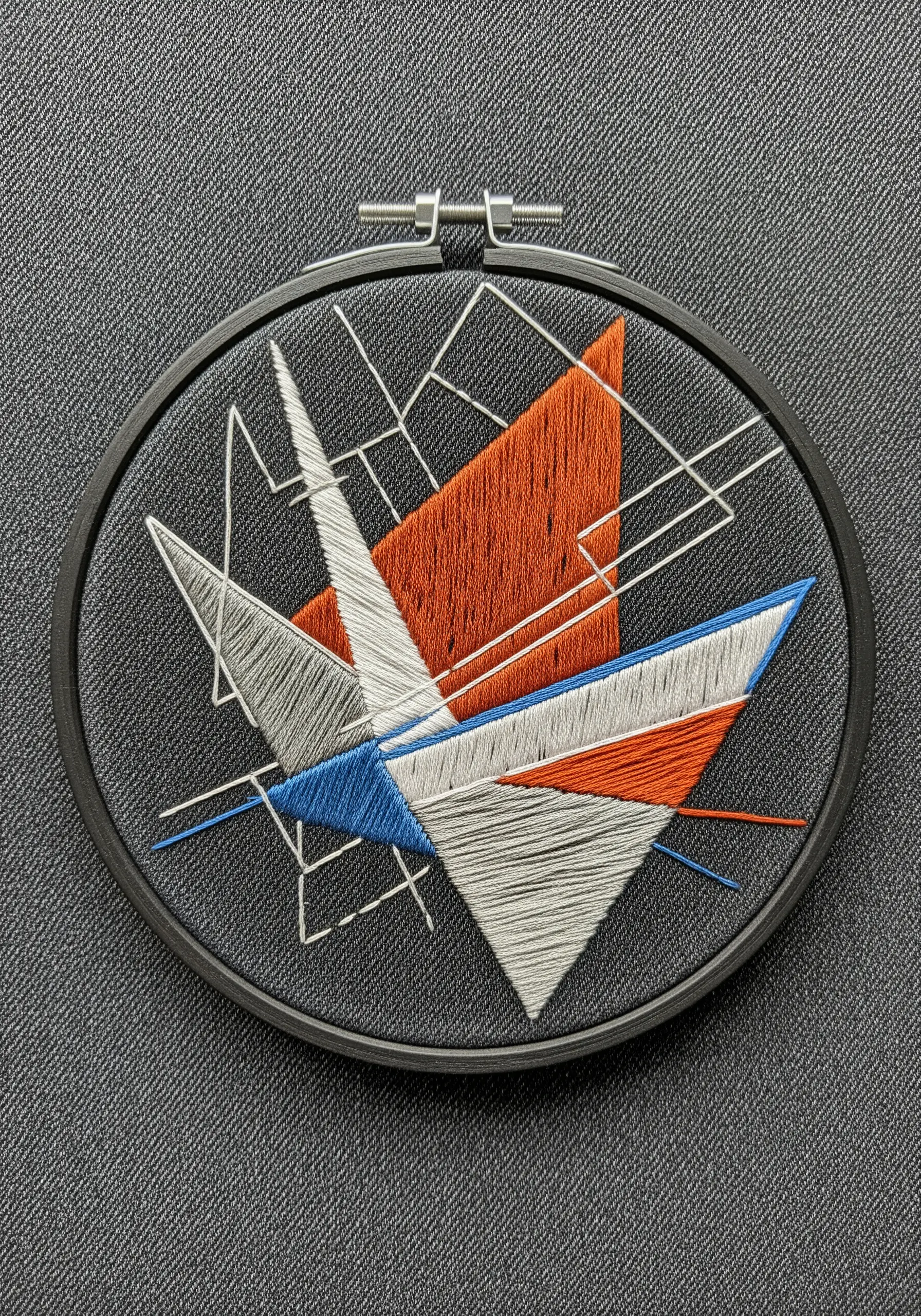
This is where precision meets improvisation.
First, create solid, geometric shapes using perfectly aligned satin stitches. Think of these as the foundation of your design.
Then, introduce a layer of fine, single-thread lines that intersect and extend beyond these solid forms.
These ‘scaffolding’ lines, worked in a simple backstitch or straight stitch, create a sense of depth and deconstruction, as if you’re revealing the framework behind the finished shapes.
It’s a fantastic way to experiment with modern thread art ideas.
11. Radiating Energy with a Thread Burst
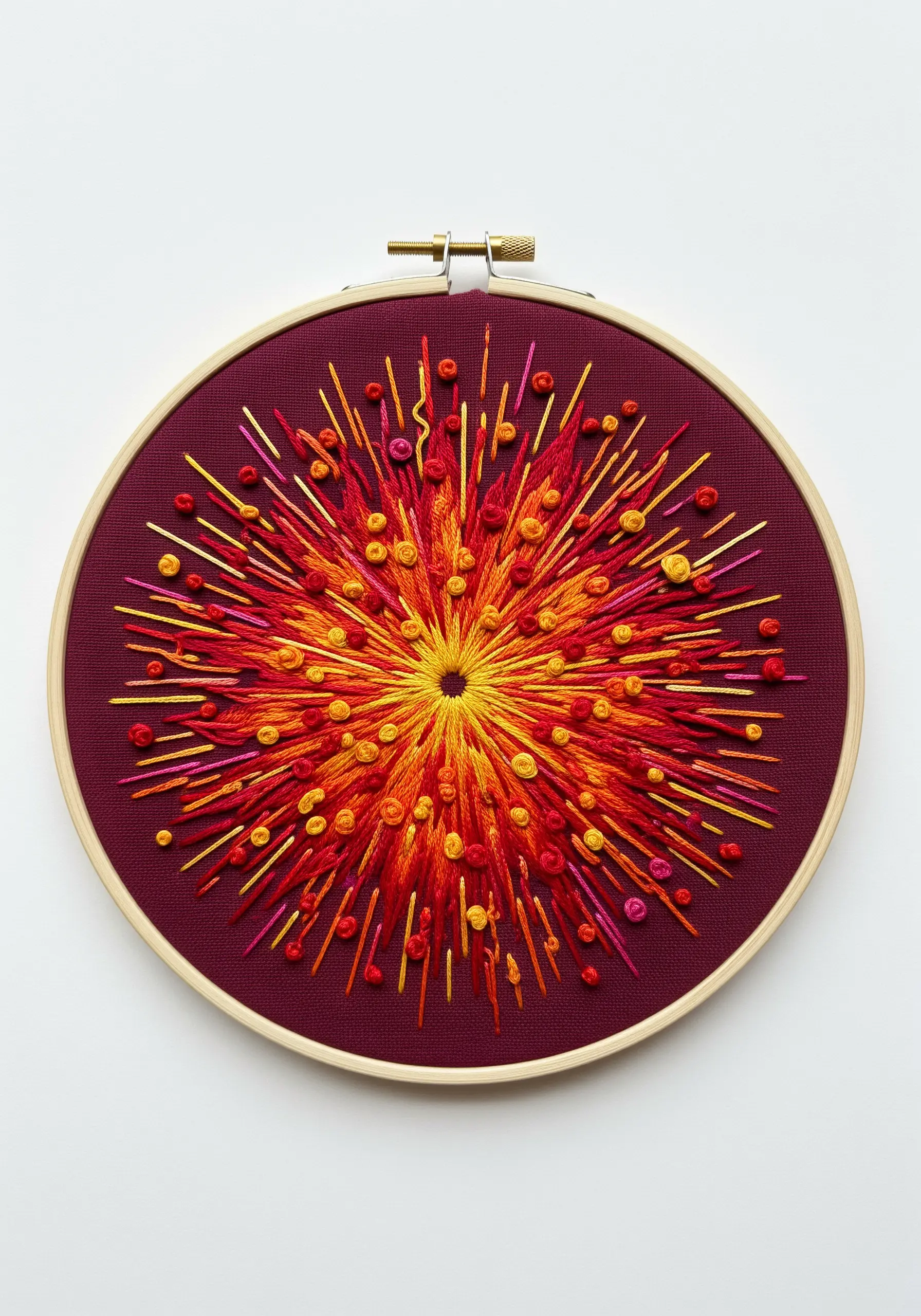
Capture the feeling of an explosion or a sunburst with carefully controlled chaos.
Start with a central point and work outwards, creating radiating lines of straight stitches.
The key to making it feel dynamic is variation: use different thread weights, vary the lengths of your stitches, and blend a hot color palette of reds, oranges, and yellows.
Scatter small French knots and seed stitches throughout the burst, like sparks flying from the center.
This technique transforms simple straight stitches into an expression of pure energy, a perfect example of abstract thread burst techniques.
12. Floating Motifs on Transparent Fabric
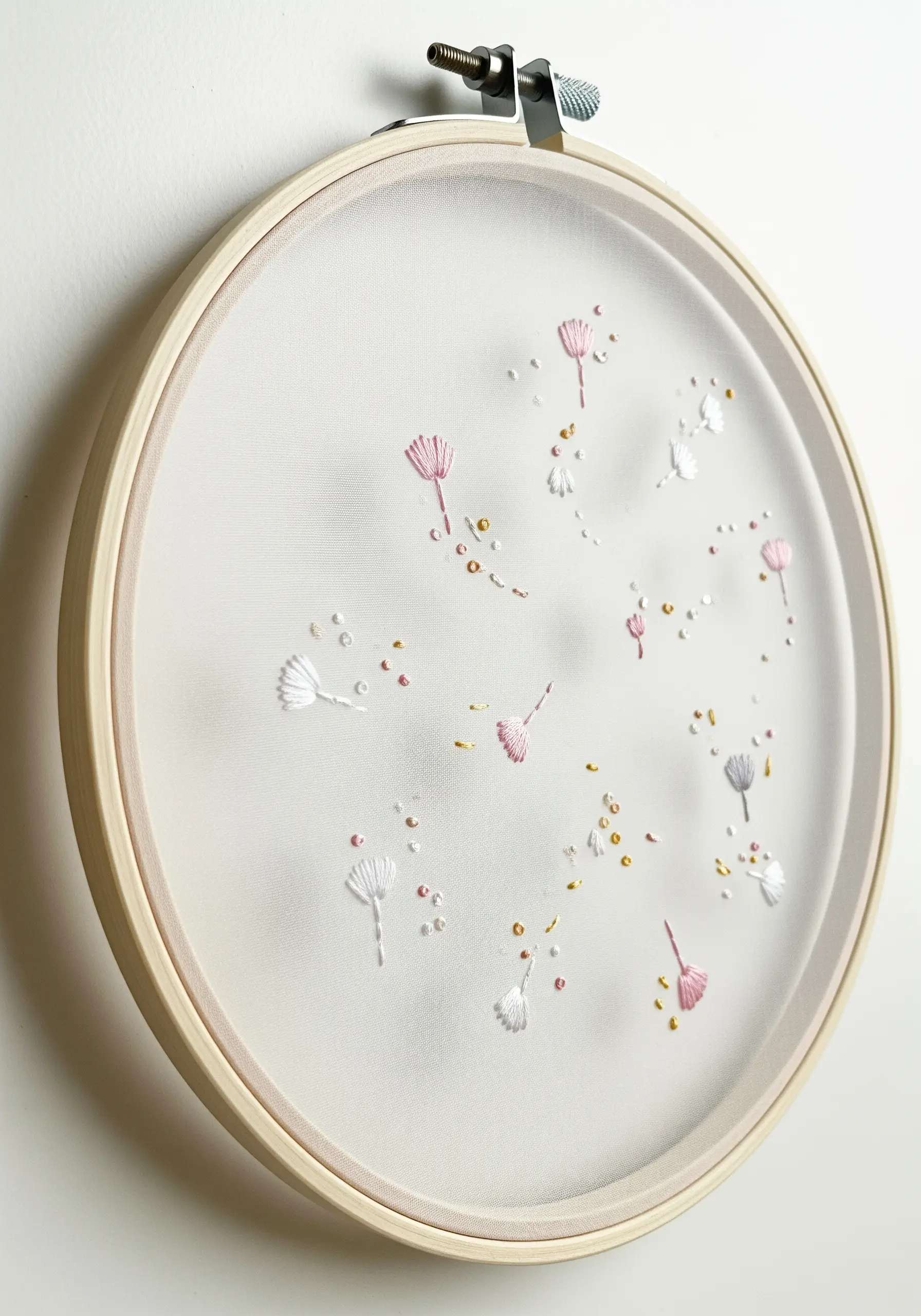
Using sheer tulle or organza as your base fabric creates an immediate sense of delicacy and magic.
Simple stitches appear to float in mid-air, making it the perfect canvas for airy motifs like dandelion seeds or fireflies.
Use a combination of tiny satin stitches and single straight stitches for the main forms.
Then, add a scattering of tiny seed beads or metallic French knots to catch the light and add a hint of sparkle.
This approach makes the negative space just as important as the stitches themselves, ideal for minimal DIY embroidery projects you’ll want to display.
13. Sculptural Coral Gardens with Dimensional Stitches
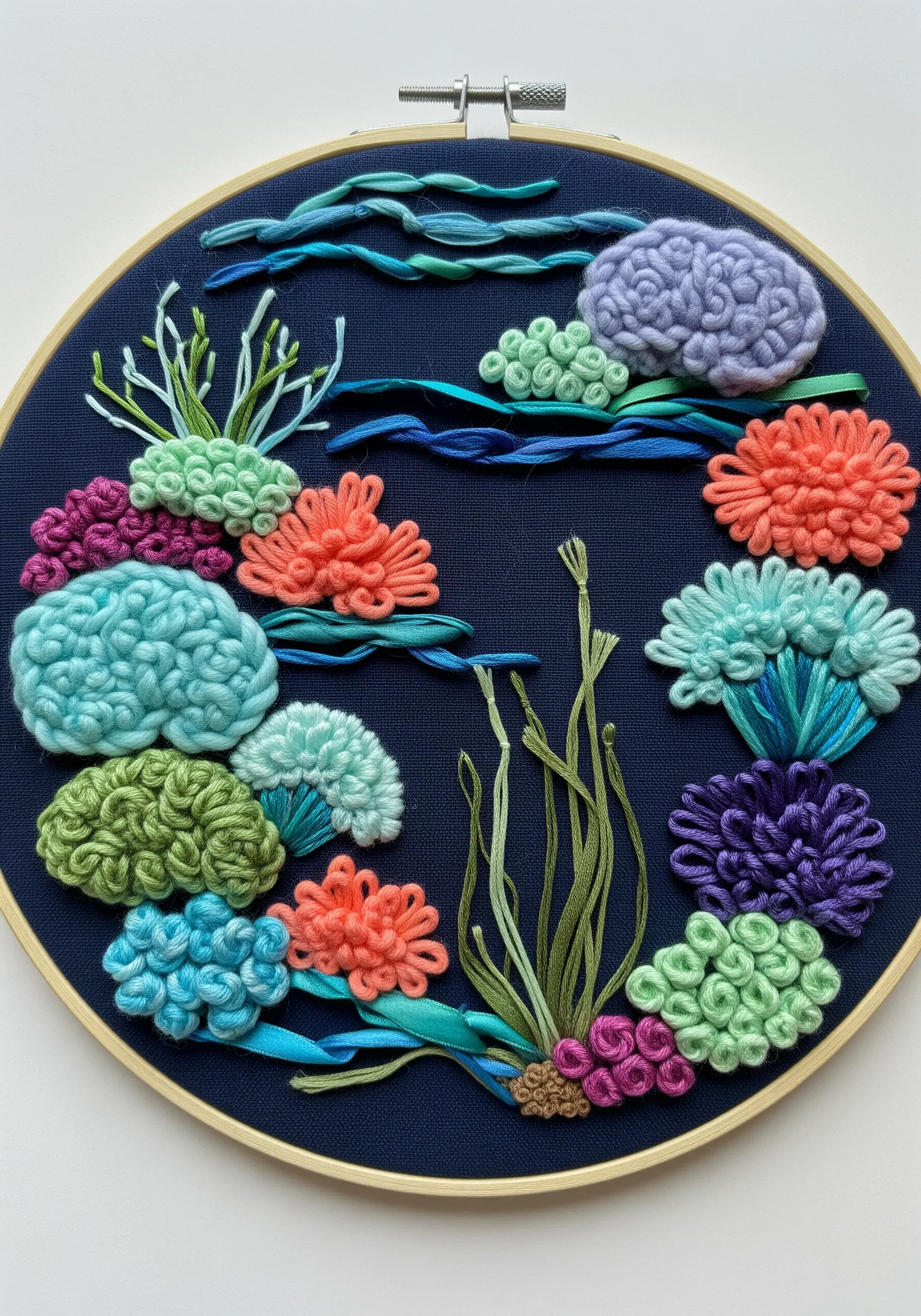
Build a vibrant, tactile underwater scene by assigning a different dimensional stitch to each type of coral.
Use tightly packed French knots in a solid color to create brain coral.
Form sea anemones with clusters of detached chain stitches (lazy daisies).
Turkey work, when trimmed short and dense, is perfect for creating a mossy texture on rocks.
Combine these techniques on a dark blue fabric to make the bright colors pop, creating an immersive piece that is a joy to both see and touch, much like embroidery projects inspired by textures you’d find on a nature walk.
14. Minimalist Pathways with Graphic Accents
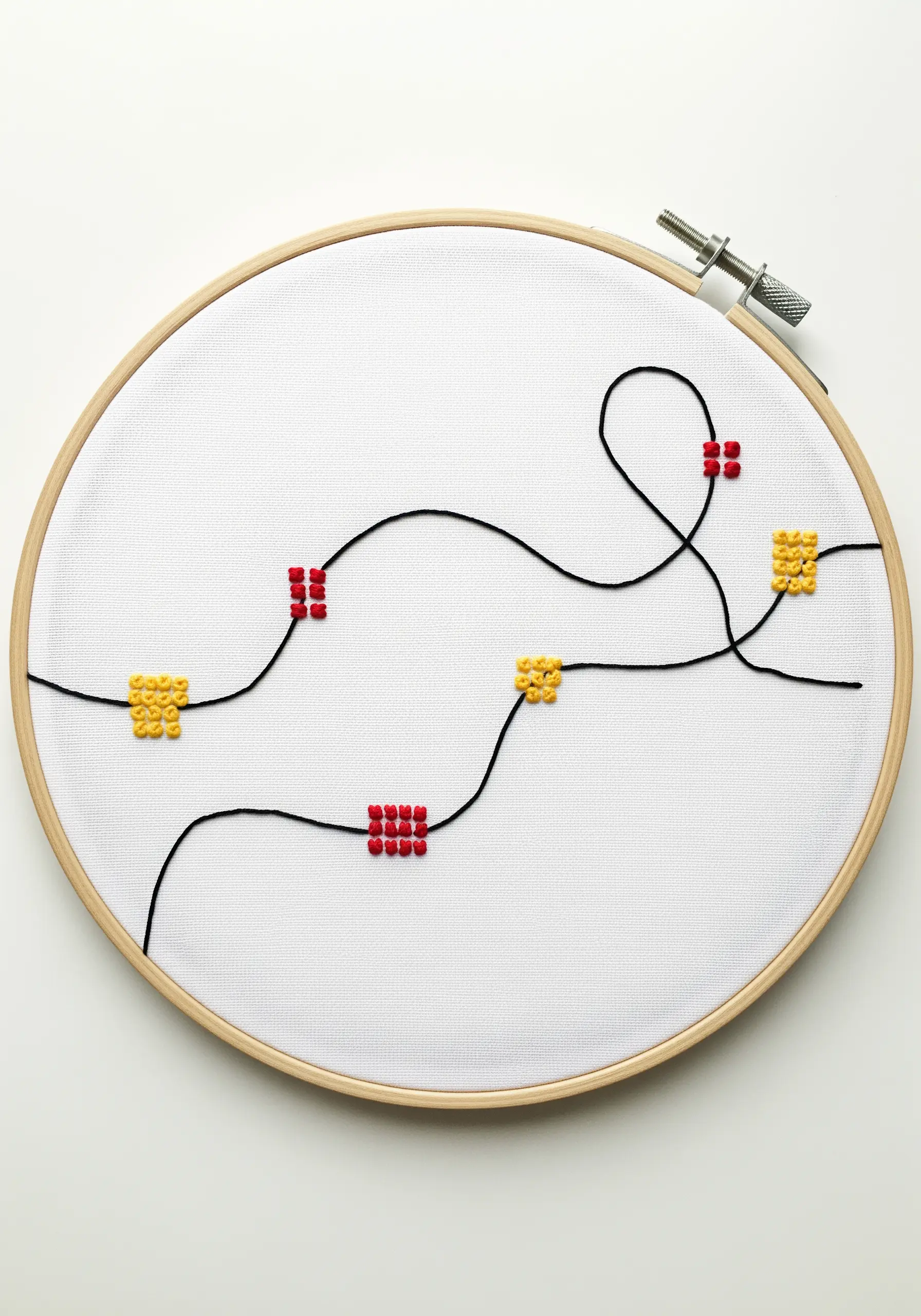
This design proves that simplicity can be incredibly striking.
It pairs a single, meandering line with small, structured blocks of color.
First, lay down a long piece of black perle cotton or yarn, securing it to the fabric with small, subtle couching stitches.
Then, punctuate this fluid line with small, dense squares of cross-stitch or satin stitch.
This unexpected combination of a free-form line and gridded stitches creates a balanced, modern composition that feels both playful and intentional, a great example of modern grid dot stitch concepts.
15. Hoop Weaving with Textural Embellishments
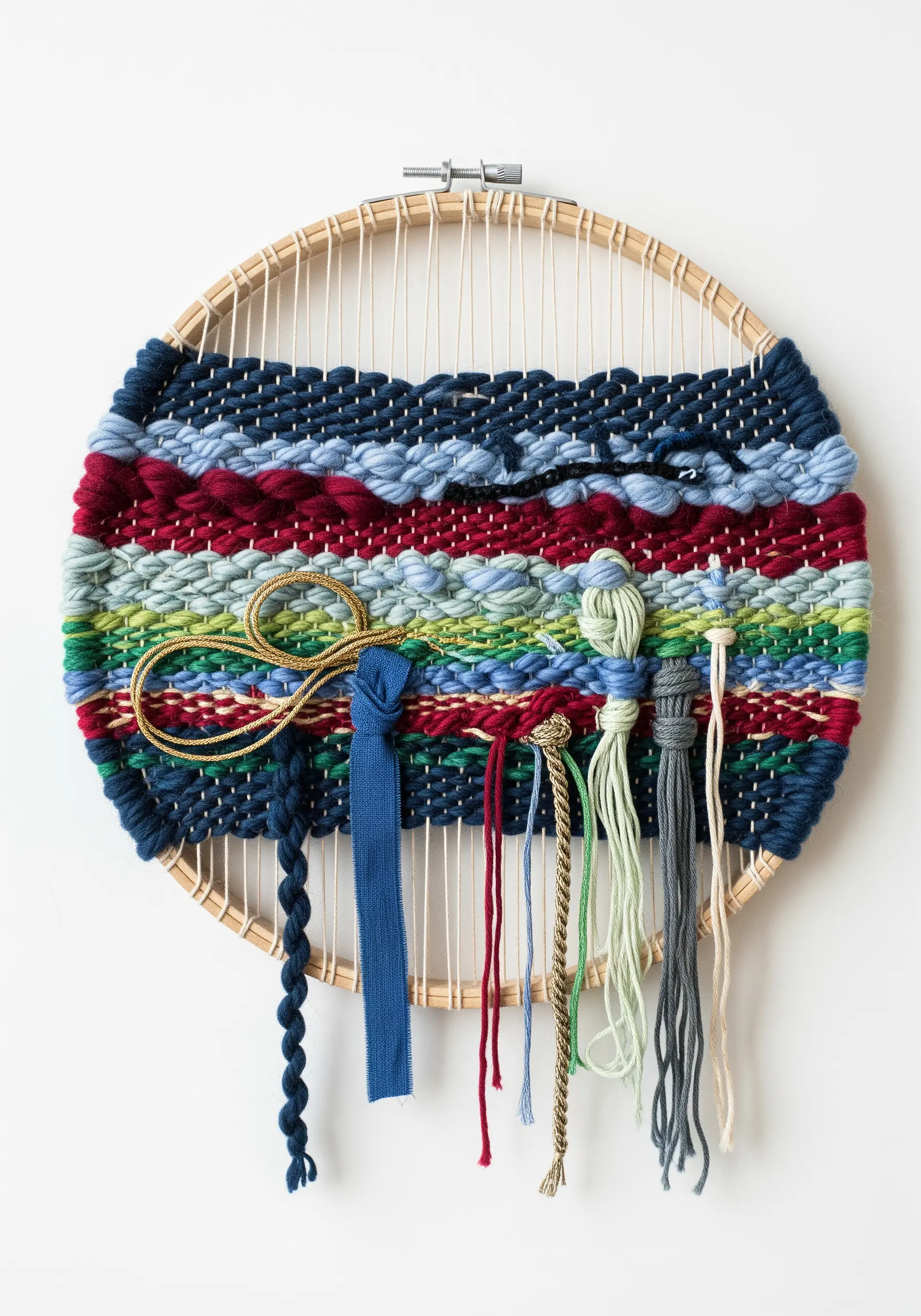
Turn your embroidery hoop into a frame loom for a project that blends weaving and macrame.
Create your warp by stretching threads vertically across the hoop, securing them in the back.
Then, weave horizontally with a variety of materials—thick yarn, thin ribbon, metallic cord, and standard floss.
Experiment with different weaving patterns and leave long tails at the bottom to create tassels, braids, or knots.
This transforms the hoop from a tool into an integral part of the finished artwork, like in many layered yarn wall art projects.
16. Embroidered Terrazzo with Satin Stitch ‘Chips’
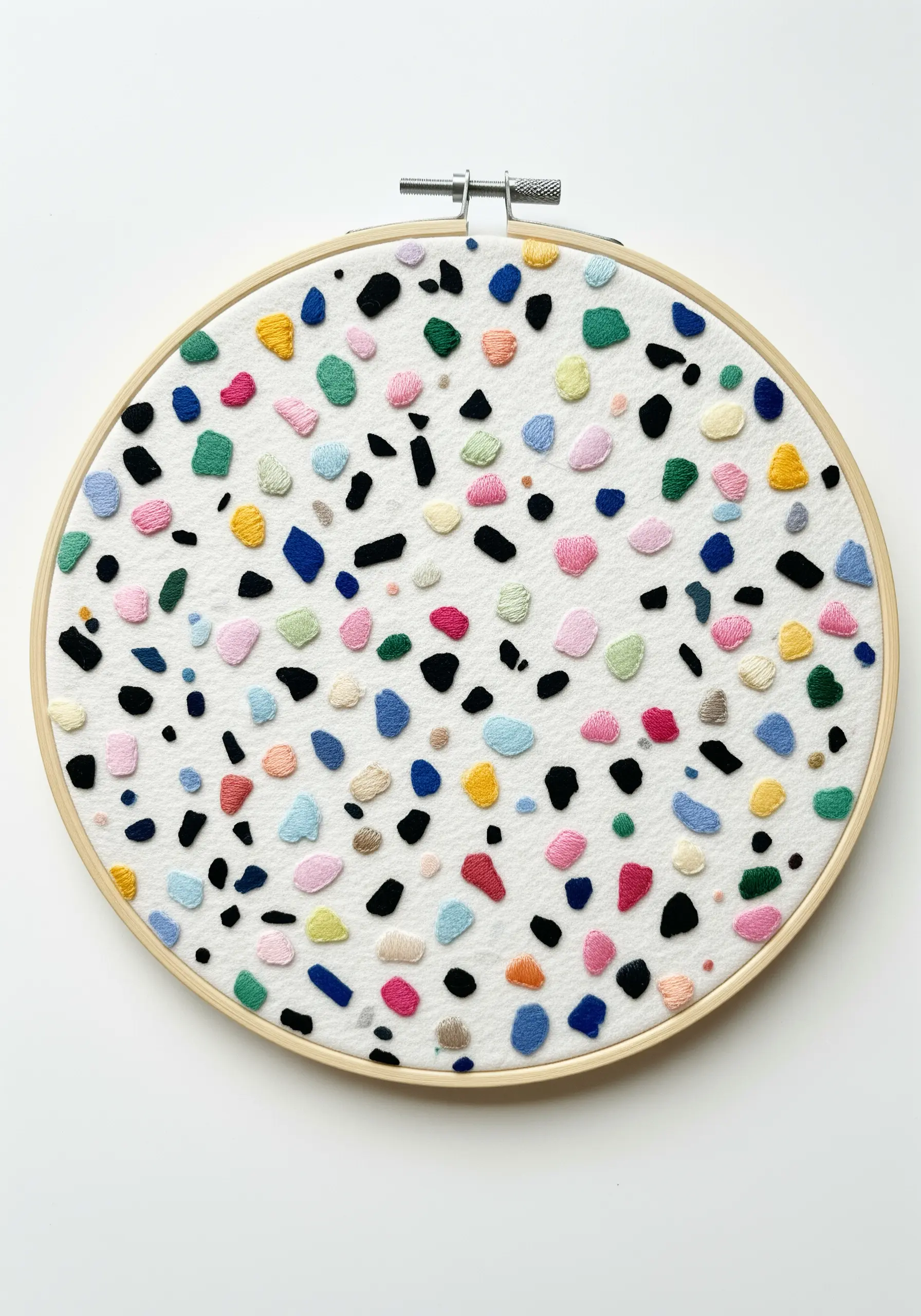
This is the perfect technique for using up even the smallest scraps of leftover thread.
Recreate the playful, speckled look of terrazzo flooring by filling your fabric with small, irregular shapes made from satin stitch.
The key is randomness: vary the size, shape, color, and stitch direction of each ‘chip’.
Mix in a variety of colors—brights, pastels, and darks—against a neutral background to make the pattern pop.
This method turns chaos into a cohesive, joyful pattern, an excellent example of creative fabric collage embroidery compositions.
17. Chaotic Energy with Mixed-Media Embellishment
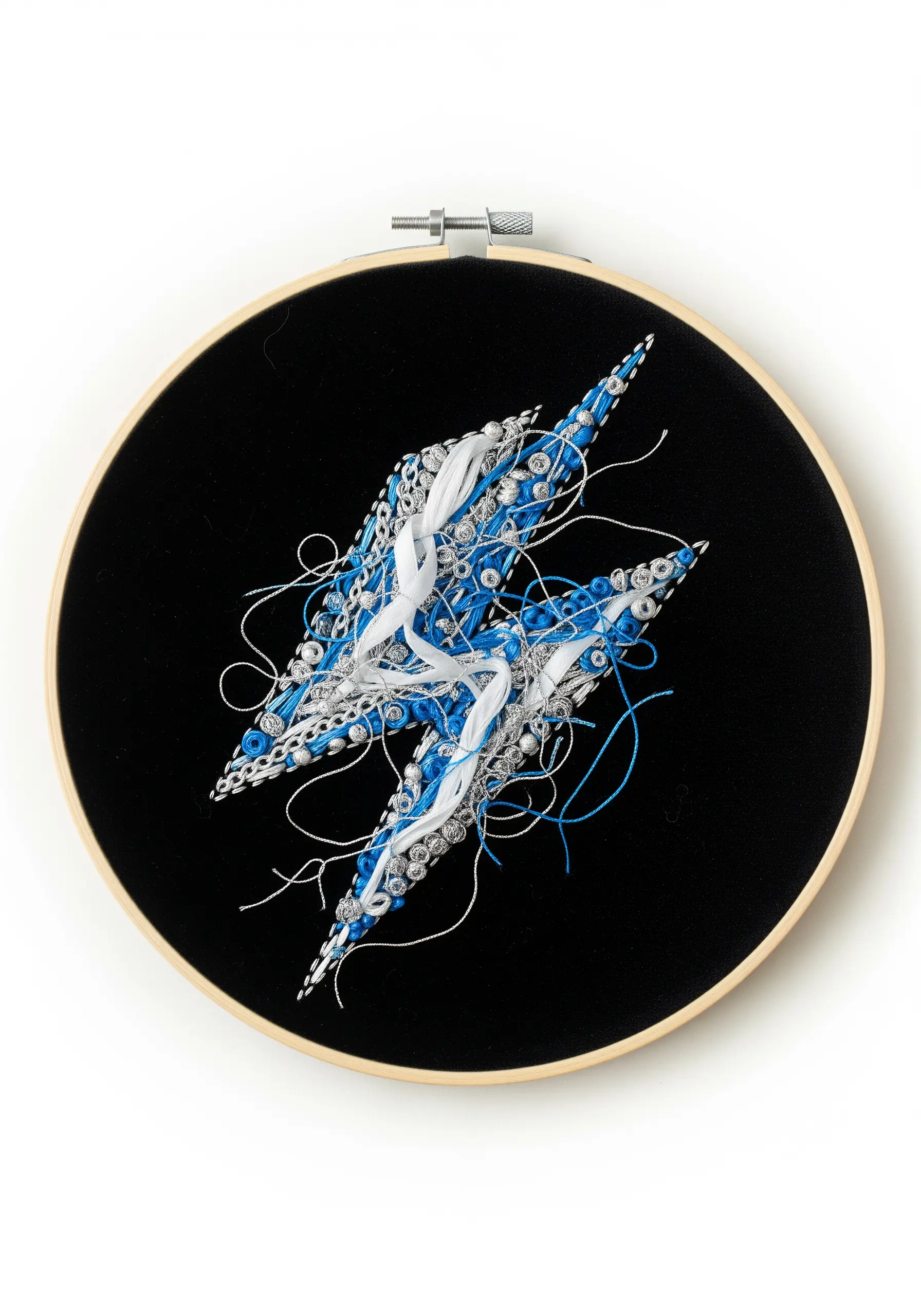
To convey a sense of raw, electric energy, you need to break the rules of traditional embroidery.
Start with a strong shape, like a lightning bolt, and fill it with a chaotic mix of materials.
Couch down pieces of fine metal chain, stitch rows of silver seed beads, and add tangled nests of metallic thread.
Let some threads hang loose and unfinished.
This maximalist, multi-material approach creates a design that feels alive and untamed, and is particularly striking in abstract metallic thread projects against a dark background.
18. Soft Sculptural Clouds with Punch Needle
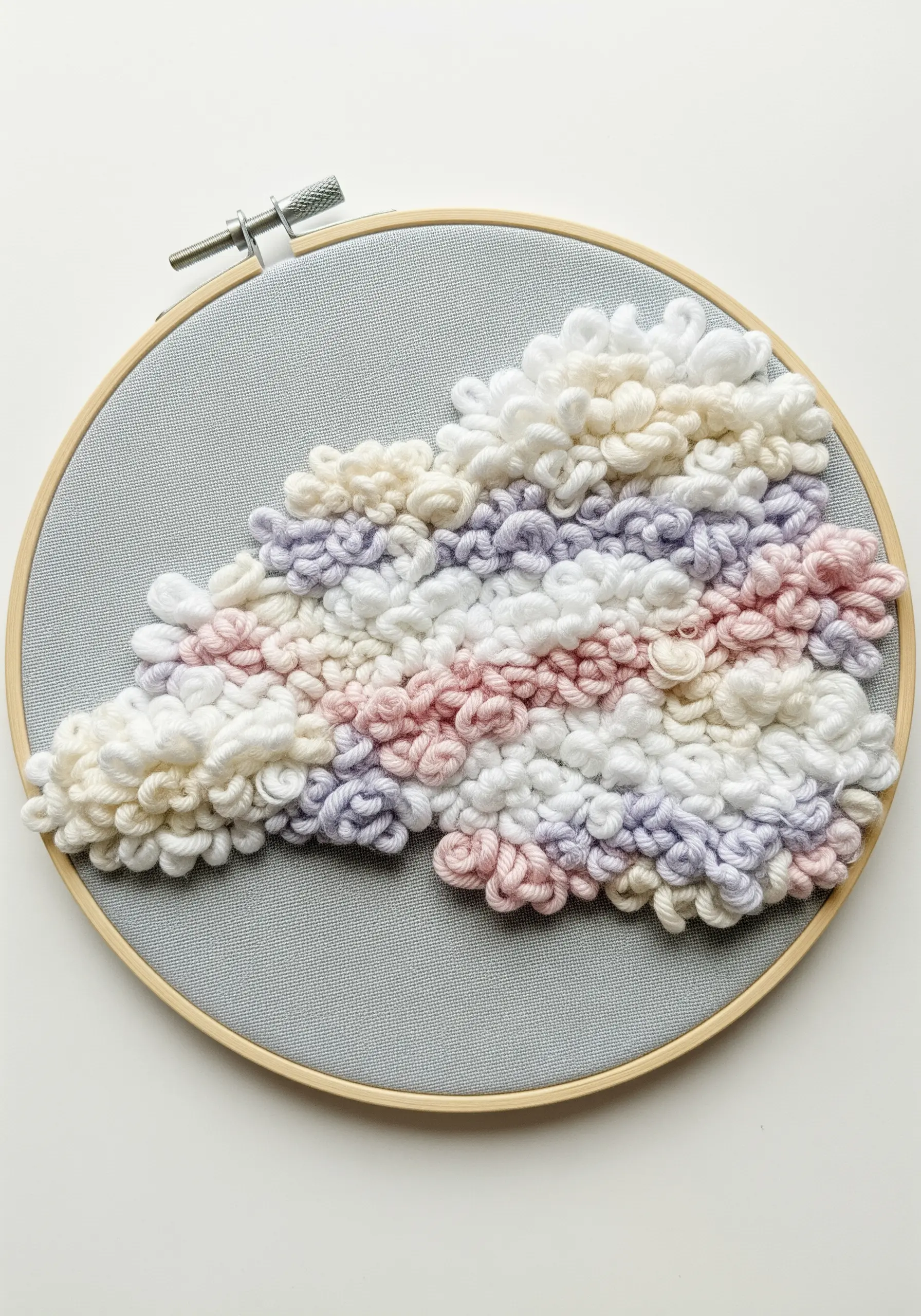
For an ultra-plush, sculptural texture that you can’t achieve with traditional needles, explore punch needle embroidery.
Using thick, soft yarn, this tool creates dense loops on the surface of your fabric, resulting in a texture similar to a shag rug.
Create an abstract, cloud-like form by working in rows and blending soft pastel colors.
The finished piece is more of a soft sculpture than a flat embroidery, adding incredible warmth and dimension to your wall.
This is one of the most satisfying texture-rich embroidery ideas for bedroom spaces built for rest.
19. Abstract Landscapes with Impasto Satin Stitch
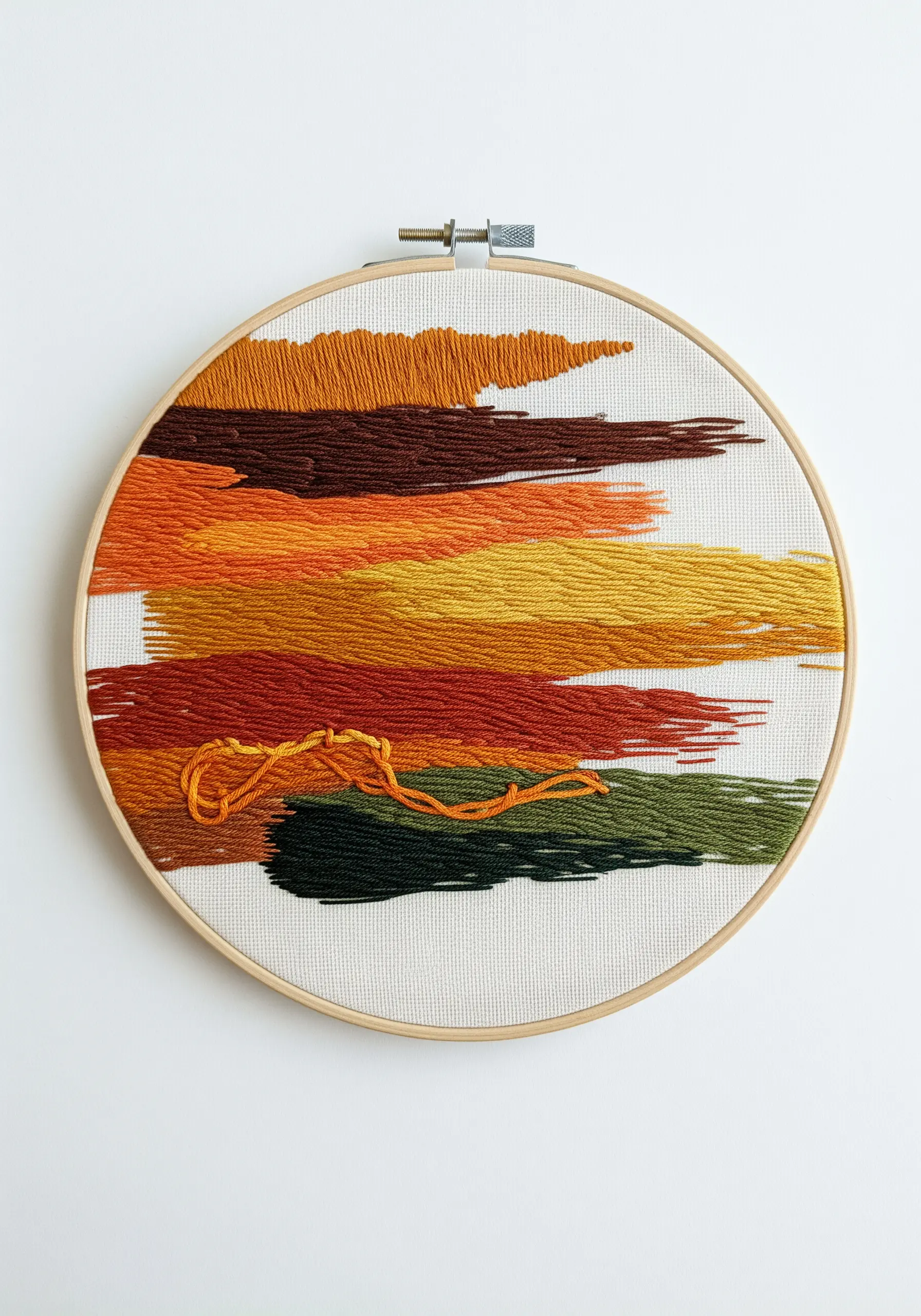
Treat your thread like thick paint to create an expressive, abstract landscape.
Use blocks of horizontal satin stitch to represent different elements—earth, sky, or water.
Don’t aim for perfect, flat stitches; instead, let them have some volume and texture, like impasto brushstrokes.
Allow the edges of your color blocks to be slightly uneven and organic.
This technique turns a simple stitch into a powerful tool for expression, perfect for creating embroidery patterns inspired by stones, wood, and leaves.
20. A Modern Sampler of Woven Filling Stitches
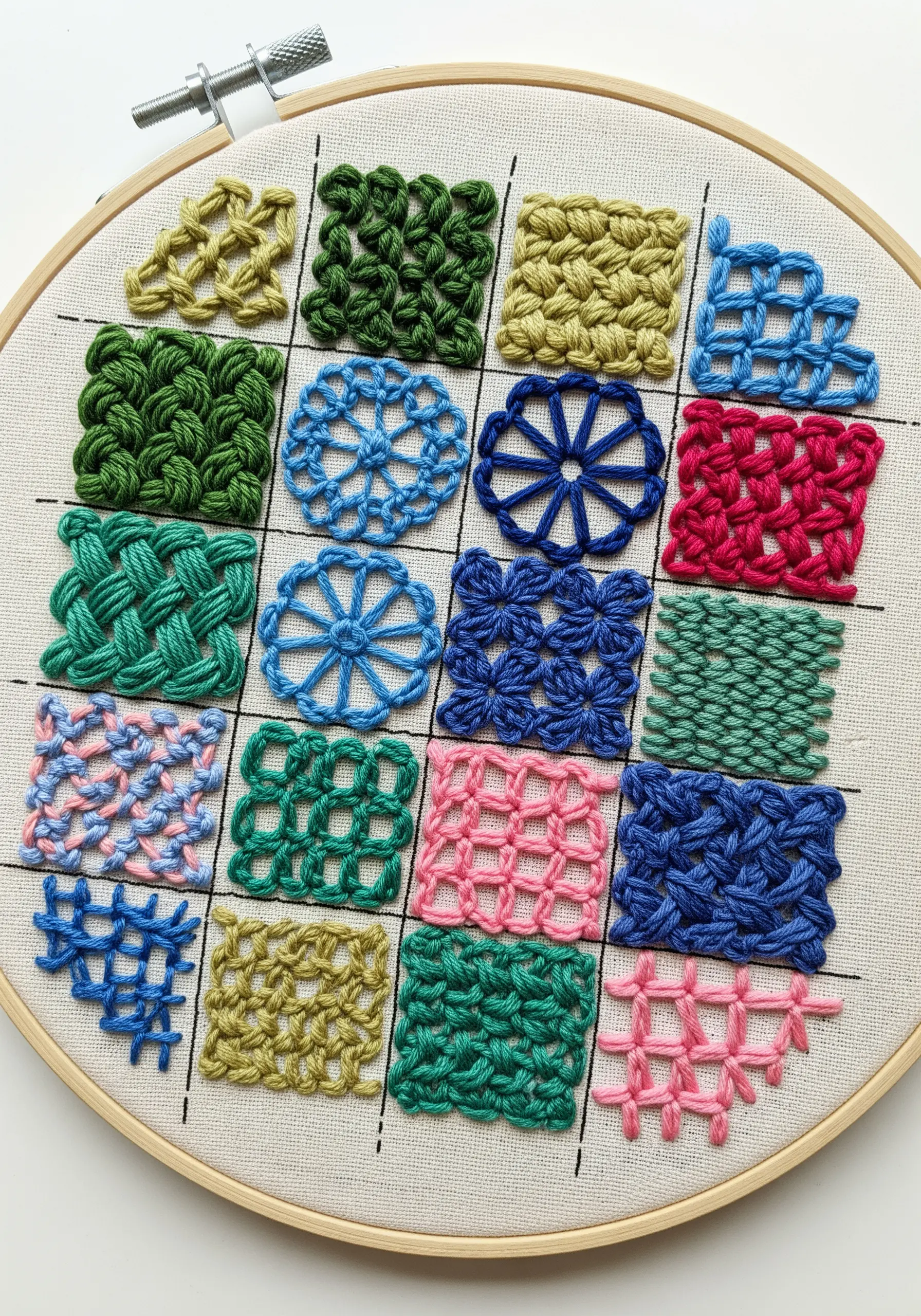
Transform a simple practice sampler into a graphic piece of art by organizing it within a clean grid.
Draw a grid on your fabric and challenge yourself to fill each square with a different woven or lattice-based filling stitch.
Explore techniques like the trellis stitch, woven picot, Ceylon stitch, or diagonal laid work.
This structured approach not only helps you master a variety of complex stitches but also creates a visually fascinating piece that showcases the beauty of threaded structures, showing off your knowledge of unexpected embroidery techniques.
21. Visualizing Sound with Gradient Straight Stitch

Turn sound into a tangible piece of art by embroidering a soundwave.
You can find apps that will visualize any audio clip for you—from a line in a song to a loved one’s voice.
Translate the peaks and valleys of the wave into simple vertical straight stitches of varying heights.
The true artistry lies in the color choice: use a smooth rainbow gradient to give the soundwave life and movement.
Stitched on black fabric, this technique is a stunning example of how to create contemporary rainbow blend stitches.
22. A Study in Duality: Combining Textural Halves
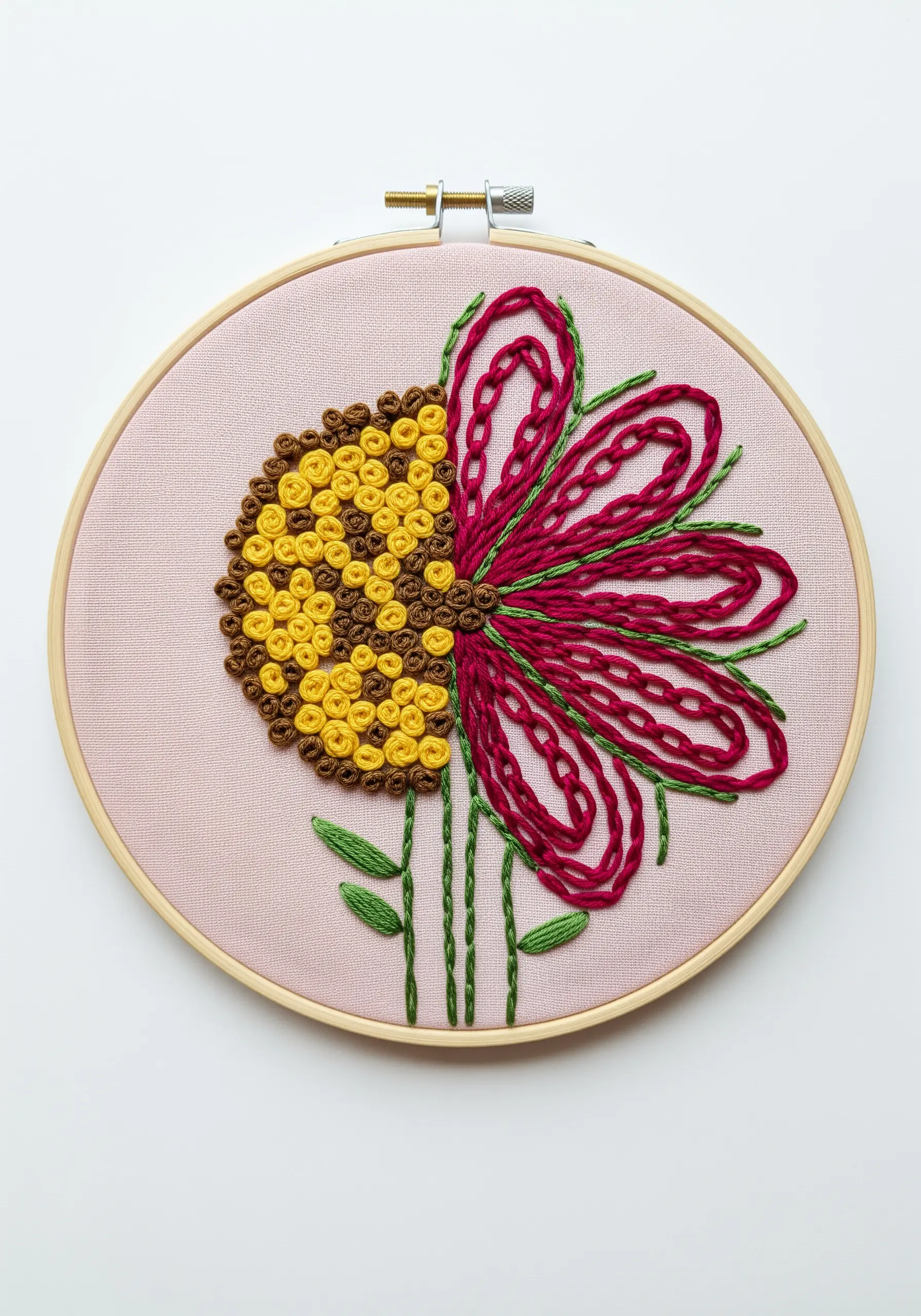
Create a visually arresting design by exploring the concept of duality within a single motif.
Split a simple shape, like a flower or a circle, directly down the middle.
Fill one half with a dense, solid stitch like French knots to give it weight and a pointillist texture.
Fill the other half with an open, linear stitch like the detached chain stitch to create a sense of lightness and delicacy.
This exercise in contrasts highlights the unique character of each stitch and is a clever use of two-color embroidery ideas that make minimalism feel rich.
23. Celestial Aura with Beads, Ribbons, and Crystals
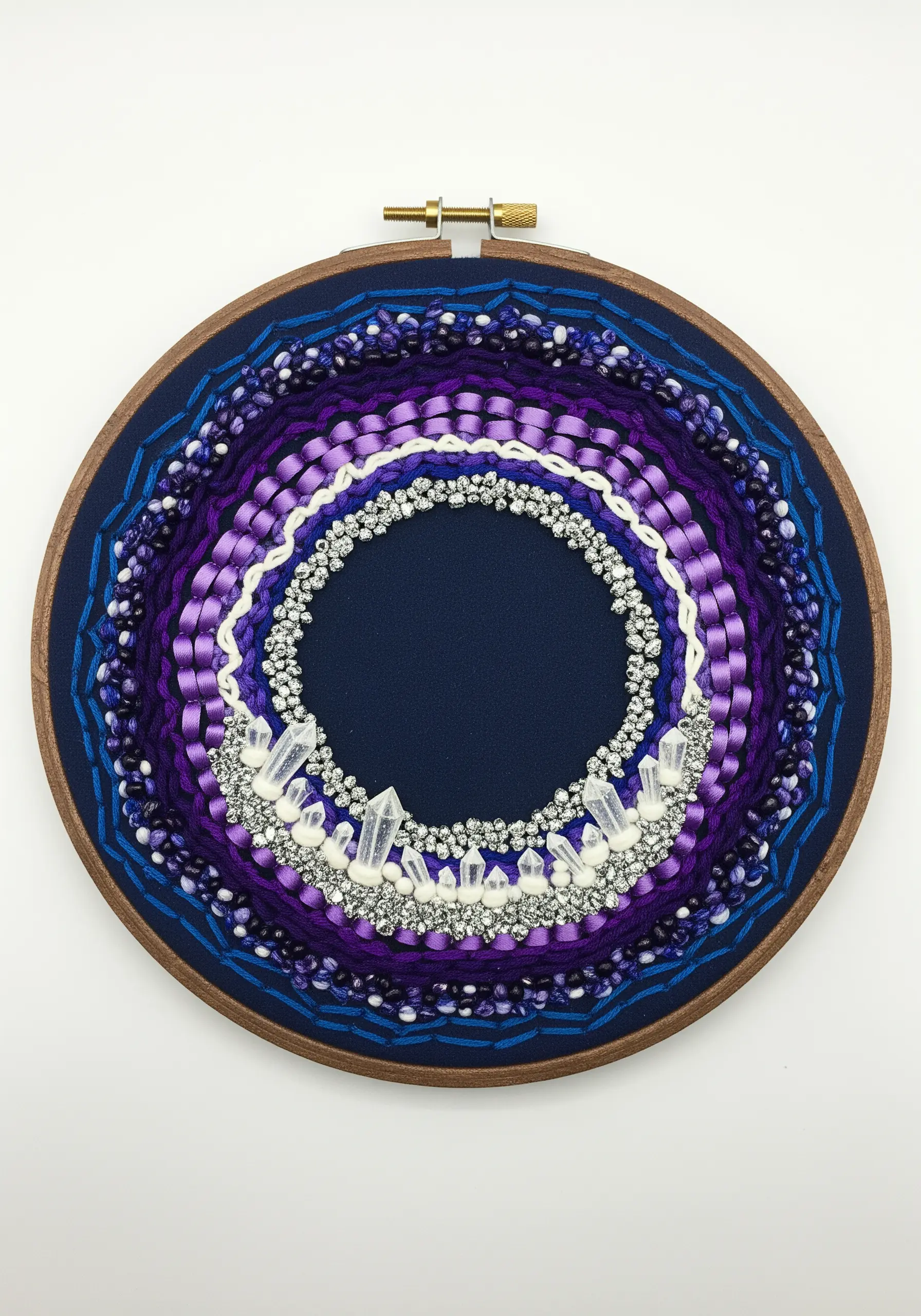
Move beyond thread to build a truly opulent, mixed-media piece.
Create a celestial, geode-like design by working in concentric circles of different materials.
Lay down rings of woven ribbon, couched metallic cord, and rows of shimmering seed beads.
For the magnificent center, incorporate larger elements like quartz crystal points or polished stones, securing them with intricate beadwork.
This maximalist approach results in a rich, tactile piece of art that feels precious and powerful, perfect for framed embroidery artworks that capture tiny details beautifully.
24. Layered Abstraction with Trapped Threads

This advanced technique creates incredible depth by physically separating layers of stitching.
First, stitch bold, abstract color blocks onto your base fabric.
Next, place a clear acrylic disc or a layer of sheer organza over your work, securing it to the hoop.
On this top layer, stitch a new design of loose, meandering lines, allowing the threads to float freely above the bottom layer.
This creates a stunning interplay of color, line, and shadow, turning your hoop into a multi-dimensional canvas. It’s a method seen in unique creative collage inspirations for combining paper layers.
25. A Solar Flare with Braided and Metallic Rays
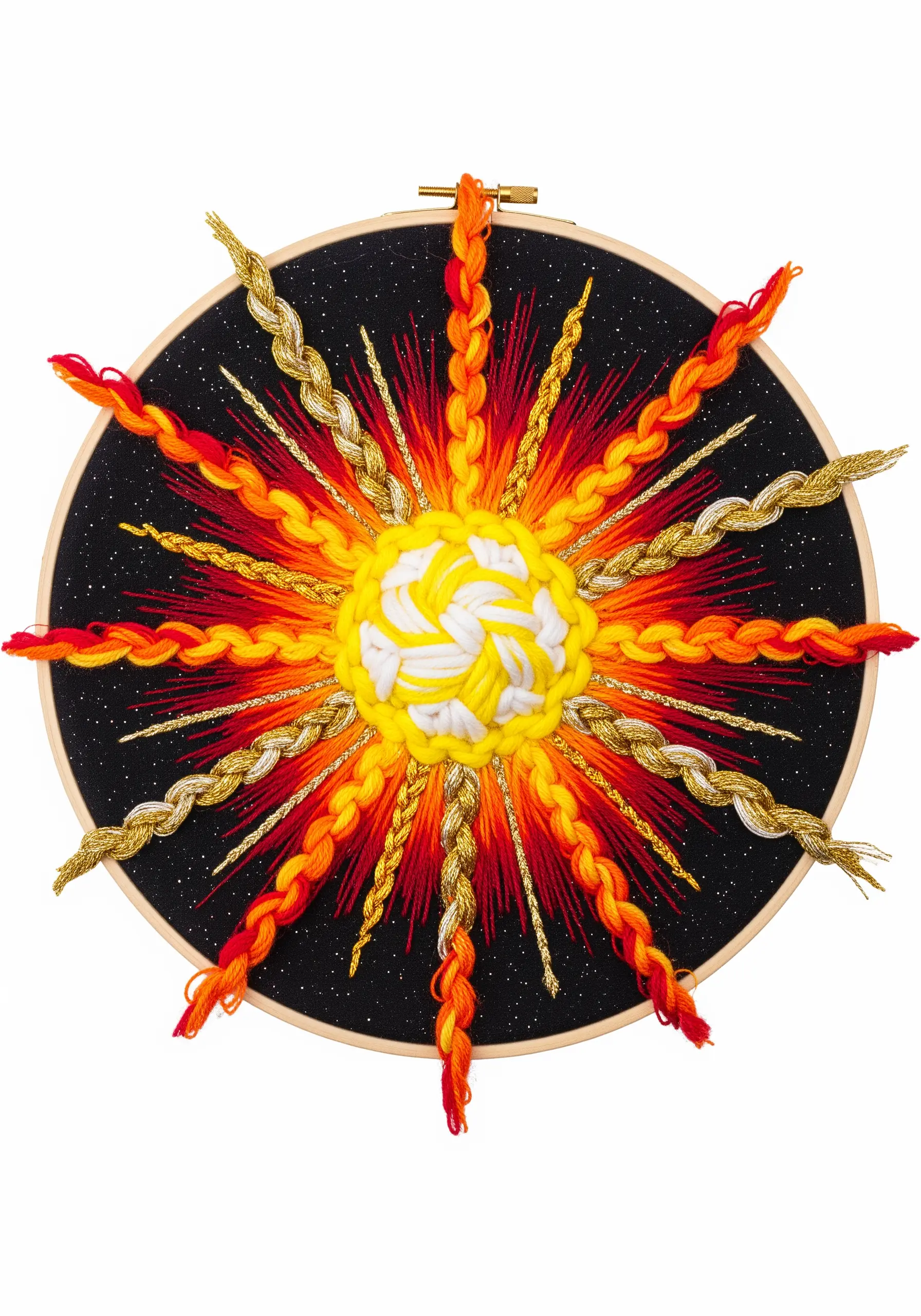
Give your sun motifs an upgrade with intense texture and shine.
For the center of the sun, use a dense, woven stitch like the basket stitch for a solid core.
To create the radiating rays, alternate between different types of thread for maximum contrast.
Use thick, four-strand braids for matte, sculptural rays, and high-shine metallic threads for sharp, reflective ones.
Letting the braided ends hang loose and frayed adds to the sense of fiery, untamed energy, a perfect match for a starry black fabric.
This is a great way to use abstract thread burst techniques for dramatic star-shaped centerpieces.
26. Deconstructed Portrait with Textural Stitches
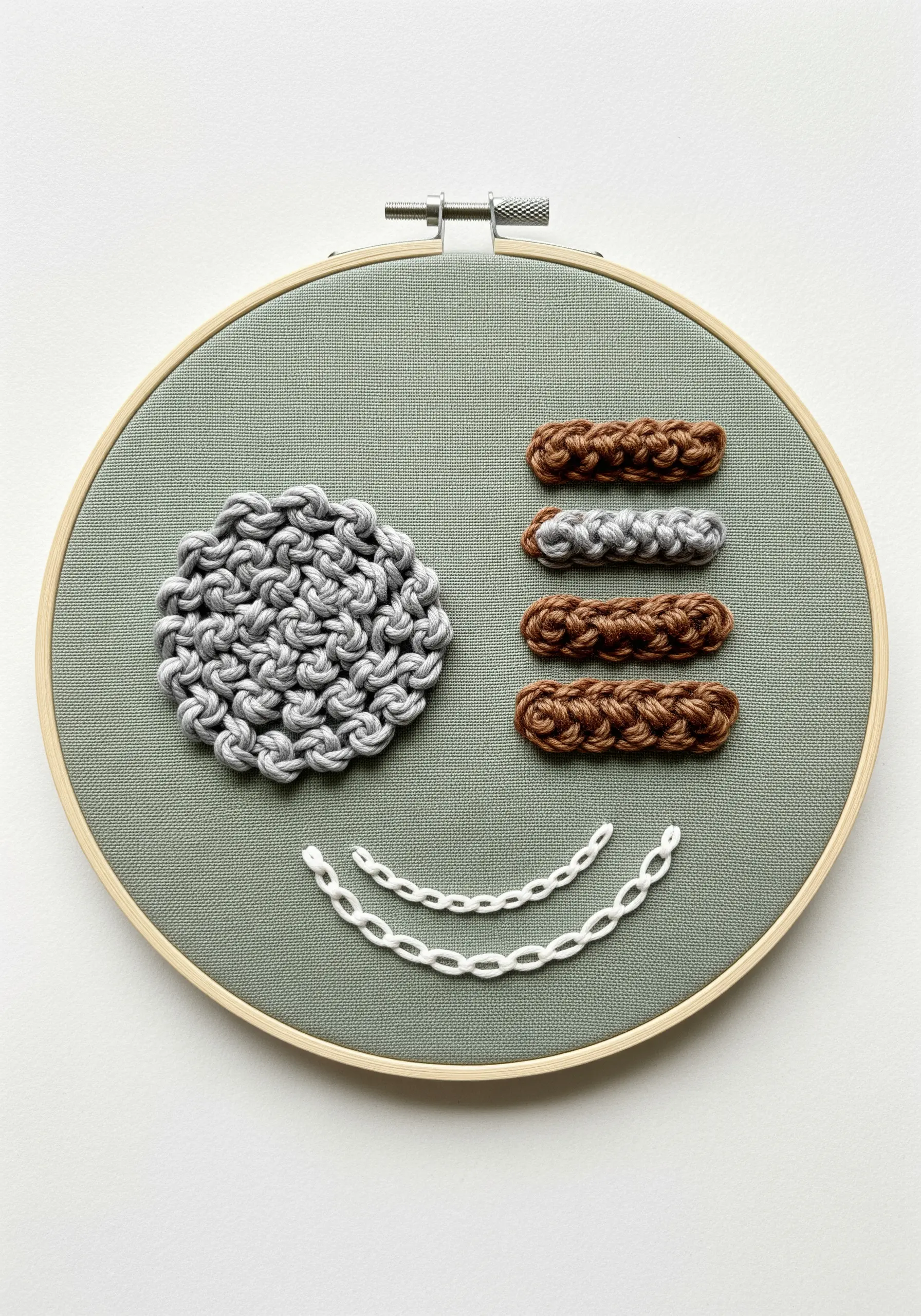
You don’t need lines to suggest a face.
This playful, modern approach uses abstract clusters of texture to represent facial features.
Create a circular eye with a tightly woven basket stitch. Use a few parallel bars of satin stitch to imply a nose, and a simple line of chain stitches for a mouth.
By deconstructing the portrait into its most basic textural forms, you invite the viewer to engage their imagination and complete the picture themselves.
This method turns a portrait into simple embroidery patterns that make statement wall art.
27. Abstract Cartography with Woven Landmarks
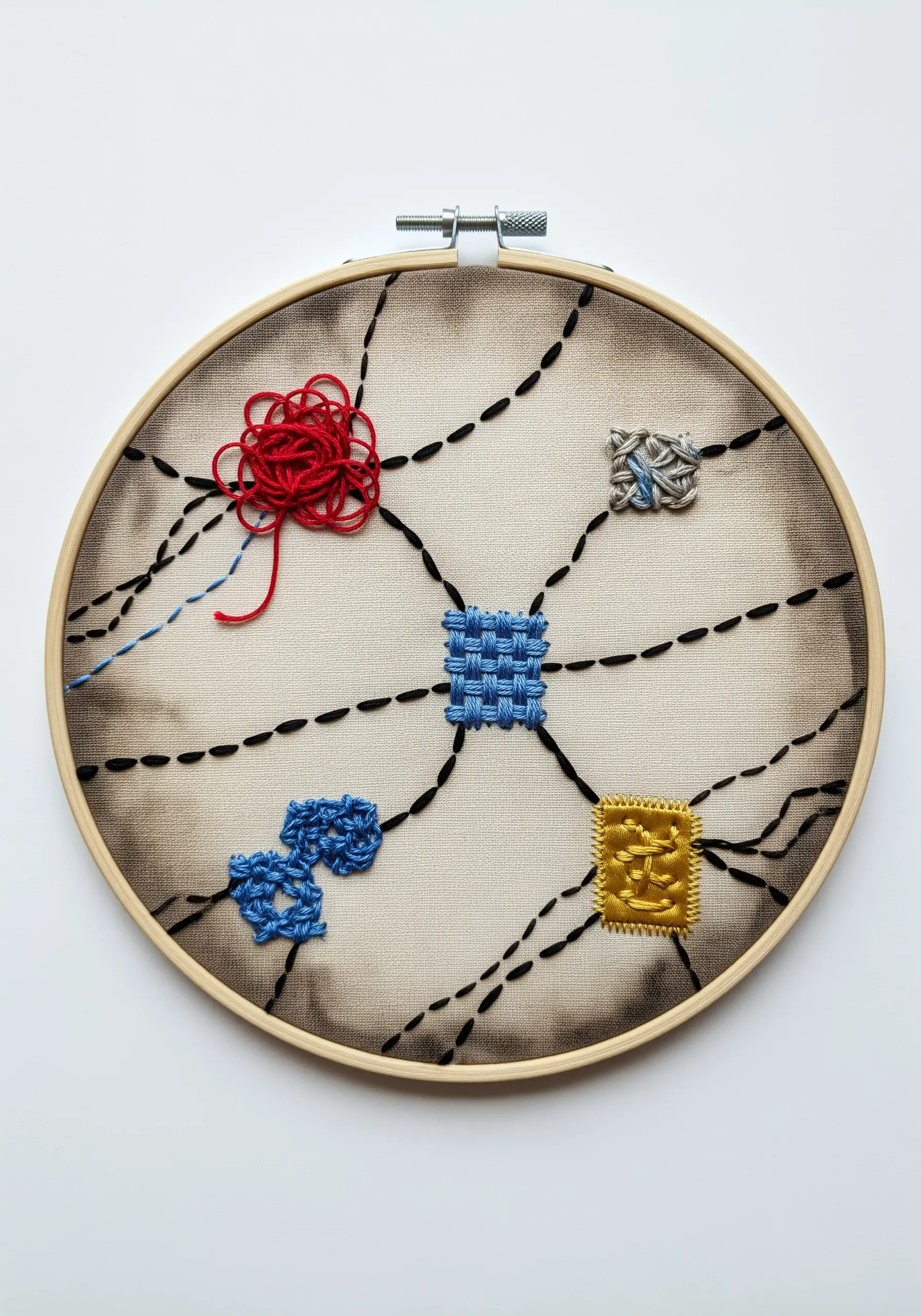
Create a conceptual map of a real or imagined place.
Start by lightly staining your fabric with tea or coffee for an aged, vintage feel.
Use a simple running stitch in a dark thread to create paths, borders, or coastlines.
Instead of marking locations with dots, stitch small, textured squares using woven filling stitches like the basket weave or trellis stitch.
These become your ‘landmarks’.
A single, chaotic knot of red thread can represent ‘home’ or a significant spot, turning your hoop into one of those personal travel-inspired string art maps.
28. Architectural Forms with Suspended Thread Lines
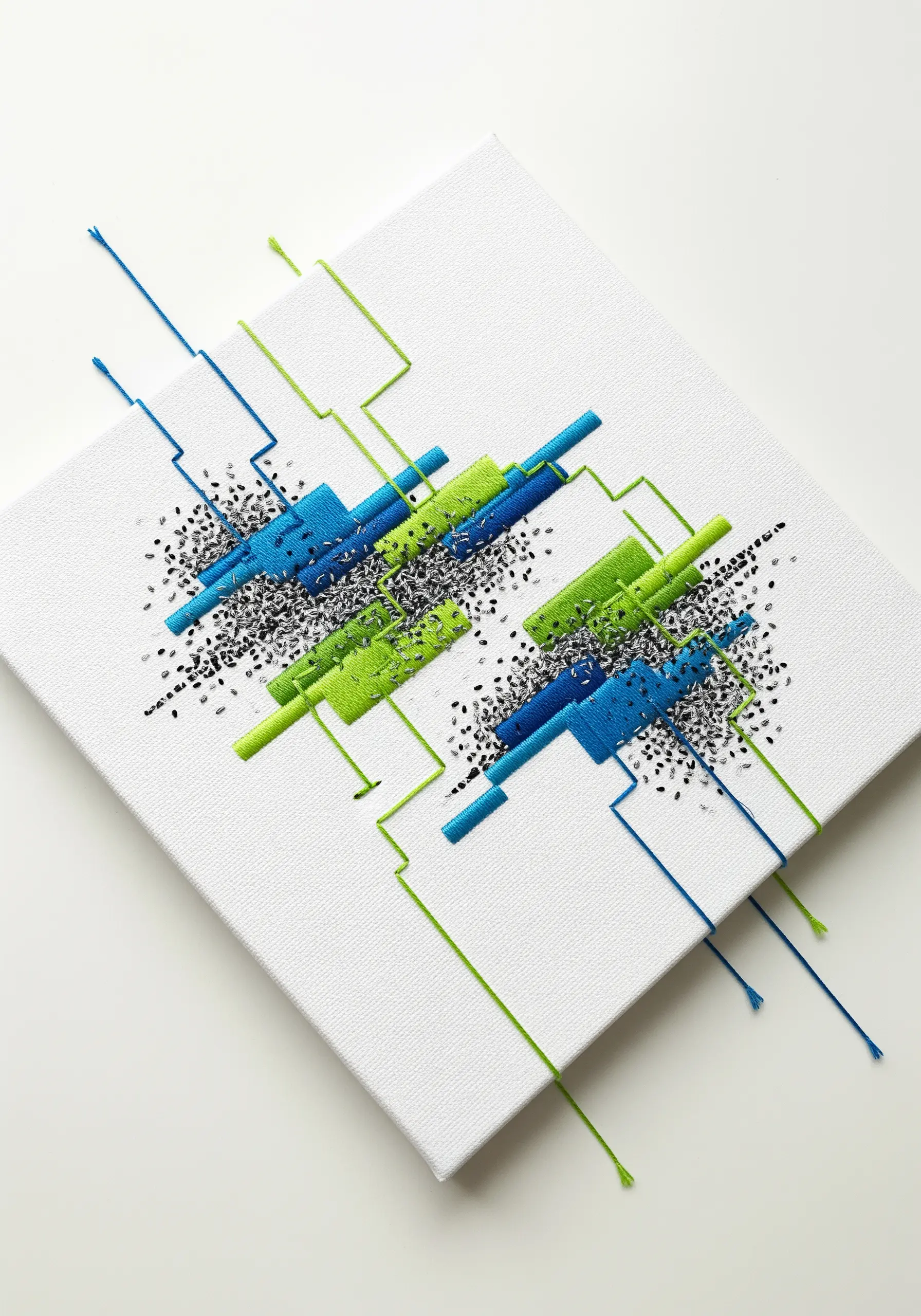
For a truly professional, gallery-style finish, move your embroidery from a hoop to a stretched canvas.
Create bold, architectural blocks of color using pristine satin stitch.
The key to this technique is what happens next: extend single strands of thread from the edges of your stitched blocks, letting them float across the canvas before securing them on the back.
These suspended lines break the boundaries of the embroidery itself, creating a dynamic sense of movement and depth.
This method is perfect for embroidery on canvas wall pieces.