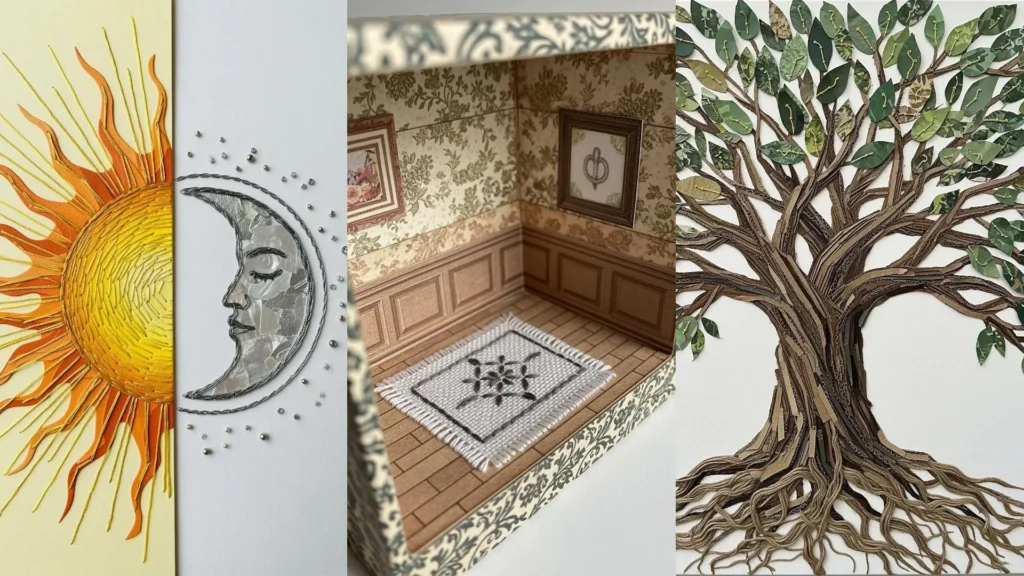
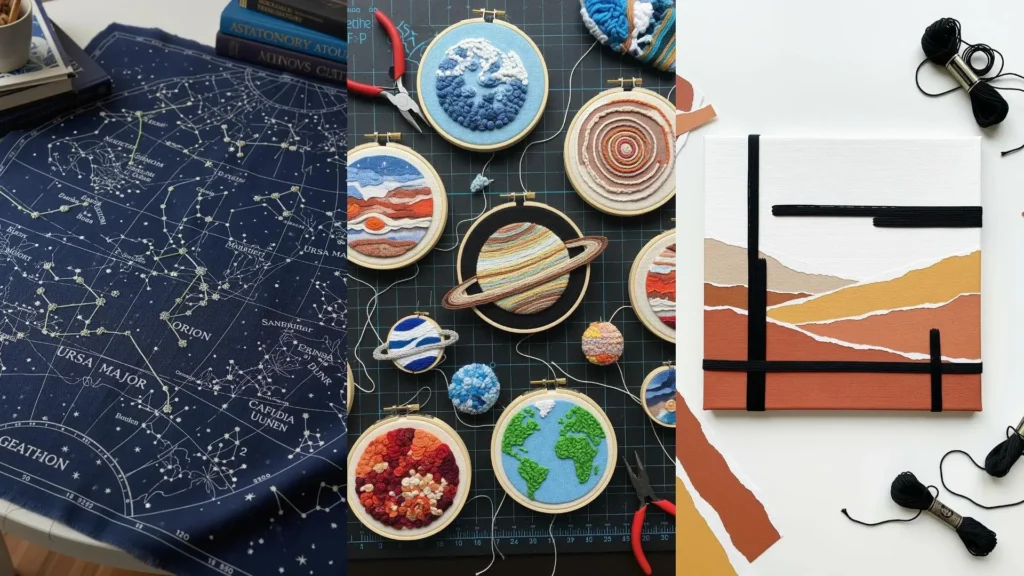
Have you ever looked at a piece of art—a painting, a sculpture, or even a paper collage—and felt a pull to recreate that same feeling with a needle and thread? This is where your embroidery can truly transform. It’s not just about learning a new stitch; it’s about learning to see the world through the lens of texture, line, and dimension.
These paper collage projects are more than just inspiration. They are a practical guide to thinking like an artist. A torn paper edge becomes a lesson in frayed appliqué. The layer of a papercut diorama teaches you about perspective using sheer fabric. Coiled paper strips show you how to build dimension with French knots and couching.
Let these ideas be a quiet encouragement to experiment. You don’t need a complex pattern to begin. Simply notice a texture you love and ask, ‘How could I make that with thread?’ The answer will unlock a more intuitive, expressive, and deeply personal style of stitching—one that is entirely your own.
1. Translate Paper Quilling into Dimensional Stitches

Observe how coiled paper strips create raised floral centers and delicate tendrils.
Replicate this effect in your embroidery by using French knots for dense, bobbled textures and bullion knots for elongated, worm-like coils.
For the fine, scrolling stems, couch a metallic or contrasting thread onto your fabric, securing it with tiny, evenly spaced stitches to mimic the clean lines of paper art.
This layering of stitches adds sculptural depth that makes your botanical pieces feel alive.
2. Use Seed Stitch to Create Atmospheric Movement

The scattered white marks that create a swirling galaxy can be translated directly into embroidery using a simple seed stitch—small, straight stitches worked in random directions.
Use a single strand of white or silver metallic floss on a dark fabric background to create a sense of depth and cosmic energy.
For the larger stars, use a padded satin stitch by first creating a base of small stitches and then covering them with smooth satin stitches; this gives them a raised, 3D effect that catches the light.
3. Capture Iridescence with Specialty Threads

The shimmering, holographic effect on these paper insects is a challenge you can absolutely meet with thread.
Incorporate iridescent or metallic blending filaments, like Kreinik, by twisting them with a single strand of your base color floss.
This subtly introduces shimmer without overpowering the design.
For the bold, graphic outlines, use a whipped backstitch in black; this stitch creates a smooth, solid line that defines the shapes and makes the iridescent fills pop, just like ink on paper.
4. Build Geometric Depth with Layered Fills

The intricate, layered geometry of a paper mandala offers a perfect blueprint for textured embroidery.
Instead of one flat fill, assign a different stitch or thread weight to each concentric layer of your design.
Work the innermost sections with a dense satin stitch, the middle layers with a lighter long-and-short stitch, and the outer edges with open basketweave or couched threads.
This creates a visual hierarchy and tangible depth, turning a simple geometric pattern into a complex modern mandala.
5. Stitch Sea Foam with Clustered Knots

The texture of the wave crests here is a direct inspiration for creating tactile sea foam.
Use clusters of French knots, varying the size by wrapping the thread once or twice around your needle.
For extra dimension, incorporate a few bullion knots into the mix to mimic the rolling action of the foam.
Stitch them tightly together on the edge of your wave, using a bright white or off-white thread to contrast with the deep blues of the water, which you can render with long-and-short stitch blending.
6. Represent Seasons with Varied Stitch Density

This series of trees provides a masterclass in using texture to tell a story.
Translate this concept by using French knots or lazy daisy stitches for the leaves.
For the spring tree, use sparse knots in pale pinks.
Make the summer tree dense and lush with vibrant greens.
In autumn, mix colors—reds, oranges, yellows—and allow some stitches to be looser, as if falling.
For winter, use white and iridescent threads, perhaps adding tiny seed beads to suggest frost, creating an elegant seasonal framed embroidery.
7. Replicate Fur with Directional Stitching

The artist layered tiny strips of paper to mimic the direction of fur—a technique known in embroidery as ‘thread painting’ or long-and-short stitch.
To create a realistic pet portrait, use a single strand of cotton floss and follow the natural flow of the animal’s fur.
Your stitches should be like tiny brushstrokes, blending shades of color to create highlights and shadows.
Pay close attention to the direction around the eyes and snout; this is what brings the portrait to life.
8. Create Ornate Details with Couching

The raised, decorative elements on this box, made from quilled paper, can be beautifully replicated using couching.
Lay down thicker threads, yarn, or even fine cord onto your fabric in your desired pattern.
Then, use a thinner, coordinating thread to tack it down with small, perpendicular stitches.
This technique is perfect for creating bold outlines, scrollwork, and medallions, adding a touch of antique elegance to your projects.
9. Add a Fringe with Woven Picot Stitch

The fringed white edges in this geometric piece offer a stunning textural contrast that you can achieve with woven picot stitches.
This detached stitch creates small, sturdy loops that can be worked along the edge of a satin-stitched shape to create a clean, 3D fringe.
You can control the length and density of the fringe by adjusting your stitch size.
It’s a sophisticated way to add an unexpected tactile element to otherwise flat geometric hoop art.
10. Design a Sampler to Explore Stitch Textures

This four-quadrant paper art piece is a beautiful model for an embroidery sampler.
Divide your hoop into sections and challenge yourself to fill each one with a different textural stitch or technique.
Dedicate one quadrant to French knots, another to woven wheels (like the coiled roses), a third to laid work, and a fourth to couched patterns.
This structured approach transforms stitch practice into a cohesive and artistic sampler.
11. Mimic Torn Paper Edges with Appliqué

The raw, torn edges of the paper hills add organic texture against the clean lines of the sun.
Recreate this effect by using fabric appliqué with frayed edges.
Cut your fabric shapes slightly larger than needed, then gently pull away the threads along the edge you want to look torn.
Secure the shape to your background fabric with a simple running stitch set slightly in from the frayed edge.
This technique is perfect for landscapes and abstract minimal embroidery.
12. Layer Stitches for Feathered Dimension

The peacock’s magnificent tail is built from hundreds of layered paper pieces—a concept that translates beautifully to embroidery.
For each ‘eye’ of the feather, use concentric circles of satin stitch in different colors.
To create the fine, wispy parts of the feather, use detached fly stitches or single straight stitches radiating from the central quill.
Layering these stitches and incorporating metallic threads will give your bird a regal, lifelike shimmer.
13. Weave Lace Patterns with Detached Stitches

The intricate white ‘lace’ on this dress form can be recreated using a combination of detached buttonhole stitch and fly stitch.
These stitches are worked over guide threads rather than directly into the fabric, allowing you to build open, airy, lace-like patterns.
Use them to create scalloped edges, delicate netting, and floral motifs.
For a base, consider applying a fabric collage, giving you a unique ground for your creative fabric collage.
14. Achieve Folk Art Vibrancy with Dense Satin Stitch

The bold, saturated color and clean shapes of this folk art heart are perfectly suited for embroidery.
Use a dense, perfectly executed satin stitch to fill each shape, ensuring your stitches lay smooth and flat.
To keep the edges crisp and prevent colors from blurring, outline each element with a contrasting backstitch *before* you begin filling it.
This technique defines the shapes and gives your work a polished, graphic quality.
15. Spell It Out with Textural Fill Stitches

Each letter in this piece uses a different paper technique, inspiring a similar approach with thread.
When stitching words or monograms, assign a unique fill stitch to each letter to add personality.
Fill one letter with French knots, another with a geometric blackwork pattern, and a third with simple, clean running stitches.
This turns simple typography into a captivating thread-based typography sampler.
16. Create Depth with Atmospheric Perspective

This underwater scene uses layers and color to create a powerful sense of depth.
Apply this art principle to your embroidery.
Stitch elements in the foreground (like the coral) with thick, textured threads and bold stitches like bullion knots or woven wheels.
For the background elements, use fewer strands of floss, cooler colors, and simpler stitches like seed stitch.
This contrast in texture and detail will make your compositions feel immersive and three-dimensional.
17. Capture Botanical Details with Fine-Line Stitching

The delicate illustrations on these bookmarks are a reminder of the power of fine lines.
To stitch your own detailed botanicals, use only a single strand of six-strand cotton floss.
Use a stem stitch or whipped backstitch for smooth, clean outlines on stems and leaves.
For tiny petals and seed heads, use minute satin stitches or single seed stitches.
This precision allows you to capture the scientific elegance of botanical art, creating thoughtful DIY gifts.
18. Construct 3D Florals with Stumpwork

The dimensionality of this paper dahlia is breathtaking, and you can achieve a similar effect with stumpwork embroidery.
In this technique, you stitch individual petals onto a separate piece of fabric, often with a thin wire integrated along the edge.
You then cut out the petals and attach them to your main embroidery, shaping them to create a lifelike, 3D flower that lifts off the surface.
It’s an advanced but incredibly rewarding way to create textured petals.
19. Combine Fabric Collage with Stitched Details

This portrait uses a map collage as its base, a perfect inspiration for mixed-media embroidery.
Begin by creating a collage on your base fabric using scraps of printed cloth, securing them with fusible web or a simple running stitch.
Then, stitch the facial features and defining lines directly on top of the collage.
For the dynamic hair, couch down thick, colorful yarns to mimic the texture of the paper coils, blending the two mediums seamlessly.
20. Scatter French Knots and Seed Stitches for Sprinkles

The playful sprinkles on this paper cake are easy to replicate with thread.
Use a combination of tiny, single-strand French knots and short, straight seed stitches in a variety of bright colors.
Scatter them randomly across the ‘icing’ area to create a natural, celebratory texture.
For the piped icing, a whipped chain stitch or a thick, couched cord will give you the perfect raised, swirling line.
21. Render Ironwork with Raised Outlines

The elegant curves and solid lines of this wrought iron balcony translate beautifully into embroidery.
To capture the bold, graphic quality of the ironwork, use a raised outline stitch like a whipped backstitch or a heavy chain stitch with a dark, high-contrast thread.
Using 4-6 strands of floss will give your lines the necessary weight and presence to stand out against the ‘building’ background, which you could create with fabric appliqué or simple brick stitch fills.
22. Create a Diorama Effect with Layered Organza

This papercut light box creates depth by separating layers in physical space.
You can create a similar diorama effect in a single hoop by stitching on multiple layers of sheer fabric, like silk organza.
Embroider the background elements (distant trees) on the bottom layer of fabric, and the foreground elements (the mushroom-dotted floor) on the top layer.
When stretched together in the hoop, the transparent layers create a magical, three-dimensional forest scene.
23. Translate Woven Patterns into Counted-Thread Work

An ornate rug pattern provides a perfect grid-based design for counted-thread embroidery like cross-stitch or needlepoint.
Transfer the geometric motifs onto graph paper to create a stitch chart.
Work the design on Aida cloth or evenweave linen using tent stitch for a classic tapestry look, or full cross-stitches for a more textured finish.
This methodical approach is a meditative way to create intricate, heirloom-quality pieces.
24. Use Variegated Thread to Mimic Collage

The strips of patterned paper that form these feathers can be beautifully emulated with variegated embroidery floss.
A single strand of variegated thread will naturally shift in color as you stitch, creating stripes and gradients within a satin-stitched shape.
Choose a thread with a short color repeat for distinct stripes, or one with a long, slow transition for a subtle ombré effect.
It’s an effortless way to achieve a complex, collaged look.
25. Design Patchwork with Blanket Stitch Appliqué

The colorful panels of this paper hot air balloon are an invitation to play with fabric appliqué.
Cut your shapes from various patterned fabrics and arrange them on your background.
Secure each piece with a neat, evenly spaced blanket stitch around the edge.
Using a contrasting color for your blanket stitch adds another layer of decorative detail and gives the finished piece a clean, handcrafted feel, perfect for cozy wall hoop projects.
26. Emulate Cable Knits with Raised Stitches

The challenge of translating a knit texture to embroidery can be met with dimensional stitches.
To mimic the look of cable knits, use a raised stem stitch band or a Pekinese stitch, which weaves thread through a backstitch foundation to create a thick, braid-like line.
For an even bolder effect, couch down several strands of chunky yarn, twisting them as you go to replicate the classic cable twist.
This adds incredible tactile interest to any project.
27. Stitch Petit Point for Vintage Elegance

The delicate floral patterns on these teacups evoke the look of petit point, a fine form of needlepoint.
To capture this vintage charm, work your design on a high-count fabric (like 28-count linen or higher) using a single strand of floss.
Use tiny tent stitches or half cross-stitches to create a detailed, tapestry-like effect.
This technique is perfect for creating small, precious objects that feel like treasured heirlooms.
28. Create Heirlooms with Photo Transfer and Thread

A family tree is a deeply personal project, and combining embroidery with photography makes it even more so.
You can print photos directly onto specially treated fabric sheets that you can then stitch.
Frame each tiny portrait with a simple oval of backstitch or a more ornate border of lazy daisy stitches.
For the tree itself, use vertical satin stitches for the bark and a mix of French knots and lazy daisies for the leaves to create a rich, organic texture.
29. Replicate Stained Glass with Bold Outlines

The vibrant colors and dark outlines of stained glass are a classic inspiration for embroidery.
Create the ‘leading’ by using a thick, heavy outline—a six-strand chain stitch or a padded satin stitch in black or dark gray works perfectly.
Then, fill the sections with a smooth, dense satin stitch or long-and-short stitch.
To enhance the illusion of glowing glass, choose silky, high-sheen threads like rayon or silk, which catch the light beautifully.