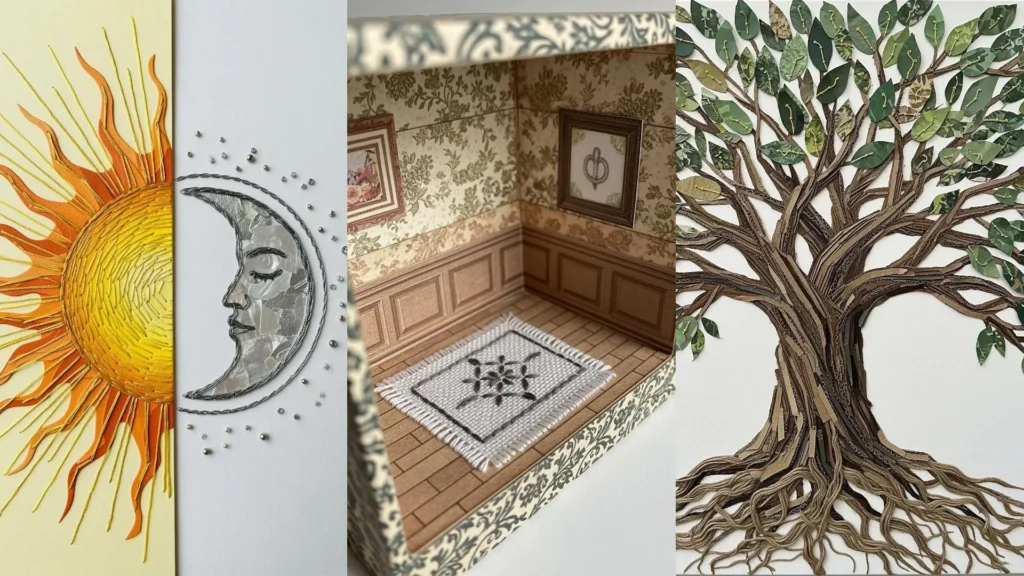
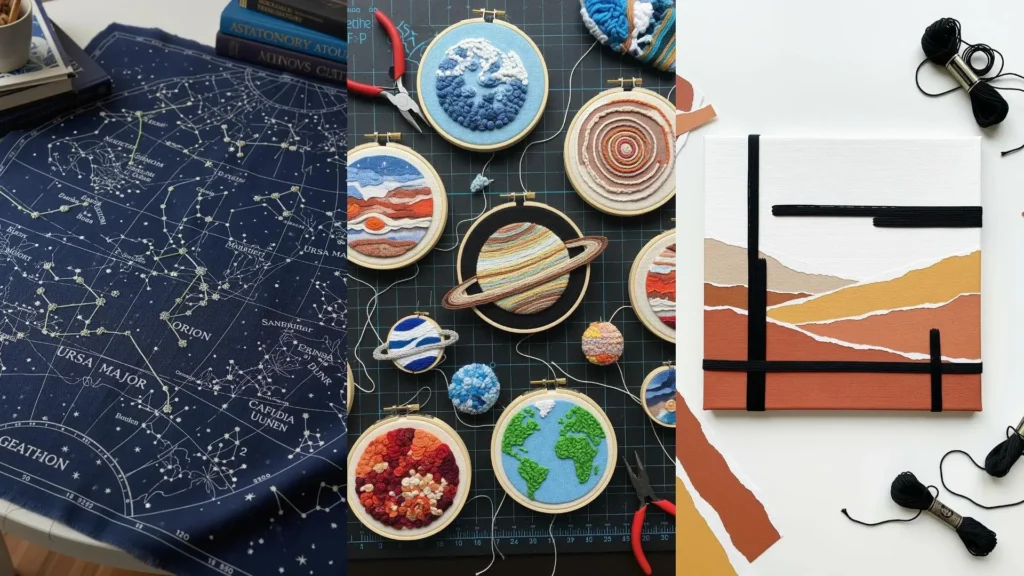
Your journal is more than a place for words; it’s a private canvas waiting for a story. Why not let that story begin on the cover? By blending embroidery with other materials, you can transform a simple notebook into a deeply personal work of art that you can hold in your hands.
This isn’t about recreating complex patterns inside a hoop. It’s about breaking free from it. Think of thread as a line you can draw with, paint as a texture you can build, and paper as a layer of history you can add. Combining these elements allows you to create surfaces rich with depth and meaning.
Whether you’re layering stitches over a painted galaxy, weaving thread through a paper collage, or adding delicate embroidery to a vintage photograph, these techniques invite you to play. They are about exploring the conversation between materials—the softness of thread against the roughness of torn paper, the shimmer of a bead on a matte painted surface. Let’s begin.
1. Layered Paper Collage with Botanical Stitches

Begin by creating a textural background on your journal cover with torn papers—think old book pages, sheet music, or hand-painted sheets.
Adhere them with a matte medium, then embroider a botanical element directly through the layers.
Use a sharp needle to pierce the paper cleanly. For the fern, vary the angle of your satin stitches on each leaflet to mimic the subtle imperfections of natural growth.
This technique gains its power from the contrast between the delicate, precise thread and the rough, layered edges of the paper collage.
2. Celestial Watercolor Wash with Silver Threadwork

First, paint a cosmic watercolor background on a piece of heavy watercolor paper cut to the size of your journal cover. Let deep blues, purples, and blacks bleed into each other for a galactic effect.
Once fully dry, adhere it to your journal and begin stitching. Use a single strand of metallic silver or light gray thread for a delicate, starlit shimmer.
For the moon, a dense long-and-short stitch that follows the crescent shape creates a beautiful sense of volume and light.
You can then scatter tiny French knots or seed stitches as distant stars, making the design feel expansive and magical.
3. Abstract Landscapes with Thread Wrapping and Impasto

Build a vibrant, textured background using thick acrylic paint applied with a palette knife. This impasto technique provides physical ridges and valleys for your thread to grip.
While the paint is still slightly tacky, wrap embroidery floss tightly around the journal. The thread will sink into the paint, securing it without glue and integrating it into the texture.
Use a bold, contrasting thread, like black against a sunset palette, to create dramatic, graphic lines that define the abstract hills and horizon.
This method brilliantly transforms thread from a decorative element into a structural, sculptural line.
4. Geometric Thread Weaving on a Stamped Grid

Lightly stamp or draw your geometric guides onto the journal cover to create a precise framework for your stitching.
Instead of simply filling the shapes, treat them like miniature looms. Create a foundation of long straight stitches that span the shape from one side to the other.
Then, weave a second, often contrasting, thread over and under these foundation stitches. This creates a rich, woven texture that is far more dynamic than a simple satin stitch.
Using a metallic thread for one of the colors introduces a subtle, luxurious highlight that catches the light beautifully.
5. Embellishing Vintage Portraits with Delicate Stitches

Adhere a copy of a vintage photograph to your journal cover. The beauty of this technique, often called photo embroidery, lies in its subtlety.
Use a single strand of embroidery floss to add delicate, textural highlights. Tiny French knots on a collar, seed beads stitched into a hairpiece, or a small floral crown add dimension without overwhelming the image.
For miniature flowers, detached chain stitches and French knots work perfectly. This process breathes new life into historical images, creating a personal and narrative connection.
6. Sculptural Ocean Waves with Beadwork and Paint

Use a palette knife to apply thick white and blue acrylic paint in sweeping motions, building up the crests of waves for a sculptural effect.
While the paint is still wet, press tiny white seed beads and clear microbeads directly into the crests to simulate the effervescent texture of seafoam.
For an extra touch of light, stitch or glue a line of iridescent sequins or blue beads along the curve of a wave. This suggests sunlight glinting on the water.
This is a true mixed-media success, where paint provides the form and beadwork adds the fine texture and sparkle.
7. Layered Collage with a Raised Embroidery Motif

First, build a collage base on your journal using textured papers, vintage illustrations, and fabric scraps.
Stitch your main subject, like a moth, on a separate piece of felt or sturdy fabric. This allows you to use a hoop for perfect tension and fine detail, like long-and-short stitch for blended wing colors.
Carefully cut out the embroidered motif, leaving a small border, and adhere it to your collage. This creates a compelling, raised, 3D effect.
You can even tuck real pressed botanicals under the collage layers to integrate natural elements directly into your design.
8. Textural Stitching on a Faux Bois Background

Create a realistic bark texture on your journal cover using modeling paste, manipulated with a sculpting tool or even a fork. Once dry, paint it with shades of brown and gray.
Using a strong, sharp needle, embroider your scene directly onto this hardened, textured surface.
Employ dense satin stitch for the door and stones, making sure to vary the thread direction to mimic wood grain and masonry.
For the vines, a whipped backstitch or stem stitch creates a raised, twisting effect, while French knots make perfect tiny mushrooms.
9. Hand-Lettered Quotes on a Painted Canvas Patch

Begin by painting a small piece of canvas with a soft watercolor or acrylic gradient. This becomes the backdrop for your words.
Using a water-soluble pen, transfer your favorite quote in a calligraphic style. Stitch over the lettering with a simple backstitch or stem stitch for clean lines.
A dark, contrasting thread ensures the words are crisp and legible against the soft colors.
Finally, fray the edges of the canvas patch slightly before gluing it onto your journal for a soft, tactile finish that stands out.
10. Galactic Alcohol Ink with Beaded Planets

Use alcohol inks on synthetic paper to create a vibrant, fluid background that mimics a colorful nebula, then adhere this panel to your journal cover.
Outline planets with a fine gold metallic thread using a couching stitch, which ensures perfectly smooth, clean circles.
Fill the planets with a dense mosaic of sequins and seed beads. This creates a dazzling, jewel-like effect that contrasts with the fluid ink background.
Add radiating straight stitches in gold thread to create graphic starbursts that tie the composition together.
11. Fabric Appliqué with Decorative Edge Stitching

Create a patchwork heart by first sewing together small squares of scrap fabric. This is a perfect way to use up precious leftovers and memories.
Use a heat-activated adhesive to appliqué the finished heart onto your journal cover for a clean, flat application.
To secure the edges and add a charming handmade detail, stitch a simple running stitch around the perimeter of the heart.
Choosing a contrasting thread color, like red on a neutral cover, makes the hand-stitched detail a deliberate and beautiful focal point.
12. Botanical Illustration with Sculptural Fiber Moss

Prepare your journal cover with a layer of gesso or textured paint, then paint your mushroom illustrations directly onto this earthy surface.
Instead of stitching the entire design, select one key element to render in 3D for maximum impact. Here, the moss at the mushrooms’ base is the star.
Create this mossy effect using turkey work (ghiordes knot) or by couching down loops of textured, fuzzy yarn.
This selective use of embroidery adds a surprising tactile element to an otherwise flat painting, inviting touch and curiosity.
13. Radiant Sun Motif with Woven Stitches

For the center of the sun, use a woven wheel stitch. This technique creates a raised, circular element with beautiful texture that immediately draws the eye.
Create the sun’s rays with sharp, radiating straight stitches. Vary their length to create a dynamic sense of movement and energy.
Use two or three analogous shades of yellow and gold to add subtle depth to both the woven center and the rays.
Finally, intersperse a few gold sequins along the rays to catch the light and add a touch of celestial sparkle, elevating the entire piece.
14. Thread-Painted Bird on a Framed Linen Patch

Work your detailed bird using the thread painting technique on a separate piece of even-weave linen. This allows you to use a hoop for superior tension and control.
Blend multiple shades of thread to create soft, realistic feather textures and subtle gradients.
Once the embroidery is complete, carefully cut out the linen, leaving a neat border. You can fray the edges slightly for a softer finish.
Adhere the finished patch to your painted journal cover. This method allows for maximum detail without having to wrestle with stitching through a thick book cover.
15. Monochrome Redwork Sampler as a Focal Point

Work a small sampler of various stitches—like chain stitch, fly stitch, and woven bars—on a piece of neutral linen or cotton fabric.
Sticking to a single, bold color creates a cohesive, graphic look that highlights the unique texture and form of each stitch. This is the essence of modern Redwork.
Arrange your stitches in a balanced, grid-like composition to give it a clean, contemporary feel.
Mount the finished sampler onto a journal with a complementary cover color, like a deep teal or charcoal, to make the red thread truly pop.
16. Botanical Composition with Pressed Flowers and Tulle

Arrange your delicate pressed flowers and ferns on the journal cover, composing your botanical scene.
Lay a single layer of fine, sheer tulle over the entire arrangement. Pull it taut and secure it at the back of the cover.
Using a single strand of thread that matches the tulle, add tiny, almost invisible tacking stitches around the edges of the petals and leaves.
This secures the botanicals without crushing them, while the tulle softens the look and adds a protective, ethereal layer.
17. Miniature Window Diorama with 3D Stitches

Create your window frame using appliqué fabric or even thin pieces of balsa wood for a true 3D effect that casts a small shadow.
For a lush, overflowing flower box, rely on highly textural stitches. Woven wheel roses, dense French knots, and bullion knots create dimensional blossoms that pop off the surface.
Use detached chain stitches for leaves and stem stitch for trailing vines, letting them cascade naturally down the cover.
This delightful technique turns your journal cover into a charming, miniature scene that invites closer inspection.
18. Abstract Mark-Making with Thread and Collage

Build an expressive, chaotic background by layering torn paper, cardboard, and splatters of paint on your journal cover.
Instead of stitching a recognizable image, use thread to make abstract marks. Employ clusters of straight stitches, chunky cross-stitches, and couched threads to add graphic interruptions.
A bold, limited color palette, like black and red on a dark background, enhances the raw, energetic feel of the piece.
Here, thread functions as a drawing tool, adding another layer of defiant line and texture to the composition.
19. Interactive Mandala with Ink and Thread

Draw or stamp intricate mandala designs onto a fabric panel using a fine-tipped permanent ink pen, like a coloring book page.
Instead of filling the entire design with color, choose specific sections to fill with embroidery. This creates a beautiful interplay between the flat ink lines and the raised, colorful thread.
Use satin stitch for solid fills and add decorative beads or French knots to the centers for a touch of sparkle and dimension.
This combination of the meditative acts of drawing and stitching results in a visually engaging and deeply personal piece.
20. Minimalist Cityscape with Architectural Line Work

On a dark-colored journal, a simple outline can have a powerful impact. Start by lightly sketching a city skyline, focusing only on the iconic silhouettes.
Use a simple backstitch in a bright, contrasting color like white or silver to trace the outline. Keep your stitches small and even to achieve crisp, clean architectural lines.
For the windows, use single, short straight stitches in a warm yellow or gold thread. This minimal detail suggests glowing lights and brings the entire quiet scene to life.
The elegance of this design lies in its restraint and the effective use of negative space.
21. Anatomical Illustration with Thread Painting

Begin by transferring a detailed drawing of an anatomical heart onto your fabric. This will be your map.
Use thread painting (long-and-short stitch) to fill the design, paying close attention to the direction of your stitches to mimic muscle fiber and create a sense of form.
Blend multiple shades of red and deep purples to achieve realistic shading. Use a contrasting blue for the veins to create clear visual distinction.
Mount the finished embroidery over a collage of vintage anatomical charts for a cohesive, intellectual aesthetic.
22. Geometric Crystal Formations with Satin Stitch

This design is all about precision. Start by drawing the geometric crystal cluster onto your fabric, clearly defining each facet.
Fill each facet with satin stitch, but here is the key: change the direction of your stitches for every single facet.
This simple change in angle makes each plane catch the light differently, creating the illusion of depth and sparkle without needing metallic thread.
Use a gradient of analogous colors, like multiple purples, to enhance the sense of dimension and realism.
23. Painted Pond Scene with Felt Appliqué Details

First, paint a serene pond scene onto your journal cover. Blend blues and whites with a soft brush to create the impression of ripples and light on the water.
Cut your lily pad shapes from green felt. Add vein details with a few simple straight stitches in a slightly darker green thread.
Adhere the felt lily pads to the painted surface using fabric glue. The raised, soft texture of the felt instantly lifts them off the ‘water,’ creating a simple but highly effective 3D effect.
This is a quick way to add dimension to a painted piece without complex embroidery.
24. Fabric Collage Balloon with Embroidered Structure

Create the main balloon shape by collaging different patterns of fabric onto a single backing piece. This is a wonderful way to use meaningful scraps.
Once the collage is assembled, use embroidery to add the structural details that tie it all together.
Use a dark, contrasting stem stitch or chain stitch for the ropes and netting over the balloon, which unifies the disparate fabric patterns.
For the basket, a woven stitch (like weaving bars) creates a realistic, textured effect that completes the illustration.
25. Zentangle Patterns with Selective Embroidery

Combine the meditative art of Zentangle with your stitching. Draw your intricate, structured patterns onto the journal cover with a permanent fineliner pen.
Instead of stitching the entire design, select a few key areas to fill with thread. This creates a powerful contrast between the flat ink and the raised texture.
Use simple, dense stitches like satin stitch or seed stitch to fill the chosen sections. The goal is to add texture, not overly complex stitchery.
A monochrome palette keeps the focus squarely on the interplay of pattern and material, resulting in a sophisticated and graphic finish.
26. Star Constellation on a Splatter-Paint Night Sky

Create a realistic and dynamic night sky by splattering white acrylic paint over a black journal cover. Use a stiff brush or an old toothbrush to achieve a fine mist of distant stars.
Once dry, use a single strand of white or silver thread to connect the main stars of your chosen constellation. Simple, clean straight stitches are all you need.
For the main stars themselves, use a slightly more prominent stitch, like a small star stitch or a single French knot in a metallic thread, to make them stand out.
This technique is beautifully simple, relying on the contrast between the random paint splatters and the precise, geometric lines of thread.
27. Thread-Painted Autumn Leaves on Watercolor Paper

Challenge your materials by stitching directly onto a sturdy piece of watercolor paper instead of fabric. Pre-punching the stitch holes with a fine needle makes the process smooth.
Use long-and-short stitch to blend rich autumnal colors—reds, oranges, and golds—to capture the variegated beauty of changing leaves.
For more delicate leaves, like the ginkgo, use long, open straight stitches to suggest the veins without overwhelming the form.
Mount the finished embroidered paper onto your journal, perhaps over a soft wash of color, to create a layered, artisanal piece. Stitch your autumn leaves with intention.
28. Modern Color-Blocked Stitch Sampler

Divide your journal cover into clean, geometric blocks of color using paint or colored paper. This creates a modern, graphic canvas.
Within each color block, fill the space with a single, repeating stitch. This turns the journal into a tactile study of texture and color.
Choose a different stitch for each block to create contrast: dense French knots in one, orderly chain stitch rows in another, and a woven pattern in a third.
The key is consistency within each block. This approach creates a design that is bold, contemporary, and highly satisfying to the touch.