You have a deep appreciation for embroidery. You’ve followed the patterns, mastered the stitches, and filled hoops with beautiful work. Yet, you sense there’s another level of artistry waiting for you, one that feels more personal, expressive, and uniquely yours.
The key isn’t necessarily a more complicated stitch; it’s a change in how you see your materials. It’s time to think beyond the hoop and invite other textures to the conversation. Imagine your thread as the element that connects paint, paper, botanicals, and even ceramics into a single, cohesive story.
This collection is your guide to that next step. Here, embroidery is not just an embellishment but a structural and conceptual tool. You’ll discover how to integrate your stitching into broader mixed-media contexts, creating art that is rich with depth, meaning, and intention. Let’s explore the possibilities together.
1. Botanical Artistry on Watercolor Paper

Begin by applying a soft watercolor wash to heavy, cold-press paper, which prevents buckling.
Once dry, arrange pressed botanicals and use a fine couching stitch with metallic thread to trace organic, flowing lines around them.
Couching protects delicate metallic fibers from abrasion and allows for elegant curves that a standard stitch can’t achieve on paper.
This method transforms your needlework into delicate, gallery-worthy pressed flower embroidery ideas that blend painting with textile art.
Use a sharp, size 10 needle to create clean perforations without tearing the paper.
2. The Embroidered Appliqué Patch

Elevate a collage by creating a central motif as a separate embroidered appliqué.
Stitch your design—like this intricate moth—onto a piece of fabric backed with a firm stabilizer, then carefully trim around the edges.
Layer torn papers, vintage text, and fabric scraps onto your journal cover or canvas, securing them with archival glue.
Attach the finished embroidered patch on top using a few discreet tacking stitches, creating a raised, dimensional effect that draws the eye.
This technique gives your centerpiece a clean, professional finish, making it stand out from the background textures in your DIY embroidered mixed-media journals.
3. Sculptural Yarn on Painted Canvas

Introduce dramatic texture to a painted canvas by incorporating chunky, hand-knitted yarn.
First, build up a tactile base on the canvas using thick gesso or modeling paste, creating peaks and valleys for visual interest.
Once the paint and gesso are fully cured, couch the thick yarn directly onto the surface using a strong, matching embroidery floss.
This contrast between the hard, painted texture and the soft, yielding fiber creates a powerful sensory experience and adds sculptural depth to your abstract art.
These abstract thread layer-on-layer creations transform a flat surface into a dynamic object.
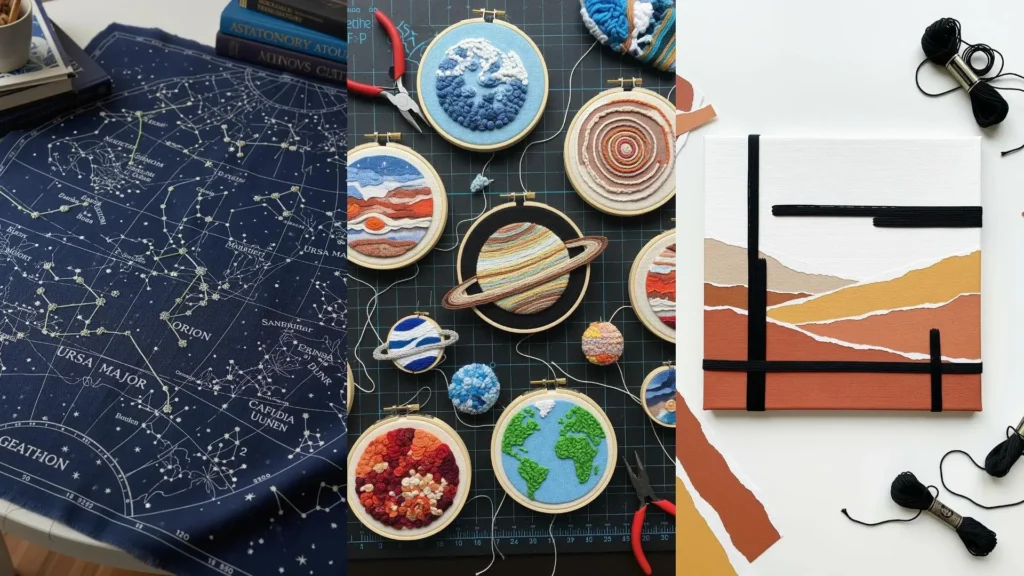
4. Celestial Stitching on a Painted Galaxy

Transform a simple hoop into a cosmic scene by painting your fabric before you stitch.
Use a dark cotton fabric and apply acrylic or fabric paints with a sponge to blend a swirling galaxy of purples, blues, and whites.
After the paint is completely dry, use single strands of metallic or white floss to add constellations with straight stitches and stars with tiny French knots or seed beads.
The paint provides a rich, deep background that makes your stitched elements shimmer with celestial light, turning simple stitches into dreamy wall gallery pieces.
5. Thread as Line Art on an Illustration

Use thread to add a graphic, dimensional layer to a drawing or print on heavy cardstock.
Instead of filling shapes, treat your thread as a drawing tool, using a simple backstitch to trace or add new contours to the image.
Choose a high-contrast thread color, like this bold red, to create a striking visual separation between the original art and your stitched lines.
To avoid tearing the paper, carefully pre-pierce your stitch holes with an awl or a thick needle before you begin sewing, turning illustrations into modern thread portraits.
6. Stitching Through Layered Paper Collage

Combine collage and embroidery to create uniquely tactile greeting cards or small art pieces.
Tear and layer colored or textured paper to create an abstract landscape or motif, securing the pieces with a glue stick.
Use a simple running stitch or blanket stitch to add a decorative border or accent line that physically binds the paper layers together.
This not only adds visual interest but also introduces a handmade warmth that glue alone cannot provide, perfect for DIY embroidered mixed-media cards.
Use a thimble to help push the needle through the multiple layers of cardstock without straining your fingers.
7. Thread and Texture on Mini Canvases

Explore different mixed-media textures across a series of small, related canvases.
On one canvas, apply crackle paste and, once dry, stitch over the fissures with metallic thread to highlight the pattern.
On another, use decoupage with vintage paper like sheet music, then add a brightly colored embroidered motif as a focal point.
For a third, create sculptural swirls with thick acrylic paint or modeling paste, then couch a contrasting thread into the grooves to define the movement.
This approach allows you to experiment with ways to combine embroidery and mixed media on a manageable scale.
8. Dimensional Embroidery on Paper Cutouts

Give your paper crafts a surprising element of depth and texture by adding embroidery directly to cutouts.
Print or draw your motif onto heavy cardstock, then carefully cut it out.
Use satin stitch and long-and-short stitch to fill areas of the paper cutout, creating a plush, raised surface that contrasts beautifully with the flat paper.
You can then mount the embellished cutout onto another surface—like a vintage book page—using foam spacers to create a shadowbox effect.
This project is perfect for turning simple illustrations into striking handmade art objects.
9. Weaving Embroidery into Textile Wall Hangings

Integrate a beautifully embroidered panel into a larger woven or macrame wall hanging for a truly unique piece of art.
First, complete your embroidery on a piece of linen or cotton canvas—a central motif like a sun works perfectly.
Then, either weave around the finished panel on a loom or stitch it directly onto a larger woven background.
Surround the embroidered section with complementary tassels, braids, and fabric strips to create a cohesive piece that celebrates multiple fiber arts, resulting in stunning mixed-fiber wall hangings.
10. Embellishing Vintage Photographs with Thread

Breathe new life into old black-and-white photographs by adding vibrant, unexpected floral crowns or details.
Choose a reproduction print on matte photo paper, which is easier to pierce than original glossy photos.
Use bold, contrasting colors and simple, effective stitches like woven wheel flowers and lazy daisy leaves to create the design.
The juxtaposition of the monochrome portrait and the bright, textural embroidery creates a surreal and captivating piece of art.
Always work with a copy, preserving the original photograph while you explore these powerful embroidery mixed-media DIY ideas.
11. Abstract Stitching Over a Printed Map

Use a vintage map as an unconventional fabric to create a piece of art that tells a story of place and texture.
Mount a section of a map into your hoop, treating it just like fabric.
Instead of stitching a specific design, explore abstract textures and lines, using dense rows of satin stitch, running stitch, and couching to create a tactile overlay.
The stitched colors can represent elevation, weather patterns, or emotional journeys, turning a functional document into a piece of personal, abstract thread embroidery.
12. Creating a Diorama with Stitched Elements

Move your embroidery off the wall and into a three-dimensional scene by building a diorama.
Stitch your main elements, like these mushrooms, onto sturdy fabric, then trim them out, leaving a small border.
Line a shadowbox with a painted backdrop or scenic paper.
Build up the foreground with natural materials like moss, twigs, and paper, then place your stitched elements within the scene at varying depths to create perspective.
This method allows you to create immersive handmade sculptures that tell a complete visual story.
13. Architectural Lines and Paper Collage

Combine architectural illustration with abstract elements by using thread to connect different focal points.
Start with a line drawing on heavy paper and add blocks of textured or handmade paper to suggest walls or windows.
Then, use a single, dark thread to create tense, intersecting lines that span across the illustration, as if mapping sightlines or energy.
This technique adds a layer of conceptual depth, turning a static image into a dynamic exploration of space and connection.
These collage art ideas transform flat surfaces into interactive designs.
14. Beading on Cyanotype Fabric Prints

Enhance the ethereal beauty of a cyanotype print with the delicate texture of seed beads.
Create your botanical print on treated fabric, allowing the iconic Prussian blue to develop fully.
Instead of thread, use a beading needle and translucent thread to meticulously fill in areas of the print with tiny seed beads.
The subtle shimmer and raised texture of the beads catch the light beautifully, adding a magical, pointillist effect to the monochrome floral silhouette.
This is a perfect example of mixed-media fabric collage embroidery projects using beads.
15. Hand-Stitched Paper Garlands

Create beautiful, reusable decorations by stitching together watercolor paper shapes.
Paint heavy watercolor paper with soft, blended colors and cut out your desired shapes, like leaves, stars, or moons.
Use a sewing machine with a slightly longer stitch length (or hand-stitch with a simple running stitch) to connect the paper pieces into a garland.
The visible stitching adds a charming, handcrafted detail that elevates these simple cutouts into something special, making them perfect paper art projects that complement personalized embroidery gifts.
16. Urban String Art on Textured Surfaces

Take string art off the traditional wood-and-nail base and apply it directly to a textured wall or canvas.
Lightly sketch a geometric design and use small, discreet pins or nails at each corner and intersection.
Wrap neon-colored embroidery floss or yarn tightly around the pins to create crisp, clean lines.
The contrast between the bright, smooth thread and the rough, matte surface creates a bold, modern look that feels like a graphic installation, similar to these nature-inspired string art patterns, but with an urban twist.
17. Embroidery and Resin for a Water Effect

Create stunningly realistic water scenes by combining embroidery with art resin.
First, complete all your embroidered elements—like seaweed and ocean plants—on a wooden base, securing your threads on the back.
You can also add sand, shells, and beads for extra texture.
Carefully pour a layer of clear art resin over the designated ‘water’ areas, using a heat gun to remove any bubbles.
The resin creates a glossy, liquid finish that makes the embroidery beneath look submerged, resulting in breathtaking coastal ocean-inspired string art ideas.
18. Weaving Stitches on Upcycled Ceramics

Transform a vintage plate or ceramic dish into a loom for decorative stitching.
Using a diamond-tipped drill bit, carefully drill a series of evenly spaced holes around the rim of the plate.
You can then use these holes as anchor points to weave colorful threads across the center, creating intricate geometric patterns or woven textures.
This technique upcycles a forgotten object into a unique piece of art, bridging the gap between hard ceramics and soft textiles to create creative handmade art objects that double as home decor.
19. A Sampler of Stitches on Mixed Surfaces

Create a sophisticated textile collage by practicing different stitches on a variety of materials.
Cut small squares of different fabrics—linen, cotton, canvas, felt, and even thick paper—and arrange them in a grid.
On each square, execute a different stitch or a small linear pattern. This allows you to explore how thread tension and texture change depending on the foundation material.
Mounting the finished squares together creates a beautiful reference piece that is also a work of art, celebrating the diversity of stitching natural textures.