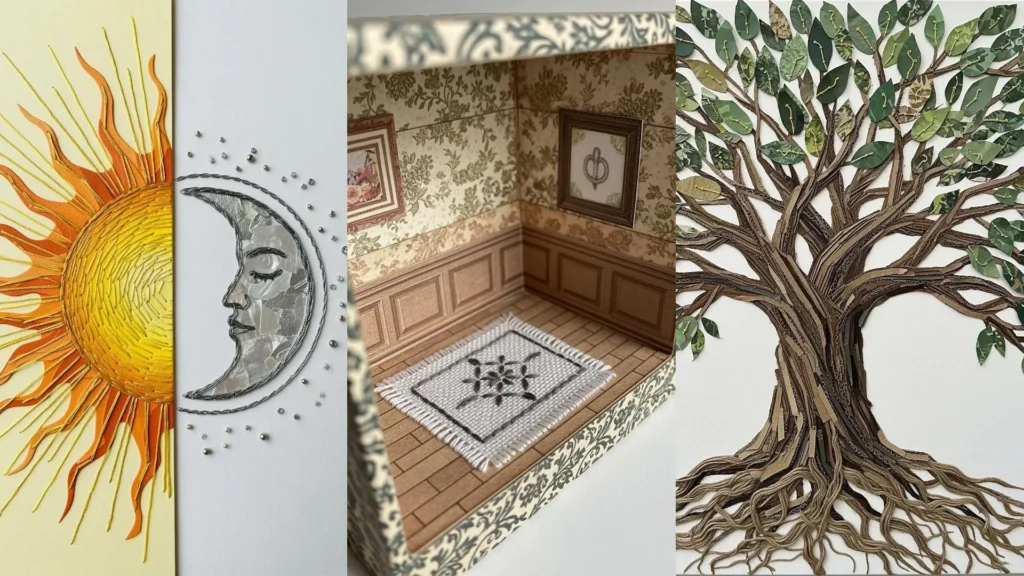
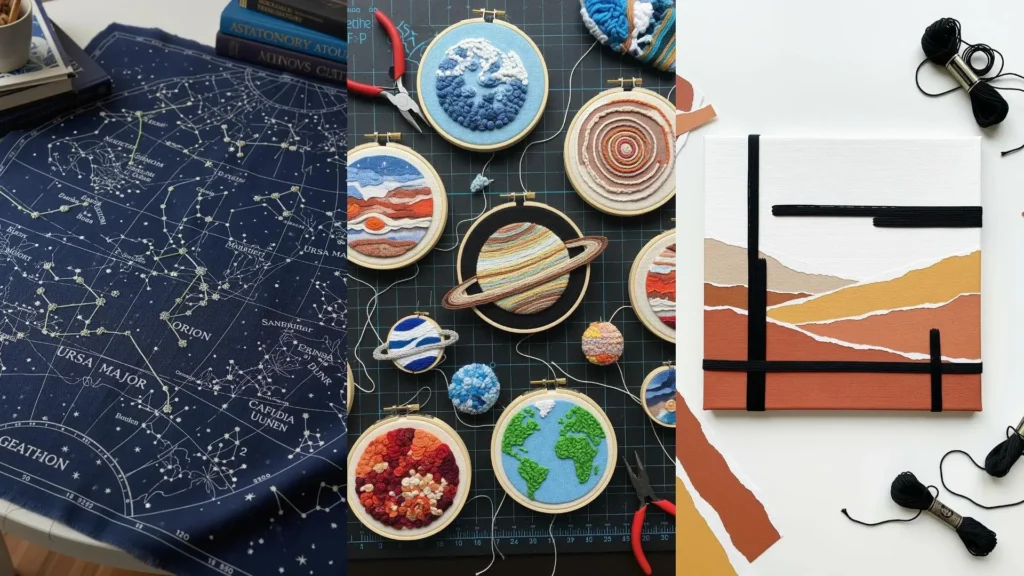
You likely have a stash of materials—old maps, photos, fabric scraps, and paper—that you’ve saved because they felt “special,” yet they sit unused in a drawer. Embroidery is the binding agent that can finally bring these disparates textures together. By pushing your needle through surfaces other than fabric, you stop just decorating and start constructing new narratives.
Mixed media embroidery isn’t about chaos; it’s about the deliberate contrast between the soft, organic nature of thread and the rigid, flat surfaces of paper, cardboard, or photographs. It requires you to rethink your tension, your needle choice, and your composition. The result is art that feels tactile, layered, and deeply personal.
I want you to look at these 17 ideas not as a checklist, but as permission to break the rules of traditional hoop art. Grab a vintage photo, a piece of cardstock, or a dried leaf, and let’s explore how a simple running stitch can transform it into something entirely new.
1. Reviving vintage portraits with floral crowns

Don’t just stitch over a photograph; treat the paper as a canvas that demands respect and precision.
Use a sharp needle to pre-punch your holes before threading—this prevents the glossy surface from cracking under tension.
Focus on adding vintage inspired fabric collage embroidery ideas like a floral headdress that frames the subject rather than obscuring it.
The contrast between the black-and-white print and vibrant satin stitches creates an emotional, narrative bridge between past and present.
2. Geometric gold thread on watercolor washes

Combine fluid paint with structured thread to create abstract thread flow patterns that guide the eye.
Use metallic threads for your geometric lines—they catch the light and provide a hard edge against the soft watercolor bleed.
Keep your tension loose on paper to avoid tearing, or back the watercolor paper with interfacing for stability.
The rigidity of the gold line work elevates the organic nature of the paint, making the piece feel deliberate and architectural.
3. Mapping memories with travel routes

Transform a simple map into a personal narrative by stitching your journey directly onto the cartography.
Use a bold red thread to trace routes, evoking the classic aesthetic of old-world travel planning.
Anchor major cities with French knots or small charms to add tactile interest to the flat paper surface.
Check out abstract stitch maps patterns to learn how to balance geographic accuracy with artistic license.
4. Stitching directly into art journals

Forget glue—use thread as the primary binding element for your collage work.
Simple running stitches or cross stitches add texture that markers and pens simply cannot replicate.
Layer torn papers, musical scores, and stamps, then secure them with mixed media crafts with embroidery techniques that act as both fastener and decoration.
This tactile approach turns a flat page into a sculptural experience.
5. Delicate embroidery on dried leaves

Working with nature requires a gentle hand—ensure your leaves are pressed but not brittle before you begin.
Use a single strand of floss to prevent tearing the delicate veins of the leaf.
Applying creative pressed flower embroidery ideas to actual foliage creates a stunning, ephemeral piece of art.
Seal the leaf with a matte medium afterward to preserve the structure and prevent decay over time.
6. Cardboard loom weaving experiments

You don’t need a professional loom to create yarn wall art tutorials worth displaying.
Cut notches into sturdy cardboard to create a warp, then weave diverse textures—velvet ribbon, thick wool, and cotton cord.
The mix of materials creates a rich, tapestry-like surface that feels modern and approachable.
Leave the fringe raw or knot it tightly for a clean finish that hides the cardboard origin entirely.
7. Miniature landscapes on playing cards

Alter standard playing cards by stitching tiny, detailed worlds into the negative space.
Use bullion knots for clouds or sheep to add three-dimensional pop to the flat card surface.
These tiny artistic crafts force you to simplify your design, focusing on color blocking and texture.
Pre-poke your holes with a pushpin to ensure your needle passes through the laminated cardstock smoothly.
8. Textured neutral fabric collage

Create depth without color by layering lace, linen, and raw cotton in a monochromatic palette.
Use couching stitches to secure thick cords that act as drawing lines across the different fabrics.
Explore layered fabric collage embroidery projects to understand how fraying edges add necessary softness.
The result is a tactile, sophisticated piece where shadow and texture do the work of color.
9. Stitching into cyanotype sun prints

Enhance the deep Prussian blue of a cyanotype with crisp white thread for high contrast.
Use the thread to highlight the skeletal structure of the printed ferns or leaves.
This technique plays with negative space flower embroidery patterns, where the print provides the shadow and the thread provides the light.
Keep the stitches sparse to let the chemistry of the print shine through.
10. Wrapped yarn cardboard sculptures

Transform waste cardboard into structural art by wrapping it tightly with vibrant yarn.
Use a blanket stitch along the edges to finish the shapes professionally and hide the corrugated core.
These creative ways to turn old fabrics and yarn into sculpture allow for bold color blocking.
Combine multiple shapes to build a modular, architectural piece that stands on its own.
11. Typography on heavy paper

Embroidering quotes on paper demands a focus on kerning and font weight.
Use a split stitch or chain stitch for letters to give them a raised, bold appearance that ink cannot achieve.
Look into thread-based typography ideas to choose fonts that are stitch-friendly.
The texture of the thread makes the words feel permanent and impactful, perfect for mantras or gifts.
12. Floral motifs on translucent vellum

Stitching on vellum or tracing paper creates a dreamy, floating effect for your botanicals.
Because the back is visible, keep your knots and jump threads impeccably neat or incorporate them into the design.
Use paper art hacks like backing your work with a second sheet to diffuse the messy underside.
The translucency adds a delicate, ethereal quality that fabric often masks.
13. Miniature art on used tea bags

Don’t throw away your tea bags; the stained paper offers a gorgeous, aged patina for stitching.
Empty the tea, let it dry, and use the small canvas for tiny embroidery details like birds or single blooms.
The fragility of the material requires a very sharp needle and a light touch.
Display them in a group to create a gallery of miniature, recycled art.
14. 3D Diorama inside a hollow book

Create a secret world by carving out a book and filling it with embroidered elements.
Use stumpwork techniques—stitching over wire—to make mushrooms and trees stand upright.
Explore 3d embroidery wall art pieces to understand how to build structural integrity in thread.
Layering moss, fabric, and thread creates a depth that draws the viewer in.
15. Hand-stitched greeting cards

Elevate simple cardstock with geometric stitching or fabric appliqués.
Combine fabric scraps with simple running stitches to create DIY embroidered cards that feel personal and high-touch.
Use a thimble to protect your fingers when pushing through multiple layers of paper and fabric.
These small projects are perfect for testing color palettes before committing to larger pieces.
16. Mixed media fashion illustration

Blend sketching with textile art by drawing a figure and dressing it in real fabric and thread.
Layer tulle, lace, and sequins to create volume and texture on the flat page.
Look at fabric collage embroidery ideas for inspiration on mixing materials seamlessly.
This technique allows you to be a fashion designer without sewing a full garment.
17. Wire and paper thread sculpture

Move off the hoop entirely and wrap wire forms with paper pulp and thread.
Use copper wire as a base and accentuate it with spiraled wire stitches or wrapped embroidery floss.
These fiber thread wall sculptures challenge the definition of embroidery by making it free-standing.
Focus on the interplay of negative space and the density of the wrapped fiber.