When you pick up a needle and thread, you’re not just making stitches; you’re making choices. And it’s those small, intentional choices that elevate your work from a simple craft to a piece of personal art.
Forget the pressure to create a masterpiece. Instead, focus on the quiet satisfaction of a single, perfect stitch. Think about how changing the number of threads can transform a bold line into a delicate one, or how altering the direction of your satin stitch can create the illusion of light.
These mini patterns are more than just quick projects; they are invitations to experiment. Use them to explore texture, to play with color, and to see how a thoughtful technique can bring a simple shape to life. Here, you’ll find the clarity and confidence to make your next piece feel truly, beautifully yours.
1. Master the Radiating Satin Stitch

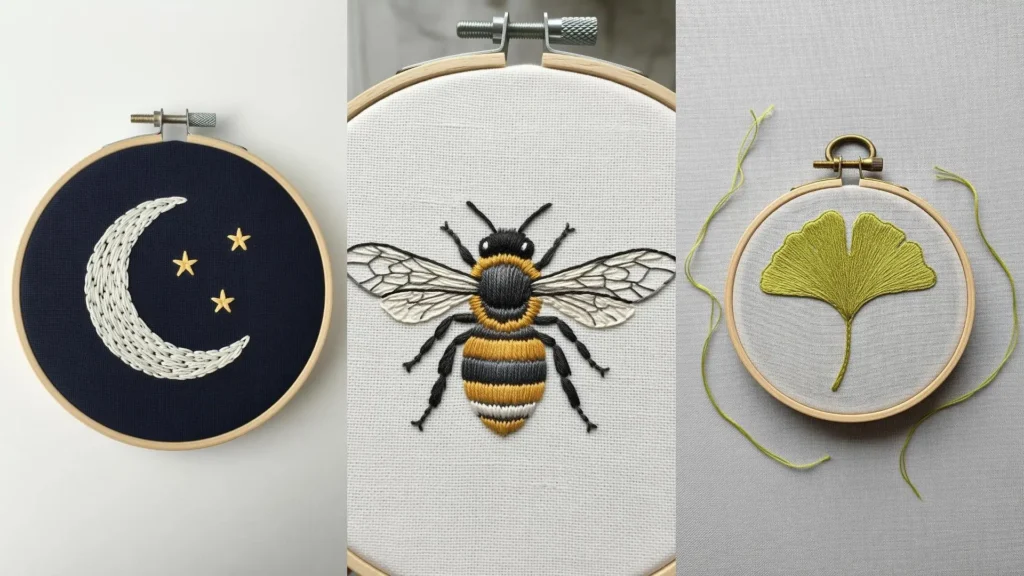
To create the elegant fanned lines of a ginkgo leaf, use a single anchor point at the base of the stem.
Work your satin stitches outward from this point, pivoting the angle slightly for each new stitch.
This technique ensures every line radiates perfectly, creating a sense of organic geometry.
Choose a warm, ochre-colored cotton floss; its matte finish provides a sophisticated glow that feels more subtle than metallic thread.
2. Build Dimension with Padded Satin Stitch

For a motif that pops, like this bumblebee, first fill the shape with a foundation of small, straight stitches.
Then, cover this padding with satin stitches worked in the opposite direction.
This simple step raises the surface, creating a subtle 3D effect that catches the light and adds a professional, patch-like quality.
Use a single strand of black floss for the outlines to keep them crisp and defined against the raised fill.
3. Achieve Crispness in Minimalist Line Art

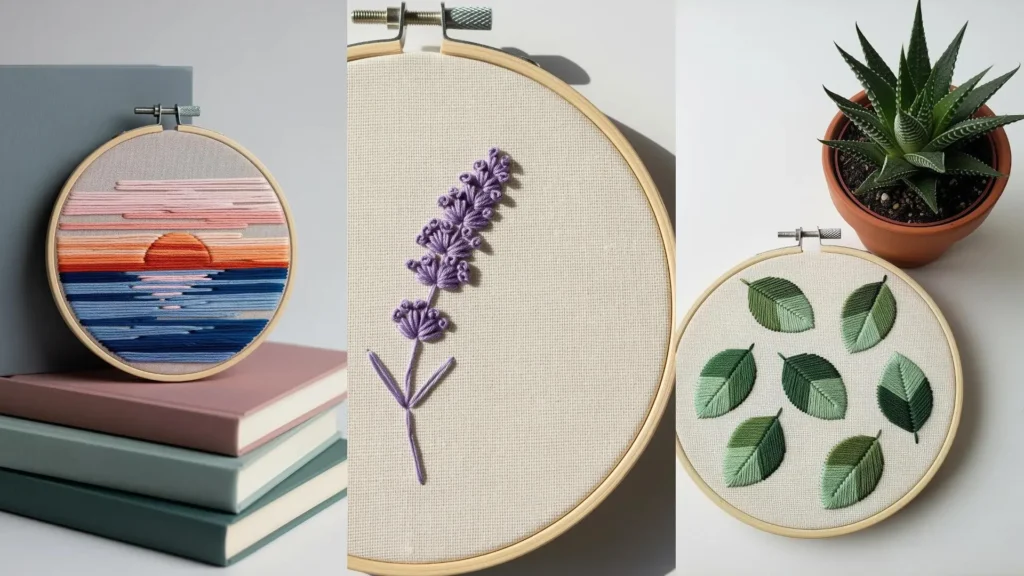
When creating geometric landscapes, your stitch choice determines the final look.
Opt for a two-strand backstitch or stem stitch to achieve a line that is clean and present, but not bulky.
The key to sharp peaks and valleys is maintaining consistent thread tension—too tight and the fabric will pucker; too loose and the lines will sag.
This precision transforms a simple outline into a striking piece of minimalist line art embroidery.
4. Create Organic Texture with Varied French Knots

Bring lavender to life by varying the size of your French knots.
Use one, two, or three wraps of floss around your needle to create buds of different dimensions, mimicking a natural cluster.
Stitch them closely together, allowing some knots to overlap slightly for a fuller, more lush appearance.
Blending three to four shades of purple, periwinkle, and lavender will give the final piece an effortless depth and realism.
5. Imply Shimmer with Directional Stitching

To capture the moon’s ethereal glow without using metallic thread, focus on stitch direction.
Fill the crescent shape with long, straight stitches, layered loosely and angled in slightly different directions.
This technique, known as long-and-short stitch, creates a textured surface that catches light unevenly, suggesting shimmer and movement.
Using a silver or variegated gray floss on dark navy fabric enhances the high-contrast, cosmic effect.
6. Add a Subtle Lift to Apparel Motifs

When embroidering on durable fabric like denim, give your tiny motifs extra presence with padding.
Lay a foundation of seed stitches within your mushroom outline before covering it with a smooth satin stitch.
This raises the design from the fabric surface, preventing it from getting lost in the texture of the denim and giving it a clean, dimensional look.
These small embroidery ideas instantly elevate any garment.
7. Capture Movement with Detached Chain Stitches

A dandelion’s delicate structure is perfect for practicing lightness and movement.
Use detached chain stitches (lazy daisies) for the seed heads at the center, and simple straight stitches for the seeds blowing away.
Vary the length and angle of the straight stitches to create a believable sense of wind and motion.
Stitching with a single strand of white floss on a neutral fabric keeps the design feeling airy and ethereal.
8. Strengthen Outlines with a Whipped Backstitch

For a minimalist outline that feels substantial and smooth, a simple backstitch can sometimes look disjointed.
Elevate it by whipping the stitch: after completing your backstitch outline, pass a new thread under each stitch without piercing the fabric.
This wraps the outline, concealing the gaps and creating a single, fluid, rope-like line that gives the design a polished, deliberate finish.
9. Frame Your Stitches as Miniature Art

Transform a small botanical study into a piece of decor by considering its presentation from the start.
Use a fishbone stitch to create the fern’s leaves, as it naturally forms the central vein and angled texture in one step.
Once finished, mount the piece on acid-free board and place it in a simple wooden frame.
This elevates your work from a practice swatch to one of those stunning embroidery projects worthy of display.
10. Use Negative Space for High-Impact Designs

When stitching constellations, the fabric is as important as the thread.
Choose a deep black or navy fabric to allow the negative space to define the design.
Use a bright white thread and simple star stitches or tiny French knots for the stars, connecting them with a clean, two-strand backstitch.
The dramatic contrast creates a bold, graphic look that feels both modern and timeless.
11. Contrast Textures for Realistic Detail

To give an acorn a lifelike quality, focus on contrasting textures.
For the cap, use tightly packed French knots or a woven wheel stitch to create a bumpy, dimensional surface.
In contrast, fill the nut with a smooth, directional satin stitch, letting the stitches follow its natural curve.
This tactile difference between the two sections makes the small motif more engaging and visually interesting.
12. Layer Stitches to Build Natural Density

To avoid a flat, cartoonish tree, build your pine with layers.
Start with a central trunk using a stem stitch, then add branches using angled straight stitches or a fishbone stitch.
Use a slightly darker green for the bottom layer of branches and a lighter green for the top layer.
This subtle layering creates shadow and depth, giving the tree a much more realistic and organic structure.
13. Define Shapes with a Whipped Spiral

For a perfect spiral, like a snail’s shell, a whipped backstitch or whipped chain stitch is ideal.
First, stitch the spiral using a standard backstitch. Then, whip it by looping a contrasting or matching thread around each stitch.
This technique smooths out the segmented look of the backstitch, creating a clean, raised, and continuous line that gives the shell beautiful definition.
It’s a perfect finishing touch for tiny embroidery patterns on linens.
14. Suggest Form with Open Fill Stitching

You don’t always need to fill a shape completely to give it substance.
This hummingbird uses an open fill technique, where straight stitches are laid parallel to each other but with small gaps in between, allowing the base fabric to show through.
This creates a sense of lightness and texture, suggesting feathers without heavy stitching.
Outline the entire shape with a clean split stitch to ensure the form remains defined and sharp.
15. Compose a Natural Floral Cluster

To make a small floral bouquet feel organic, avoid perfect symmetry.
Use five detached chain stitches for each forget-me-not, but allow the flowers to overlap slightly and face different directions.
Place some flowers higher than others to create a gentle, mounded shape.
This thoughtful composition turns simple stitches into a charming, lifelike cluster, perfect for tiny jewelry pieces or embellishments.
16. Create Dynamic Contrast with Texture

Make a simple sun motif compelling by playing with texture.
Fill the center with densely packed French or colonial knots for a bumpy, tactile surface that invites touch.
For the rays, switch to a perfectly smooth satin stitch or clean straight stitches.
This dramatic contrast between the raised, complex center and the flat, simple rays is what gives the design its modern, graphic energy.
17. Blend Colors with Miniature Thread Painting

Even in a tiny motif, you can create beautiful gradients with long-and-short stitch.
Use two or three similar shades—like tan and light brown—to fill the leaf, using staggered stitches to blend the colors where they meet.
This creates a soft, realistic transition that mimics natural variegation.
Enclose the design with a dark, single-strand backstitch outline to add definition and make the subtle color work stand out.
18. Achieve an Illusion of Weightlessness on Tulle

Stitching on a sheer fabric like tulle or organza creates a magical, floating effect.
To do this successfully, use a water-soluble stabilizer on the back for support while you work, then gently rinse it away when finished.
Use simple, light stitches like a backstitch or stem stitch with only two strands of floss.
The transparent background makes the dragonfly appear suspended in air, turning the fabric’s sheerness into a key design element.
19. Ensure a Flawless Satin Stitch Edge

For a perfectly smooth satin-stitched shape like this strawberry, the edge is everything.
Before you begin filling, outline the entire shape with a split stitch or backstitch using one or two strands of the same color.
Then, when you work your satin stitch, bring your needle up and down just outside this guide.
The outline acts as a small dam, helping you create a crisp, raised, and perfectly defined edge with no gaps.
20. Create Delicate Tapering Lines

To capture the natural structure of bare branches, your lines need to taper from thick to thin.
Start with a stem stitch or whipped backstitch for the main trunk using three strands of floss.
For the medium branches, switch to two strands.
Finally, create the smallest, most delicate twigs with a single strand and simple straight stitches. This gradual reduction in thread weight creates an elegant, realistic silhouette.
21. Give Small Motifs a 3D Dome Effect

A padded satin stitch is the key to creating a raised, glossy finish on this ladybug.
First, fill the red sections with a base of horizontal straight stitches. Then, cover them with vertical satin stitches.
This underlying layer pushes the satin stitch up, creating a smooth, rounded dome that looks professional and feels substantial.
It’s a technique that adds a touch of luxury to the smallest details on a shirt cuff or collar.
22. Add Dimension to Petals with Loop Stitches

For daisy petals that don’t lie flat, use a detached chain stitch, but keep the anchoring stitch slightly loose.
This creates a looped petal that lifts away from the fabric, casting a small shadow and adding a subtle 3D quality.
Contrast this airy effect by filling the center with a dense, textured cluster of French knots.
The combination of looped petals and knotted texture makes the flower feel more dynamic and alive.
23. Convey Character with a Simple Backstitch

You can tell an entire story with just one stitch.
For a delicate line drawing like this fawn, a simple backstitch is your best tool.
Use two strands of floss for the main outline to give it presence, then switch to a single strand for the fine details like the eyelashes and ear lines.
The elegance comes from the clean execution and the expressive power of the negative space you leave untouched.
24. Sculpt with Directional Satin Stitch

Create the illusion of form and shadow using only one color by changing the direction of your satin stitches.
For this seashell, fill each segment with stitches angled to radiate from the base.
This simple adjustment causes each section to reflect light differently, creating defined ridges and a contoured, three-dimensional look without any complex shading.
It’s a powerful way to add depth to small DIY tabletop decor.
25. Achieve a Soft, Matte Finish for Foliage

To capture the soft, velvety look of eucalyptus leaves, your thread and stitch choice are crucial.
Opt for a matte cotton floss in a muted teal or sage green, as shiny thread can look artificial.
Fill each leaf with a satin stitch, angling the threads toward the center.
Finish with a single backstitch or stem stitch down the middle of each leaf, which defines the shape and adds a subtle, realistic vein.
26. Treat Your Thread Like a Pen for Fine Details

For an intricate, lace-like design such as this moth, think of your needle as a fine-tipped ink pen.
Use a single strand of white or silver thread on a dark, high-contrast fabric.
Rely on a simple backstitch or split stitch to trace the delicate patterns.
The beauty of these dramatic dark thread embroidery designs is in the precision of the lines, not the complexity of the stitches—it’s drawing with thread.
27. Create Smooth Gradients with Thread Painting

To depict the smooth, rounded surface of river stones, thread painting is the perfect technique.
Use long-and-short stitches with three to four shades of grey, blending them carefully to create a seamless gradient from light to dark.
Keep your stitches tight and uniform to mimic a solid surface.
A single, bright white straight stitch can be added to suggest a highlight, instantly giving the stone a sense of form and shine.
28. Layer Petals for Realistic Floral Dimension

Make your flowers look less flat by stitching them in layers.
For this poppy, embroider the petals in the background first. Then, stitch the foreground petals, allowing their edges to slightly overlap the ones behind them.
Angle your satin stitches to follow the natural curve of each petal.
This simple layering technique instantly creates a sense of depth and makes the flower feel much more lifelike and three-dimensional.
29. Build Symmetrical Designs from a Central Point

When stitching a geometric shape like a snowflake, always work from the center out.
Start by creating the main axes with straight stitches. Then, add the smaller, decorative elements like V-shapes (fly stitches) and branches to each arm.
Working symmetrically ensures your design remains balanced and even.
Using a mix of white and pale blue thread adds a frosty, dimensional quality that enhances the crystalline feel.
30. Combine Felt Appliqué with Simple Stitches

For a quick and charming result, combine fabric appliqué with embroidery.
Cut your rabbit shape from a piece of soft felt—its edges won’t fray, so no hemming is needed.
Secure it to your background fabric with a simple running stitch or blanket stitch around the perimeter.
This adds texture and dimension much faster than filling the entire shape with thread, creating cute animal embroidery with a soft, storybook feel.
31. Use Fishbone Stitch for Grains and Leaves

The fishbone stitch is incredibly versatile for small botanicals.
For this stalk of wheat, use it to fill each individual grain.
The stitch creates a central line and angled sides simultaneously, resulting in a slightly raised, herringbone-like texture that perfectly mimics the shape of a wheat kernel.
It’s an efficient stitch that delivers both fill and texture in one elegant motion.
32. Create Gnarled Bark with Variegated Thread

To give a tree trunk a sense of age and texture, a variegated brown thread is your secret weapon.
Use a mix of stem stitch and irregular straight stitches, allowing the thread’s natural color variations to create highlights and shadows.
Twist the thread as you stitch to control where the darker and lighter sections fall.
For the foliage, densely packed French knots provide the perfect textural contrast to the twisted bark.
33. Define Petals with a Fine Outline

When stitching small, light-colored flowers, petals can sometimes blur together.
To prevent this, add a subtle outline using a single strand of a slightly darker shade.
First, fill the petals with a fishbone or satin stitch. Then, use a delicate split stitch to trace the edge of each petal.
This tiny detail adds just enough definition to make each flower distinct, giving your work a clean, professional finish.
34. Blend Colors Softly for a Feathered Effect

To create the soft, natural look of a feather, blend your colors directly on the fabric.
Using a long-and-short stitch, alternate your needle between two colors, like tan and off-white.
Don’t try to create perfect blocks of color; instead, let the stitches intermingle randomly.
This technique creates a soft, broken-color effect that looks more organic and less rigid than traditional shading.