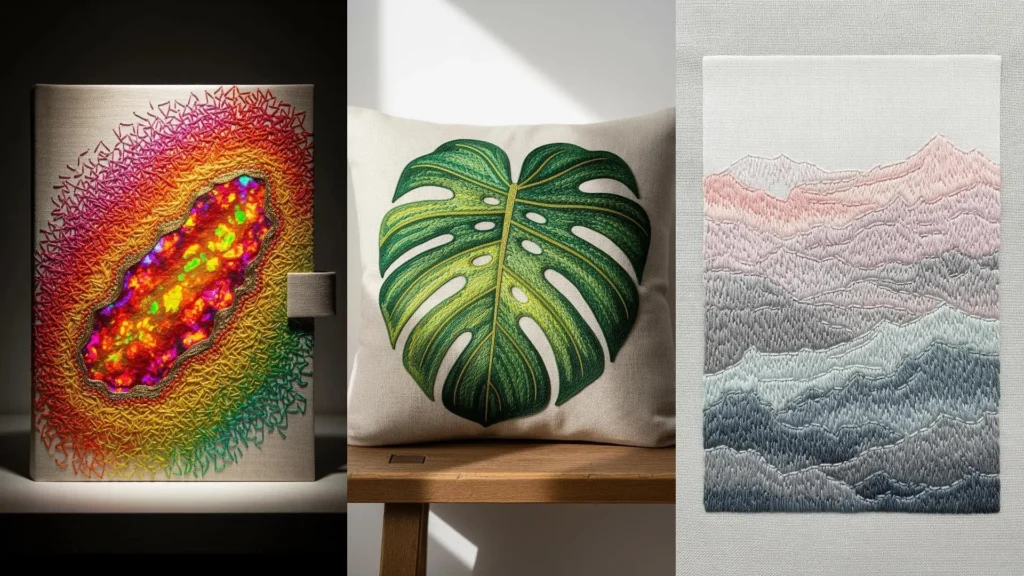
If you’ve ever felt that your embroidery, while beautiful, is missing a certain depth or graphic punch, I want you to consider the foundational principles of string art. It’s not about switching crafts, but about borrowing a new way of seeing composition, color, and texture.
Think of it as deconstructing a landscape into its essential lines and color fields. String art teaches us how to build depth through layering, create gradients with simple color transitions, and use tension to define a sharp, clean edge. These are the exact skills that elevate a hand-stitched piece from a simple motif to a polished work of art.
In these examples, I’ll guide you through translating these bold, geometric ideas into your own needle and thread. You’ll learn how to imply texture, sculpt with color, and compose a scene with newfound confidence. This is where your stitching finds its voice.
1. Render a Radiant Sunburst with Graduated Tones

Create a powerful focal point by graduating your thread colors from a bright, central anchor point outwards.
Use a pale yellow or metallic gold for the sun’s core, blending into soft peaches, pinks, and finally a pale sky blue at the edges.
This technique relies on long, straight stitches pulled taut, which mimics the tension of string art and creates a clean, graphic effect.
The key to a smooth transition is selecting shades with minimal contrast between them, letting the colors melt into one another for a luminous, atmospheric glow.
2. Capture Ocean Dynamics with Layered Straight Stitches

Build energetic waves by layering different shades of blue, from deep navy in the foreground to light aqua in the back.
Use dense, overlapping straight stitches to form the body of each wave, then switch to a fine white or silver metallic thread for the seafoam.
Create that iconic curl by arranging your anchor points (or pinpricks in paper) along a curve and pulling threads tightly across it.
This method allows you to explore movement and depth without complex shading—the visual weight of the layered thread does all the work.
3. Imply Foliage with Textured Knots and Negative Space

Instead of filling every leaf shape, suggest a dense canopy using clusters of French knots or colonial knots.
Vary the shades of green within each cluster to give the foliage depth and realism, mimicking how light filters through leaves.
Allow the background fabric to show through; this negative space is crucial for defining the tree trunks and branches, making the white bark stand out with greater intensity.
This approach combines high-texture stitchwork with minimalist lines, creating a balanced and sophisticated piece of nature-inspired art.
4. Sculpt a Minimalist Landscape with a Monochromatic Palette

Define rolling hills or desert dunes using a tightly controlled color palette—think shades of sand, terracotta, and cream.
The artistry comes from varying the direction and density of your long stitches to create shadows and highlights, sculpting the landscape with thread alone.
By limiting your colors, you draw attention to the clean lines and subtle textural shifts in the composition.
This is a perfect example of how minimal designs can achieve maximum impact through thoughtful composition and restraint.
5. Weave an Aurora with Neon and Glow-in-the-Dark Thread

Capture the magic of the northern lights by using fluorescent or glow-in-the-dark threads against a dark navy or black fabric.
Create the aurora’s flowing bands with long, sweeping stitches, overlapping different colors like neon green, pink, and electric blue.
Incorporate tiny seed beads or French knots in silver thread to represent stars, adding another layer of light and texture to your cosmic scene.
The contrast between the bright, energetic threads and the deep, quiet background creates a truly mesmerizing effect.
6. Stitch a Serene Zen Garden with Disciplined Lines

Evoke the tranquility of a raked sand garden using precise, parallel straight stitches in a single color, like grey or silver.
Introduce texture by creating rock formations with dense clusters of French knots in charcoal or black, or by couching thicker yarn onto the surface.
The power of this design lies in its balance and control—the rigidly straight lines of the “sand” contrast beautifully with the organic shapes of the rocks and trees.
This project is an excellent exercise in stitch tension and spacing, turning your wall into a zone of pure calm and focus, much like minimalist embroidery wall art.
7. Construct a Neon Skyline with Architectural Stitches

Translate the energy of a city at night into thread by outlining skyscrapers with vibrant, contrasting colors on a black background.
Use simple backstitch or stem stitch for the building outlines, then fill the interiors with a web of long straight stitches to suggest structure and light.
Introduce pops of fluorescent yellow or red to mimic lit windows, creating focal points within the dense network of blue and pink lines.
These architectural string art designs teach you how to use geometric shapes and bold color to build a dynamic, modern composition.
8. Create Autumnal Depth with Layered Leaf Motifs

Build a sense of perspective in a forest scene by varying the size and density of your motifs.
For the trees in the foreground, use thicker thread and more detailed stitches; for those in the background, use a single strand and simpler outlines.
Scatter detached chain stitches or single straight stitches across the ground to represent fallen leaves, using a variegated thread in autumn tones for a natural, randomized look.
This technique of layering and varying detail is fundamental to creating realistic depth in any landscape embroidery, even for simple leaf patterns.
9. Cultivate a High-Texture Coral Reef Garden

Move beyond flat stitches and build a tactile underwater world using highly dimensional techniques.
Create coral structures with woven wheel stitches, cast-on stitches, and dense clusters of French knots in vibrant, tropical colors.
Incorporate metallic threads or tiny beads to suggest shimmering water and small fish, adding sparkle and movement to the piece.
Learning these nature texture hacks allows you to create art that invites touch and engages more than just the eyes.
10. Capture Atmospheric Fog with Thread Density

Create the illusion of misty valleys by varying the spacing of your stitches, a technique known as atmospheric perspective.
Use dense, tightly packed stitches for the dark treelines in the foreground to give them visual weight and clarity.
For the distant hills and fog, use sparse, widely spaced stitches with a fine, single-strand white or light grey thread.
This masterful control over thread density allows you to paint a moody, photorealistic landscape, perfect for transforming bare walls without over-decorating.
11. Carve a Canyon with Heavy-Weight Fibers

For dramatic, large-scale texture, move beyond standard embroidery floss and incorporate thicker materials like yarn, twine, or even rope.
Use a couching stitch to secure these heavy fibers to your background fabric, allowing you to create bold, sculptural lines that define the canyon’s strata.
Mix different weights and textures—a smooth yarn next to a rough twine—to mimic the varied rock formations and add incredible tactile depth.
This approach turns your embroidery into one of those stunning fiber art installations with a powerful, gallery-worthy presence.
12. Stitch a Lavender Field with Rhythmic, Angled Lines

Suggest rows of lavender not by stitching individual flowers, but by creating blocks of color with angled straight stitches.
Use two or three shades of purple and lilac within each row, layering them to create texture and the impression of dense blossoms.
The disciplined, repetitive angles create a strong sense of perspective, drawing the eye through the field toward the horizon.
This method is a simple yet incredibly effective way to represent entire fields of flowers, a great technique for projects like botanical tote bags.
13. Illustrate an Eruption with Beading and Textural Contrasts

Capture the raw energy of a volcano by combining different materials and textures for each element.
Use smooth, long bugle beads mixed with yellow and red thread for the erupting lava, giving it a sharp, crystalline quality.
Contrast this with soft, fluffy yarn or wool roving, couched down to create the billowing smoke clouds.
The interplay between the hard, reflective beads and the soft, matte yarn creates a dynamic visual tension that makes the piece feel alive, a great example of abstract mixed-media embroidery.
14. Weave a Winter Scene with Chunky Yarn and Metallics

Create a soft, insulating layer of snow by weaving chunky, unspun wool roving through the base of your design.
For the delicate snowflakes and icy branches, switch to a fine silver metallic thread. Use isolated straight stitches to form crystalline shapes, adding tiny seed beads at the intersections for extra sparkle.
This contrast between the soft, heavy wool and the fine, glistening thread gives your winter scene a magical, tactile quality.
These minimal festive motifs show how texture can elevate a simple theme.
15. Master Color Blending Within a Single Motif

To create a seamless gradient within a defined shape like a leaf, divide the area into sections for each color.
Start with the darkest color at the bottom (e.g., deep red), filling its section completely. Then, bring the next color (orange) down into the red section with a few sparse stitches, and pull the red up into the orange section.
This intentional overlapping blurs the hard line between colors, resulting in a smooth, painted effect.
It’s the key to achieving those magical ombre effects that look complex but are based on a simple principle.
16. Set a Scene with Silhouettes and a Saturated Sky

Create a dramatic sunset by filling the entire background with horizontal straight stitches in a rich gradient of red, orange, and purple.
Once the vibrant sky is complete, add your foreground elements—like trees and animals—in solid black thread.
Use a dense satin stitch or long-and-short stitch to ensure the silhouettes are completely opaque and have crisp, clean edges.
This high-contrast technique is visually powerful and perfect for telling a story, whether you’re stitching a savanna or an embroidered city skyline.
17. Depict Flowing Water with Vertical Stitches and Knots

To create the illusion of a cascading waterfall, use uninterrupted vertical straight stitches with variegated blue and white thread.
Let the threads hang slightly loose to enhance the sense of movement and gravity.
Where the water hits the rocks, switch to a dense cluster of white French knots or seed beads to simulate the energetic splash and foam.
This combination of smooth vertical lines and clustered textures is an elegant way to capture the different states of water, making for DIY art that looks expensive.
18. Grow a 3D Wildflower Meadow with Woven Stitches

Instead of flat floral shapes, build dimensional, textural flowers using woven stitches like the wagon wheel rose or the cast-on stitch.
Group these textural blooms in varying sizes and colors to create the charmingly chaotic feel of a wildflower field.
Use single, straight green stitches for the stems, varying their length and angle to make the garden feel more natural and less uniform.
This technique is central to cottagecore floral embroidery and adds a delightful, touchable quality to your work.
19. Enhance Your Design with a Textured Fabric Base

Don’t underestimate the power of your background fabric. A coarse material like burlap or linen adds instant rustic texture and depth to your landscape.
When stitching on a textured base, use a slightly thicker thread (like pearl cotton or all 6 strands of floss) to ensure your design stands out against the weave.
The natural, earthy quality of the fabric becomes an integral part of the final piece, enhancing the organic feel of a river or field.
It’s an easy way to bring life to boring fabric scraps and add professional polish.
20. Mix Fiber Weights for Dynamic Waves and Light

Create a visually exciting seascape by combining dramatically different fiber thicknesses in one piece.
Use a chunky, braided yarn for the rolling waves, using a couching stitch to tack down the thick cords and create powerful, sculptural lines.
For the lighthouse beam, switch to a fine, bright yellow embroidery floss and use long, radiating straight stitches to convey a sharp, focused light.
This technique of mixing fibers is a signature of advanced textile art, allowing you to create mixed-fiber creations with incredible depth and interest.