Have you ever looked at the texture of moss on a stone or the intricate veins of a fallen leaf and wished you could translate that feeling into thread? So often, we focus on color and shape, but the true essence of nature lies in its texture—the rough bark, the smooth petal, the crystalline frost.
Elevating your embroidery isn’t about mastering hundreds of complex stitches. It’s about learning to see with your fingertips and choosing the right combination of thread, fabric, and technique to bring that tactile quality to life. It’s in the thoughtful pairing of a thick yarn next to a fine silk, or the dense cluster of French knots that feels as lush as it looks.
These 22 ideas are more than just projects; they are invitations to observe the world more closely. Use them as a starting point to develop your own language of texture, turning every piece you create into a more intentional, expressive, and resonant work of art.
1. Build Sculptural Tree Bark with Yarn Couching

Create deep, tactile grooves by couching thick yarn onto a linen or burlap base.
Lay down strands of chunky wool or cotton yarn to form the main lines of the tree trunk and branches.
Then, using a thinner, matching embroidery floss, stitch over the yarn at regular intervals to secure it to the fabric.
For mossy patches, fill small areas with dense punch needle loops or French knots in various shades of green and gold.
This contrast between the linear, couched yarn and the clustered knots creates compelling visual depth, turning a flat surface into one of the most stunning embroidered wall hangings.
2. Layer Knots for a Dense Moss Effect

To capture the lush, varied texture of moss, rely on a dense composition of different knots.
Fill your hoop with a tapestry of French knots, colonial knots, and small bullion knots, varying the number of thread strands from three to six.
Work in tight clusters using a monochrome palette of greens—from chartreuse to deep forest green.
For added dimension, create a few woven wheel stitches (or rose stitches) and pull them tight to form dense, bud-like shapes.
This technique is perfect for creating rich, moss fern embroidery textures that feel as real as they look.
3. Capture Water’s Movement with Mixed Threads

Evoke the shimmer of moving water by stitching parallel lines with threads of different finishes.
Combine standard matte cotton floss with a high-sheen rayon or a subtle metallic thread.
Use a simple running stitch or backstitch, letting the threads lay side-by-side without twisting.
The slight variation in light reflection between the matte and shiny fibers creates a gentle sense of movement and depth.
This is one of the most effective abstract thread embroidery ideas for capturing the essence of nature without literal interpretation.
4. Incorporate Beads for Mineral Formations

To mimic the crystalline structure of a geode or raw minerals, integrate beads and stone chips directly into your stitching.
Fill the central area of your design with a cluster of tiny white or clear beads, securing them with small tacking stitches.
Frame this beaded center with radiating straight stitches in metallic thread to create a starburst effect.
Surround the entire motif with punch needle loops or dense satin stitch to create a soft, contrasting border, a hallmark of mixed-media contemporary embroidery designs.
5. Use Negative Space for Delicate Florals

The texture of Queen Anne’s lace or baby’s breath is as much about the space between the blossoms as the stitches themselves.
Use single, delicate French knots for each tiny flower head, clustering them loosely at the end of fine, straight-stitched stems.
Choose a neutral, high-quality linen as your canvas.
By leaving ample negative space, you allow the composition to feel light and airy, transforming a simple stitch into minimalist embroidery wall art.
6. Mimic Cracked Earth with Couching and Appliqué

Recreate the bold, graphic pattern of parched earth by combining fabric manipulation with heavy threadwork.
Begin by stitching a base fabric with subtle, textural running stitches to represent soil.
Then, lay a thick cord or plied yarn in a geometric, cracked pattern over the top.
Secure the cord using a couching stitch with a matching color of floss.
This technique adds dramatic, three-dimensional lines that define the shapes and works beautifully for embroidery cushion designs that need a strong textural statement.
7. Translate Woodgrain with Vertical Satin Stitch

Instead of outlining a tree, focus on capturing the linear texture of its bark.
Fill your hoop with long, vertical satin stitches using a palette of muted browns, grays, and creams.
Vary the length and width of your stitches, occasionally leaving small gaps to mimic the natural imperfections in woodgrain.
Using different weights of thread, like a fine floss next to a thicker Perle cotton, will enhance the textural contrast.
This abstract approach is perfect for creating organic embroidery designs with a modern feel.
8. Create a Frosted Effect with Metallic Thread

Capture the crystalline texture of frost on branches using a silver metallic or glitter thread against a dark background.
Use a fern stitch to create the main branching structures, as its V-shape naturally mimics the way ice crystals form.
Add smaller, detached chain stitches or single straight stitches at the tips to represent finer ice formations.
The key is the high contrast between the sparkling thread and the deep blue or black fabric, ideal for elegant, holiday-themed string art patterns.
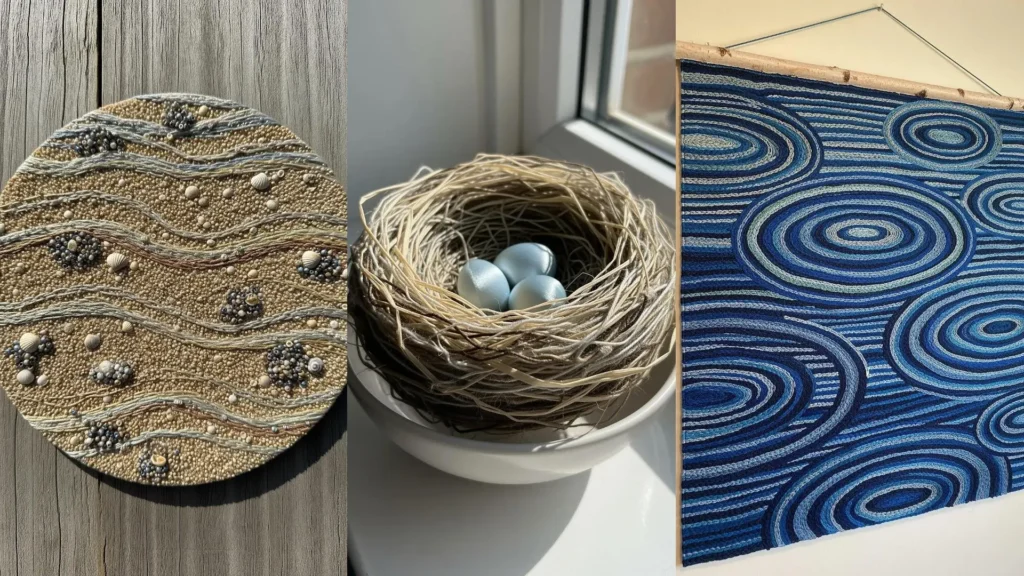
9. Build a Tactile Shoreline with Beads and Knots

Evoke the feeling of a sandy shore by incorporating dimensional elements.
For the wet sand, use a mix of beige and gold seed beads, tiny shell fragments, and French knots, creating a dense, gritty texture.
Depict the foamy edge of the waves with tightly packed white colonial knots, which stand up more firmly than French knots.
This multi-sensory approach is perfect for coastal-theme tiny embroidery art, inviting both sight and touch.
10. Form Pinecone Scales with Layered Satin Stitch

The beautiful, overlapping pattern of a pinecone or pangolin scales can be recreated with carefully layered satin stitches.
Draw a grid of scallop shapes as your guide.
Stitch each ‘scale’ individually, starting from the bottom row and working your way up, allowing the top of each new row to slightly overlap the one below it.
Use two tones of the same color within each scale—a darker shade for the base and a lighter one for the tip—to create a sense of dimension.
These are the kinds of nature texture embroidery hacks that create incredible realism.
11. Weave a Bird’s Nest with Mixed Fibers

Go beyond standard embroidery floss to construct a truly authentic bird’s nest.
Incorporate a variety of fibers like jute twine, raw wool roving, thin strips of fabric, and even natural raffia.
Use a couching technique to tack down the thicker fibers, and weave the thinner ones in and out of the base structure.
This method produces a wonderfully chaotic yet intentional texture, making it one of the most compelling mixed fiber creations you can make.
12. Render Butterfly Wings with Thread Painting

The smooth, velvety texture of a butterfly’s wing is best achieved with thread painting, also known as the long-and-short stitch.
Use a single strand of floss for the most seamless color blending.
Lay your stitches following the natural direction of the wing’s patterns to create a sense of flow and realism.
For the sharp black outlines, switch to a neat backstitch. This technique is similar to floral thread painting techniques and delivers stunning results.
Finish with raised white French knots for the body details.
13. Define Leaf Skeletons with Precision Stitching

Capture the delicate, lace-like structure of a leaf skeleton by focusing on fine lines and high contrast.
Choose a dark or vibrant fabric that makes your thread color pop.
Use a single strand of floss and a whipped backstitch or stem stitch to create clean, raised lines for the central veins.
For the finer veins, a simple backstitch is sufficient.
This minimalist approach highlights the beauty of natural geometry and is a great way to elevate simple hand-embroidery leaf patterns.
14. Stitch on Unconventional Surfaces Like a Lampshade

Take your embroidery off the hoop and onto functional objects to explore how texture interacts with light.
A fabric lampshade provides a unique canvas for simple patterns like birch bark.
Use a basic backstitch with black or dark grey thread to create the characteristic horizontal lines.
When the lamp is on, the light will shine through the stitched areas, creating a beautiful silhouette effect and turning your work into an interactive piece of decor, just like embroidered textile wall hangings.
15. Create a Meadow with a Sampler of Stitches

A field of wildflowers is a perfect opportunity to combine multiple high-texture stitches in one piece.
Use padded satin stitch for daisy petals to make them pop, and dense French knots for lavender buds.
Incorporate bullion knots for goldenrod and detached chain stitches for leaves.
By varying the height and density of your stitches, you create a rich, tactile landscape that draws the eye in. It’s a classic technique for lush, cottagecore floral embroidery ideas.
16. Depict Soil Strata with Layered Fabric Collage

To represent the layers of earth and rock, combine fabric dyeing, appliqué, and hand stitching.
Start by painting or dyeing strips of fabric in earthy tones of ochre, terracotta, and charcoal.
Arrange these strips in horizontal layers, fraying the edges slightly before stitching them down with a simple running stitch.
Add embroidered details like French knot pebbles or straight-stitched grass to enhance the texture of each layer.
This method results in wonderfully tactile abstract fabric collage embroidery ideas.
17. Form Agate Contours by Wrapping Cord

Mimic the swirling, concentric lines of an agate slice with a simple cord-wrapping technique.
Start with a thick cotton rope as your base.
Using variegated or multiple solid-colored embroidery threads, wrap sections of the cord tightly.
As you coil the wrapped cord to form a bowl or flat mat, the color changes in the thread will create organic, flowing patterns that resemble natural stone formations.
This is a perfect example of texture-rich thread art where the material does the creative work for you.
18. Sculpt 3D Roots with Wrapped Wire

Give tree roots a gnarled, three-dimensional form by using a wire armature.
Bend and shape thin, flexible craft wire into the desired root structure.
Wrap the wire tightly with variegated yarn in shades of brown, grey, and green.
Once wrapped, you can couch the entire form onto your backing fabric, allowing parts of it to lift away from the surface for a truly sculptural effect.
These are the kinds of embroidery projects inspired by textures that push the boundaries of the craft.
19. Mimic Dewdrops with Clear Seed Beads

Capture the ephemeral beauty of a dew-covered spiderweb by incorporating delicate beading.
First, create the web’s structure using a fine, strong thread like silver filament or even a single strand of silk floss.
Then, go back and stitch tiny, clear seed beads or bugle beads along the threads.
The way they catch the light mimics the sparkle of water droplets, turning a simple geometric pattern into a magical piece. This is a beautiful approach for realistic animal and insect embroidery patterns.
20. Recreate a Coral Reef with a Stitch Sampler

A vibrant coral reef is the perfect subject for showcasing a wide range of textural stitches.
Use woven picot stitches to create the fan-like shapes of gorgonian corals.
Employ tightly packed French knots and bullion knots in bright oranges and reds for stony corals and anemones.
Long, flowing straight stitches in green can represent seaweed.
This combination of different forms and densities, like in some tropical flower embroidery ideas, results in a lively, underwater world.
21. Achieve Iridescence with Careful Color Blending

The shimmering, color-shifting quality of a peacock feather is a masterclass in thread painting.
Use single strands of floss in multiple shades of blue, green, and gold.
Lay your long-and-short stitches in the direction of the feather’s barbs, meticulously blending one color into the next.
The magic happens when the colors are so seamlessly integrated that the eye perceives them as one shimmering surface. The technique creates stunning ombre petal effects on flowers, too.
22. Weave a Honeycomb with Chunky Yarn

For a bold, graphic texture like a honeycomb, step away from the needle and try a simple weaving technique.
Create a hexagonal guide by hammering small nails into a framed board.
Wrap a chunky, vibrant yarn around the nails to form the honeycomb structure.
You can add extra textural details by filling some of the cells with pom-poms or woven knots made from the same yarn.
This approach elevates simple fibers into large-scale, playful yarn wall art with geometric appeal.