You have likely stared at a blank wall or a plain hoop and felt the urge to make something that doesn’t just look good, but feels like a sanctuary. We often mistake embroidery for a purely visual medium, flat and contained. But the pieces that truly transform a home are the ones that invite touch—the ones that use texture, depth, and shadow to create a sense of warmth.
I want you to stop thinking about “perfect” stitches and start thinking about surface design. How can a French knot become a landscape? How can a simple piece of wool yarn turn a flat canvas into a tapestry? The ideas I’ve curated here aren’t just patterns; they are lessons in layering, material choice, and finishing techniques that elevate your work from craft project to textile art.
Whether you have five minutes to stitch a coffee cup or a weekend to weave a tapestry, these concepts are designed to help you build a home that feels handmade, intentional, and undeniably cozy. Let’s get your needle moving.
1. Textural landscapes using French knot gradients

To achieve this dense, rug-like texture without a punch needle, you need to commit to the French knot on a massive scale.
Instead of standard six-strand floss, use a tapestry wool or a matte cotton yarn to create bulk and warmth instantly.
Work in undulating rows rather than straight lines; this organic flow mimics the rolling hills and adds a tactile quality that invites touch.
Group your color families tightly—rusts, ochres, and sage greens—to keep the aesthetic grounded and cozy.
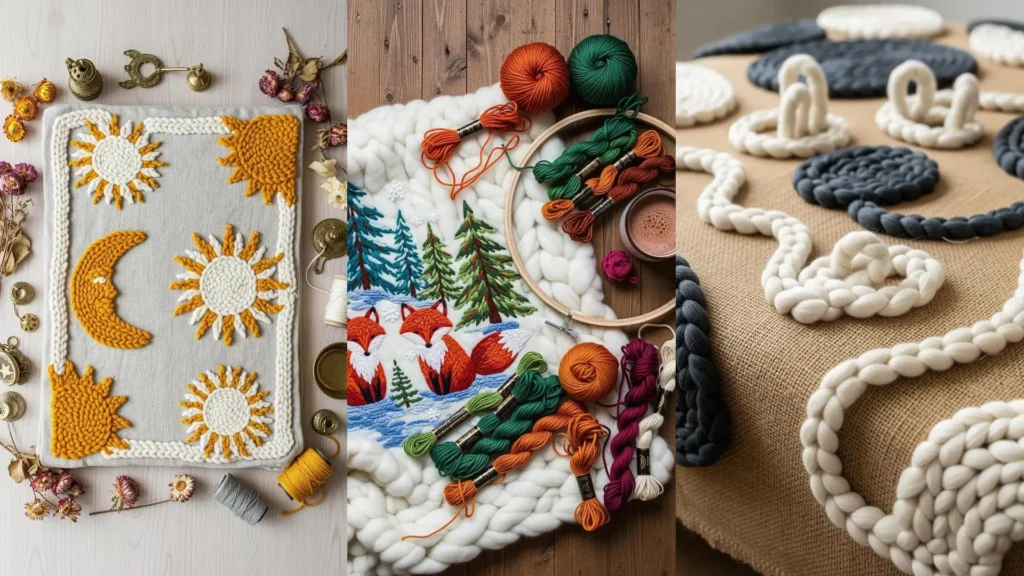
2. Interlocking rope twists with heavy chain stitch

When you want a design that feels architectural yet soft, switch to a heavy chain stitch or a split stitch using all six strands of floss.
The key here is the negative space; by leaving the background raw (linen or unbleached cotton), you allow the texture of the thread to stand out.
Overlap your shapes intentionally to create depth—stitch the ‘bottom’ rope first and the ‘top’ rope second to physically layer the threads.
These minimal embroidery wall hangings that look professional and polished rely on tension consistency, so keep your stitches short on curves.
3. Sculptural botany with raw materials

Elevate a simple floral motif by incorporating three-dimensional elements that break the plane of the fabric.
For the cotton bolls, use raw wool roving or unspun cotton and tack it down with invisible couching stitches to maintain the fluffiness.
Pair this soft texture with dry, woody stems created by wrapping wire with brown floral tape or embroidery floss.
Arranging these in a gallery wall format allows you to tell a botanical story without cluttering a single hoop.
4. Punch needle looping for tapestry effects

If you crave the look of a warm blanket on your wall, punch needle is your best technique for rapid, plush coverage.
Use a monk’s cloth foundation and varying loop heights to create physical ridges between your color bands.
The warm retro palette of mustard, terracotta, and plum works best when the shapes are simple and bold.
These bold yarn wall art patterns that turn blank walls into statements rely on density, so pack your loops tightly to hide the backing fabric completely.
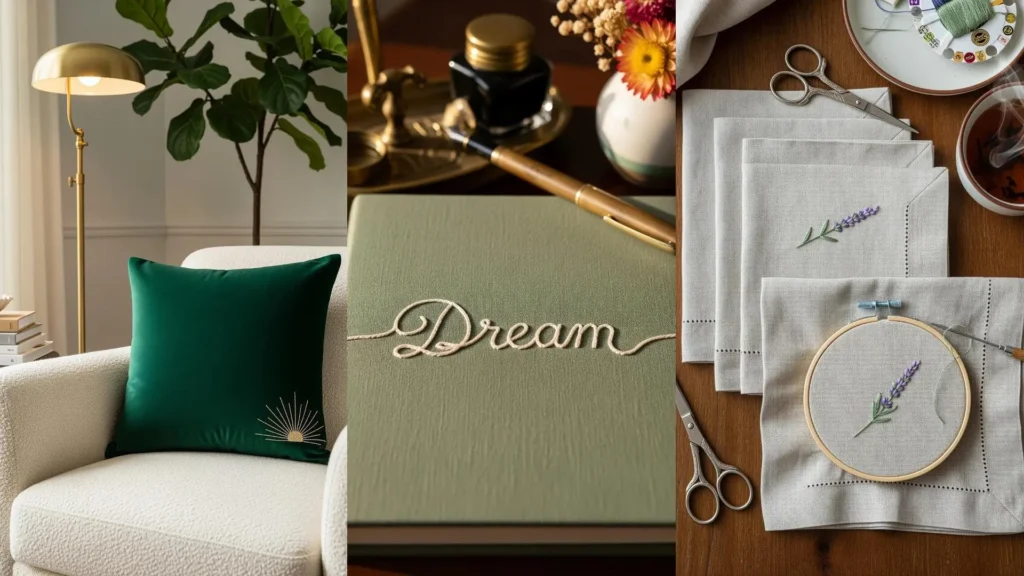
5. Velvet lettering and pine needle layering

For typography that looks luxurious, abandon the satin stitch and couch a strand of velvet ribbon or thick chenille yarn onto the fabric.
Surround this soft focal point with sharp, directional stitching for the pine needles to create a tactile contrast.
Use a single strand of green floss for the needles, overlapping them haphazardly to mimic the chaos of nature.
This combination of soft velvet and crisp lines creates a cozy winter aesthetic that feels sophisticated, not kitschy.
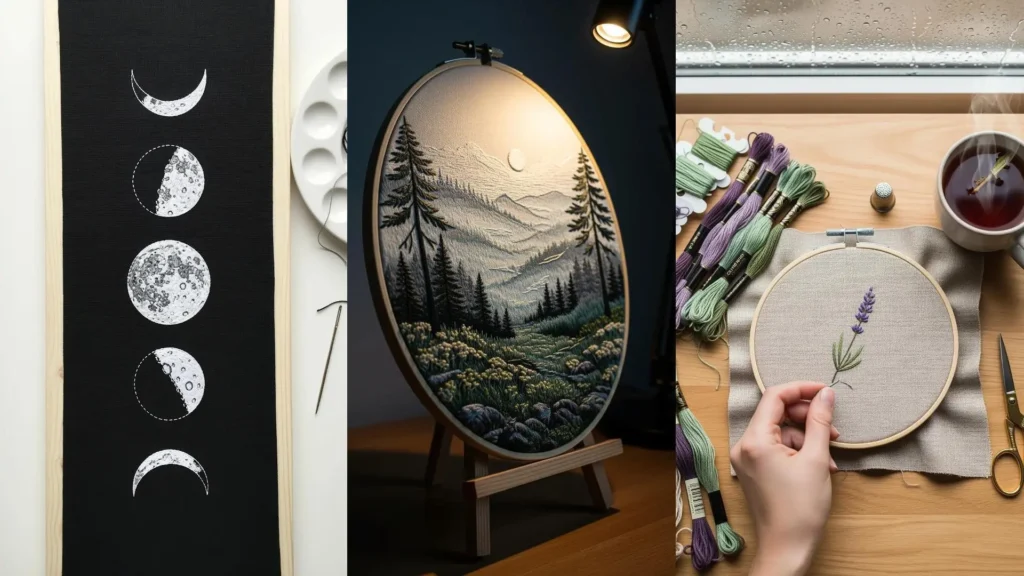
6. Celestial beading on deep velvet

Embroidery isn’t just about thread; using navy or black velvet as your ground fabric instantly adds depth and absorbs light.
Stitch your constellations using metallic gold thread, but enhance the sparkle by incorporating seed beads and French knots in silver.
The velvet can be tricky to hoop, so wrap your inner hoop with bias binding to prevent “hoop burn” or crushing the pile.
These dreamy galaxy string art concepts to transform basic threads into cosmic embroidery art become heirlooms when you mix metallics with plush textiles.
7. Mixed media landscapes with macramé fringe

Don’t let the art stop at the hoop’s edge; adding a macramé fringe extends the visual footprint and adds bohemian softness.
Attach the fringe to the bottom of the inner hoop before tightening the outer hoop, or sew it to the backing fabric for a cleaner finish.
For the landscape itself, use a variety of stitch textures—French knots for trees, satin stitch for mountains—to differentiate the elements.
Such embroidery wall hangings that bring calm to any room work best when the yarn fringe matches the neutral tones of the sky.
8. Trompe-l’œil knitting effects with thread

You can replicate the cozy look of cable knit sweaters using purely embroidery stitches.
Use a heavy chain stitch or a woven picot stitch in off-white yarn to mimic the ‘V’ shape of knit stitches.
Consistency is paramount here; draw a grid on your fabric to ensure your ‘cables’ twist at exactly the same intervals.
This technique turns hard walls into soft visual surfaces without the bulk of actual knitting.
9. Sashiko geometry on indigo fabric

Sashiko is the ultimate ‘cozy’ technique because it was originally designed to reinforce fabric for warmth.
Use a long specialty sashiko needle and white cotton thread against a dark indigo base for that classic, crisp contrast.
The beauty lies in the regularity of the running stitch; aim for your stitch length to be slightly longer than the space between stitches.
These traditional cultural textile wall art styles you can recreate with embroidery bring a sense of order and rhythm to a chaotic space.
10. Thread painting for realistic fur texture
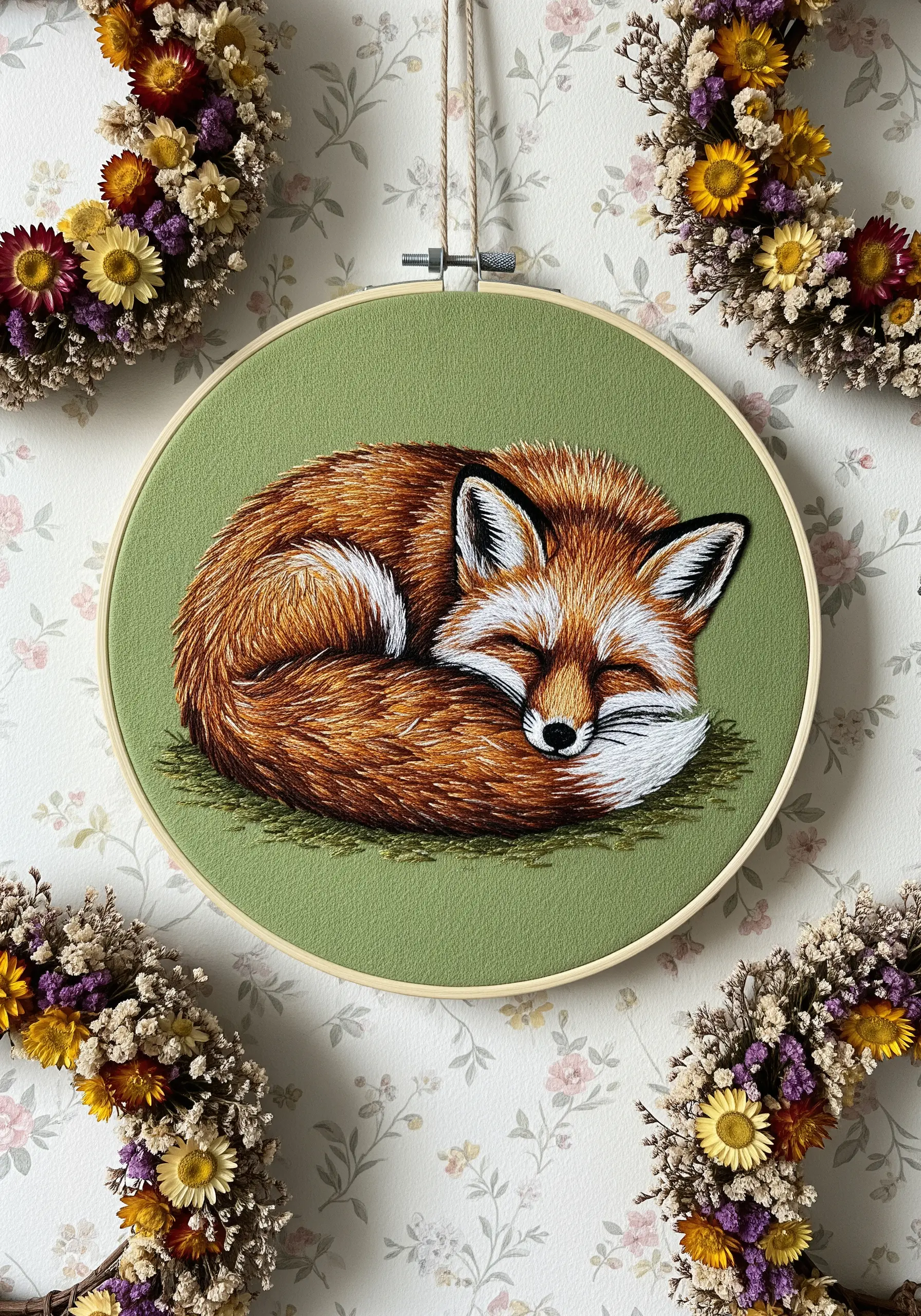
To make an animal motif feel warm and alive, you must master the long-and-short stitch to create fur blending.
Work in layers, starting from the outside of the animal and moving inward, following the natural growth direction of the fur.
Use a single strand of floss to blend rust, copper, and white tones seamlessly, avoiding blocky color transitions.
These beginner friendly animal embroidery patterns you ll love to stitch become advanced art when you pay attention to the direction of the coat.
11. Large-scale abstract tufting
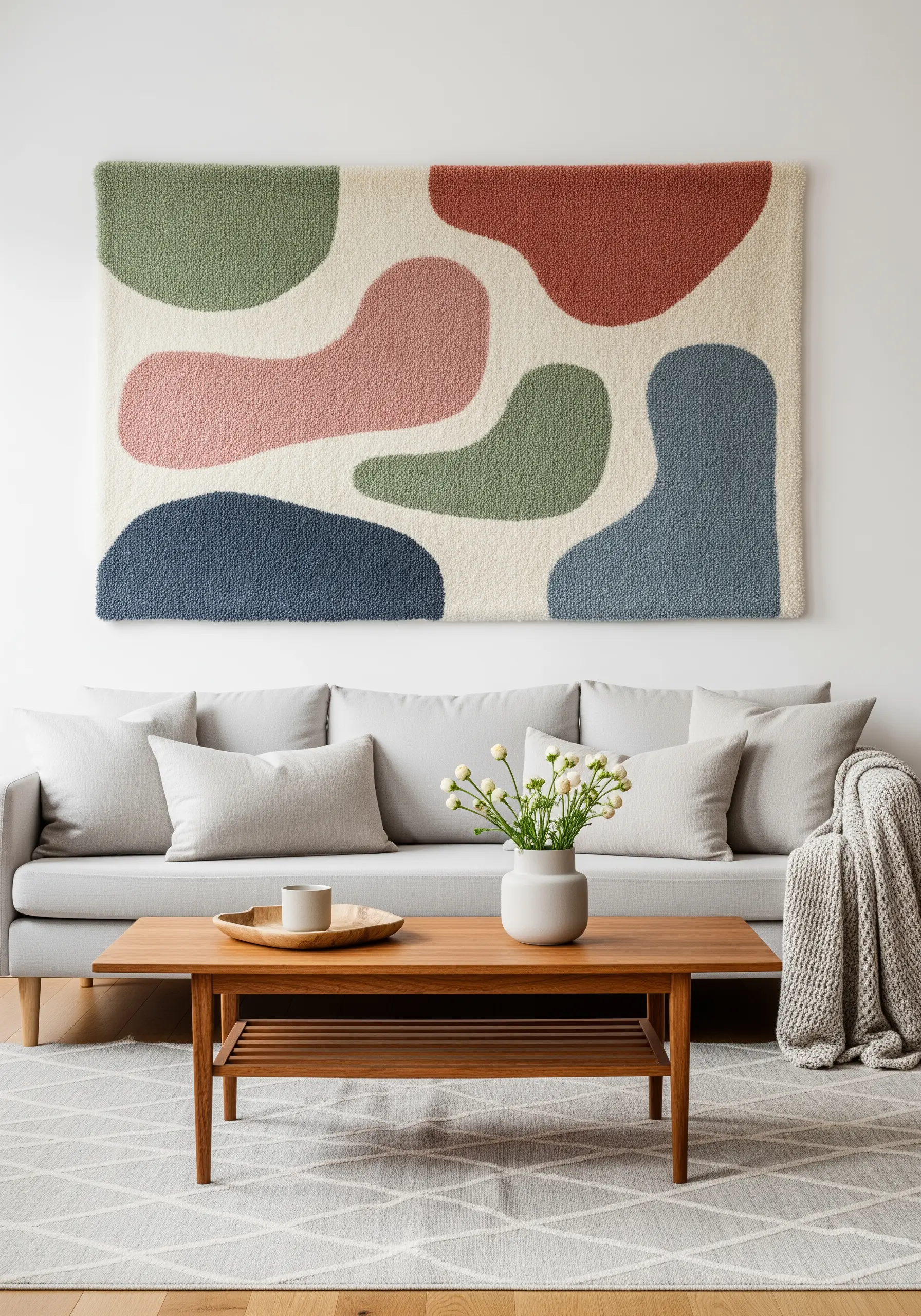
When you want to cover a large wall area, move away from the hoop and stretch your canvas on a frame for tufting or punch needle.
The abstract shapes should be large and organic, allowing the texture of the yarn to be the main focus rather than intricate details.
Vary your yarn weights—mix acrylic with wool—to create subtle differences in sheen and feel within the same color block.
Such colorful fiber art installations that will make your walls come alive act as sound dampeners, making a room feel quieter and cozier.
12. Silk ribbon florals for 3D depth

Silk ribbon embroidery offers a lustrous, three-dimensional finish that standard floss simply cannot achieve.
Use a wide-eye chenille needle to prevent the ribbon from shredding as it passes through the fabric.
The ‘ribbon stitch’ (piercing the ribbon itself at the end of the stitch) creates a perfect petal curl that looks soft and organic.
Explore floral inspired ribbon embroidery ideas for textured petals and 3d statement pieces to add a vintage, romantic warmth to your decor.
13. Woven tapestry techniques inside a hoop

Transform your embroidery hoop into a loom by warping it with strong cotton string and weaving thick roving through it.
This creates a chunky, tapestry-like texture that is much faster to complete than traditional stitching.
Change colors to create a gradient effect, blending pinks into purples for a sunset aesthetic.
These stunning yarn wall art projects you can finish in a weekend satisfy the urge for heavy texture without needing a floor loom.
14. Minimalist line art on textured fabric
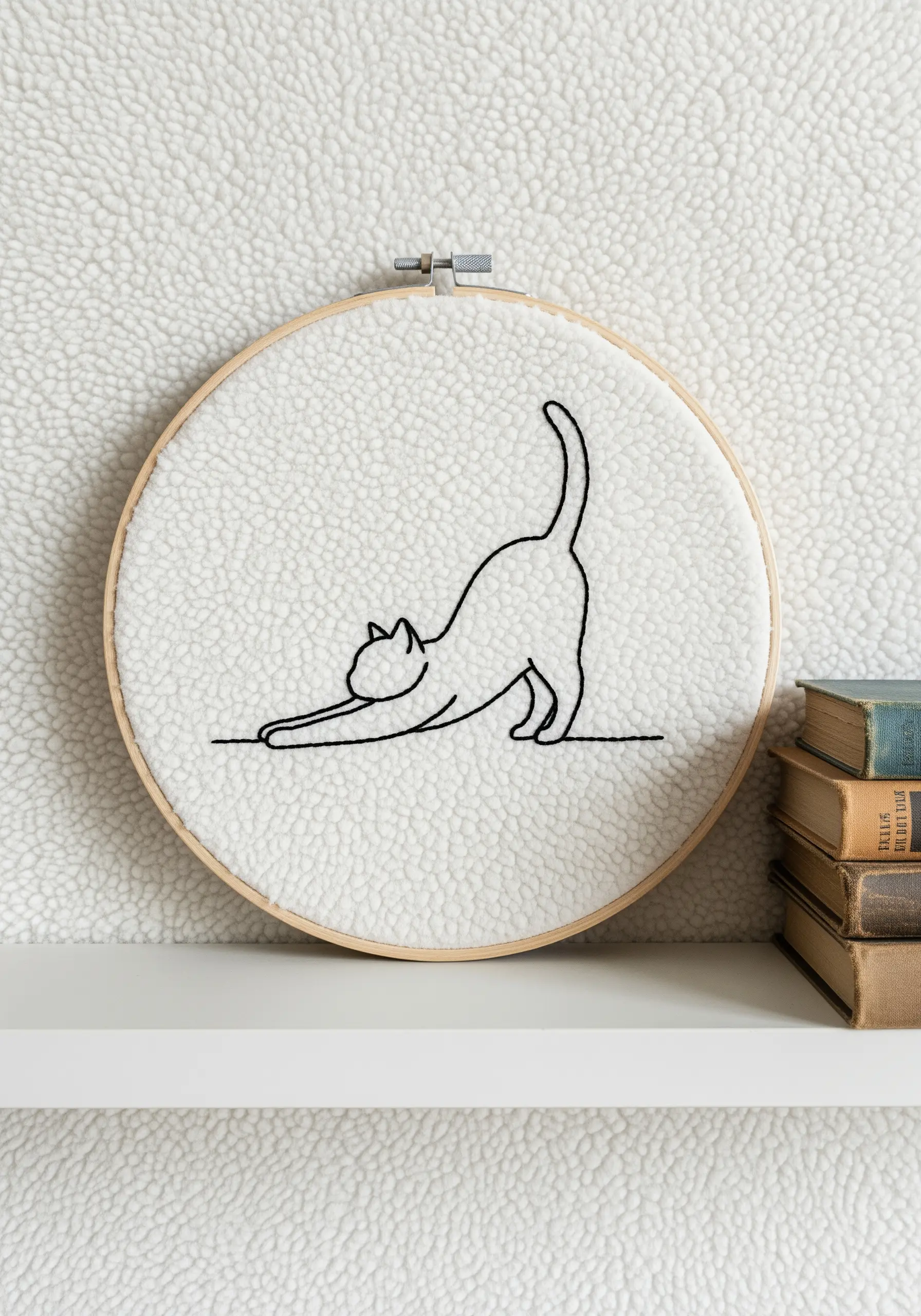
Sometimes cozy means uncluttered; pair a highly textured sherpa or boucle fabric with a simple black line design.
Because the fabric is fluffy, you will need to use a water-soluble stabilizer to stitch your design, then dissolve it away.
Use a whipped backstitch or a heavy stem stitch to ensure the black line sits *on top* of the texture rather than sinking in.
These minimalist line art embroidery hoops that add quiet luxury to your bedroom walls prove that negative space is as important as the stitch itself.
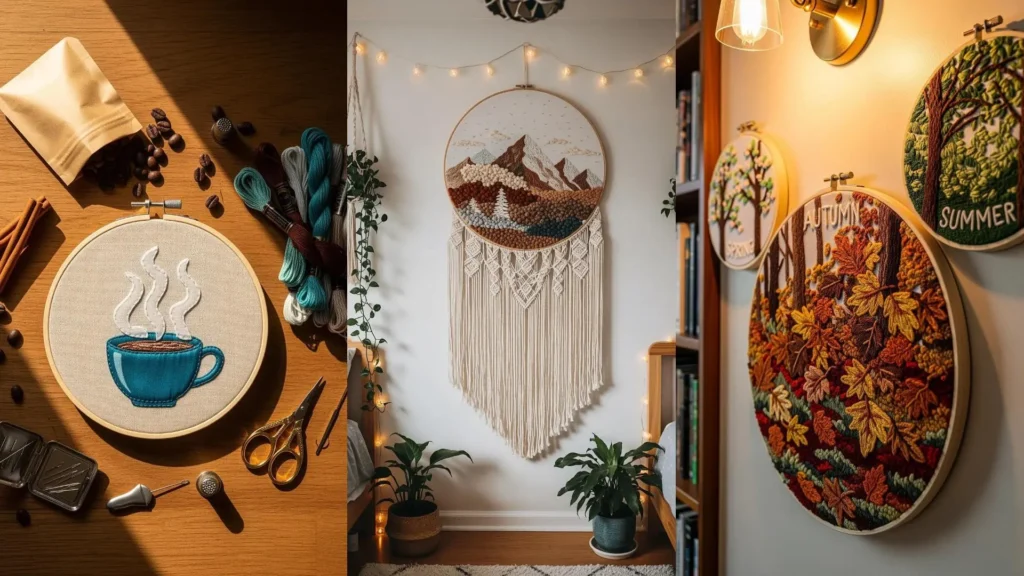
15. Satin stitch appliqué for sleek surfaces

To capture the steam of a hot coffee, use a negative space or a very light running stitch on a neutral background.
For the cup itself, satin stitch provides a glossy, ceramic-like finish that contrasts with the matte fabric.
Padding your satin stitch (stitching a base layer underneath) will give the cup a rounded, 3D effect.
Small motifs like this are small embroidery designs perfect for your morning coffee mug rugs or kitchen wall accents.
16. Floating mobile elements for kinetic art
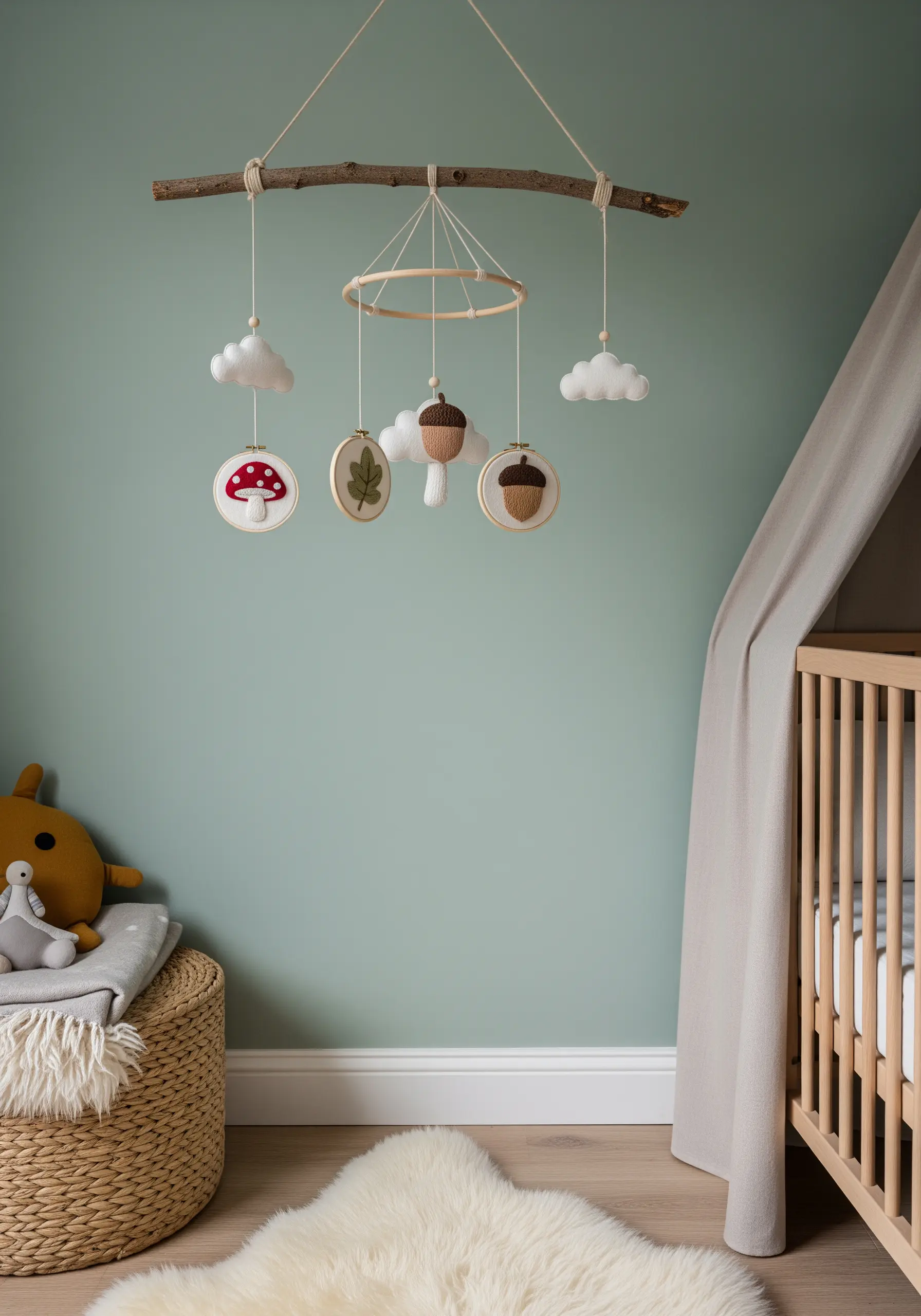
Take your embroidery off the wall and into the air by creating double-sided felt pieces for a mobile.
Stitch two pieces of felt together with a blanket stitch, stuffing them lightly with poly-fill for dimension.
Keep the motifs simple—mushrooms, leaves, clouds—and use a natural branch as the hanger to bring nature indoors.
Projects like this are perfect nursery stitch art wall ideas for cute soft baby room decor that add movement and calm to a room.
17. Nordic geometry in high contrast

Redwork (or in this case, red yarn on grey linen) evokes traditional Scandinavian winter decor.
The cross-stitch or star stitch used here relies on grid-like precision; use an even-weave fabric to keep your angles sharp.
The thickness of the yarn against the linen creates a shadow play that makes the simple shape feel substantial.
Look for soft and serene stitching projects to brighten your winter days that use symmetry to create visual order.
18. Stumpwork techniques for fuzzy textures
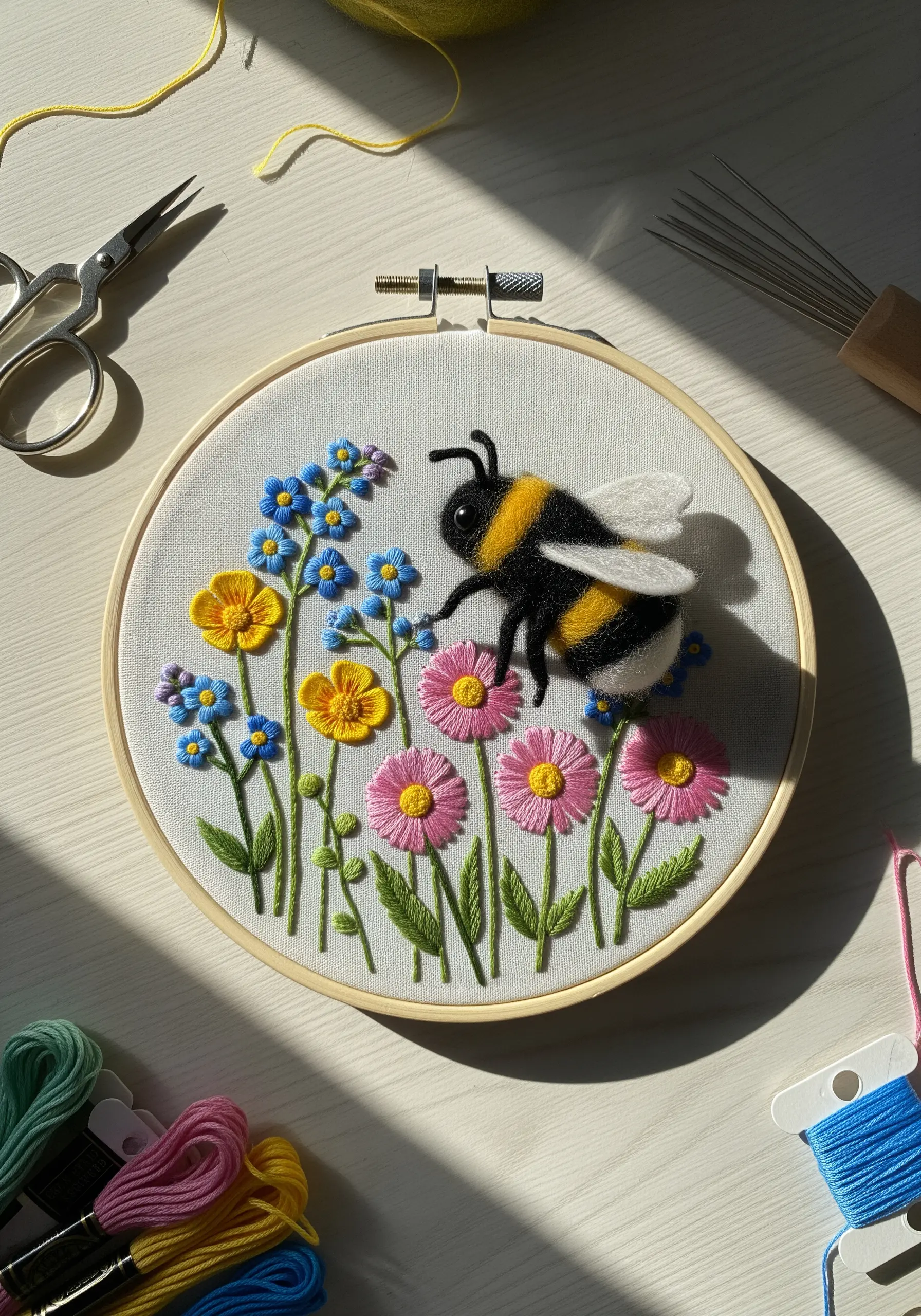
Bring a bumblebee to life by using Turkey work (also called Ghiordes knot) to create actual fringe on the body.
Stitch loops of black and yellow thread, lock them in place, and then cut and trim them to create a velvet-like pom-pom effect.
Contrast this fuzzy texture with flat, delicate satin stitch petals for the wildflowers.
Such nature inspired embroidery for picnic blankets outdoor decor adds a playful, tactile surprise that people can’t help but touch.
19. Seasonal storytelling through triptychs

Instead of one complex scene, break a tree’s lifecycle into three separate hoops to create a narrative wall display.
Focus on the changing palette: pastels for spring, deep greens for summer, and burnt oranges for autumn.
Keep the trunk stitch (bark texture) consistent across all three to unify the series.
These plant inspired embroidery hoop sets that tell a whole garden story in triptych form turn a blank hallway into a seasonal gallery.
20. Large scale tapestry on burlap
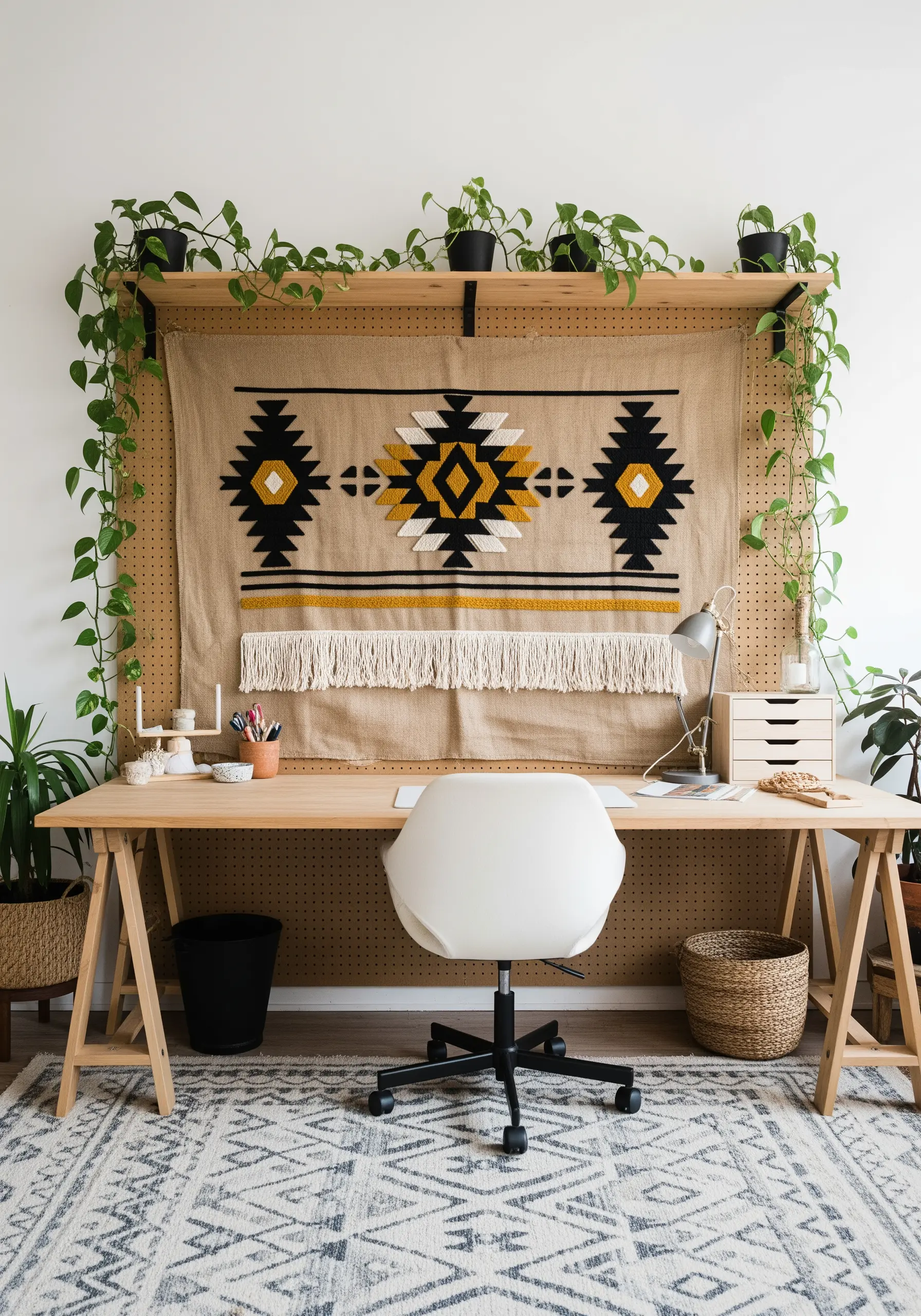
For a rustic, grand statement, embroider directly onto burlap or hessian using tapestry wool.
The wide weave of burlap is forgiving for thick yarns and geometric patterns, making it ideal for Kilim-inspired designs.
Add a heavy fringe at the bottom to weigh the fabric down so it hangs flat against the wall.
These are stunning embroidered fabric wall panels you can stitch to impress guests instantly without needing a frame.
21. Transparency play with tulle fabric

Create an ethereal, floating effect by swapping standard cotton for tulle or organza.
You must be meticulous with the back of your work; travel your thread through the stitching lines, never across the open mesh.
Use light, pastel florals to enhance the delicate nature of the fabric, making the hoop frame disappear visually.
These modern framed embroidery designs you ve never thought of hanging catch the light beautifully in a window.
22. Mixed media portraits with yarn hair

Combine fine thread painting for facial features with loose, braided yarn for hair to create a striking 3D portrait.
The contrast between the tight, detailed skin tones and the chunky, loose braids creates a dynamic focal point.
Allow the yarn braids to spill out of the hoop, breaking the boundary of the frame for a modern art feel.
Try these fabric collage embroidery portraits you ll want to try even if you can t draw to add personality to your studio.
23. White-on-white texture with beadwork
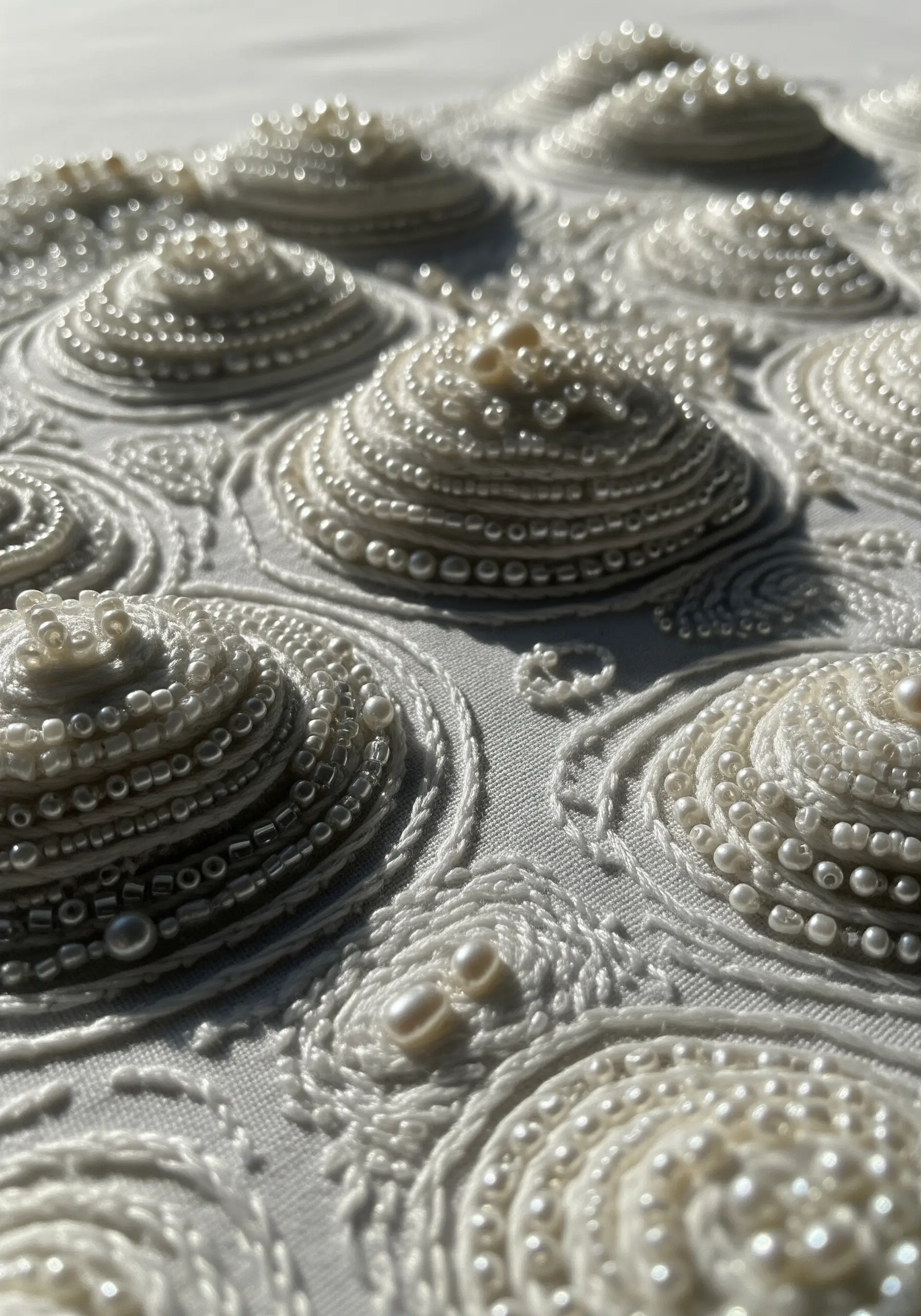
Remove color entirely and focus on the play of light and shadow using pearls, beads, and white thread.
Build up layers of bullion knots and couch down strings of pearls to create swirling, organic relief patterns.
This technique relies on high relief; the higher the stitch sits off the fabric, the more shadow it casts.
Such monochrome textile wall art concepts for elegant understated interiors look incredibly expensive and sophisticated.
24. Upcycled denim with wildflower meadows

Denim is a sturdy canvas that supports heavy floral stitching without puckering.
Stitch a wildflower meadow across the back panel, using the seams as a natural frame for your composition.
Incorporate lazy daisy stitches and French knots for varied texture that stands up to wear and tear.
Use these wildflower embroidery patterns to turn blank denim jackets into boho fashion statements that feel cozy and worn-in.