Have you ever paused, needle in hand, wondering how to bridge the gap between the soft, yielding world of fabric and the crisp, flat plane of paper? It’s a common creative hesitation—the desire to combine these beautiful mediums, but the uncertainty of how to make them speak the same language.
Here, you’ll discover that thread is more than just a decorative final touch. It is a powerful tool for connection, definition, and texture. Your needle can become a pen, drawing lines that unify disparate elements. Your floss can become paint, adding depth and dimension that lift paper right off the page.
These ideas aren’t about mastering complex new stitches. They are about shifting your perspective—seeing how a simple running stitch can become a graphic outline, how a cluster of French knots can build a tactile surface, and how a single, bright line of thread can tell a story. Let’s begin to explore that beautiful space where paper and thread meet.
1. Integrate Stitched Botanicals with Natural Elements

Create a central focus by stitching a fabric leaf appliqué directly onto your paper collage.
Use a dense satin stitch with two contrasting colors, like gold and white, to achieve a visually striking split-leaf effect that adds both color and sheen.
Define the leaf’s structure with a delicate couching stitch for the veins, which provides clean lines without piercing the paper excessively.
To balance the composition, add a small cluster of woven wheel roses in coordinating colors, which introduces a soft, three-dimensional texture that beautifully contrasts with the flat, pressed botanicals.
2. Use Hand-Stitched Lines to Unify Geometric Shapes

Instead of relying solely on glue, use a simple running stitch to physically and visually connect your paper geometric shapes.
This technique adds a graphic, handcrafted quality that transforms the piece from a simple collage into a more integrated work of art.
To prevent tearing, pre-pierce the holes in your paper with a fine needle before you begin stitching.
Choose a high-contrast thread, like black or white, to make the stitches a prominent design element that defines edges and creates pathways for the eye.
3. Layer Thread Painting Over Vintage Prints for Depth

Create an unexpected focal point by embroidering directly onto vintage prints, maps, or book pages.
Use a dense satin stitch with a metallic or silk thread to build a solid, light-catching surface that stands out against the matte paper.
When stitching a curved object like a moon, ensure your stitches follow its natural contours to enhance the illusion of volume and form.
Contrast the smooth, thread-painted areas with delicate, three-dimensional stitches like woven picot stars to add a sprinkle of fine detail and texture.
4. Sculpt with Thread to Create Dimensional Hair

Move beyond flat surfaces and use thread to build sculptural, highly textured hair on a portrait collage.
Employ a couching technique: lay down bundles of embroidery floss, yarn, or even unconventional fibers, then secure them with small, discreet stitches in a matching color.
Mix different thread weights, colors, and sheens to add realism, depth, and highlights, mimicking the way light interacts with real hair.
Arranging the threads in intentional coils and loops allows you to create dimensional hair with incredible movement and personality.
5. Embroider with Neon Thread to Mimic City Lights

In a minimalist or monochrome scene, use a single strand of vibrant, neon thread to represent a source of light.
A whipped backstitch or a clean stem stitch creates a smooth, unbroken line that perfectly captures the steady glow of a neon sign.
Stitching this element directly onto the final background layer makes it appear to float above the collage, enhancing the illusion of light piercing through the darkness of the cityscape.
This technique turns a simple line of thread into a powerful narrative element.
6. Add a Single Stitched Motif to Elevate Paper Crafts

You can make a significant impact without a complex design; a single, well-placed stitched motif adds an immediate handmade touch.
Use a simple backstitch on cardstock to create delicate line art, like a dandelion, which feels both personal and refined.
For small, solid shapes like a bee’s body, a few satin stitches provide a pop of color and texture that contrasts beautifully with the flat paper.
Combining your small embroidered element with layered papers and washi tape creates a balanced and professionally finished piece, perfect for cards or gift tags.
7. Use Directional Stitches to Emphasize Movement

Amplify the sense of motion in your collage by adding long, flowing stitches that follow the natural lines of your subject.
For a piece depicting water, use a simple backstitch or stem stitch in a contrasting color like white to represent sea foam and currents.
This directional stitching guides the viewer’s eye through the composition and reinforces the dynamic energy of the wave.
Scattered French knots serve as perfect textural accents for sea spray, adding a final layer of detail that makes the artwork feel alive and helps to emphasize movement.
8. Edge Paper Cutouts with Blanket Stitch for a Polished Finish

Elevate simple paper illustrations by transforming them into tactile appliqués with a decorative stitched edge.
Use a blanket stitch around the perimeter of your paper cutouts to give them a charming, almost textile-like quality and a clean, finished border.
This technique also provides a subtle shadow line that helps the cutout stand out from its background.
Add textural details like raised French knots for spots, creating a delightful contrast between the flat paper surface and the three-dimensional thread.
9. Outline and Define Shapes with Contrasting Backstitch

Create a cohesive look in a mixed-media piece by using thread as a unifying graphic element.
Use a simple backstitch in a contrasting color to trace the veins and outlines of paper leaves, integrating them with any real botanical elements in your collage.
This approach adds a layer of hand-drawn detail that defines each shape, making it pop against the background.
The clean lines of the backstitch bring a sense of order and intention to a composition of varied textures and materials.
10. Illustrate a Personal Journey with a Stitched Path

Transform a standard map into a deeply personal narrative by stitching a line that represents a significant journey or connection.
Use a bold, textured stitch like the chain stitch to ensure the path stands out visually against the intricate details of the map.
Choose a thread color with symbolic meaning, like red for love or adventure, to enhance the storytelling aspect of the piece.
Adding small, satin-stitched motifs like hearts or stars at key locations makes the map a truly meaningful keepsake.
11. Combine Iridescent Paper and Thread to Create Shimmer

Amplify the magic of your collage by layering embroidery over iridescent or holographic paper.
Stitch the structural elements—like the body and wing veins of a butterfly—using solid satin and backstitches.
This creates a defined framework that grounds the design while allowing the specialty paper to show through in open sections.
The technique results in a beautiful interplay where the thread provides texture and form, while the paper catches the light, mimicking the natural shimmer of butterfly wings.
12. Stitch Radiating Lines for a Dynamic Focal Point

Generate a powerful sense of energy by stitching straight stitches that radiate from a central point.
Use several shades within the same color family, like yellows and oranges, to build depth and create a vibrant gradient effect.
Stitching over a textured background of torn paper and canvas integrates the different layers of your collage, unifying them with the thread.
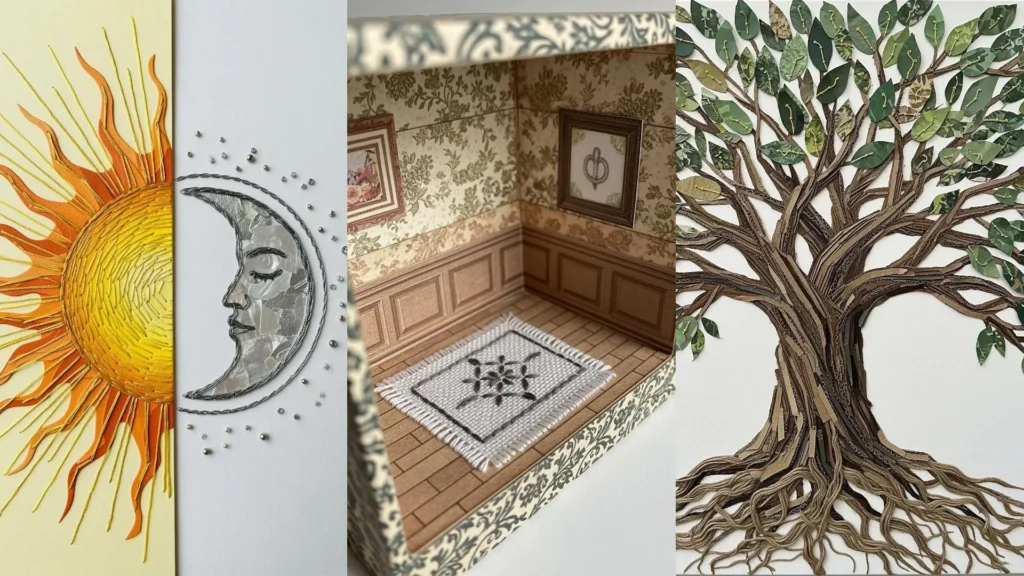
Varying the lengths of your stitches enhances the sunburst’s dynamic, explosive quality, making it an undeniable focal point.
13. Frame a Space with Mixed Stitched and Paper Botanicals

Construct a delicate wreath by combining embroidered foliage with tiny paper flowers for a rich, textural effect.
Embroider the leaves and stems directly onto your paper base using stitches like fishbone or stem stitch for definition.
Then, layer small, paper-punched flowers on top, securing each with a single French knot in the center, which doubles as a flower’s pistil.
This mixed-media approach creates a beautiful interplay between the softness of thread and the crispness of paper.
14. Add Metallic Thread to Accentuate Geometric Patterns

Elevate a graphic paper quilt design by introducing the subtle elegance of metallic thread.
Use a simple backstitch to outline the paper shapes, adding a crisp line of shimmer that defines the geometry of the pattern.
In select blocks, stitch a small, repeating motif—like a delicate feather—to create visual interest and rhythm.
The metallic thread catches the light, creating a sophisticated contrast with the matte paper and coordinating gold leaf accents.
15. Create Textured Lettering with Padded Satin Stitch

Make your embroidered text the undeniable star of your collage by giving it a raised, three-dimensional profile.
Achieve this by first creating a foundation of small running stitches or seed stitches within the outlines of your letters.
Then, work your satin stitch smoothly over this padding, keeping your stitches close together for full coverage.
This technique lifts the lettering off the page, creating a tactile quality that stands out beautifully against a flat collage of torn paper.
16. Use French Knots to Build Coral-Like Textures

Mimic the intricate, organic textures of a coral reef by using dense clusters of French knots and bullion knots.
First, create your base shapes by cutting them from brightly colored paper and arranging them in a dynamic composition.
Then, layer on the knots, varying their size, tightness, and color to create a rich, tactile surface that begs to be touched.
This method is a perfect way to add a coral-like textures and a vibrant, dimensional quality to your underwater scenes.
17. Stitch Contour Lines to Define a Paper Landscape

Add a sense of depth and topography to a layered paper landscape using simple, repeated lines of running stitch.
Choose thread colors that are a subtle shade lighter or darker than the paper they are stitched on to create soft, organic contour lines.
This technique suggests the gentle roll of hills and adds a quiet, handmade texture that harmonizes with the minimalist aesthetic.
The stitching transforms flat layers of paper into a landscape with perceived form and dimension.
18. Use Tiny Straight Stitches as Playful Sprinkles

Introduce a touch of whimsy and texture to your paper collages with one of the simplest stitches in your repertoire.
Use short, single straight stitches in a rainbow of bright colors to represent sprinkles, scattering them playfully around your central motif.
This technique requires minimal effort but delivers maximum charm, instantly adding a celebratory and whimsical, textural touch.
It’s an excellent way for beginners to confidently merge thread with paper in a fun, low-pressure project.
19. Create a Thread-Painted Centerpiece on a Collage Background

Draw the viewer’s eye by placing a detailed, thread-painted element on top of a busy collage background.
Use the long and short stitch technique for your central motif to blend colors smoothly, creating a realistic, painted effect with thread.
The dense, meticulous stitching of the ginkgo leaves provides a stunning textural contrast to the fragmented, layered look of vintage stamps and ephemera beneath.
This strategic layering makes your embroidery the clear hero of the composition, a technique often used in thread painting.
20. Stitch a Constellation Over a Photographic Print

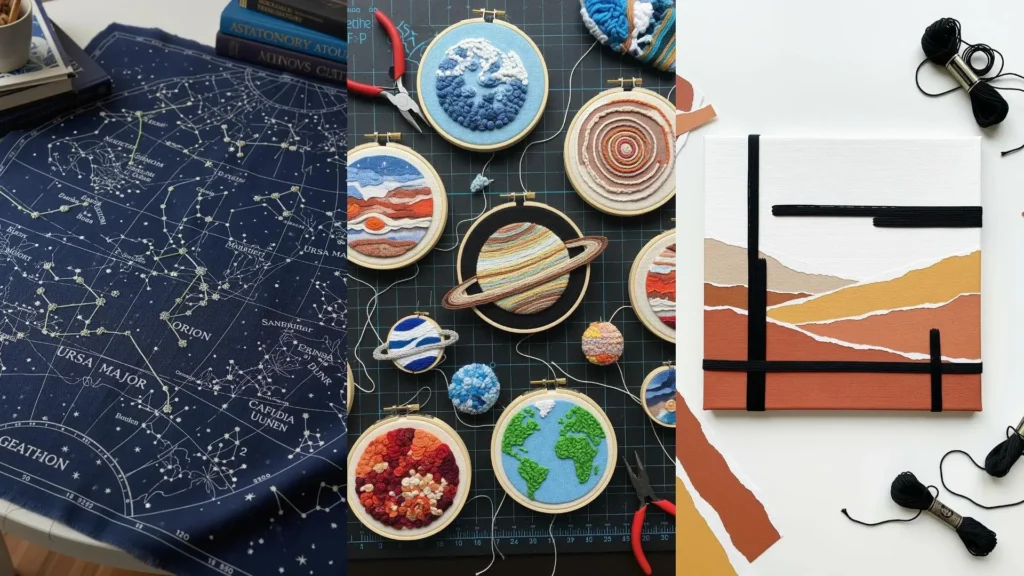
Add a layer of narrative and wonder to a photograph by embroidering a celestial map directly onto its surface.
Use a crisp backstitch with a bright white or metallic thread to connect the stars, creating the sharp, graphic lines of a constellation.
For the stars themselves, a star stitch or a cluster of small straight stitches provides a sparkling focal point.
This method beautifully juxtaposes the soft focus of a landscape with the clean precision of stitched lines, adding a touch of celestial magic.
21. Anchor a Paper Element with a Textured Stitched Ground

Integrate a paper cutout into your artwork by stitching a tactile environment for it to inhabit.
Create a realistic branch by wrapping a thick thread around a foundation of long straight stitches, which gives it a convincing, three-dimensional quality.
This technique provides a stable, textured ground that makes the flat paper bird feel like a natural part of the scene.
Complete the environment with delicate lazy daisy flowers and fishbone stitch leaves to seamlessly blend the collaged and embroidered elements.
22. Frame Abstract Thread Textures as a Collection

Elevate your stitch experiments by presenting them as a curated collection of miniature textile art.
Create small studies of texture on individual cards using freestyle loops, knots, and stitches, exploring how different threads behave.
Arrange these sampler cards on a larger, color-blocked paper background to create a sophisticated, gallery-style composition.
This approach celebrates the inherent beauty of abstract thread textures and turns your creative process into a finished piece.