Have you ever looked at a piece of traditional textile art and felt a connection—a sense that the stitches are speaking a language you almost understand? That feeling is your invitation to look deeper, not just as an admirer, but as a maker.
Embroidery is more than just a technique; it’s a global tapestry of stories, symbols, and identities, stitched into fabric over centuries. Exploring these cultural styles isn’t about perfectly replicating the past. It’s about learning a new visual vocabulary that can enrich your own creative voice.
In these designs, you’ll discover how a simple running stitch can become a profound narrative, how color choices can convey pure joy, and how texture can tell a story all its own. Let these traditions guide your needle, and you’ll find your work transformed, stitch by stitch, into something more meaningful, personal, and alive.
1. Master the Rhythm of Japanese Sashiko Stitching

Embrace the meditative quality of Sashiko by focusing on the perfect running stitch.
Use a long, fine needle and a palm thimble to push the needle through the fabric in a continuous, rocking motion, loading several stitches at once for a faster, more even result.
The key to authentic Sashiko is maintaining consistent stitch length and leaving a tiny, uniform gap between each one—this precision is what makes the geometric patterns feel so harmonious.
Choose a high-contrast, non-divisible Sashiko thread on a dark, loosely woven fabric like indigo-dyed cotton or linen; the stark contrast allows the intricate white lines to define the design.
This technique isn’t about filling space but creating balance, making it perfect for traditional cultural textile wall art styles you can recreate with embroidery.
2. Create Vibrant Otomí-Inspired Animal Motifs

Capture the joyful energy of Otomí embroidery by focusing on a single, perfectly executed stitch: the close herringbone or a slightly angled satin stitch.
To achieve the signature flat, dense fill, keep your stitches parallel and tightly packed, ensuring no fabric shows through.
Work each block of color with a single shade of six-strand cotton floss; the magic of this style is its bold, unapologetic use of color, not subtle blending.
Outline your fantastical animal shapes with a simple backstitch before filling them in—this creates a clean boundary and makes your fill stitches look sharper and more contained.
3. Embrace the Grandeur of Central Asian Suzani

To tackle a large-scale Suzani-inspired piece, break the design into smaller, manageable motifs like medallions and floral sprays.
Use a combination of stitches to create varied textures: outline your shapes with a sharp chain stitch, use a buttonhole stitch for circular elements, and apply couching for thick, decorative lines that add dimension.
The aesthetic power of Suzani comes from its bold symmetry and rhythmic color repetition.
Choose a foundational color palette of three to five shades and repeat them throughout the design to create a cohesive, balanced composition that feels both opulent and orderly.
This method turns a blank wall into one of many stunning embroidered fabric wall panels you can stitch to impress guests instantly.
4. Adorn Apparel with Ukrainian Vyshyvanka Patterns
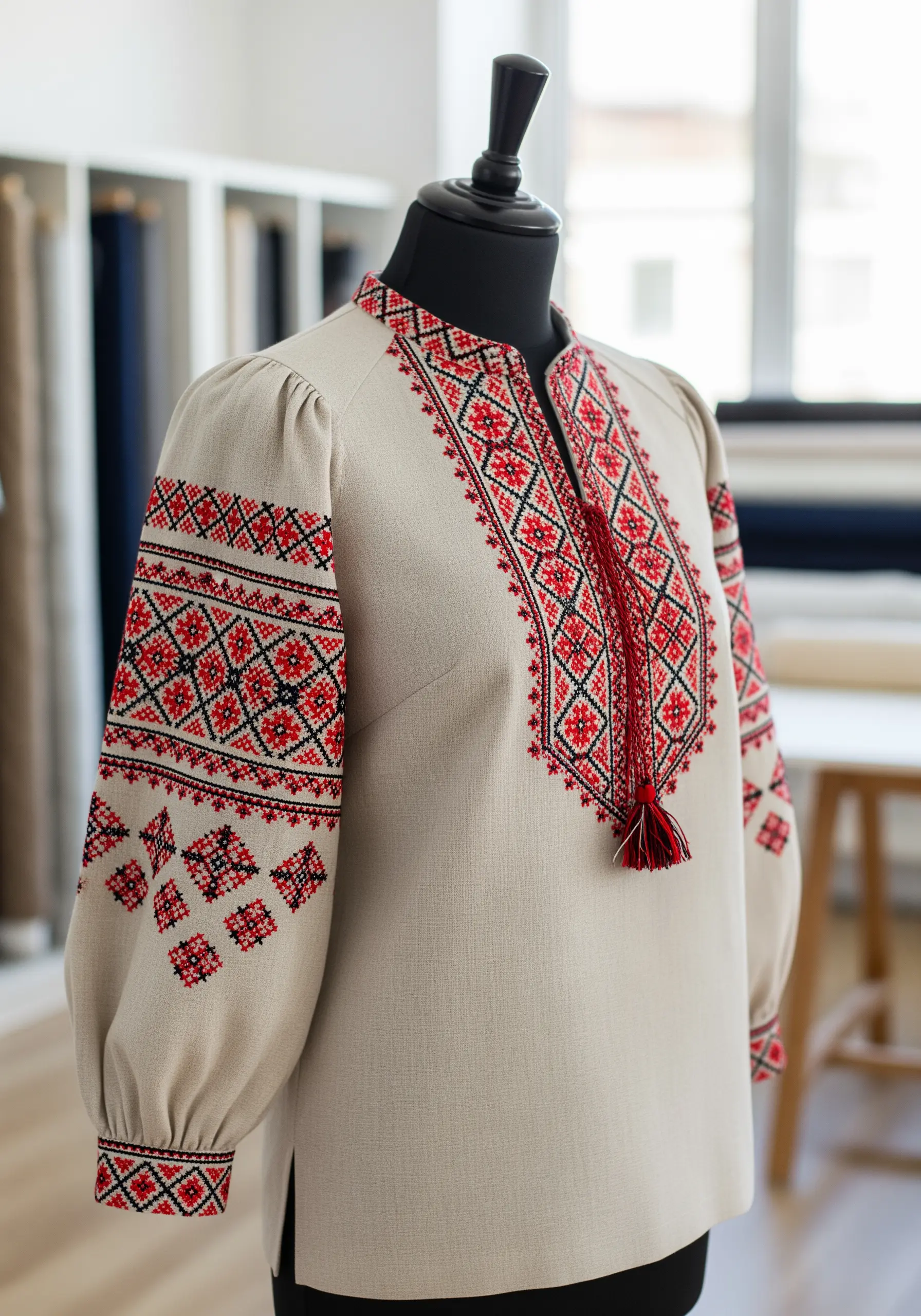
To embroider geometric Vyshyvanka patterns directly onto clothing, use a waste canvas or a water-soluble stabilizer.
This provides a temporary grid, allowing you to execute perfect cross-stitches on any fabric, from fine linen to cotton blends.
The placement of embroidery is critical; traditional designs follow the garment’s construction, emphasizing the collar, placket, and cuffs.
Pay attention to stitch tension to prevent the fabric from puckering, especially when working with dense patterns. A looser tension is often better on wearable fabrics.
Explore these hand-embroidered sleeve ideas that instantly turn a plain shirt into a statement piece to see how thoughtful placement transforms an entire garment.
5. Stitch Geometric Narratives with Tatreez Motifs

The graphic power of Palestinian Tatreez lies in its high-contrast, geometric cross-stitch.
For the sharpest finish, use an evenweave fabric or Aida cloth and ensure all your top stitches face the same direction—this small detail creates a uniform, light-reflecting surface that looks incredibly polished.
Start with a manageable project like one of these embroidered cushion covers that make your couch a comfort zone to master the rhythm of the motifs.
Choose a bold background like black or ivory to make the jewel-toned threads—rich reds, greens, and oranges—truly pop, allowing the symbolic patterns to tell their story with clarity and strength.
6. Build Rich Texture with English Crewelwork

The soul of crewelwork is its rich, dimensional texture, achieved by using two-ply wool thread on a sturdy linen twill fabric.
Instead of relying on one stitch, explore a vocabulary of textural stitches: use the long-and-short stitch for smooth shading on petals, a stem stitch for graceful vines, and clusters of French knots for tactile, bumpy surfaces like buds or animal fur.
Don’t be afraid to layer your stitches. This practice builds depth and shadow, making the motifs feel like they are lifting off the fabric.
This is one of the most effective ways to embroider natural textures that wow your friends and create a true heirloom piece.
7. Master Bold Satin Stitch for Vibrant Mexican Florals

To achieve a flawless, light-catching satin stitch for Mexican-inspired floral embroidery, preparation is everything.
First, outline your shape with a tight split stitch; this creates a slightly raised edge that your satin stitches can tuck against, resulting in a perfectly sharp and contained shape.
When filling the shape, angle your stitches to follow the natural curve of the petal or leaf. This subtle directionality gives the motif life and movement.
Working on a dark background, like black linen or cotton, will make your vibrant thread colors appear even more luminous and saturated.
8. Tell a Story with the Simplicity of Kantha Stitching

The beauty of Bengali Kantha is its reliance on the humble running stitch to create texture, pattern, and narrative.
You can replicate this style by layering two or three pieces of soft cotton and quilting them together with rows of small, straight running stitches.
For the pictorial elements, use the same running stitch to create simple, graphic outlines of figures, animals, and nature.
The aesthetic is not about perfection but about the rhythm and texture created by thousands of tiny stitches, turning it into one of the most accessible hand-embroidery textile wall art ideas that turn blank walls into cozy story spaces.
9. Recreate the Rhythmic Patterns of Kuba Textiles

Capture the essence of Kuba cloth from the Democratic Republic of Congo by focusing on raised texture and geometric rhythm.
Instead of traditional raffia, use thick cotton yarn or multiple strands of floss to create your patterns. Couch down the yarn for bold outlines and fill shapes with dense, straight stitches or tight chain stitch rows.
To mimic the appliqué look, you can stitch down small pieces of felt or contrasting fabric before embroidering over their edges.
Stick to an earthy palette of black, brown, tan, and off-white to maintain the authentic, grounded aesthetic of these powerful ethnic-inspired embroidery designs.
10. Explore the Delicate Geometry of Reticello Whitework

Reticello, a form of Italian needle lace, creates geometric patterns by removing threads from the fabric and then embellishing the resulting grid.
To try a modern, simplified version, use a water-soluble canvas over your linen. Stitch your grid and lace-like buttonhole stitch patterns onto the canvas, then dissolve it away to reveal a delicate, openwork design without the difficulty of pulling threads.
This technique creates stunning monochrome textile wall art concepts, where texture and negative space are the true stars.
Always use a fine, strong thread, like a linen or cordonnet thread, to ensure your delicate structures are stable.
11. Achieve Painterly Realism with Chinese Silk Embroidery

The secret to the ‘no-stitch’ look of Su embroidery is using a single, untwisted strand of fine silk thread.
Use a combination of long-and-short stitch and split stitch to blend colors seamlessly, creating gradients so smooth they look like watercolor paintings. Your needle becomes a paintbrush.
Stitches should be laid in layers, with each new layer of color encroaching into the last, eliminating any hard lines.
To begin, practice on a single fish scale or lotus petal until you master the soft transition between two shades. It’s a meditative process that rewards patience with breathtaking results.
12. Weave Bold Color Stories Inspired by Peruvian Textiles

While traditionally woven, you can capture the spirit of a Peruvian manta with embroidery by using thick wool yarn and focusing on bold, geometric color blocking.
Fill large bands of color using dense darning stitches or laid work—where you lay long strands of yarn across an area and tack them down with small perpendicular stitches.
This approach covers ground quickly and mimics a woven texture.
The key is the fearless color palette: juxtapose hot pinks with electric blues and vibrant greens. It’s the dynamic color relationships that give these textiles their incredible energy, making for some of the most bold and colorful framed embroidery patterns to energize your walls.
13. Illuminate Your Work with Indian Shisha Mirror Work

Incorporate the dazzling effect of Indian Shisha by learning to frame small craft mirrors with thread.
First, create a foundation by stitching a square or star-shaped grid of straight stitches directly over the mirror to hold it in place.
Then, work a tight circle of buttonhole stitches around the mirror’s edge, catching the foundation threads with each stitch to secure it permanently.
Use a vibrant, contrasting thread color to make the frame pop. This technique is perfect for adding a touch of sparkle and tradition to bags, clothing, and home decor.
14. Illustrate Narratives with Hmong Story Cloths

You can create your own Hmong-inspired “Paj Ntaub” or story cloth using simple appliqué and outline stitches.
Cut your figures—people, animals, and houses—from small pieces of contrasting fabric and tack them onto your background fabric.
Secure the edges of each piece with a neat blanket stitch, which both attaches it and creates a decorative border.
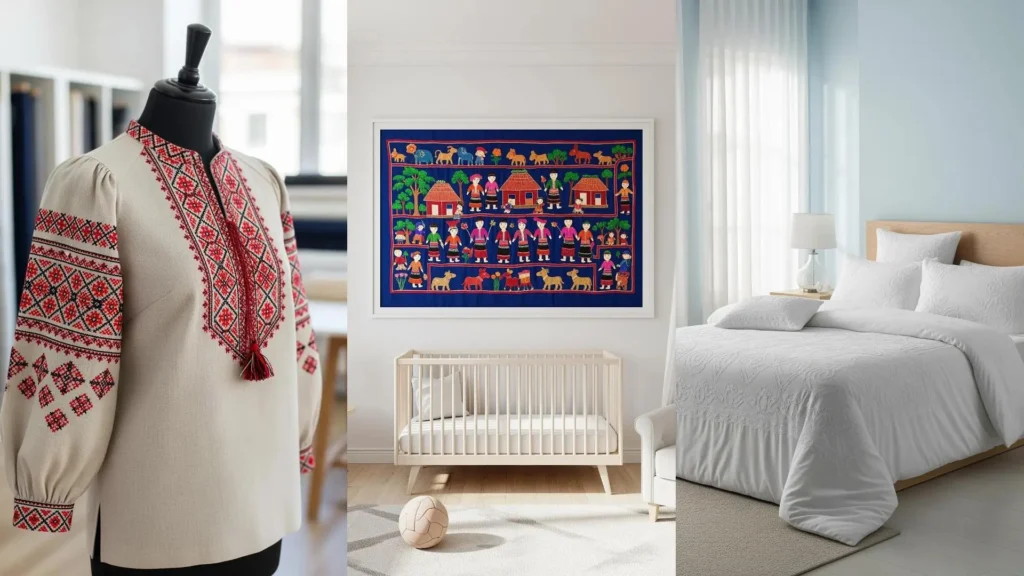
Use a simple backstitch or stem stitch to add fine details like facial features or patterns on clothing. The charm of these pieces lies in their clear, graphic storytelling, making them perfect for nursery-friendly textile wall art patterns.
15. Explore Freeform Texture with Modern Fiber Art

Translate the global tradition of textile art into a modern, personal expression by ditching the pattern and focusing purely on texture.
In a single large hoop, combine different techniques: weave chunky yarn through warp threads, create dense clusters of French knots, punch needle sections for a looped pile, and add traditional stitches for fine detail.
Mix materials freely—wool roving, silk ribbon, cotton floss, and fabric scraps—to build a tactile landscape.
This intuitive process celebrates the materials themselves and is one of the most exciting abstract thread sculpting tricks to make your embroidery look like floating art.
16. Define Motifs with Assisi-Style Voided Work

Reverse your thinking with Assisi embroidery, an Italian technique where the background is filled with cross-stitch, leaving the main motif voided or empty.
After filling the background, you define the unstitched motif with a crisp backstitch outline.
This negative space technique creates a striking, graphic effect that feels both traditional and incredibly modern.
For an authentic look, use a classic color combination like red or blue on a natural linen or evenweave fabric. It’s one of the most beautiful negative space stitch ideas for striking contemporary canvas embroidery you can try.
17. Practice Mindful Mending with Japanese Boro Stitching

Boro is the Japanese art of visible mending, celebrating the beauty of wear and repair.
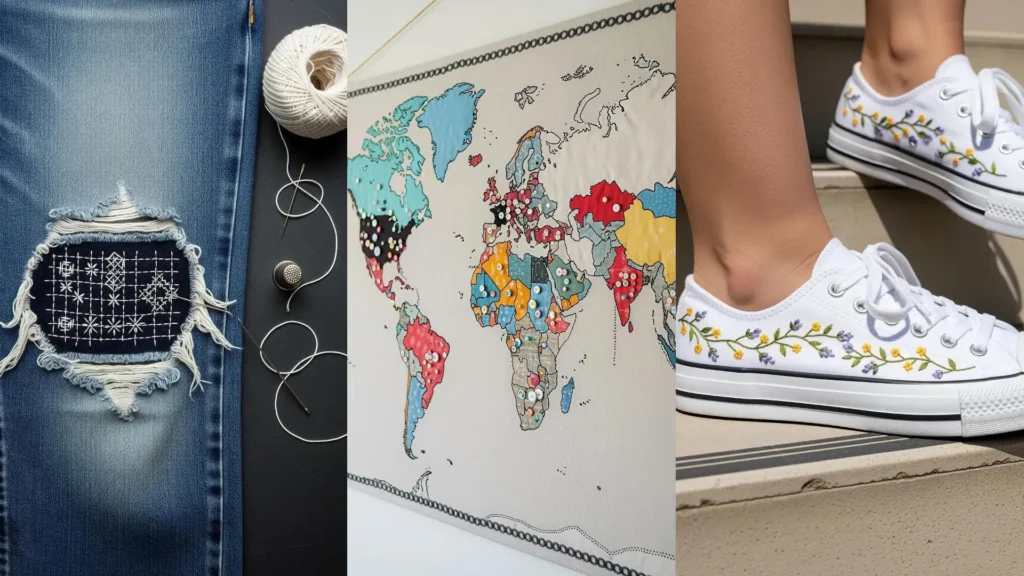
To practice it, simply layer patches of scrap fabric over a worn area and secure them with rows of straight, simple running stitches (Sashiko stitches).
Don’t strive for perfection; the charm lies in the slightly uneven stitches and overlapping, frayed edges of the patches.
Use a contrasting thread, like white on indigo denim, to highlight the mending as a design element. This is a sustainable and beautiful way to give old garments new life, making it one of the most rewarding vintage embroidered thrift flip ideas.
18. Paint with Wool Using the Colcha Stitch

Originating from the Spanish colonial traditions of the American Southwest, the Colcha stitch is a self-couching stitch perfect for filling large areas with wool yarn.
You make a long straight stitch and then tack it to the fabric with a small, angled stitch over the top. This allows you to cover surfaces quickly and efficiently, creating a unique, ribbed texture that catches the light beautifully.
Because the stitches can be angled and curved, this technique is ideal for organic, flowing designs like the birds and florals seen in traditional pieces. It’s perfect for creating rich, earth-tone embroidery wall art ideas to create a nature lover’s sanctuary.
19. Stitch Cheerful Polish Folk Floral Motifs

The charm of Polish folk embroidery comes from its stylized floral motifs and vibrant, high-contrast color palettes.
Create these cheerful designs using basic stitches: fill petals with a smooth satin stitch, create stems with a stem or chain stitch, and add centers with tight French knots.
The key to the look is the composition—arrange your stylized flowers in symmetrical bouquets or repeating patterns.
Stitch with bright reds, blues, yellows, and greens on a crisp white linen background to make the colors sing, and consider arranging them in hooped wall collage layouts that turn simple stitches into gallery-style decor.
20. Master the Intricate Flow of Kashmiri Crewel

Kashmiri embroidery, often done with a hook called an Aari, creates intricate designs with a fine, looped chain stitch.
You can achieve this elegant look with a standard needle and thread by mastering a small, tight chain stitch. The goal is to create continuous, flowing lines that swirl into dense floral and paisley patterns.
Use a fine, two-ply wool thread on a cotton or linen background. The texture of the chain stitch fill is what gives Kashmiri work its signature dimensional quality.
These detailed, nature-inspired patterns are perfect for creating your own forest-inspired embroidery patterns that bring woodland magic to your hoop.
21. Channel Huichol Art with Vibrant Yarn Couching

While traditional Huichol art involves pressing yarn into beeswax, you can capture its psychedelic spirit using couching embroidery.
Lay down strands of thick, brightly colored yarn onto your fabric, following concentric or geometric lines.
Then, use a thinner, matching thread to tack the yarn down with small, evenly spaced stitches.
This technique allows you to create bold, graphic designs with incredible color and texture. The magic is in the hypnotic repetition and the electric, high-contrast color choices, making them feel like abstract stitch maps.
22. Achieve Elegant Texture with Portuguese Whitework

Explore the subtle beauty of Bordado de Guimarães by focusing on texture over color.
This Portuguese whitework tradition uses a variety of raised, textural stitches—like bullion knots, French knots, and padded satin stitch—all in white or ecru thread on a matching linen background.
The artistry is in how the different stitch textures interact with light, creating a sophisticated and elegant design that is felt as much as it is seen.
This tone-on-tone approach is perfect for heirloom-quality items like bed linens, where the soft white thread palette creates a sense of calm luxury.
23. Create Modern Heirlooms with Scandinavian Folk Motifs

The timeless appeal of Scandinavian embroidery lies in its clean symmetry and limited, harmonious color palette.
Work your cross-stitch motifs on an evenweave linen fabric for a slightly rustic, authentic feel. The open weave of linen gives the stitches a soft, organic quality.
Focus on simple, graphic forms like stylized animals, geometric borders, and symmetrical florals. Sticking to a palette of red, blue, and white on a natural background ensures a classic look that feels both traditional and modern.
These motifs are perfect for minimalist stitches that instantly upgrade plain cotton handkerchiefs and other home linens.
24. Add Regal Detail with Moroccan Goldwork

The opulent look of Moroccan embroidery is often achieved through goldwork, specifically by couching metallic threads.
Instead of pulling a thick, delicate metallic thread through your fabric, you lay it on the surface and use a finer, stronger thread (often silk) to tack it down with tiny, almost invisible stitches.
This allows you to create intricate, flowing geometric patterns inspired by Moroccan tilework (Zellij) without fraying or breaking the precious metallic thread.
It’s the secret behind many luxury metallic thread wall decor ideas and garment embellishments.