Your needle and thread are more than just tools for craft—they are instruments for storytelling, for turning a blank piece of fabric into a space that holds warmth, memory, and intention.
But sometimes, you might feel a gap between the vision in your mind and the piece in your hands. You want your work to feel more polished, more personal, more *you*. That shift doesn’t require complex new skills. It begins with small, deliberate choices.
It’s in choosing a stem stitch over a backstitch for a cleaner curve, in using thicker yarn to create touchable texture, or in arranging simple hoops into a gallery wall that speaks with a single, clear voice. These ideas are here to guide you toward that next level of artistry, helping you create textile wall art that not only fills a space but also gives it a soul.
1. Sculptural Landscapes with Dimensional Stitches
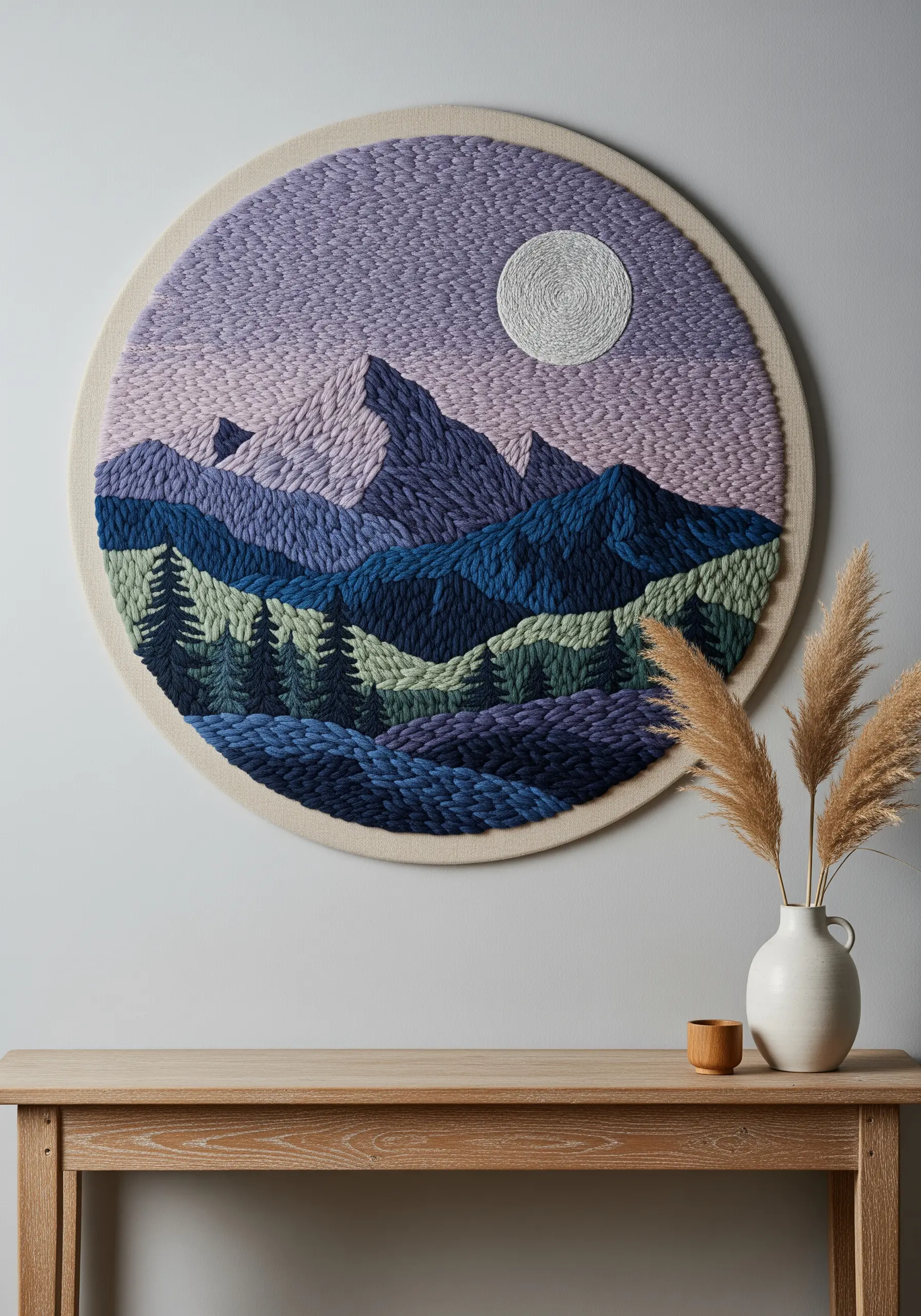
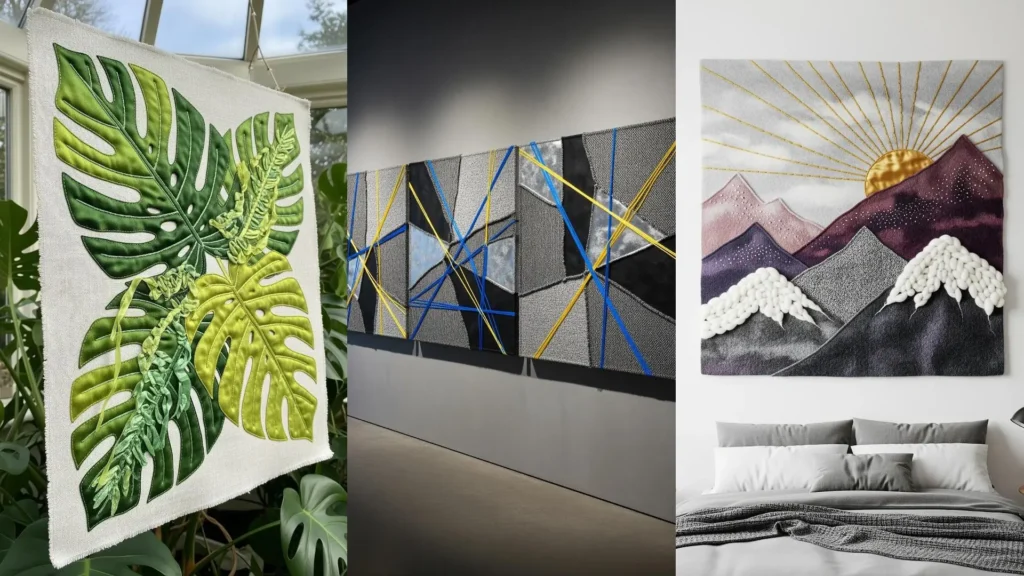
Create a tactile mountain scene by using thick yarn or roving instead of standard six-strand floss.
Use punch needle techniques or oversized French knots to build up dense, textural areas that mimic the ruggedness of rock and the softness of the sky.
Vary the direction of your stitches in each mountain range to create visual separation and depth.
For a calm sky, use a soft gradient of colors, letting your stitches blend into one another seamlessly.
This approach transforms a flat image into a piece of touchable art, inviting viewers to experience the texture as much as the view.
2. The Power of a Single, Confident Line
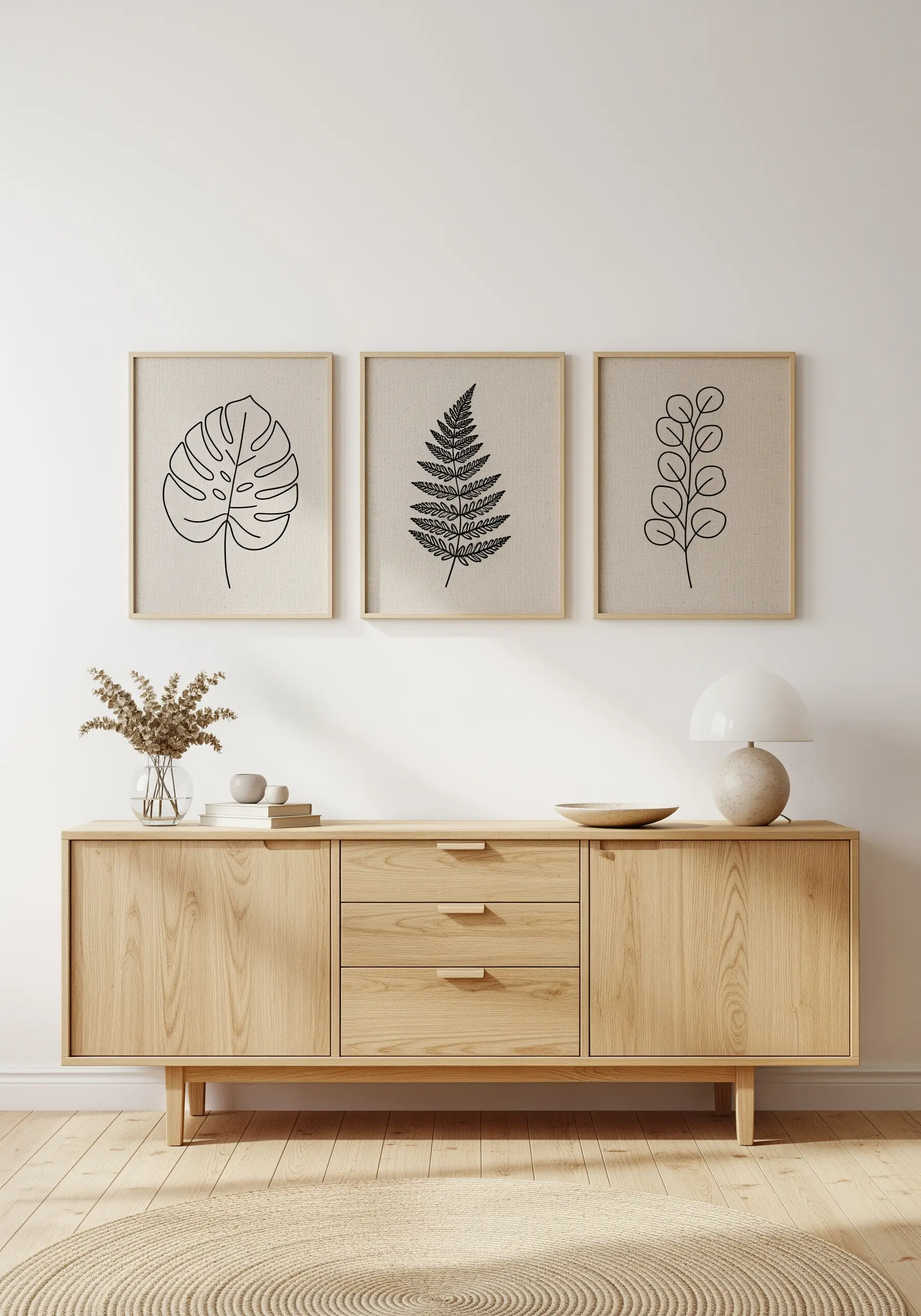
Elevate simple botanical drawings by focusing on the quality of your line work.
Use a whipped backstitch or stem stitch to create smooth, uninterrupted outlines that have a slightly raised, cord-like appearance.
Choose a high-contrast combination, like dark thread on natural linen, to emphasize the clean, graphic lines of your motif.
For delicate details like leaf veins, switch to a single strand of floss and a simple backstitch to maintain visual hierarchy.
Grouping three related but distinct designs creates a sophisticated triptych that feels intentional and curated.
3. Curate a Cohesive Hoop Gallery Wall
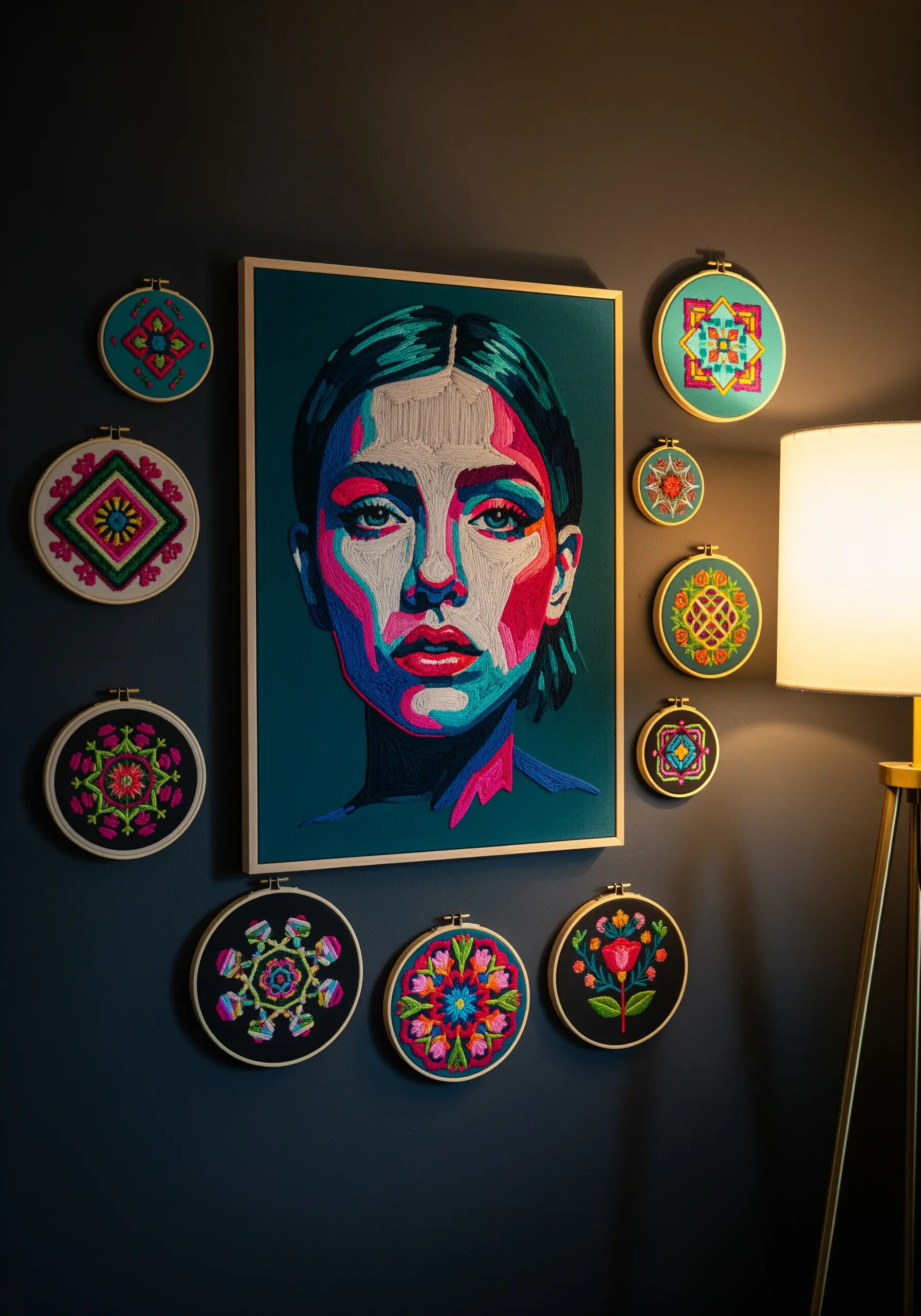
Turn a collection of hoops into a unified art installation by anchoring it with a large, central piece.
Select a dominant color palette from your main artwork—here, the vibrant teals, pinks, and blacks—and repeat those colors in smaller, abstract, or geometric patterns.
This creates a visual conversation between the pieces, making the collection feel cohesive rather than random.
Vary the size of the hoops to add rhythm and interest, but keep the fabric color consistent to tie everything together.
The result is one of the most dynamic hooped wall collage layouts that tells a larger story.
4. Stitch a Personal Atlas with Appliqué and Quilting

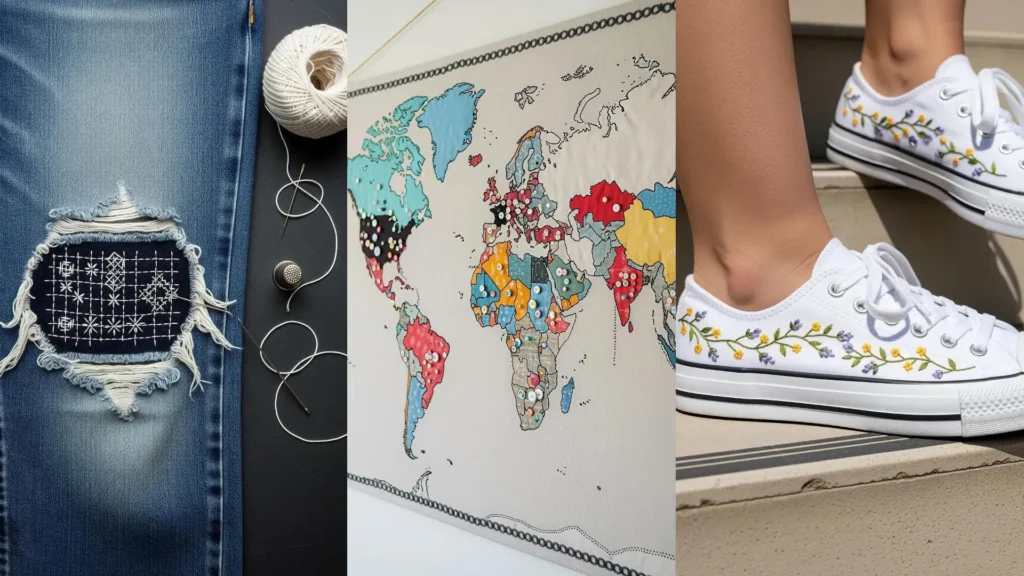
Transform a world map into a personal story by combining fabric appliqué with detailed embroidery.
Use fabric scraps that have personal meaning for different countries or continents to add a layer of narrative.
Define the landmasses with appliqué and then add small, illustrative icons using simple backstitch or satin stitch to mark significant places.
The echo quilting on the ocean creates a beautiful topographic texture that mimics water currents, adding incredible depth to the entire piece.
This project becomes a living document of your travels and dreams, making it one of those DIY embroidery art pieces that double as thoughtful gifts.
5. Blend Weaving and Macramé for a Cohesive Tapestry
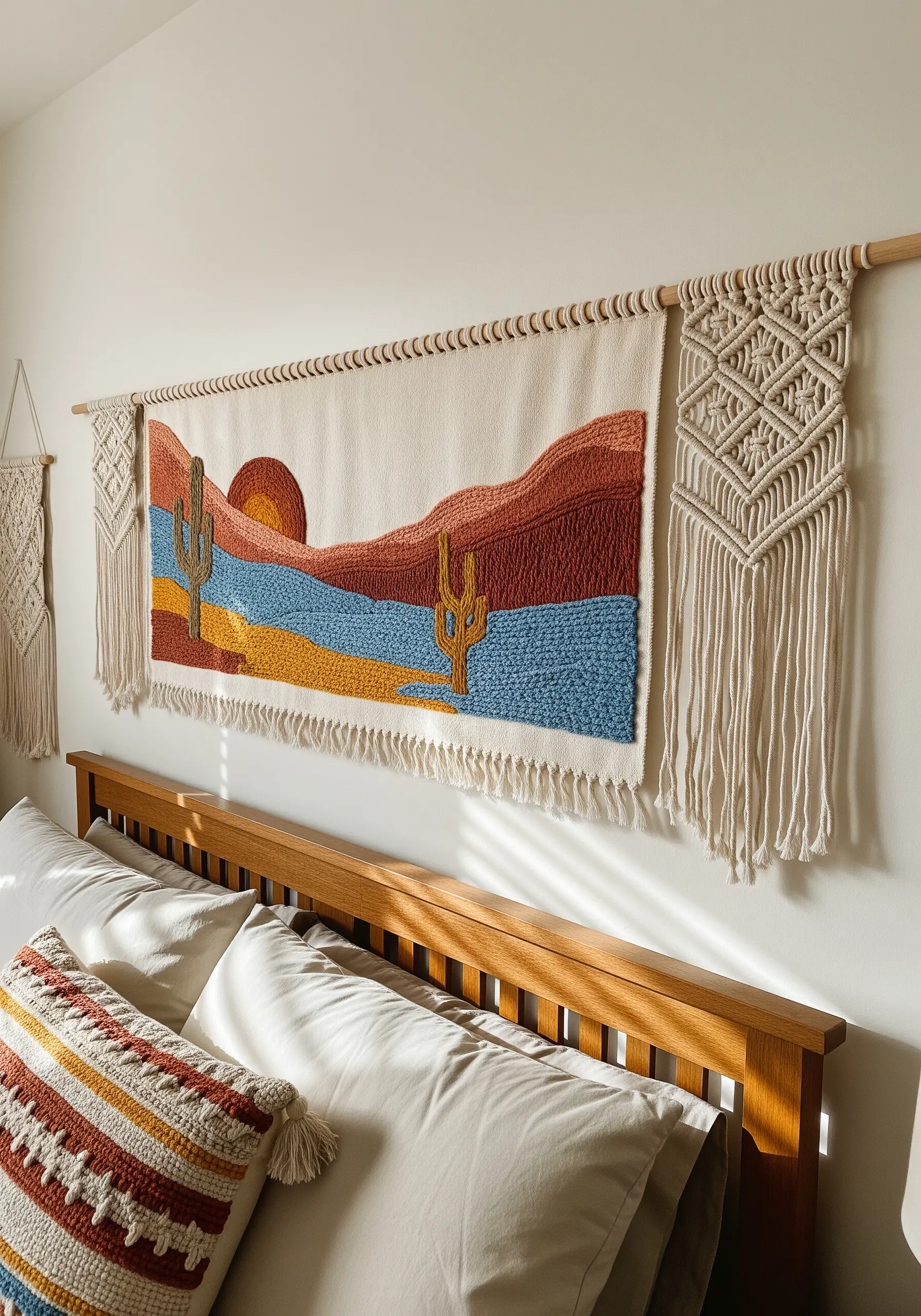
Create a statement wall hanging by integrating different fiber art forms into one piece.
Instead of treating them as separate crafts, design the woven landscape and macramé panels as a single, unified composition.
Use a consistent, earthy color palette across both the woven and knotted sections to ensure visual harmony.
The macramé acts as an integrated frame, adding intricate detail and texture that complements the block colors of the central woven scene.
This fusion of techniques demonstrates how to masterfully combine mixed-fiber art techniques that push creative boundaries.
6. Cosmic Cartography with Thread and Bead

Map out the night sky using a combination of thread and beads for a celestial effect.
On a dark fabric base, use metallic or iridescent white thread to stitch swirling galaxies with directional running stitches or seed stitches.
Create constellations with simple straight stitches, but add dimension by using French knots and tiny seed beads for the stars, varying their size to suggest distance.
The subtle shimmer of the beads and metallic thread against the matte black canvas catches the light beautifully, especially in a cozy reading nook.
This technique turns simple stitches into magical moon and stars embroidery ideas.
7. A Monochrome Study in Organic Texture
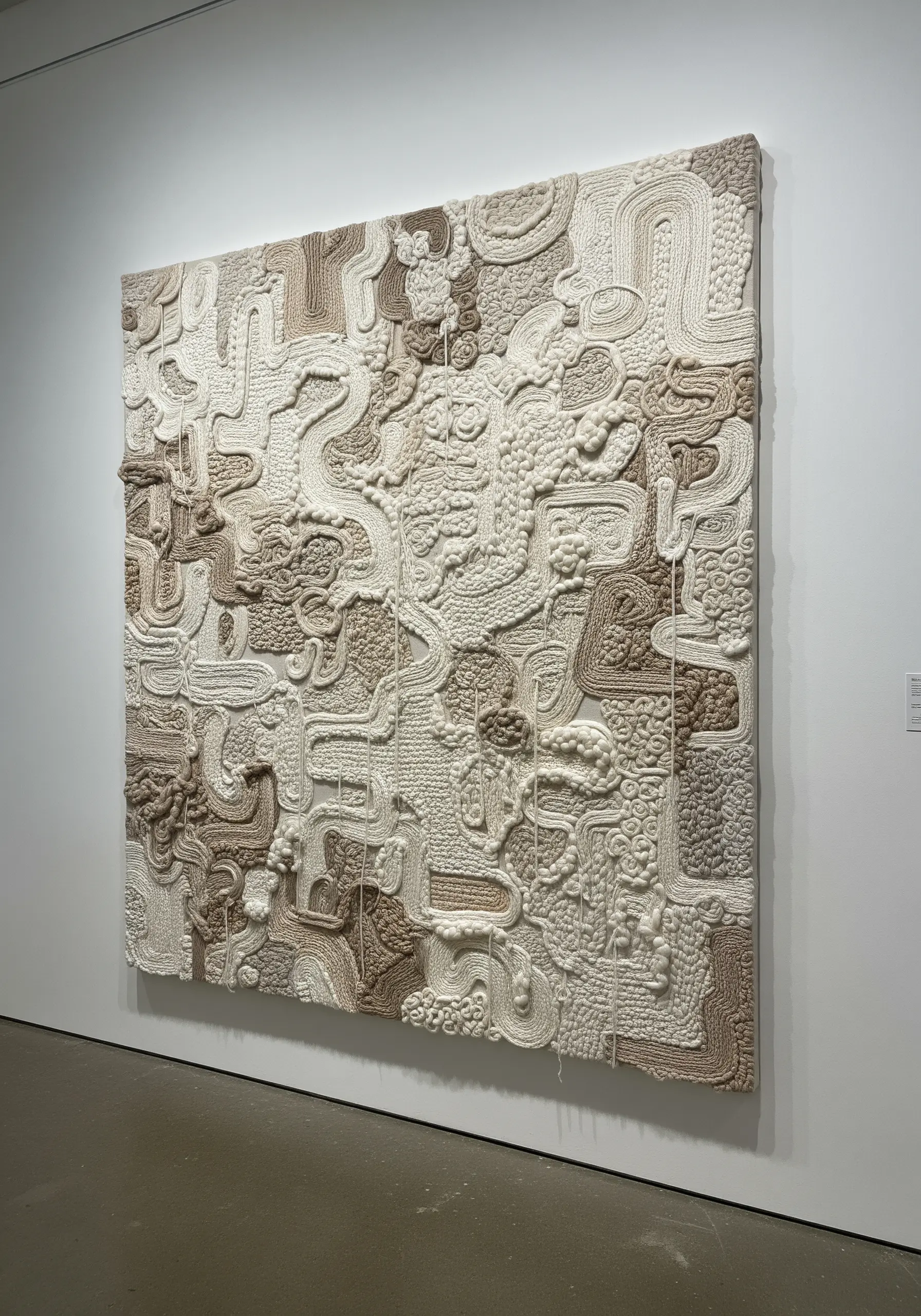
Explore the power of texture by limiting your color palette to soft neutrals like cream, beige, and taupe.
Use a variety of thick yarns and threads to create a highly tactile surface.
Incorporate couching—tacking down thick cords with smaller stitches—to create bold, meandering lines.
Fill enclosed shapes with dense clusters of French knots, bullion stitches, or woven wheel stitches to build areas of high relief.
This focus on organic texture embroidery designs transforms a simple color scheme into a complex and sophisticated work of art.
8. A Stitched Culinary Herb Garden Grid
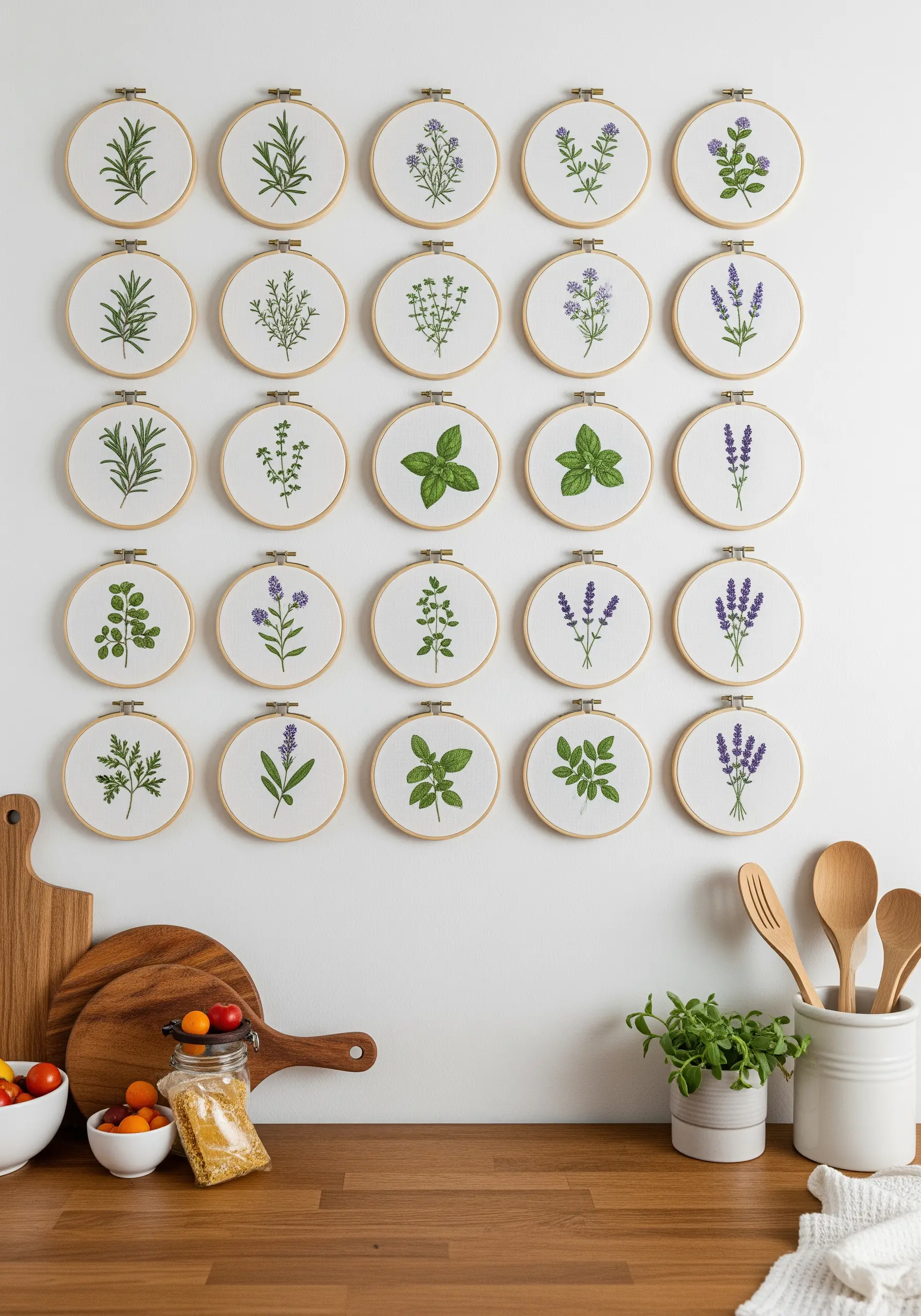
Create an elegant kitchen gallery wall by stitching a series of simple botanical subjects.
The key to this look is consistency: use the same size hoop, the same neutral fabric, and a similar scale for each herb.
This uniformity allows the unique character of each plant—stitched with delicate backstitches and satin stitches—to stand out.
Arranging the hoops in a precise grid transforms individual embroideries into a single, impactful art installation.
This is a perfect way to elevate botanical garden sampler ideas into sophisticated home decor.
9. Illustrative Depth with Thread Painting

Achieve a vibrant, illustrative quality in your work by treating your thread like paint.
Use long-and-short stitch to blend colors smoothly, creating gradients that give the mushroom caps a rounded, three-dimensional feel.
Create a sense of depth by layering elements: stitch foreground flowers and grasses over the base of the mushrooms, and keep background trees less detailed and slightly muted in color.
This technique allows you to create fantastical, storybook scenes that draw the viewer in, much like in wild garden floral embroidery ideas.
10. Embroider a Living Heirloom Family Tree
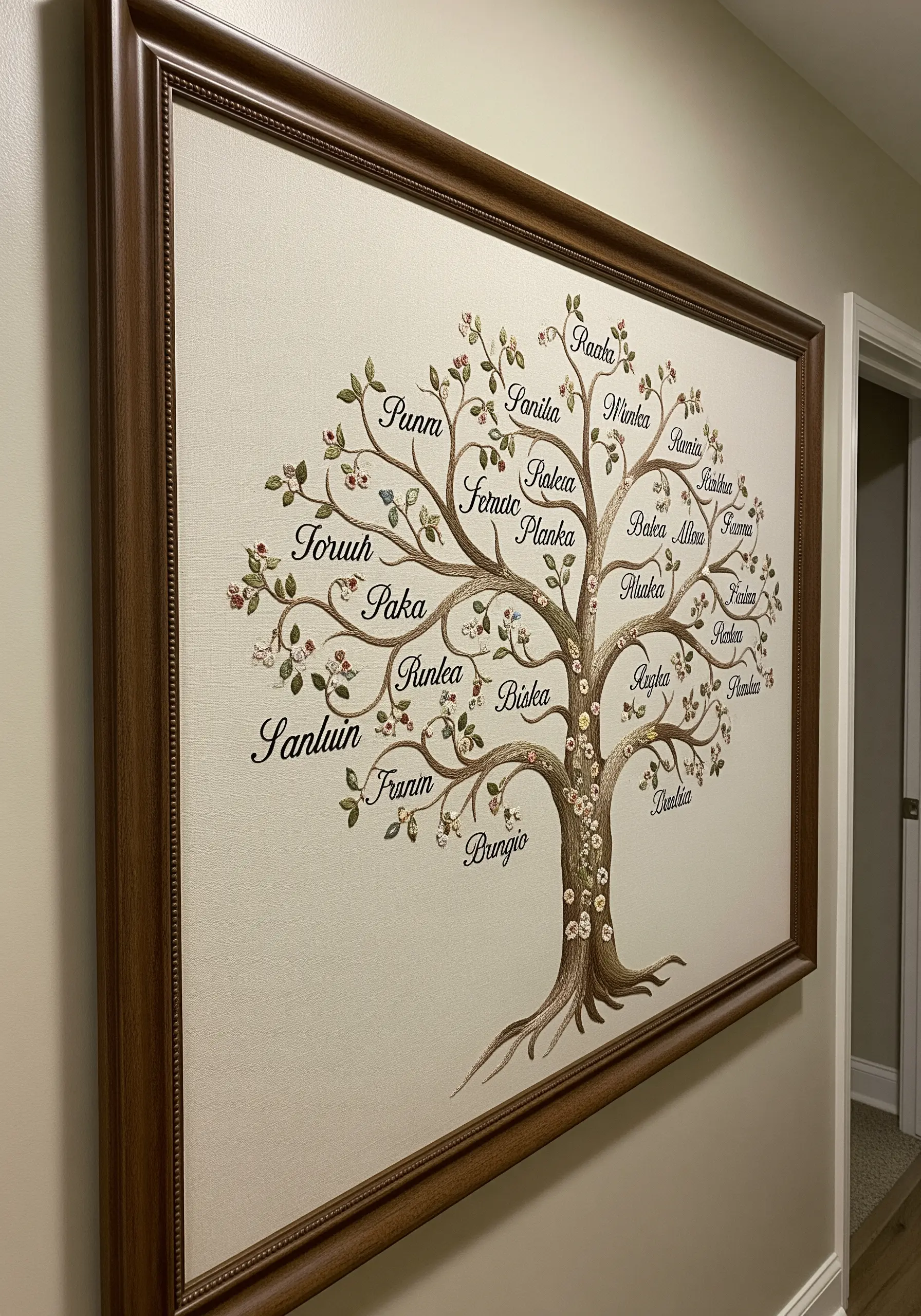
Craft a meaningful piece of family history by stitching a personalized family tree.
For the names, choose a clear, elegant script and stitch it with a fine, sharp backstitch using two strands of floss for perfect legibility.
Balance the composition by distributing the names evenly across the branches, as if they are fruits of the tree.
Add small, scattered floral motifs like lazy daisies and French knots to bring the tree to life and add touches of color.
This becomes one of those handmade art pieces that feel personal and heartfelt, destined to be cherished for generations.
11. Architectural Precision with Geometric Lines
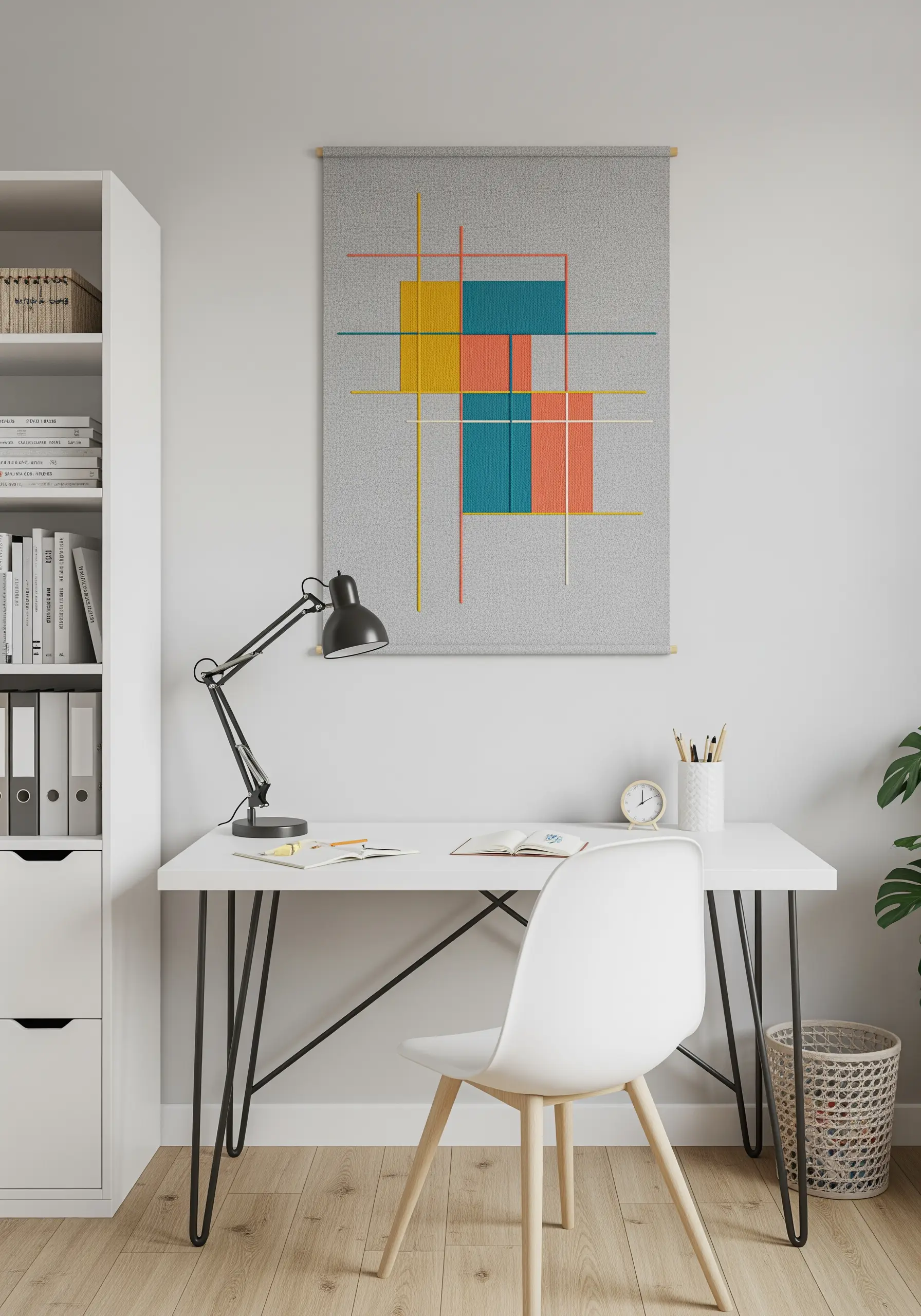
Create a modern, minimalist wall hanging inspired by architectural drawings or abstract art.
The success of this style lies in precision. Use a ruler and a water-soluble marker to draw your grid perfectly before you begin stitching.
Employ a clean, consistent stitch like a backstitch or split stitch for all lines to maintain a crisp, graphic quality.
Fill in colored blocks with perfectly aligned satin stitches, ensuring your entry and exit points are exact for sharp edges.
This is one of the best minimalist stitched ideas inspired by geometry and nature for a clean, contemporary space.
12. Capture Ocean Movement with Textural Stitches

Bring a seascape to life by incorporating three-dimensional stitches to mimic the texture of sea foam.
Use dense clusters of French knots, bullion knots, and detached chain stitches in whites and light blues to represent the crashing crest of the waves.
Vary the density of these knots—packing them tightly at the peak of the wave and scattering them outward—to create a realistic sense of movement and spray.
Contrast these highly textured areas with flatter, directional stitches for the smoother parts of the water to enhance the effect.
13. Stitched Lullabies: A Soft Sculpture Mobile
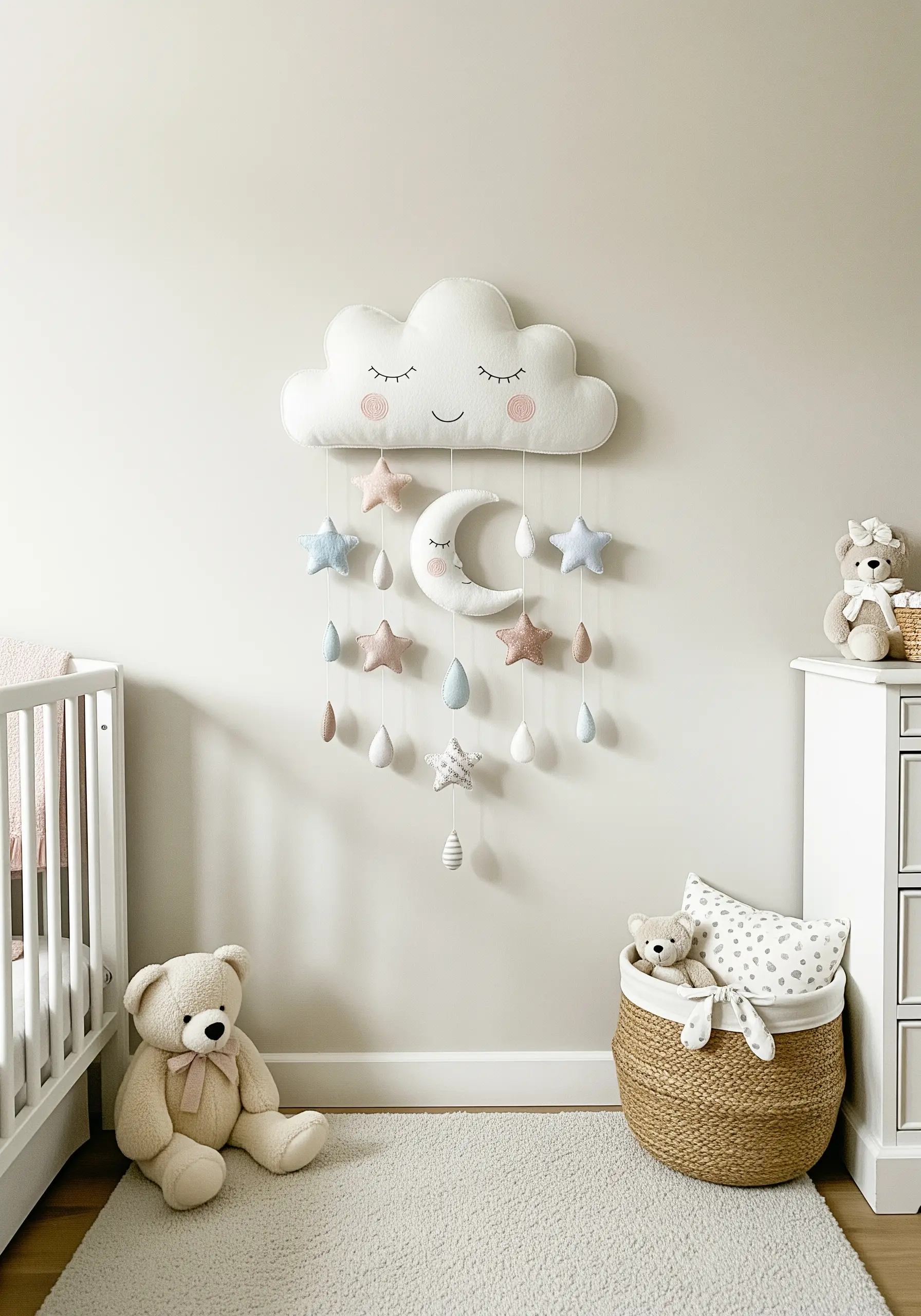
Move your embroidery off the wall and into three dimensions by creating a soft sculpture mobile.
Use felt or thick cotton for your shapes, as it’s easy to cut and holds its form well.
Embroider simple, sweet details—like sleepy eyes and rosy cheeks—before you cut out your shapes.
Stitch the front and back pieces together with a simple blanket stitch along the outside, stuffing lightly with poly-fil before you close the final seam.
These are the perfect nursery stitch art wall ideas for a gentle, handmade touch.
14. Embroidered Light: Stitching on Sheer Fabric
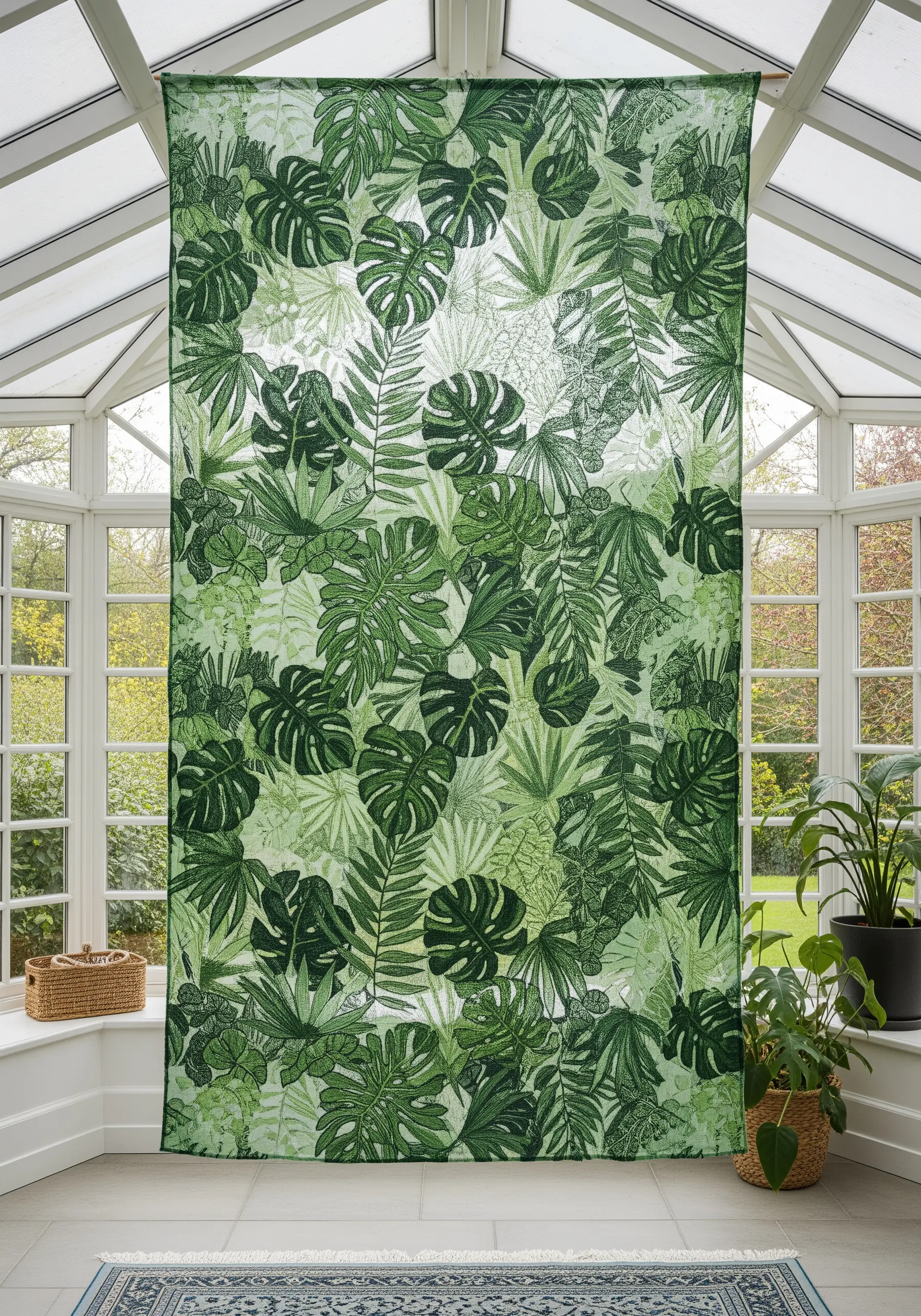
Create a stunning, ethereal effect by using sheer organza or voile as your embroidery canvas.
This technique allows light to filter through the fabric, making your stitches appear to float.
To prevent puckering on such a delicate base, use a stabilizer behind your fabric while stitching and maintain even tension.
A dense pattern of leaves, using varied shades of green and different fill stitches, creates a rich tapestry of light and shadow.
The transparency of these climbing plant stitch designs makes them perfect for sunrooms or as privacy screens.
15. Urban Landscapes in Graphic Black and White
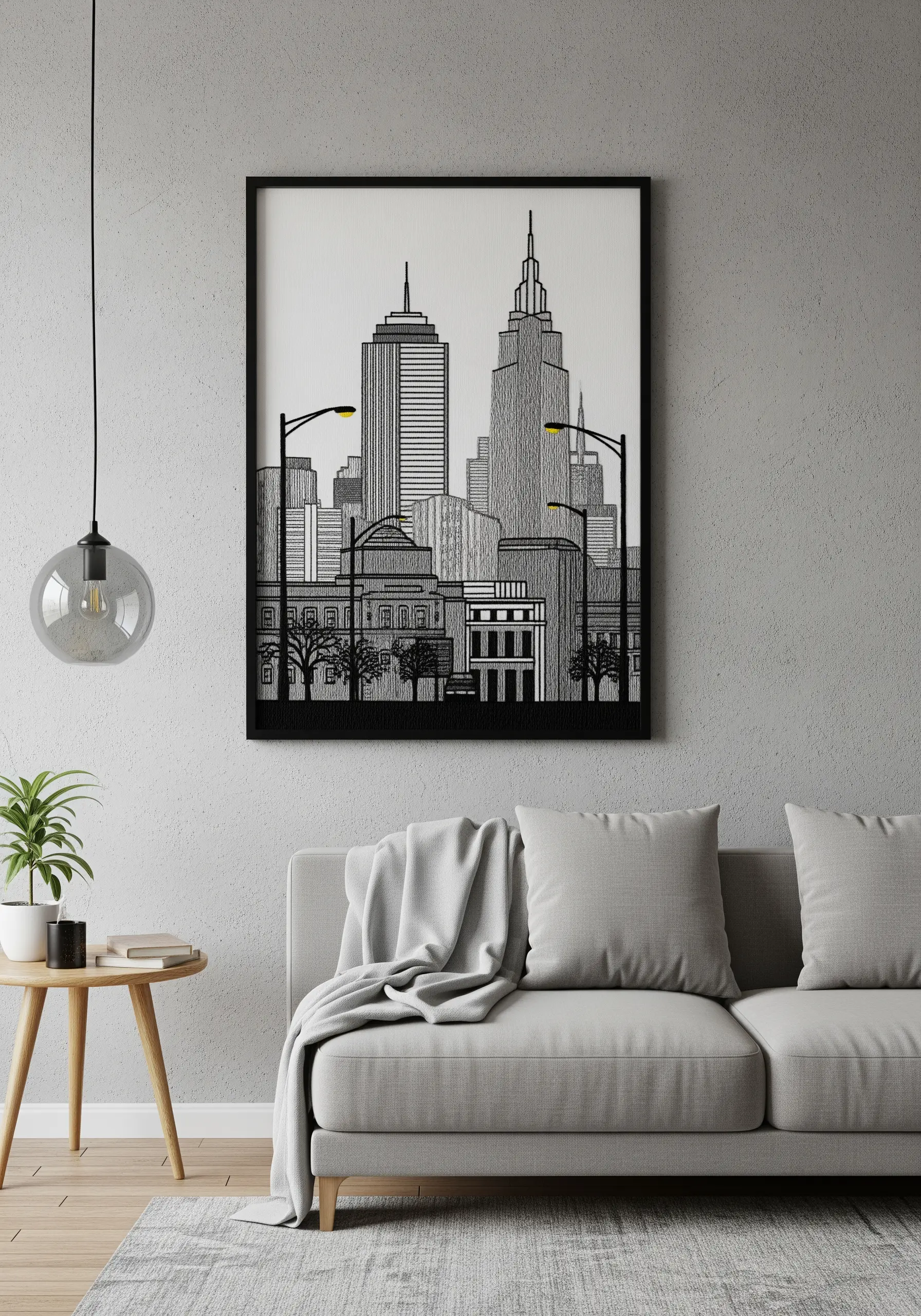
Capture the energy of a city skyline using only black thread on a white background.
This minimalist approach forces you to focus on line, shape, and perspective.
Use a consistent backstitch for all structural outlines to create a clean, architectural drawing style.
Introduce texture and shading with techniques like parallel lines (hatching) or tiny seed stitches instead of color.
A single pop of color, like the yellow in the streetlights, can serve as a powerful focal point in an otherwise monochrome piece.
16. Stitch a Narrative Panorama
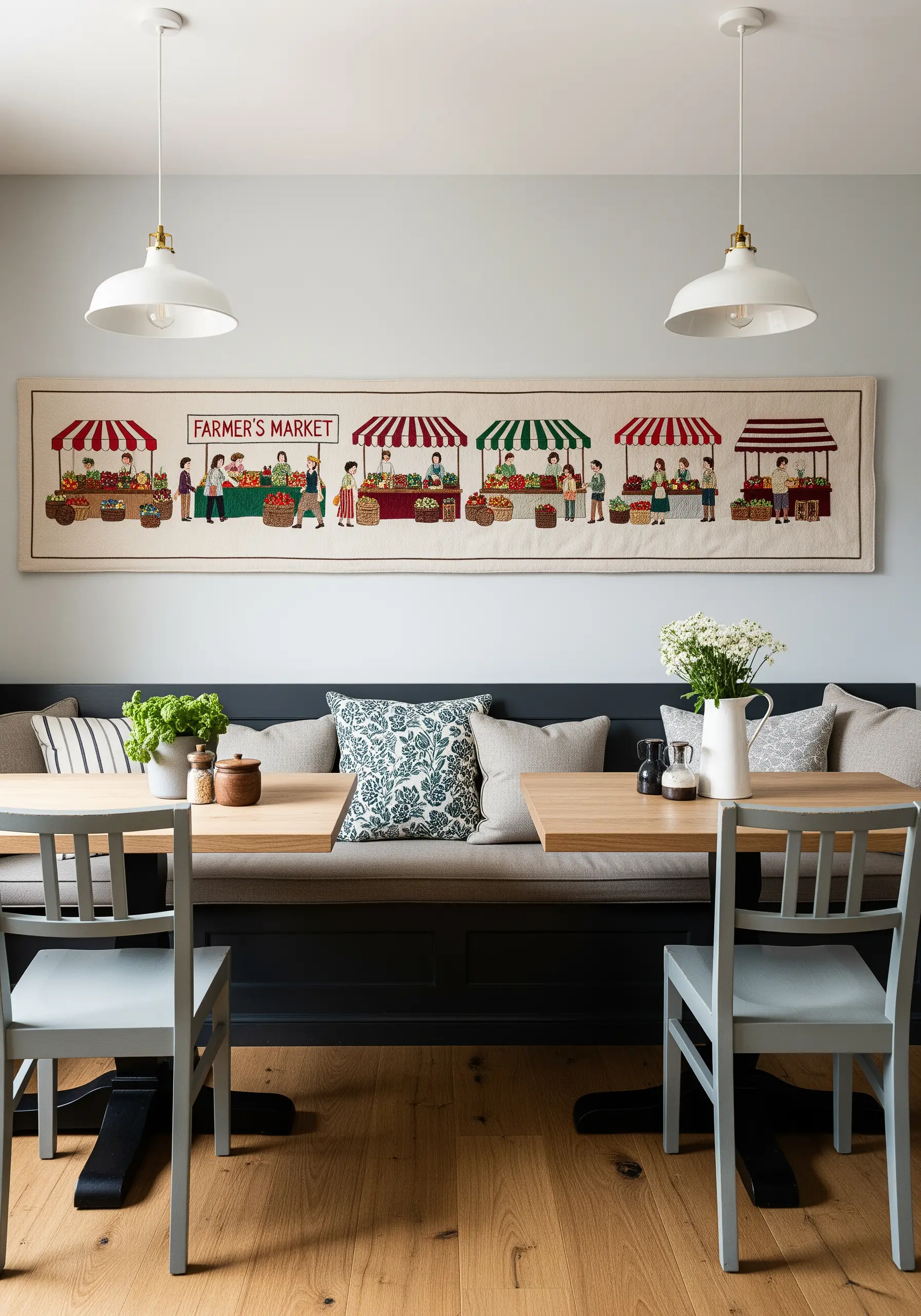
Tell a story with a long, banner-style embroidery that depicts a continuous scene.
Simplify complex subjects like a farmer’s market into charming, character-filled vignettes.
Use basic, accessible stitches—backstitch for outlines, satin stitch for small color blocks, and French knots for details—to keep the project manageable and fun.
A limited, cheerful color palette helps unify the sprawling scene and gives it a playful, folk-art feel.
This format is perfect for capturing memories or favorite places, much like you would for embroidered kitchen towel designs.
17. Create a Stained-Glass Effect with Couching
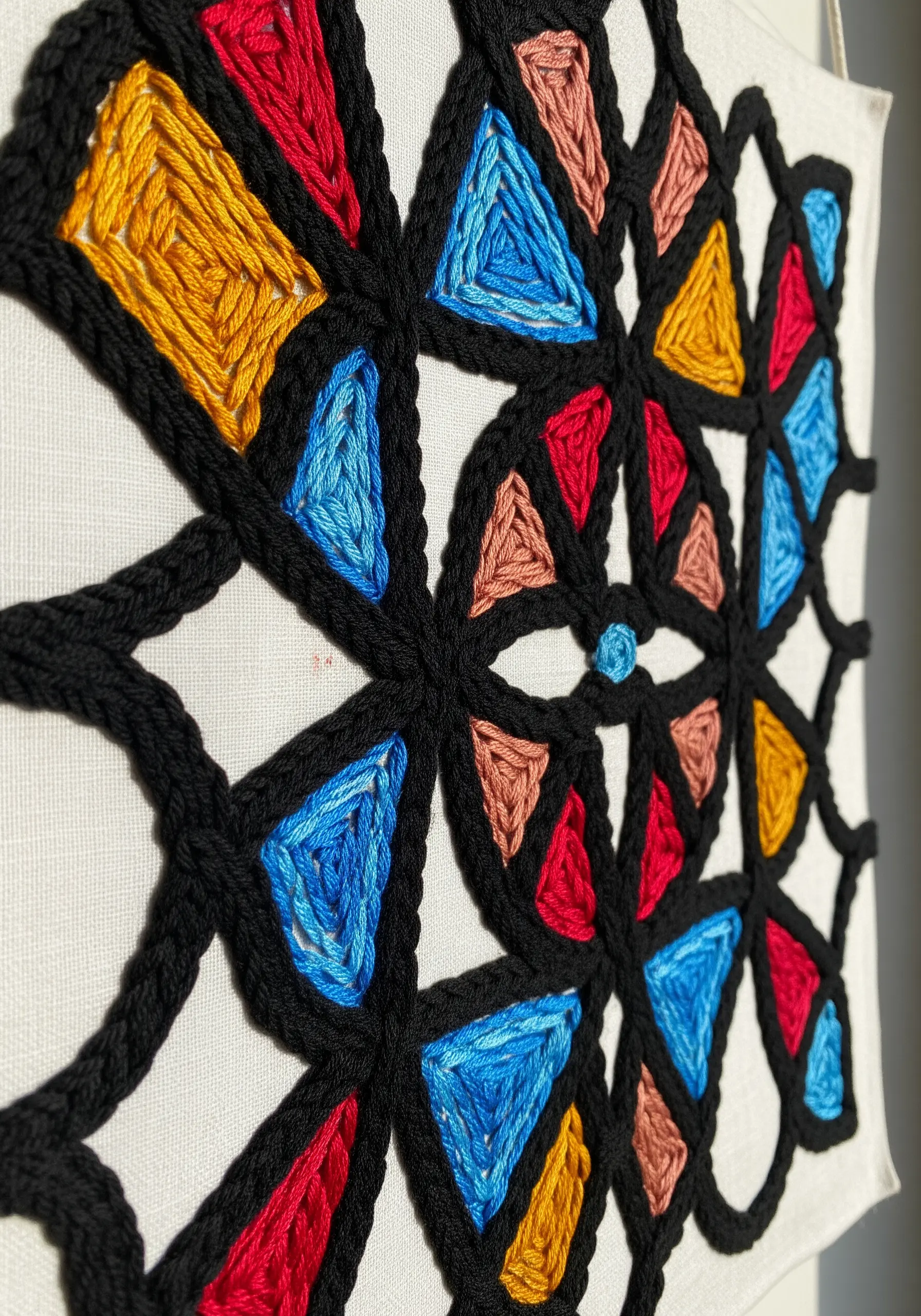
Mimic the bold look of stained glass by using a thick, black yarn for your outlines.
Instead of trying to stitch with the bulky yarn directly, use the couching technique: lay the yarn along your design lines and tack it down with a thinner, matching thread.
This creates the raised, graphic lines that are characteristic of leadlight windows.
Fill the sections with bright, jewel-toned colors using a dense satin stitch, ensuring your stitches lie flat and smooth to contrast with the heavy outlines.
18. A World in Bloom: Floral Cartography
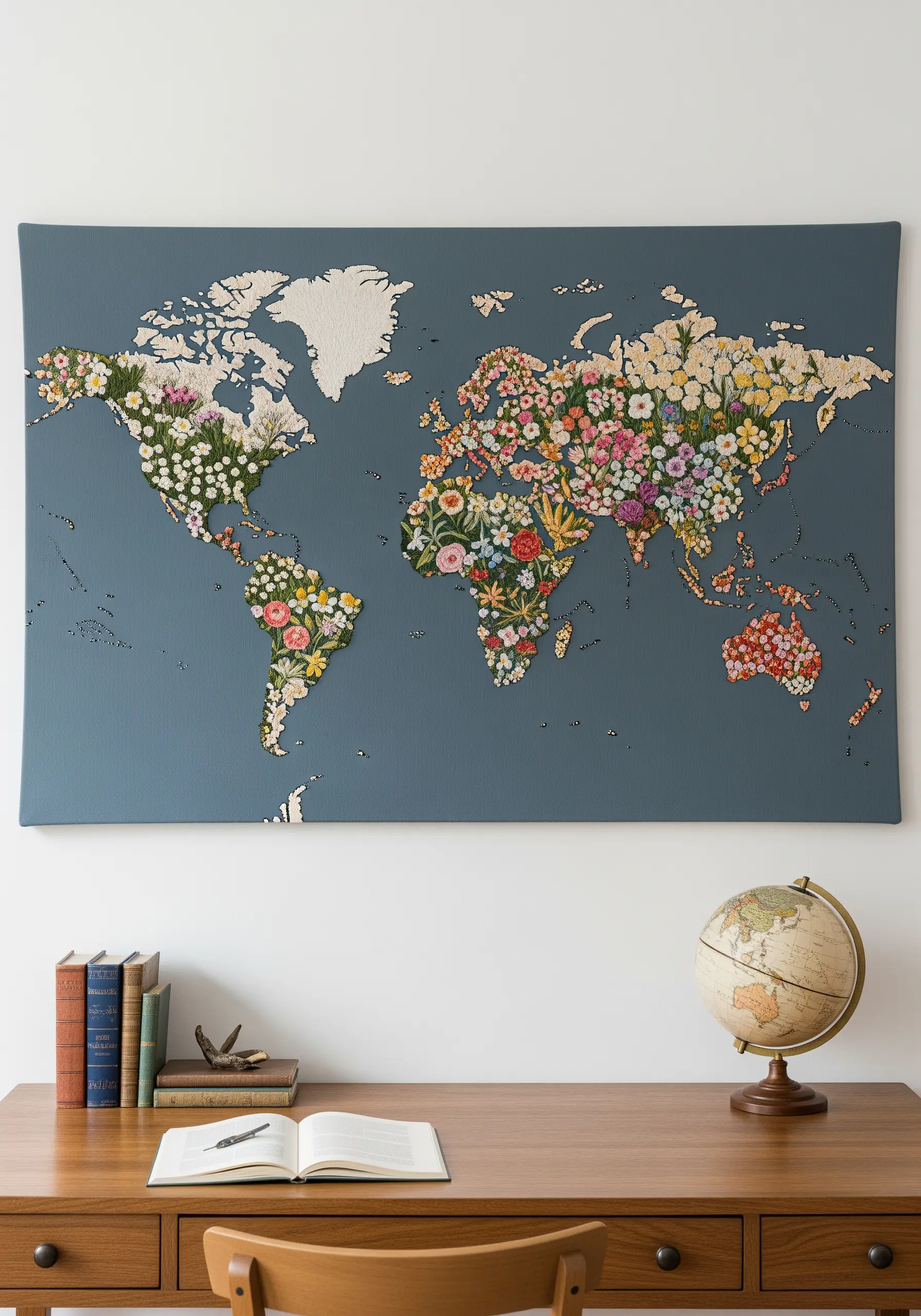
Reimagine a world map by filling the continents with a dense tapestry of embroidered flowers.
Begin by outlining the landmasses with a simple backstitch on a solid-colored fabric.
Fill the shapes with a variety of floral stitches: woven wheels, lazy daisies, bullion knots for rosebuds, and dense French knots for filler flowers.
Vary the scale, color, and type of flower to create a rich, meadow-like texture that makes each continent unique.
These types of floral embroidery wall decor projects are a beautiful way to merge geography with nature.
19. Lunar Phases in High-Contrast Texture

Make a powerful statement with a minimalist triptych that explores a single subject.
Create the cratered texture of the moon’s surface using thousands of tightly packed French knots in shades of white, grey, and silver on black fabric.
The high contrast between the textured white thread and the flat black background is what gives this piece its dramatic impact.
For the delicate crescent moons, use a simple, clean outline stitch to contrast with the heavily textured full moon.
Displaying them as a set of three vertical panels adds a modern, graphic quality to your wall.
20. Dimensional Botanicals in a Shadowbox
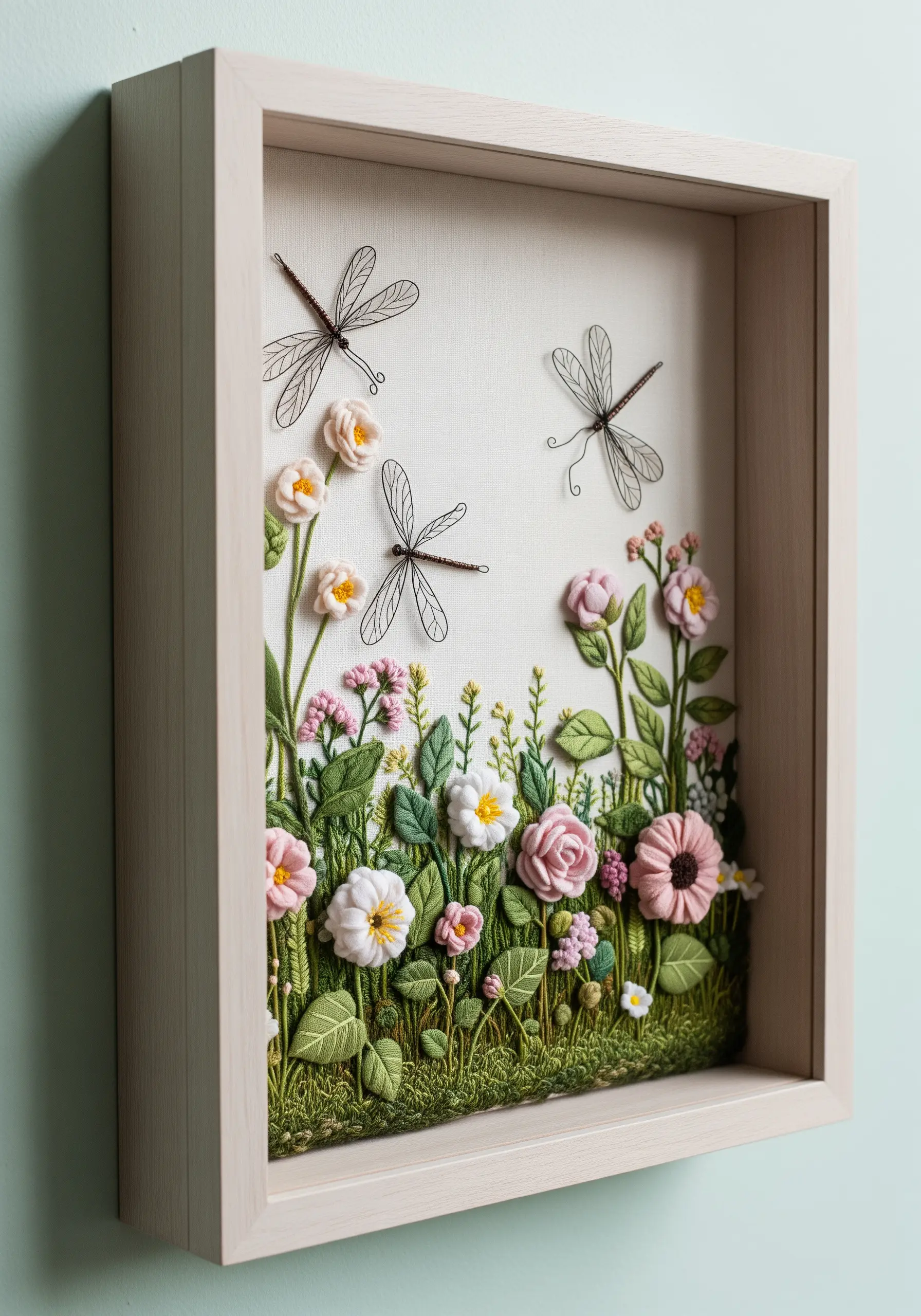
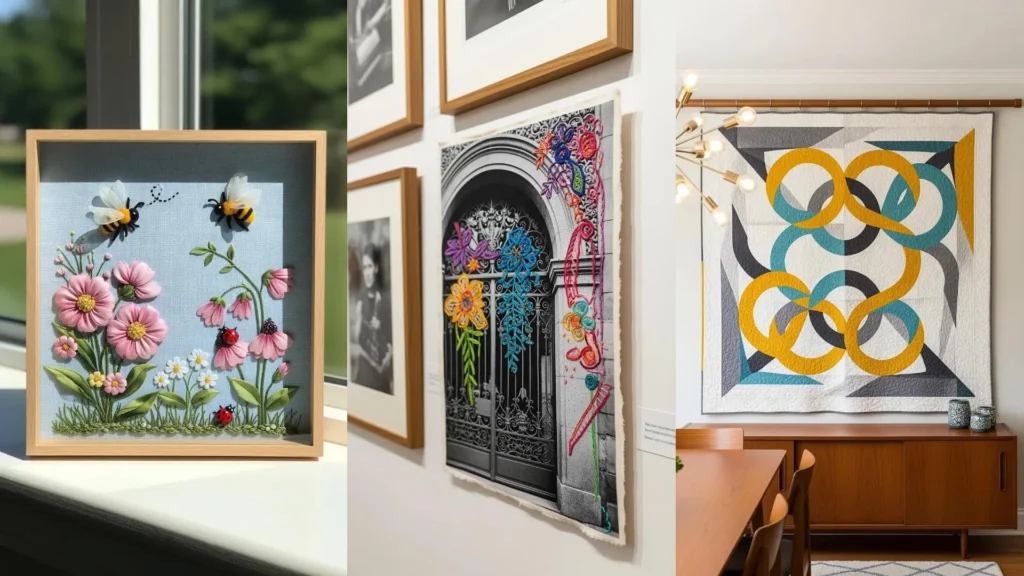
Elevate your floral embroidery by using stumpwork techniques to make elements pop off the fabric.
Create detached petals using wired buttonhole stitch, which allows you to shape them realistically.
Build up layers of texture for leaves and grass with satin stitch, Turkey work, and French knots.
The dragonflies, crafted with fine wire and delicate stitching, add a sense of life and movement.
Displaying the finished piece in a deep shadowbox frame protects the 3D elements and enhances the diorama effect, similar to floral-inspired ribbon embroidery ideas.
21. Reimagine the Folk Art Sampler

Give the traditional alphabet sampler a modern folk-art twist with a charming, illustrative layout.
Combine typography with simple, stylized motifs like houses, animals, and trees.
Establish a warm, cohesive color palette of earthy reds, greens, and browns to unify the diverse elements into a single story.
This approach turns a simple practice piece into a heartfelt wall hanging that celebrates the idea of home.
It feels both nostalgic and fresh, much like vintage-style embroidery banners that add warmth to a space.
22. Stitching on Air: A Delicate Leaf Mobile
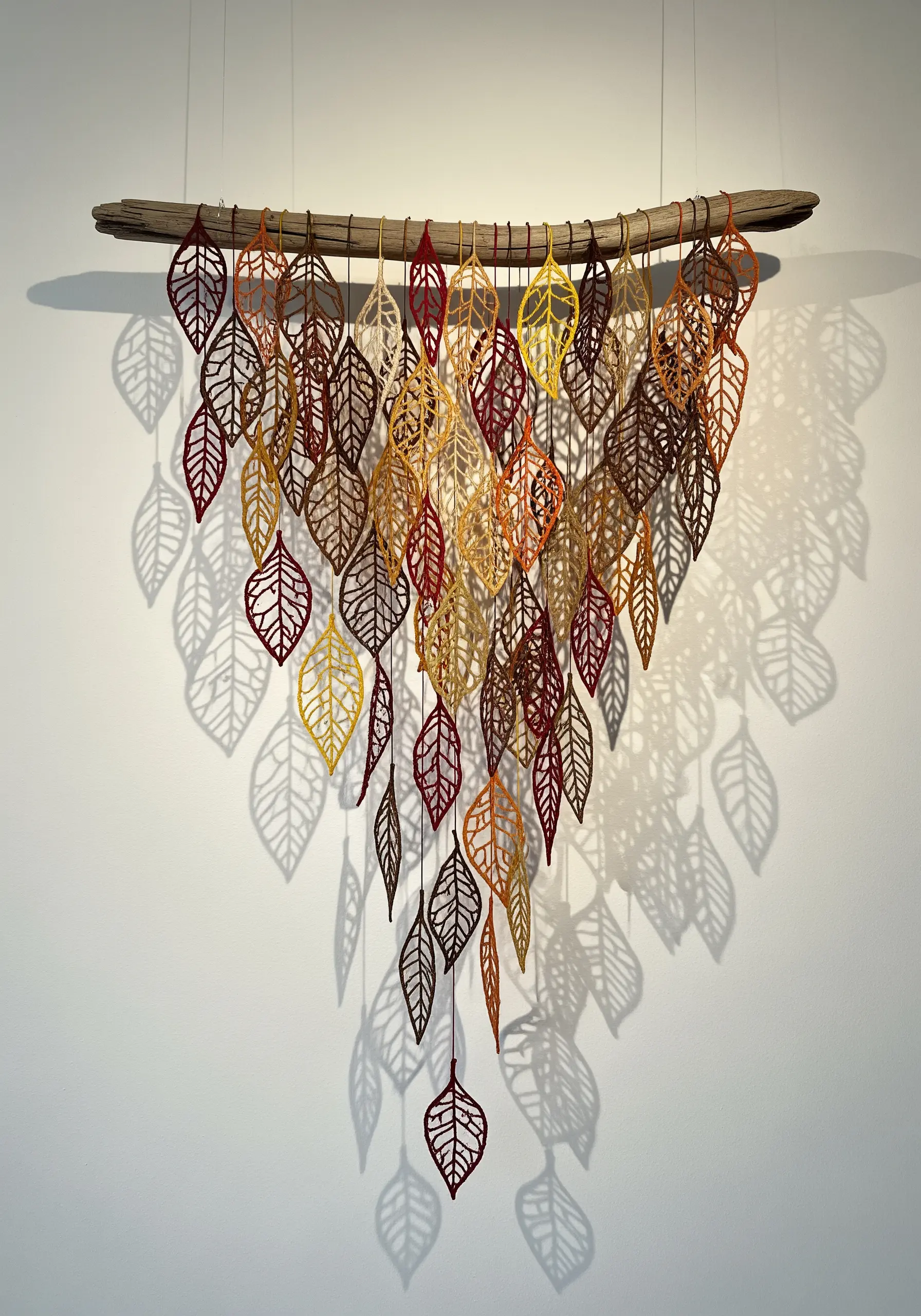
Create ethereal, lace-like elements by stitching on a water-soluble stabilizer.
Draw your leaf vein patterns onto the stabilizer, hoop it securely, and embroider your design as you normally would, ensuring your stitches connect to form a self-supporting structure.
Once finished, dissolve the stabilizer in water, leaving only the intricate thread skeleton behind.
This technique is perfect for making lightweight, delicate objects like jewelry, ornaments, or the leaves for this stunning mobile.
It’s one of the most innovative ways to embroider natural textures, capturing their fragility perfectly.
23. The Continuous Line: A Sculptural Thread Portrait
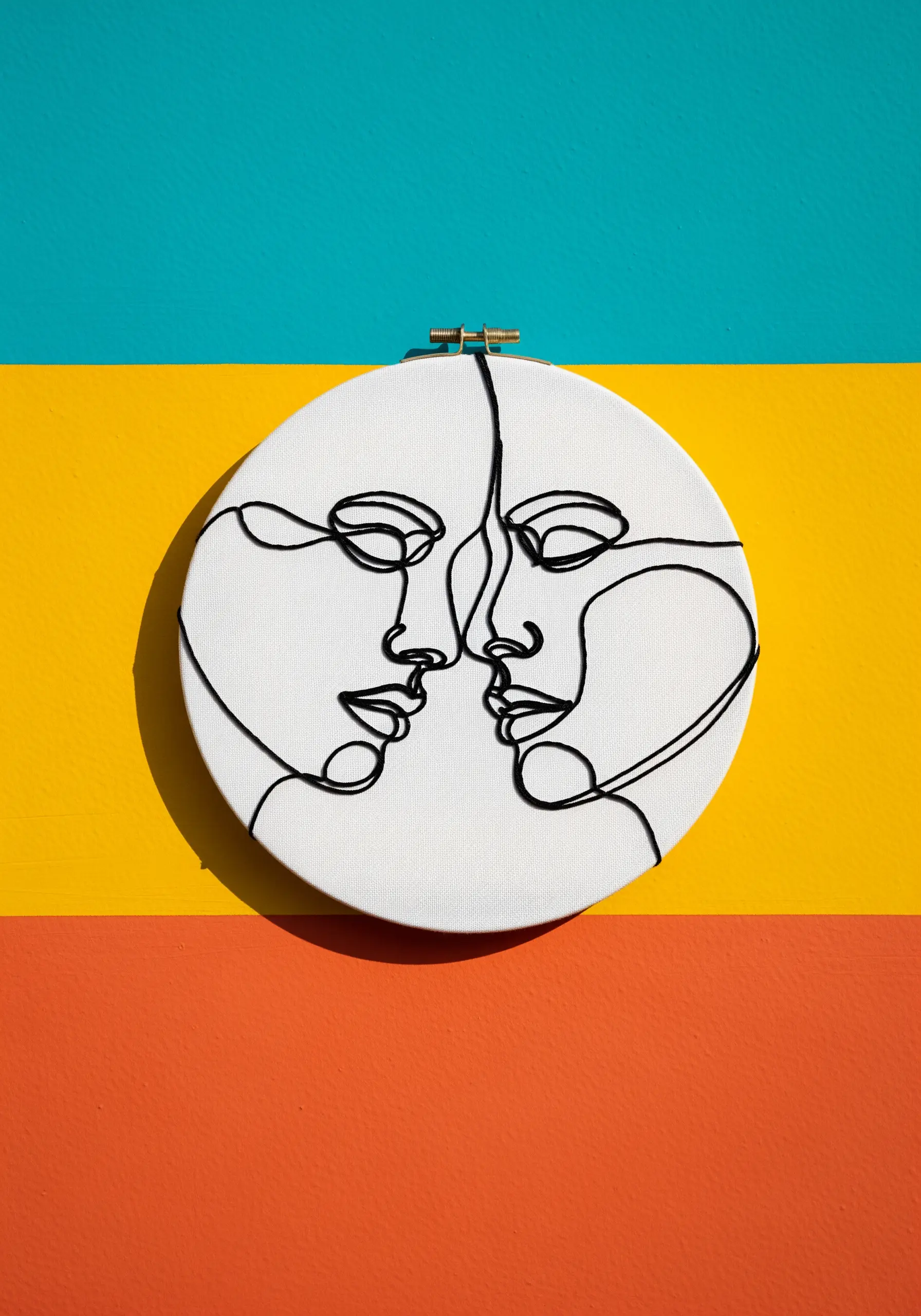
Capture the essence of a portrait with a single, unbroken line, a technique that requires careful planning.
To achieve the bold, sculptural quality, use a thick yarn or cord and couch it onto the fabric surface with a finer, matching thread.
This allows you to create fluid curves and sharp angles without distorting the fabric.
The magic of this style is in its simplicity and the illusion of a single, continuous pen stroke, making it a perfect example of modern line art faces you can stitch in under 2 hours.
24. A Meditative Mandala with Metallic Accents
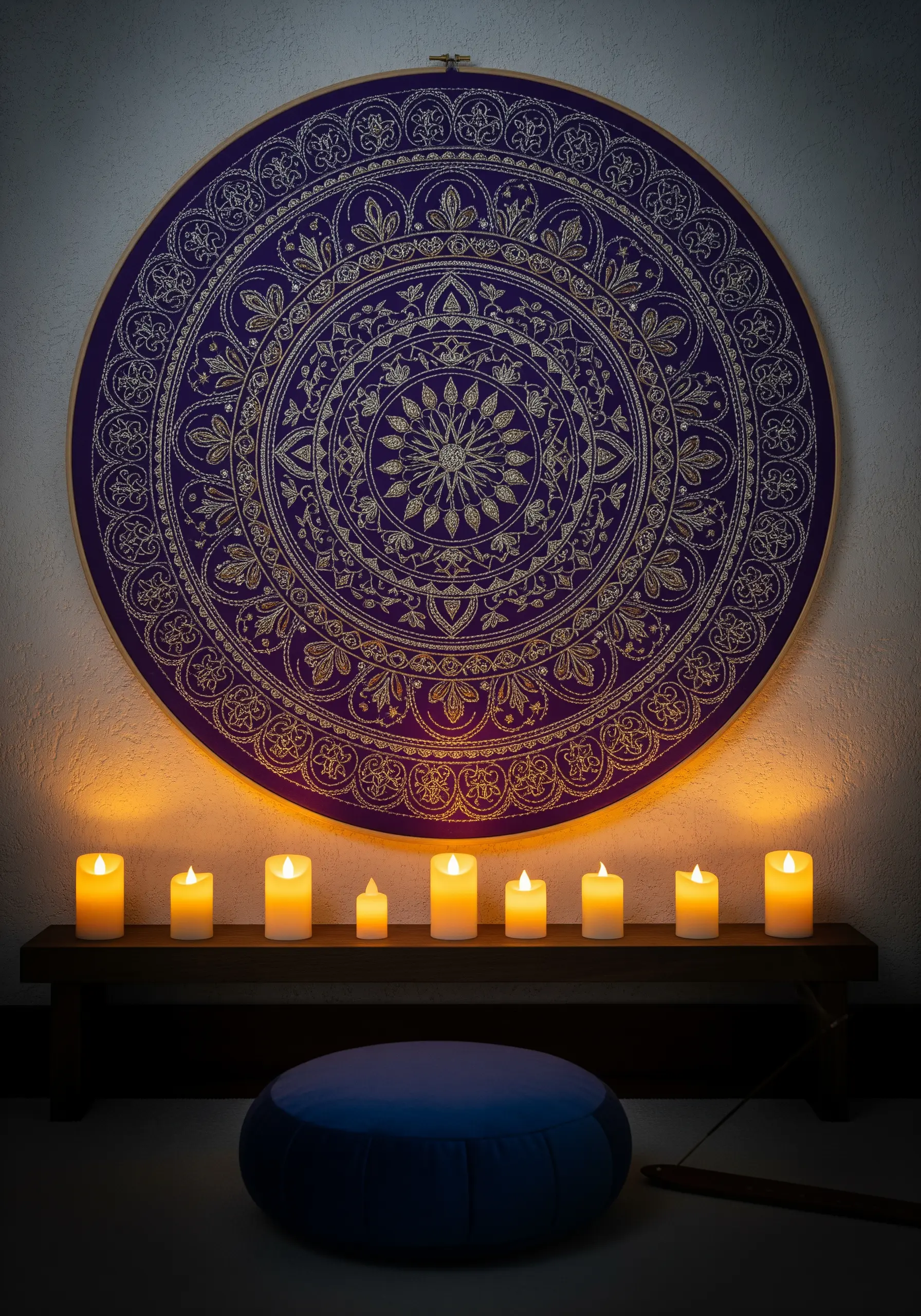
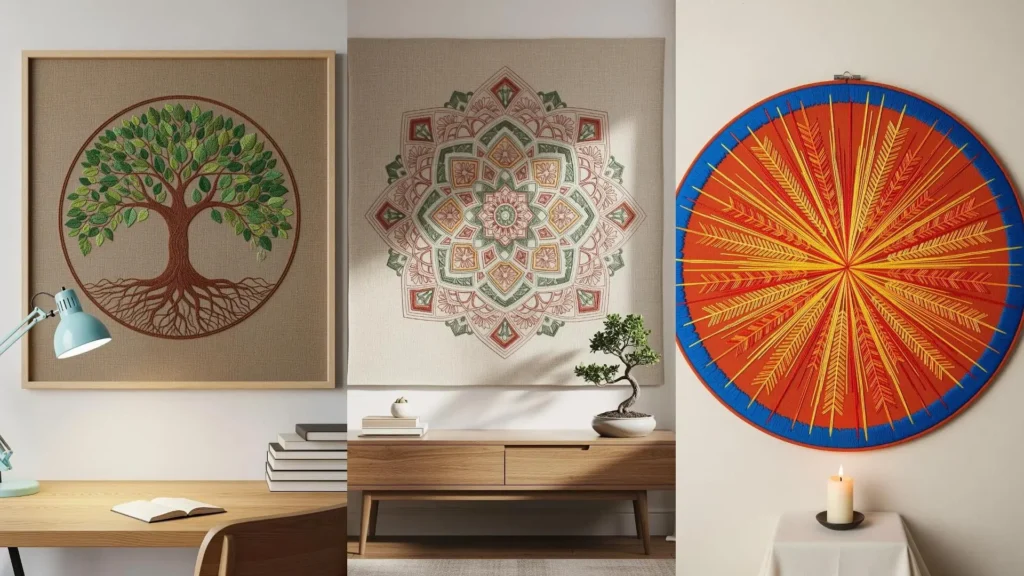
Create a focal point for a calm space by stitching a large, intricate mandala.
The beauty of a mandala lies in its symmetry and repetition, so work from the center outwards to ensure your pattern remains balanced.
Use a fine metallic thread to highlight key details, adding a subtle shimmer that catches the light and draws the eye.
Stitching on a deep, rich color like this royal purple makes the metallic thread pop, creating a sense of luxury and tranquility.
This project is one of the most rewarding modern mandala stitch patterns for mindful crafting.
25. Expressive Collages with Raw-Edge Appliqué
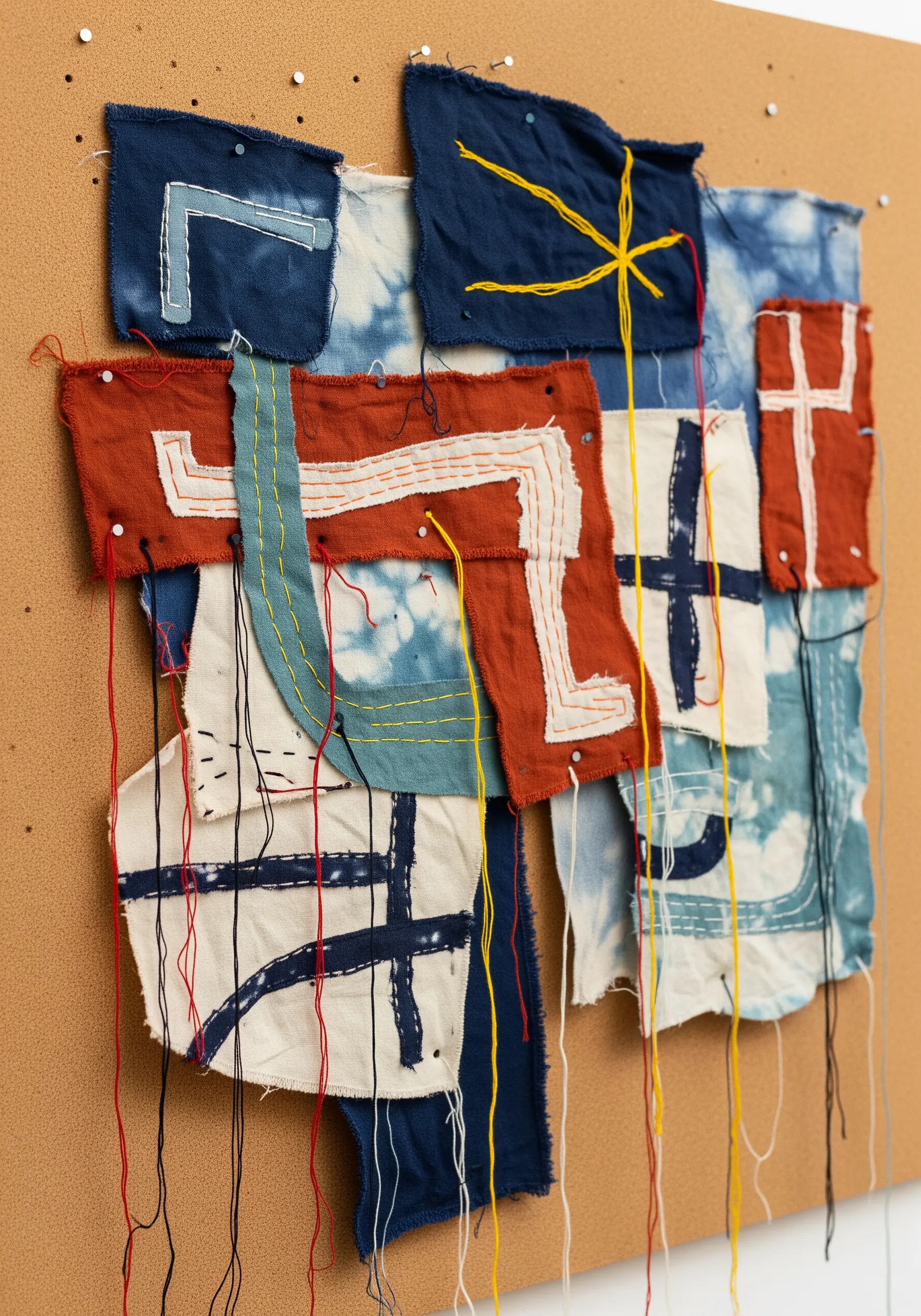
Embrace improvisation and texture by creating a collage from fabric scraps.
Layer pieces of tie-dyed or hand-dyed fabric, allowing the raw, frayed edges to become part of the design.
Use a simple, visible running stitch (inspired by Japanese Sashiko or Boro) to tack the pieces down, letting your stitches wander and cross over each other.
This technique celebrates imperfection and creates a dynamic, layered surface that is rich with history and character.
It’s one of the most liberating fabric collage embroidery ideas that turn scraps into magical wall art.
26. Architectural Portraits in Thread
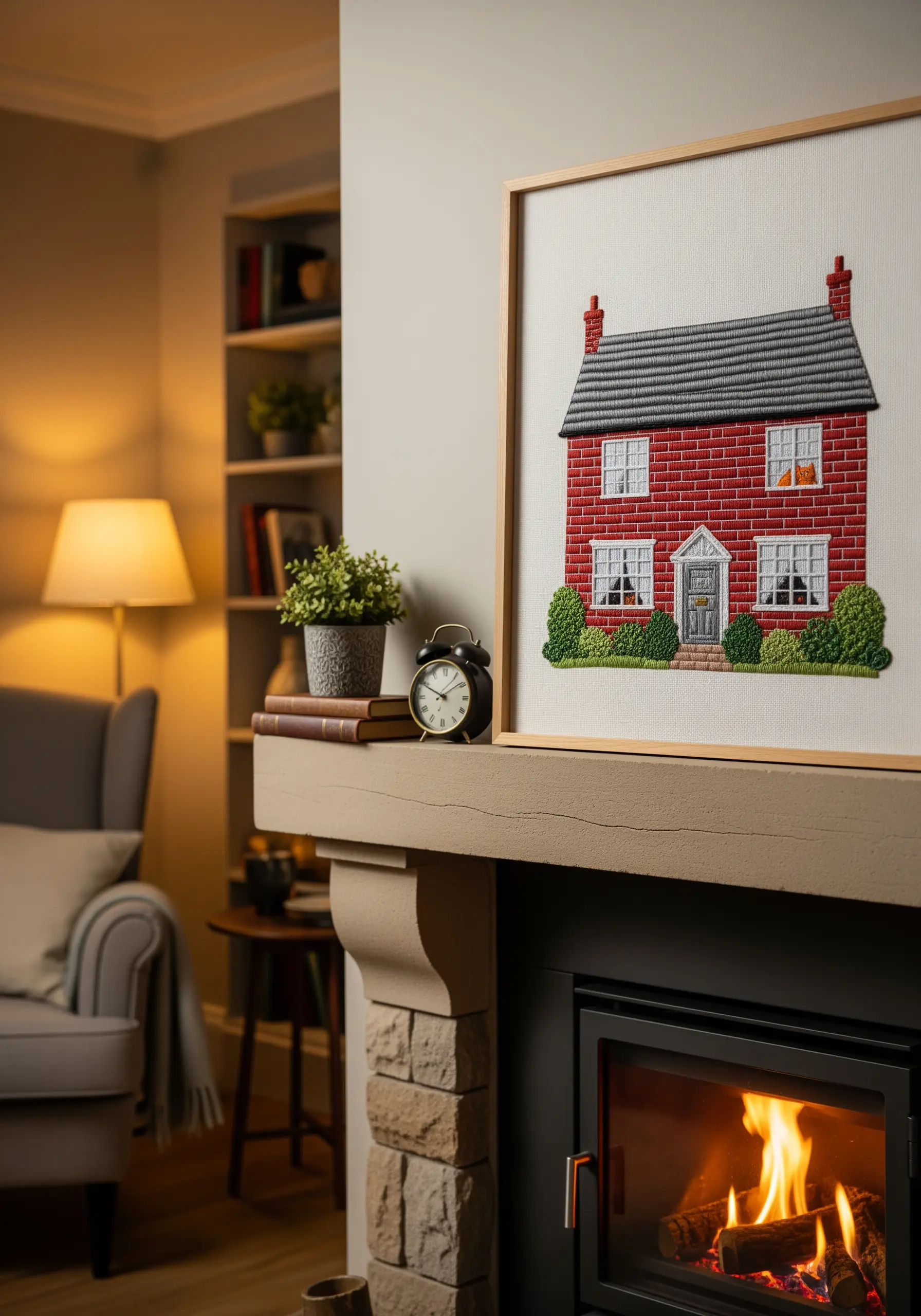
Capture the character of a beloved home with a detailed architectural embroidery.
Translate different building materials into distinct textures: use straight, uniform satin stitches for bricks, French knots for shrubbery, and a clean backstitch for window panes and rooflines.
The key is to simplify the complex details into stitchable shapes while preserving the building’s essential features.
This creates a personalized piece of art that is both realistic and charmingly handmade.
27. Botanical Realism with 3D Stitches

Achieve a stunningly realistic effect by choosing stitches that mimic natural textures.
For the pomegranate seeds, use glossy red beads or tightly packed French knots to create a juicy, three-dimensional look that catches the light.
Use long-and-short stitch for the flesh of the fruit, blending shades of pink and white to create subtle, realistic gradients.
A padded satin stitch for the rind will give it a raised, rounded feel, completing the illusion of depth.
These statement textured embroidery techniques are what make a piece truly stand out.
28. Stitch a Visual Memoir, One Block at a Time
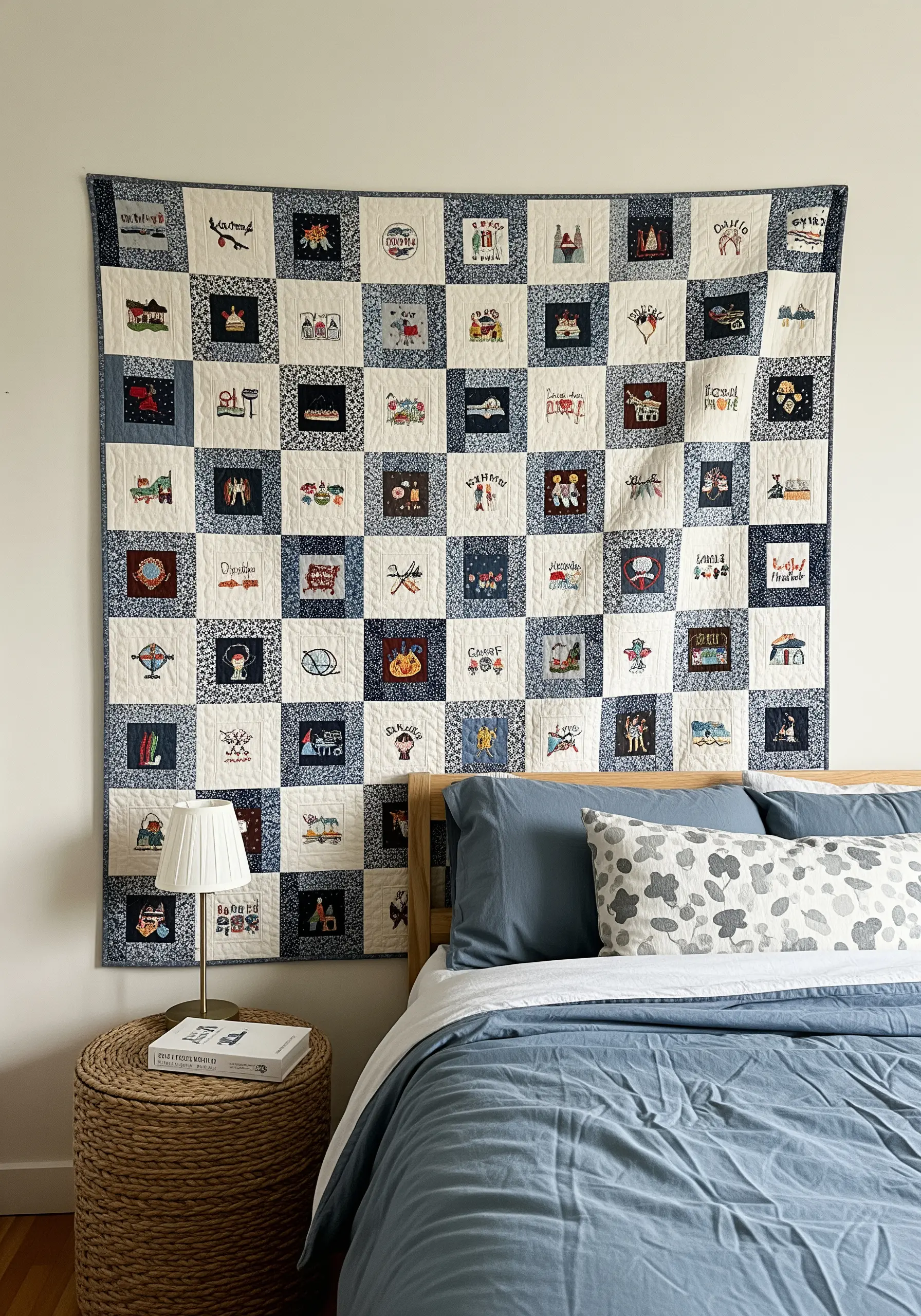
Create a deeply personal quilt by dedicating each square to a specific memory, place, or person.
The challenge with a project like this is creating a cohesive whole from many different small designs.
Solve this by using a consistent sashing fabric—the patterned blue and white material—to frame each block and tie the entire quilt together visually.
This framework provides structure, allowing the individual stories in each square to shine without the overall piece feeling chaotic.
29. A Study in Seasons with a Single Motif

Explore the passage of time by embroidering the same subject—in this case, a tree—in four different seasons.
Use stitch choice to tell the story: delicate French knots for spring blossoms, lush satin-stitched leaves for summer, fiery detached chain stitches for autumn foliage, and stark backstitched branches for winter.
Keep the tree’s core structure the same in each panel to create a clear visual connection.
Grouping the four pieces together creates a powerful narrative about change and renewal, turning them into lovely seasonal framed embroidery pieces.