You have likely stared at a blank bedroom wall, holding a beautiful embroidery hoop you made, and wondered: “How do I hang this without it looking like clutter?” It is a common hesitation. We love the texture of thread, but we fear the chaos of small, mismatched frames turning a sanctuary into a scrapbook.
The secret lies in intentional layering. You don’t need to fill every inch of space. By using grids, vertical lines, and mixing your embroidery with structural elements like shelves, rails, or textile scrolls, you can transform individual stitches into a cohesive architectural feature. It is about shifting your perspective from “hanging a picture” to “curating a surface.”
In this guide, I have gathered 30 sophisticated ways to display your needlework. From invisible floating mounts to functional acoustic panels, these ideas will help you see your embroidery not just as a hobby, but as a powerful design element that brings warmth, silence, and personality to your bedroom walls.
1. The grid layout for botanical uniformity
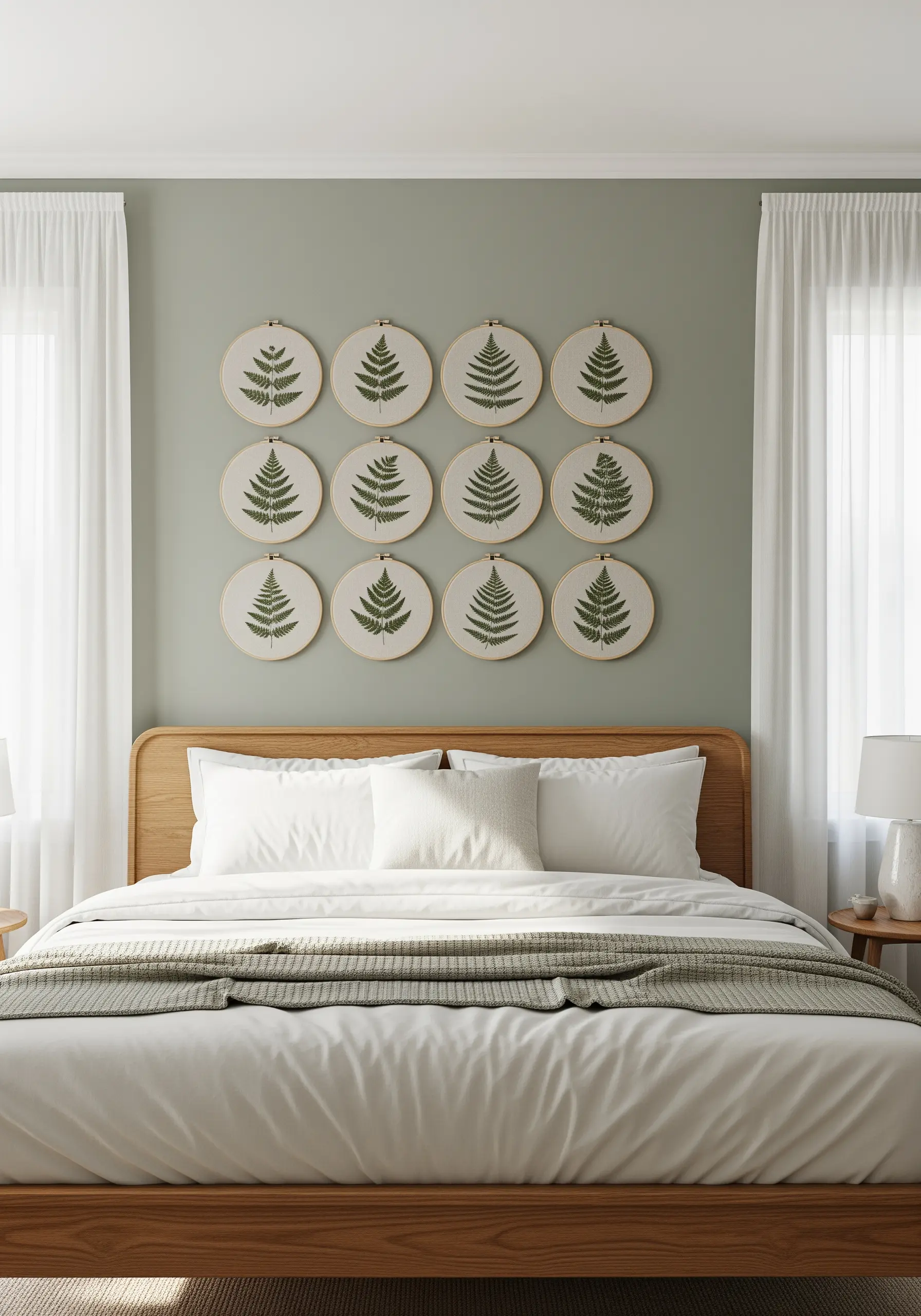
Create a sense of calm order by arranging identical wooden hoops in a strict grid formation.
Stitch a single botanical variety, like ferns or eucalyptus, but vary the angle of the leaves in each frame to keep the eye moving.
This repetition works best on neutral linen; consider leaf border embroidery ideas to understand how simple green outlines can create a sophisticated visual rhythm without overwhelming the wall.
2. Geometric banners on brass hardware
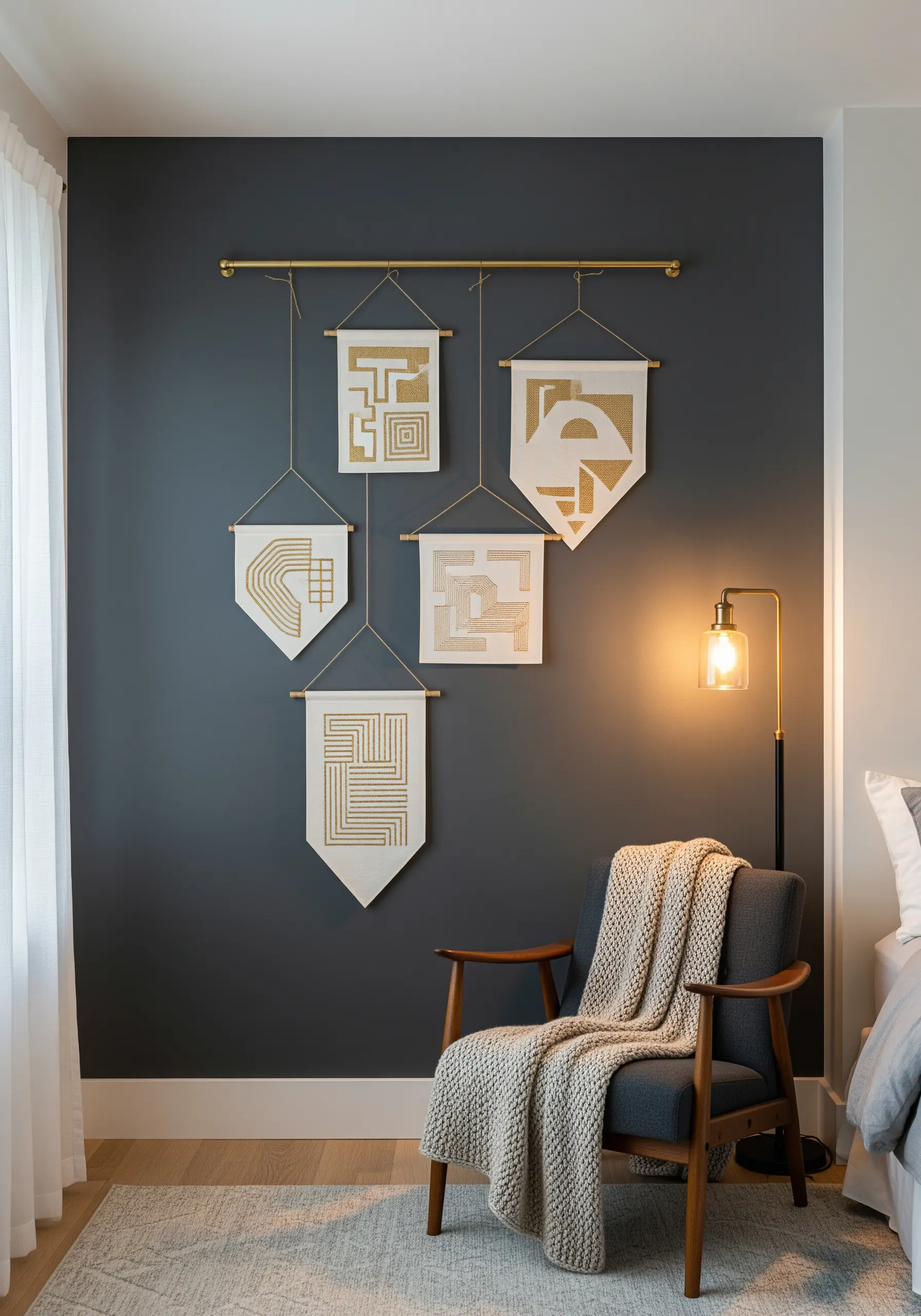
Move away from the traditional hoop by mounting your work on canvas banners suspended from a sleek brass rail.
Use goldwork or metallic thread to stitch geometric labyrinths; the sheen of the thread catches the light and adds a dynamic layer to matte walls.
These are unexpected ways to use metallic thread that transform fiber art into something resembling modern jewelry for your home.
3. Monochromatic texture panels
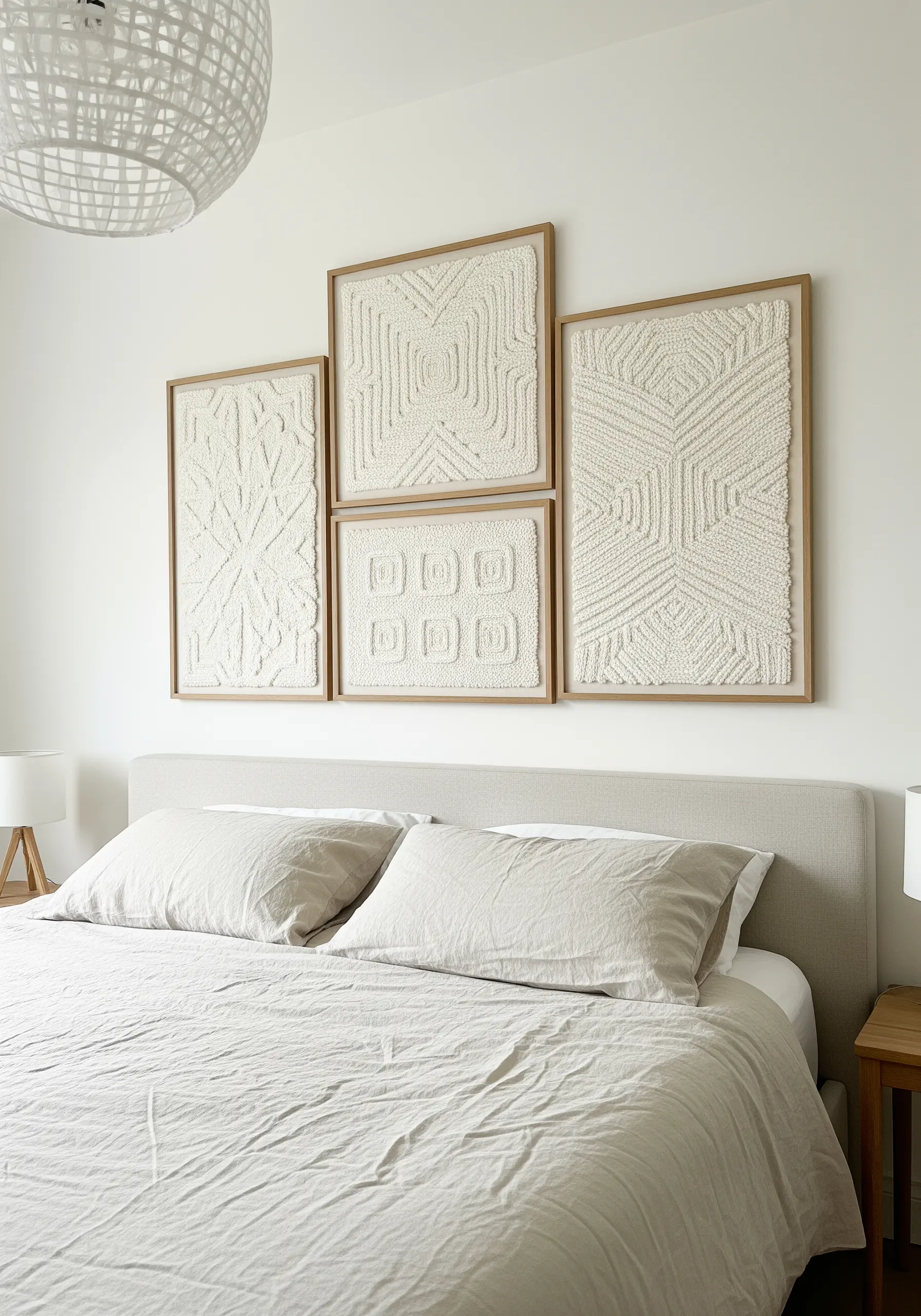
When you want art that feels substantial but quiet, rely on heavy texture rather than high-contrast color.
Use thick wool yarn to couch geometric shapes onto canvas panels, keeping the thread color identical to the background fabric.
This shadow-play effect draws from organic texture embroidery ideas where the relief of the stitch defines the design.
4. Layered shelf displays for flexibility
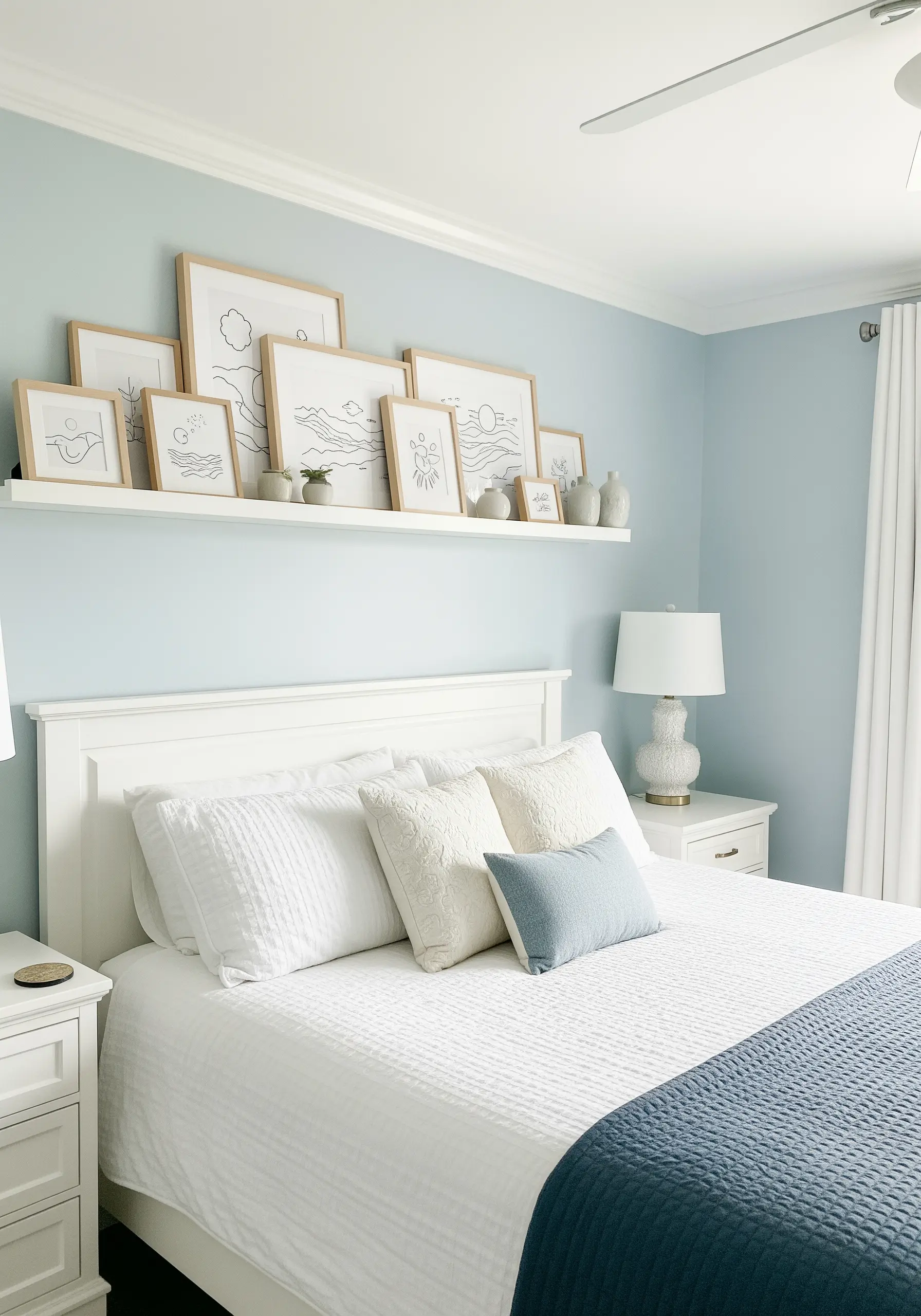
Instead of committing to nail holes, lean varied frame sizes on a picture ledge to create a casual, evolving vignette.
Combine minimal line-art landscapes with negative space to keep the arrangement airy and breathable.
You can rotate these simple line art embroidery ideas seasonally without damaging your walls or rethinking your entire layout.
5. Statement textile tapestries
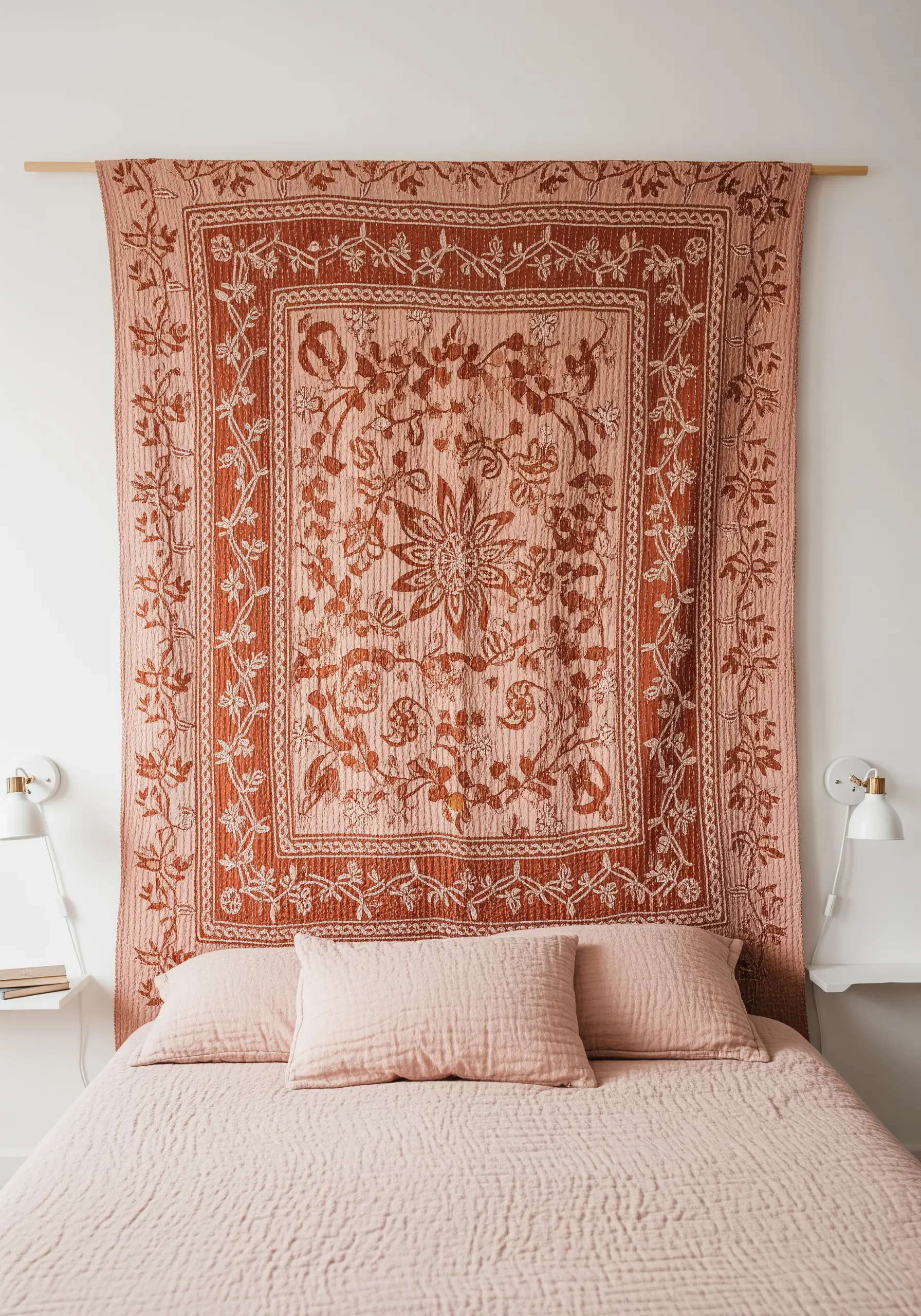
Anchor your sleeping space with a single, oversized textile that acts as a visual headboard.
Use the Kantha stitch technique—running stitches in varying densities—to create large-scale patterns that feel soft and rippled.
These embroidery wall tapestries absorb sound and add an immediate sense of coziness to a master bedroom.
6. The organic cluster arrangement
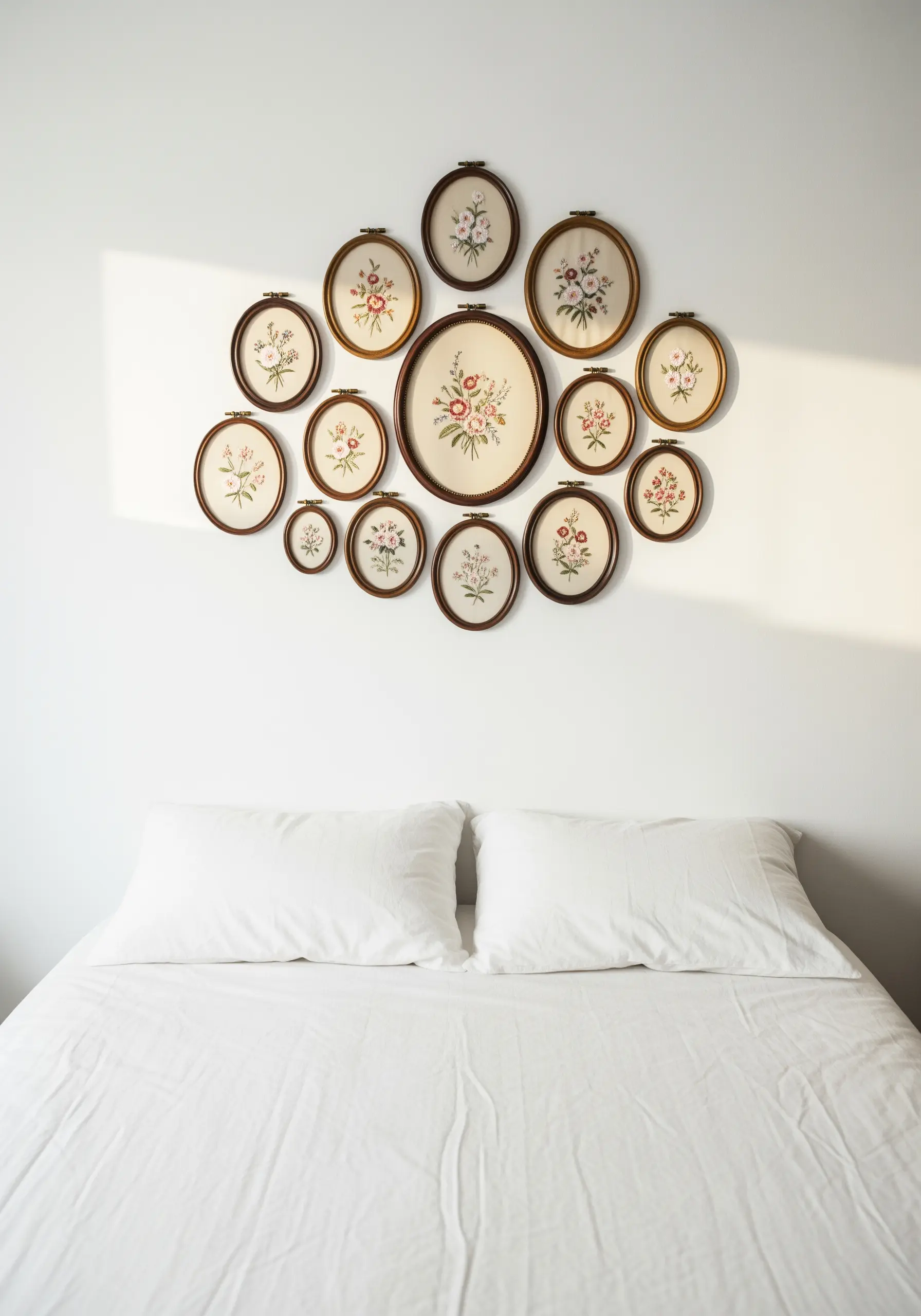
Break the rules of symmetry by clustering oval and round hoops in a cloud-like formation.
Focus on vintage floral motifs, ensuring the color palette remains consistent across all pieces to unify the disparate shapes.
These hooped wall collage layouts work beautifully when you place the largest piece in the center and radiate smaller details outward.
7. Vertical scroll panels for height
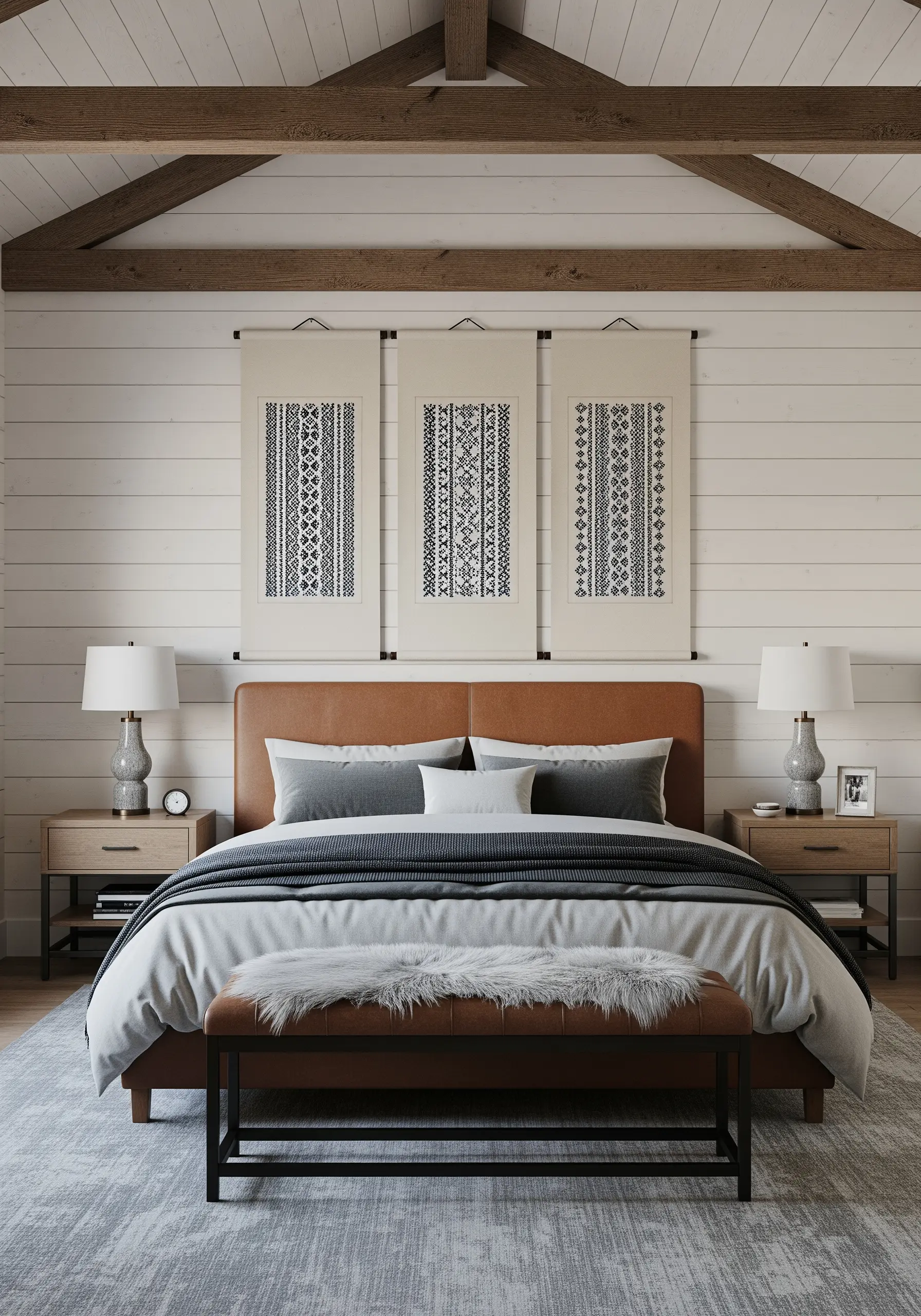
Elongate a room with low ceilings by hanging narrow, vertical fabric scrolls featuring repetitive blackwork patterns.
The contrast of black geometric stitching on raw linen draws the eye upward, creating an illusion of height.
This approach aligns with minimalist embroidery wall art styles that prioritize architectural improvement over decoration.
8. Organized inspiration on pegboards
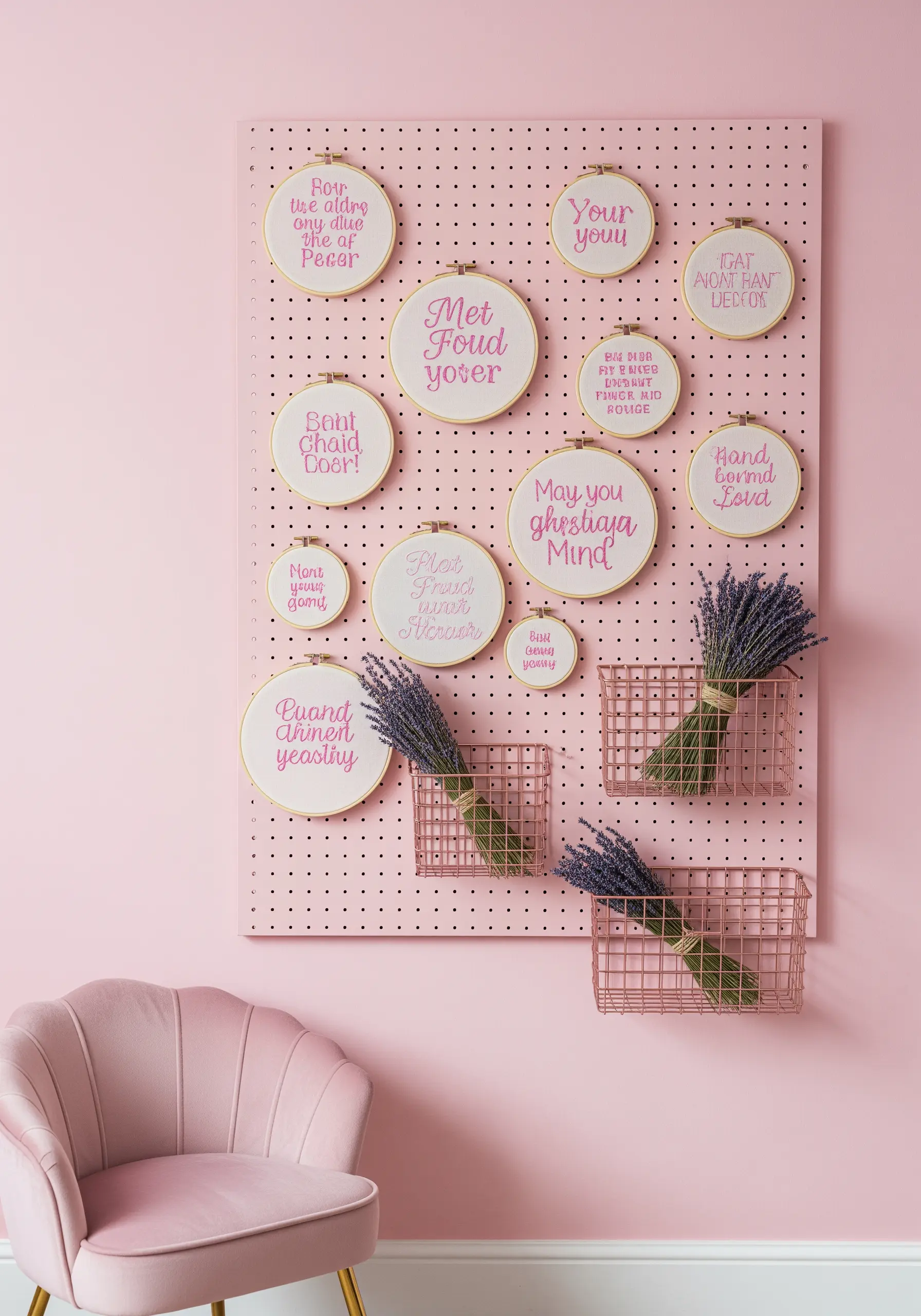
Turn your embroidery into a mood board by mounting hoops onto a color-coordinated pegboard.
Stitch your favorite affirmations or typography using a split stitch for crisp legibility.
Refer to thread-based typography ideas to ensure your letters stand out clearly against the busy texture of the perforated board.
9. Celestial columns for symmetry
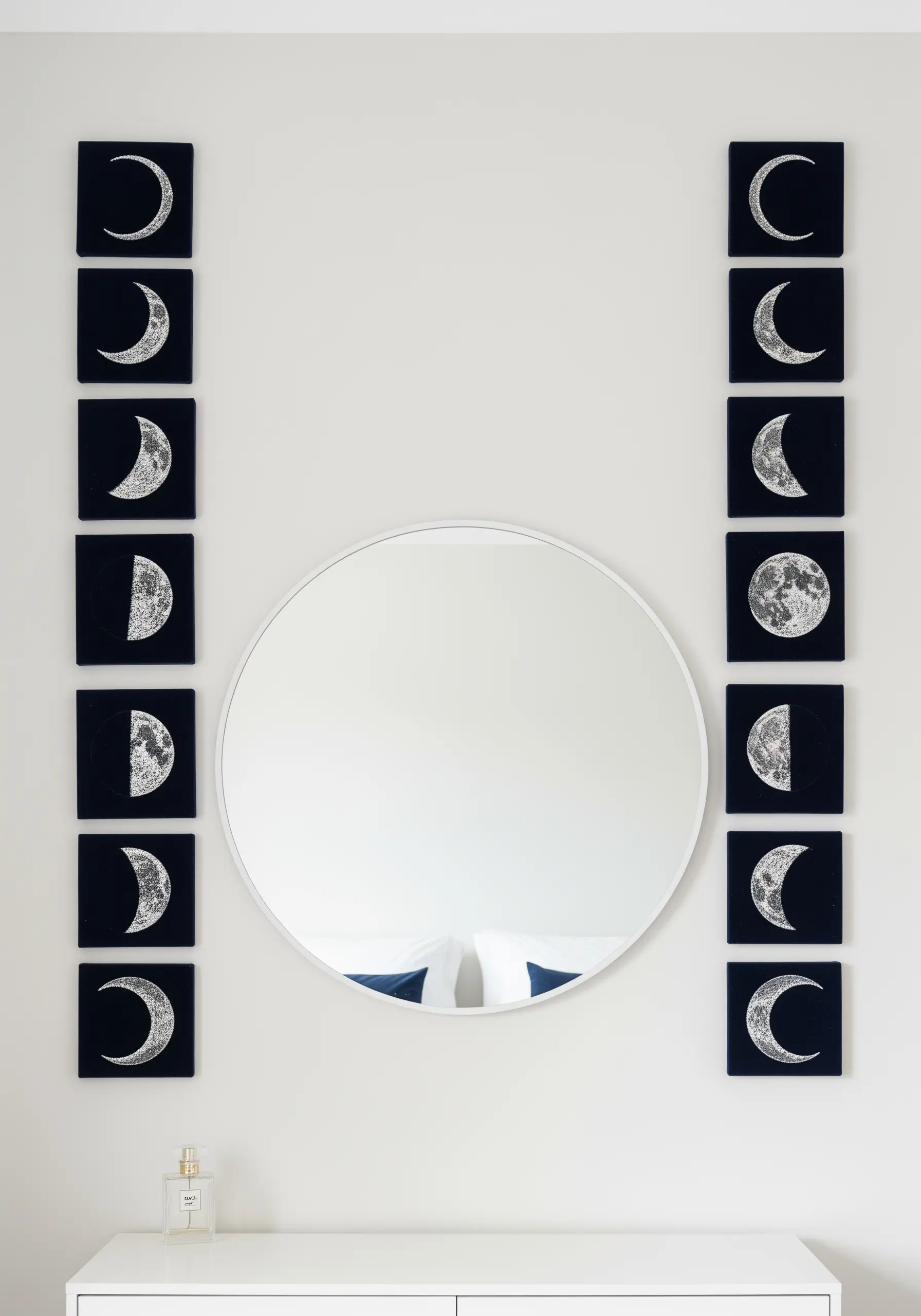
Create a meditative focal point by flanking a mirror with vertical columns of small square canvases.
Use French knots in white thread on dark fabric to create density and texture, simulating the moon’s surface.
These moon and stars embroidery ideas bring a dark, moody contrast that balances bright bedroom walls.
10. Interconnected abstract shapes
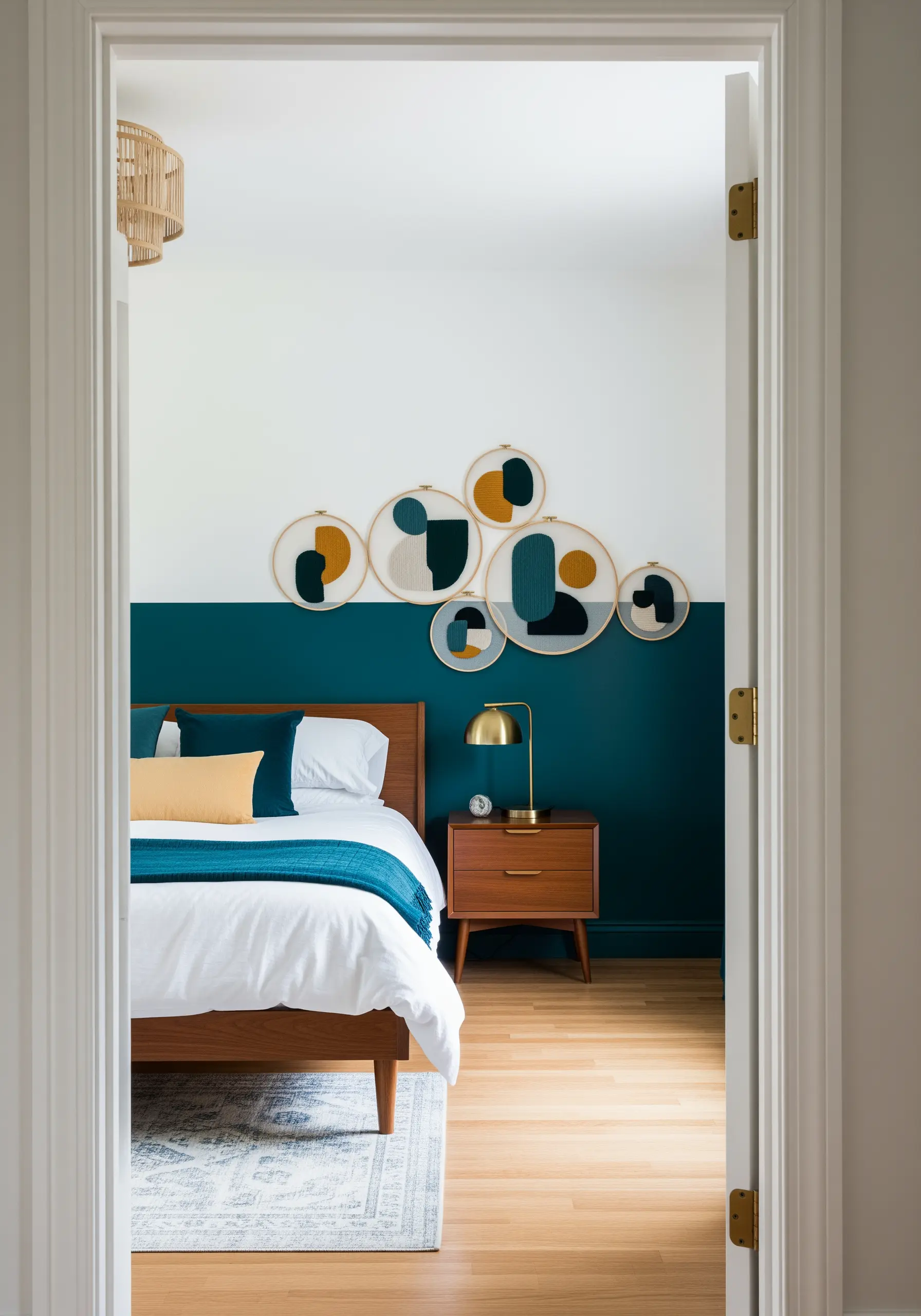
Paint your wall a deep, saturated hue and use floating hoops to create a deconstructed mural.
Use satin stitch to create bold blocks of color that seem to flow from one hoop to the next, ignoring the wooden boundaries.
These abstract wall hoop designs rely on color theory to merge separate pieces into one cohesive art installation.
11. Functional display ladders
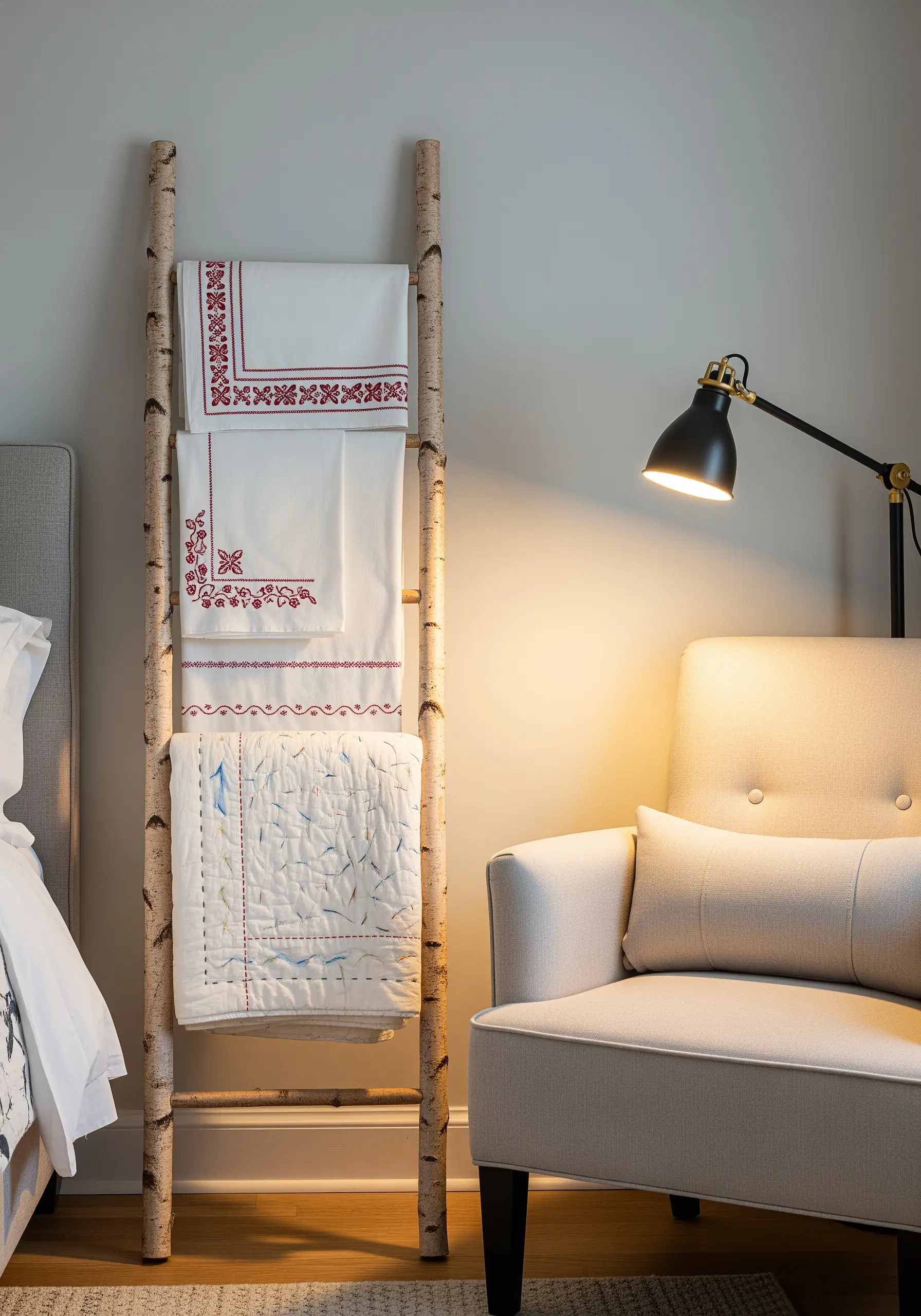
Don’t limit embroidery to hoops; display your stitched linens and quilts on a rustic wooden ladder.
Focus on Redwork or simple border patterns that remain visible even when the fabric is folded or draped.
This technique elevates heirloom-style table linen embroidery patterns into daily decor rather than hiding them in drawers.
12. The ledge gallery for quilt blocks
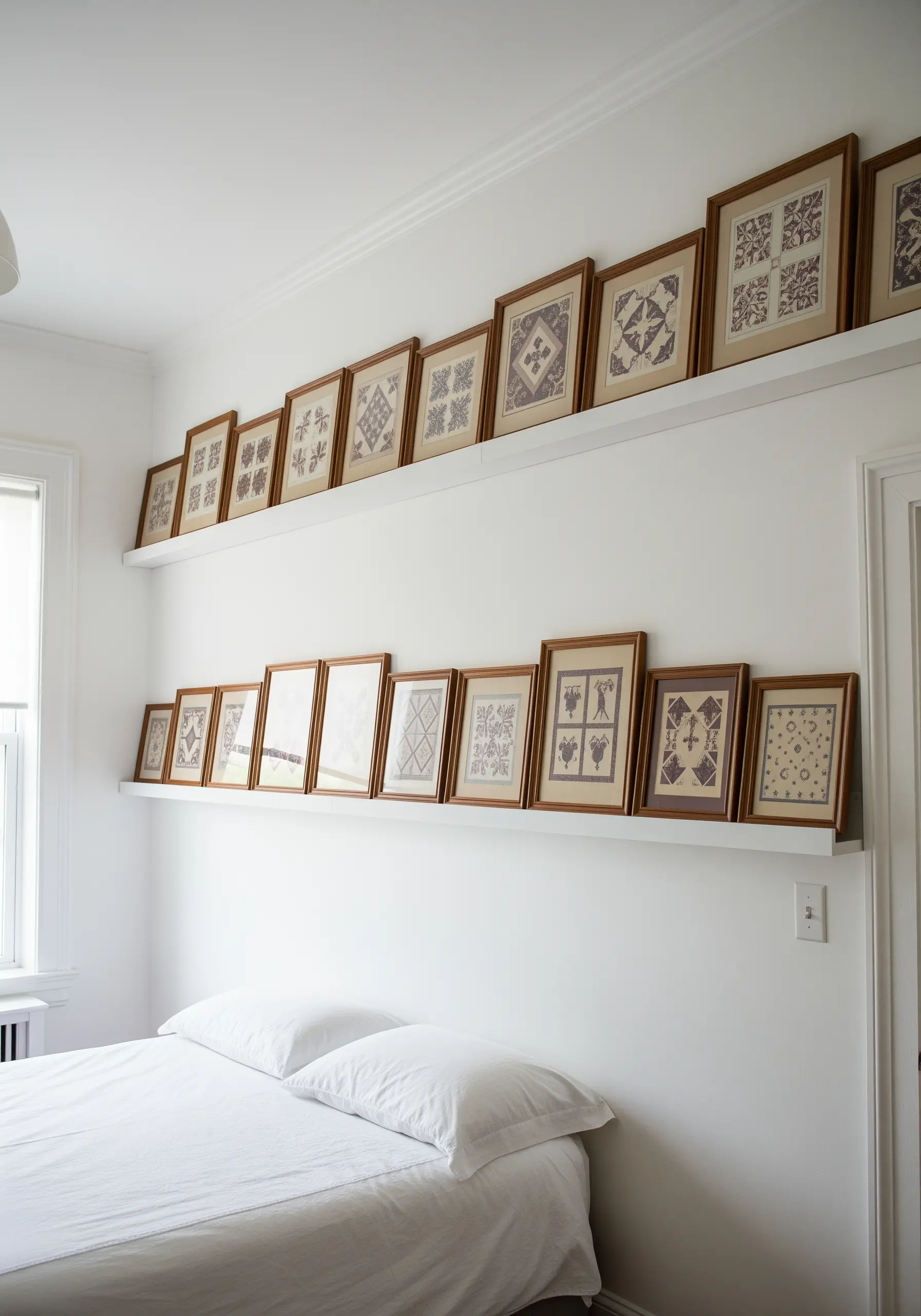
Frame individual embroidered quilt squares in wood to create a structured, linear gallery high on the wall.
The uniformity of the frames allows you to experiment with complex patterns inside without causing visual chaos.
These framed embroidery projects bridge the gap between traditional crafting and modern interior design.
13. Industrial wire grid sampling
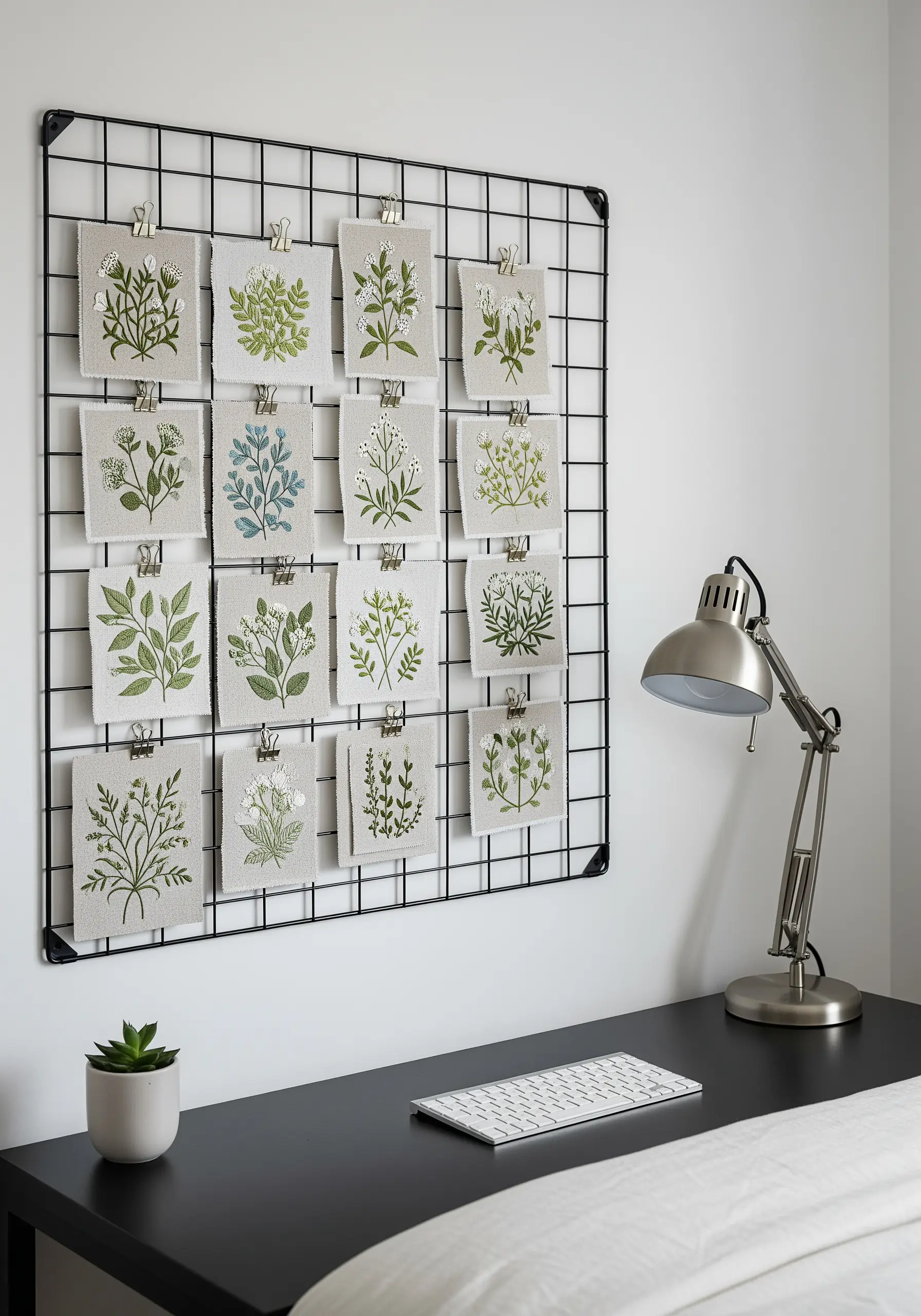
Use a wire grid to clip up raw-edged canvas swatches, creating a studio-inspired aesthetic.
Treat each swatch as a botanical study, using stem stitches and lazy daisies to capture different herbs or wildflowers.
This method is perfect for testing botanical garden sampler ideas, allowing you to swap out studies as your skills improve.
14. Continuous line triptychs
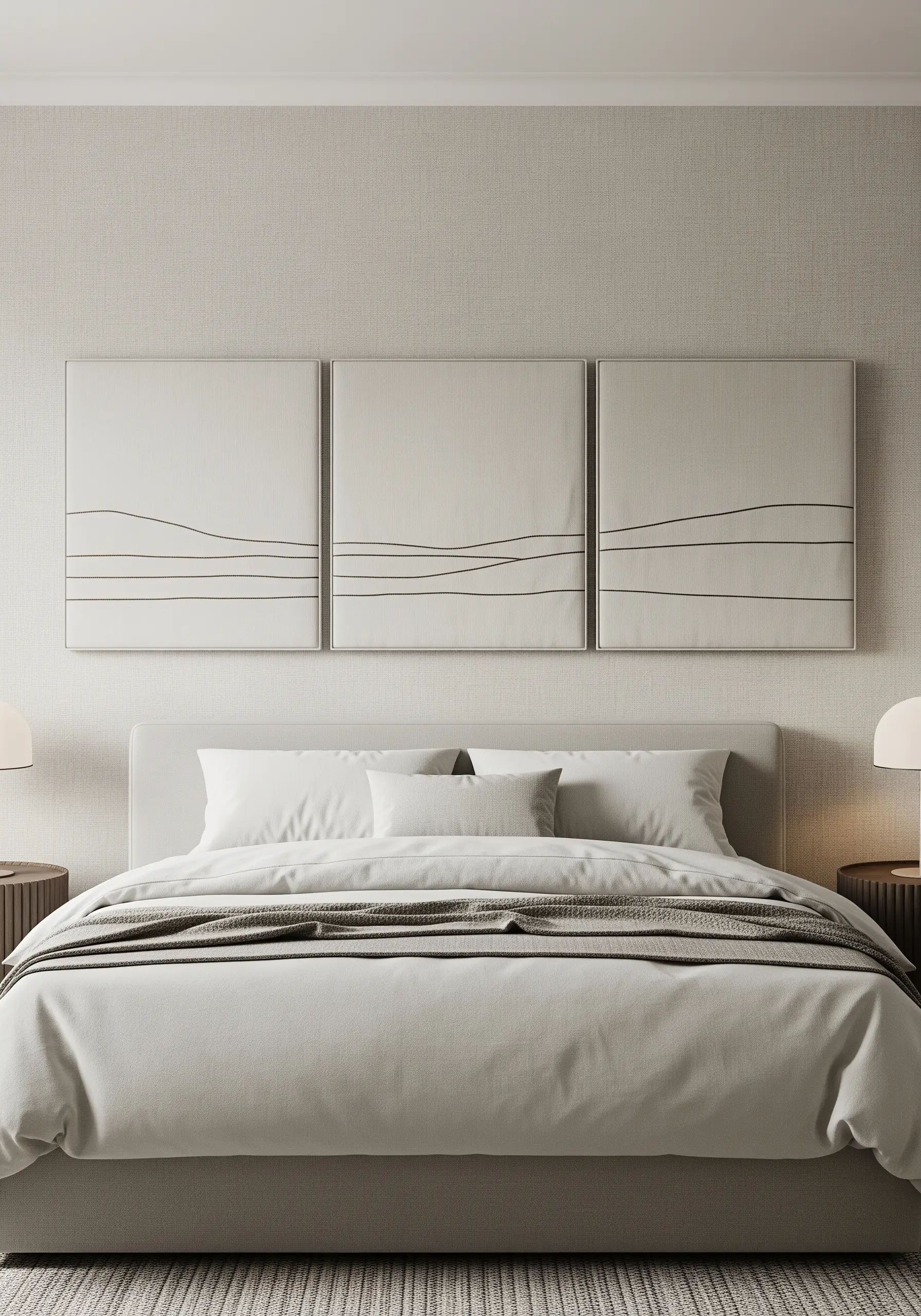
Span a single landscape design across three separate canvas panels to create a sense of horizon.
Use a couching stitch for the horizon lines to ensure they are bold, smooth, and clearly visible from a distance.
Explore modern minimalist textile wall art designs to see how breaking an image apart actually makes the room feel wider.
15. Framing the unexpected
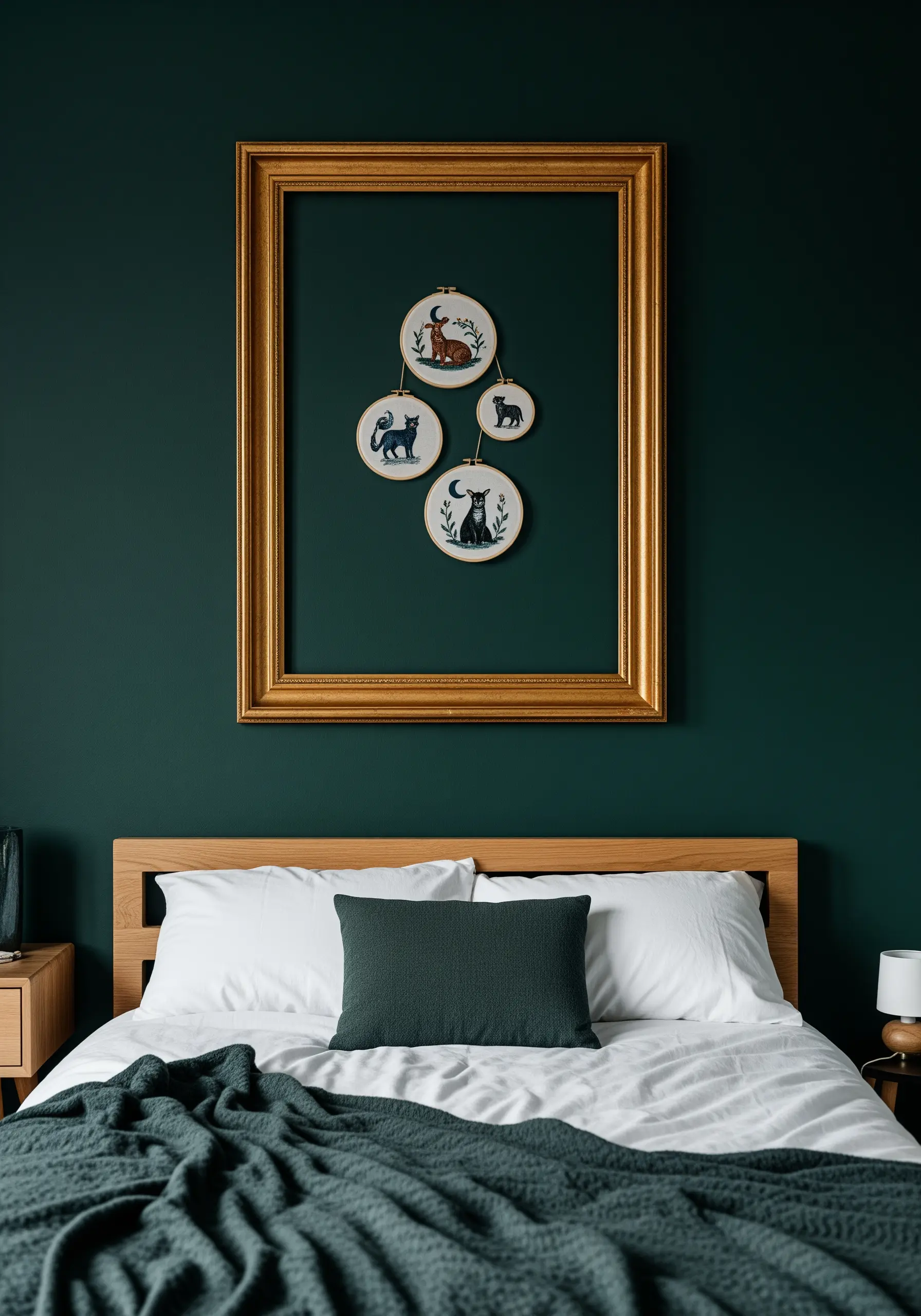
Elevate a small collection of hoops by hanging them inside a large, empty vintage frame.
This technique creates a ‘zone’ for your art, preventing small pieces from floating aimlessly on a large wall.
It works particularly well with character-driven pieces, like cat and kitten embroidery designs, giving them a deliberate and grand stage.
16. Macrame fusion wall hangings
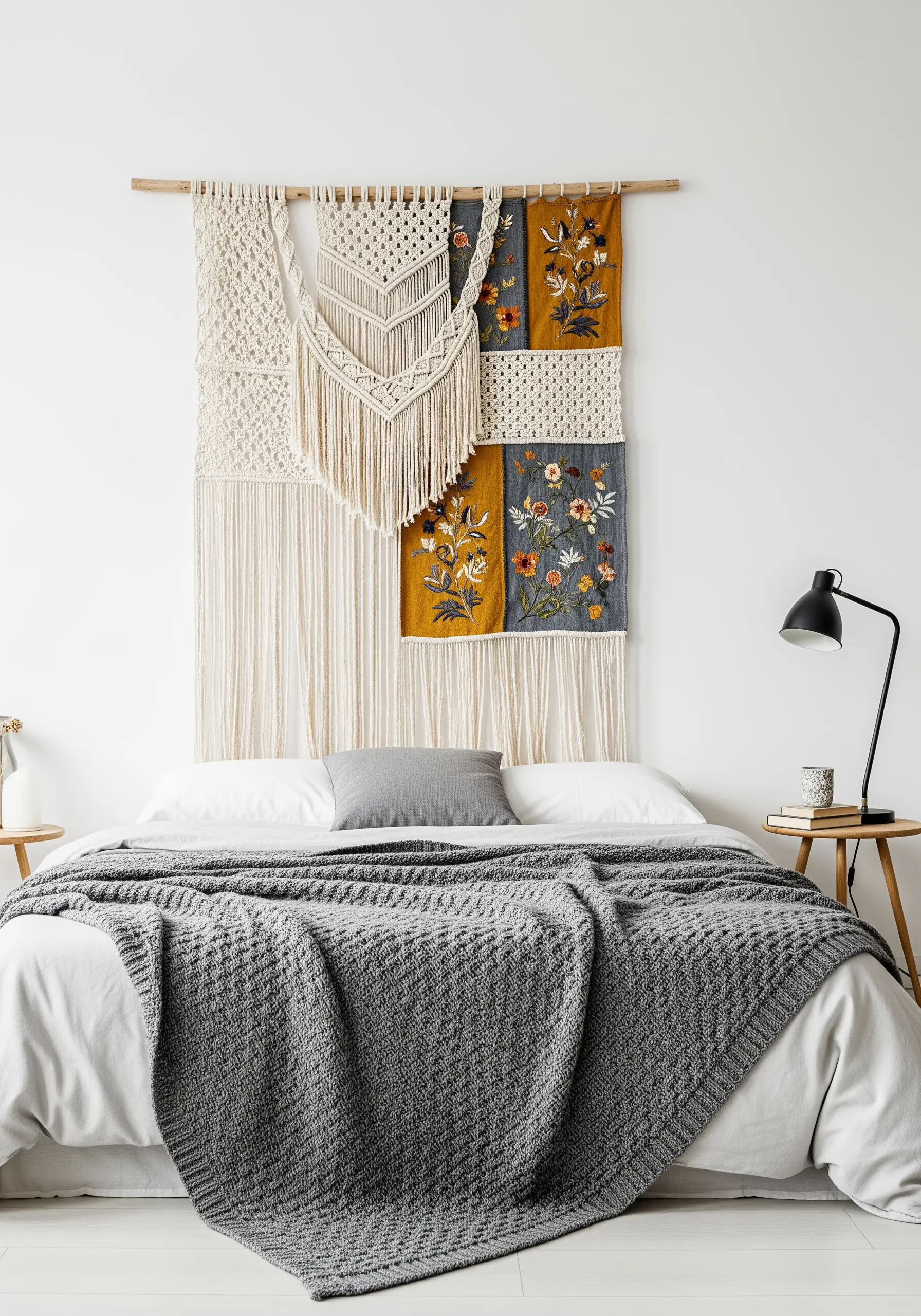
Combine the structure of embroidery with the flow of macrame by attaching fringe to the bottom of your works.
Stitch a dense floral panel and let long, combed cotton cords hang down to add softness and movement.
This is a prime example of mixed media embroidery wall art techniques that add tactile variety to your bedroom.
17. Invisible floating installations
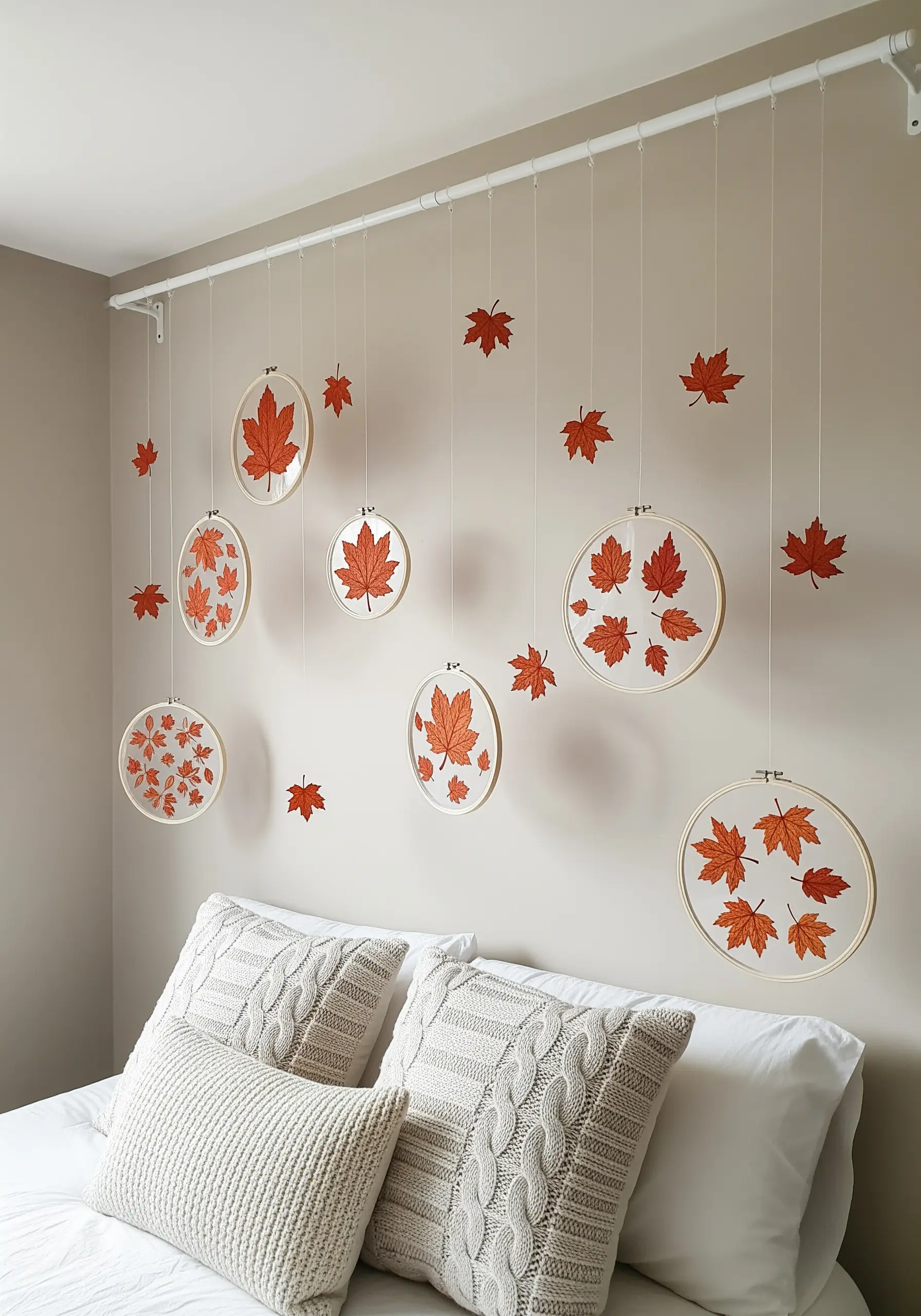
Suspend delicate hoops from the ceiling using clear fishing line to create an ethereal, floating effect.
Stitch autumn leaves on transparent tulle or organza so the light passes through, enhancing the ‘falling leaf’ illusion.
Discover ways to use neutrals in leaf embroidery to keep the installation feeling natural and airy, not heavy.
18. Modular cork and hoop displays
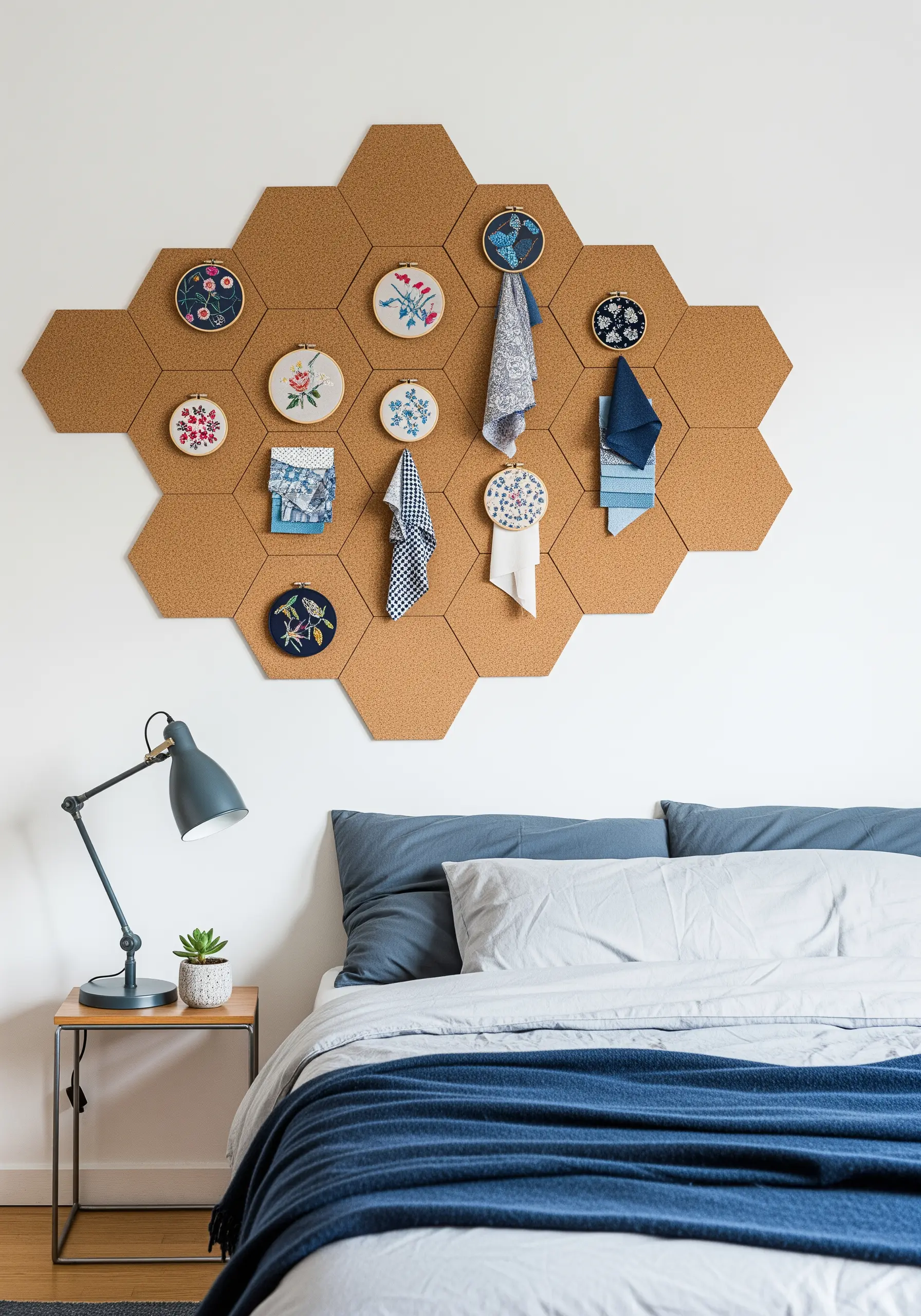
Create a honeycomb pattern with cork tiles and interspersed embroidery hoops for a warm, textured feature wall.
Use the embroidery to introduce pops of blue or floral patterns that break up the brown cork monotony.
These small embroidery motifs act as jewels within the larger geometric structure.
19. Architectural framing with panels
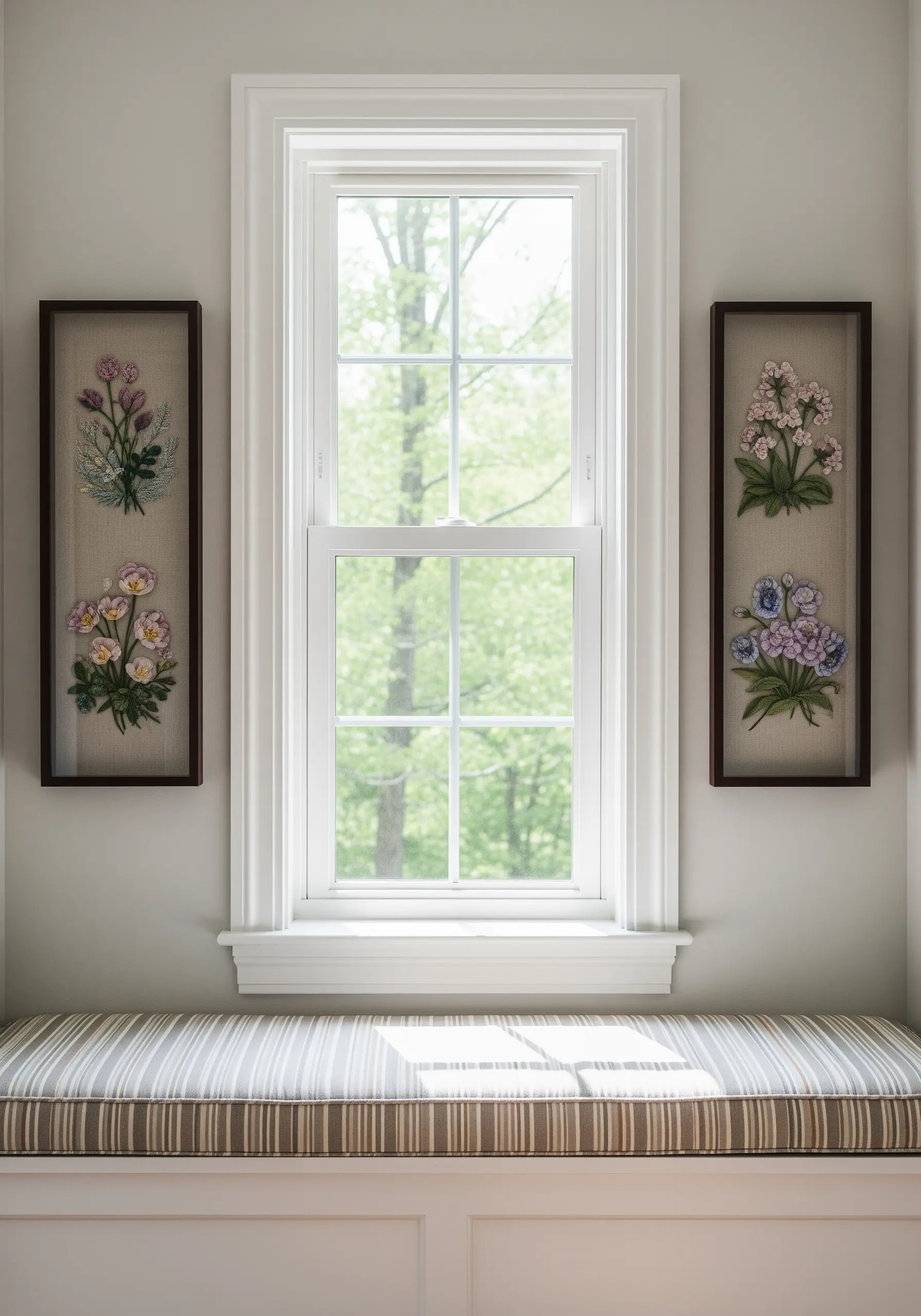
Use tall, narrow embroidery frames to flank windows, mimicking the vertical lines of shutters or drapes.
Fill these panels with climbing floral vines that reach upward, emphasizing the natural light source.
These floral embroidery wall decor projects bring the garden inside, even in the depths of winter.
20. Casual clipboard galleries
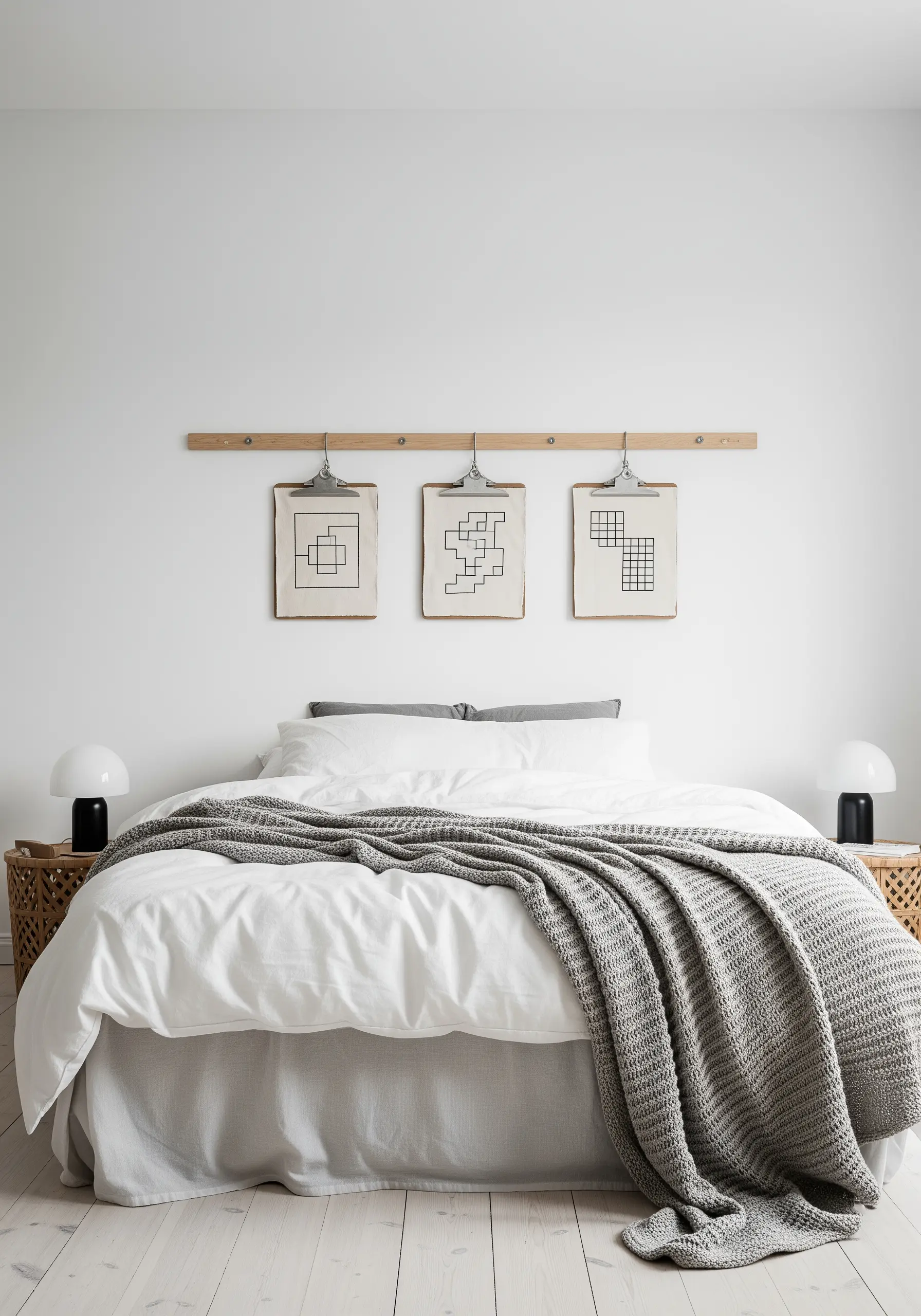
For a relaxed, non-permanent display, clip unfinished embroidery sketches onto wooden clipboards.
Focus on blackwork geometry or grid patterns that complement the utilitarian look of the clips.
This is ideal for minimal geometry stitch projects, allowing you to celebrate the process as much as the finished product.
21. High-contrast shelf styling
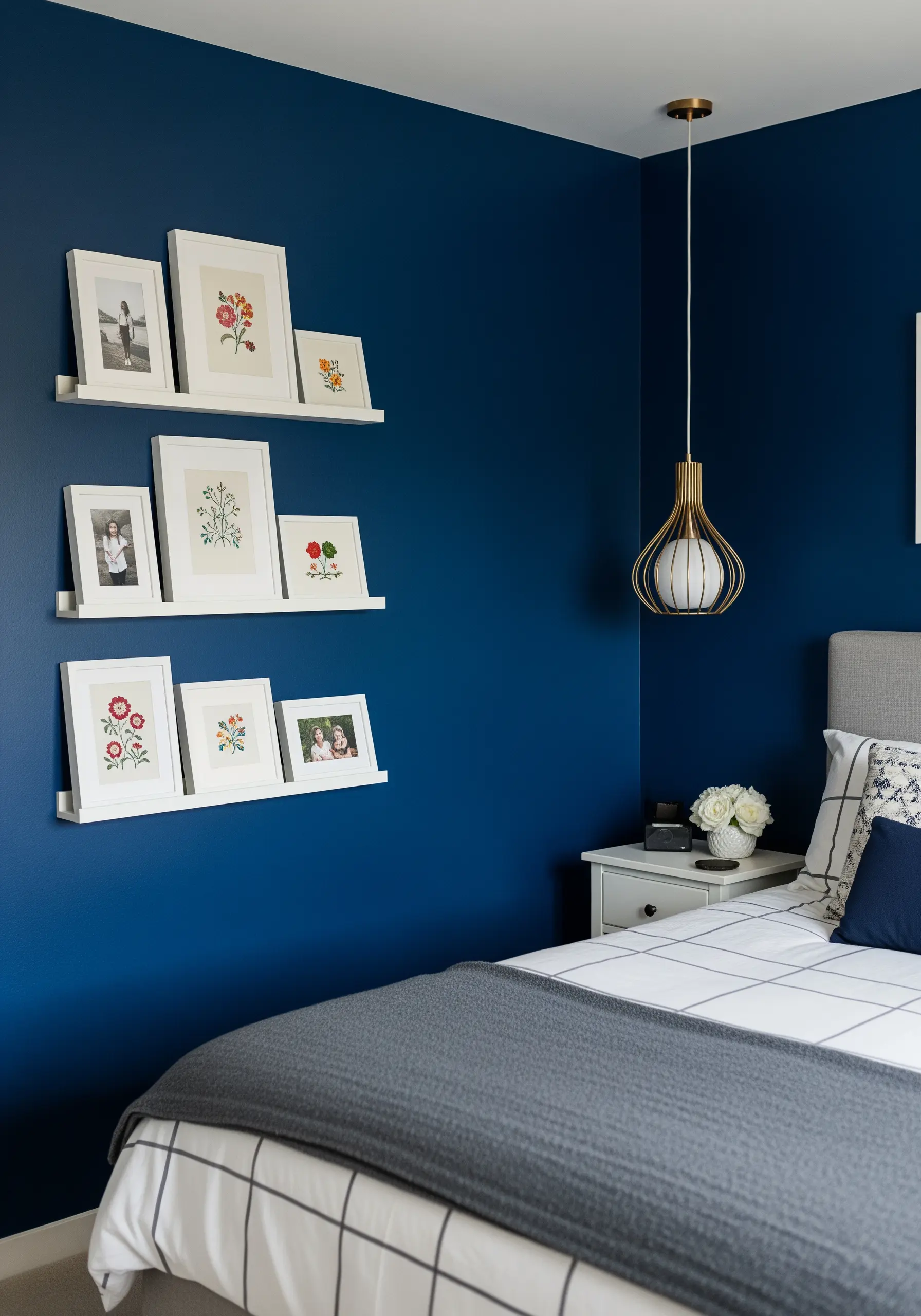
Paint your wall a deep navy and arrange white-matted frames or light wood hoops to make the art pop.
Stick to a minimal color palette within the embroidery—creams, golds, and pale greens—to maintain elegance.
You can adapt tiny hoop patch-style embroidery designs into mini-frames for this exact gallery look.
22. Topographic line textures
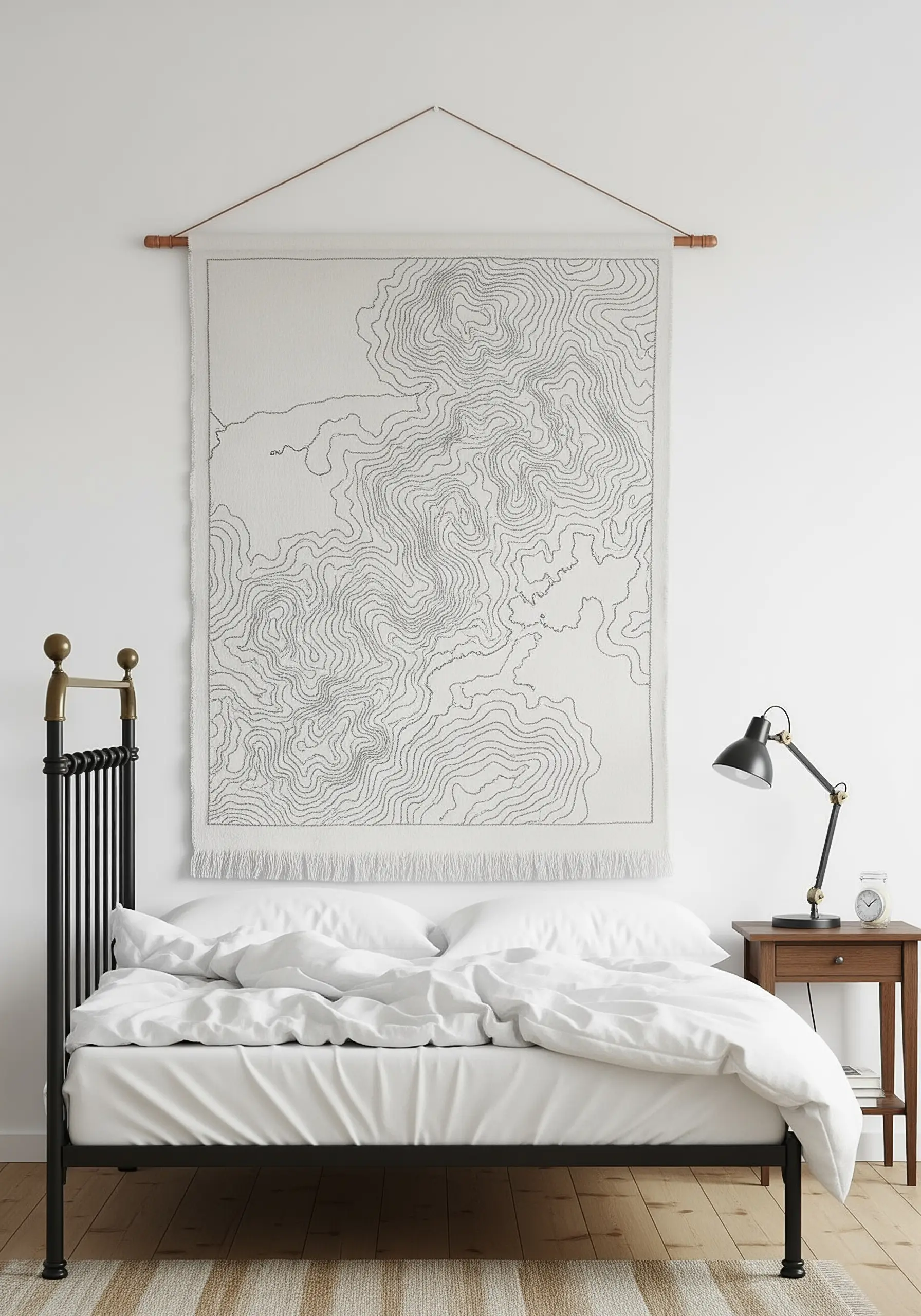
Use a simple backstitch or stem stitch to create dense, topographic map-style lines on a large canvas.
The beauty here lies in the density of the lines; from afar, it looks like a texture, but up close, it’s intricate stitching.
These one-line embroidery wall arts rely on rhythm and flow rather than color changes.
23. Embroidered acoustic tiles
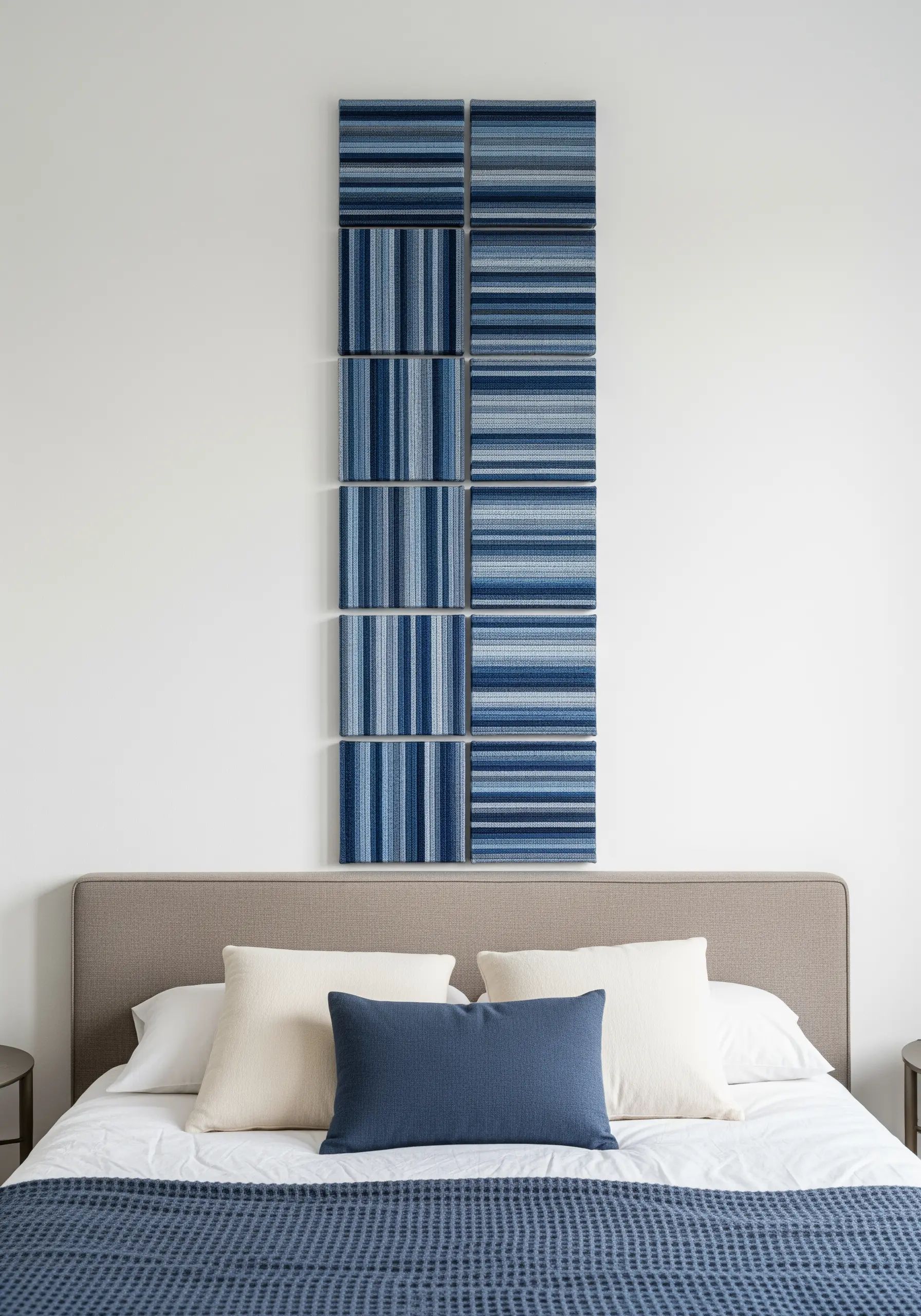
Combine sound dampening with art by stitching directly through felt acoustic panels.
Use thick wool yarn to create vertical stripes or gradients that align across multiple tiles.
This utilizes modern thread illusion techniques to turn functional home necessities into striking design features.
24. Large-scale wire mesh installation
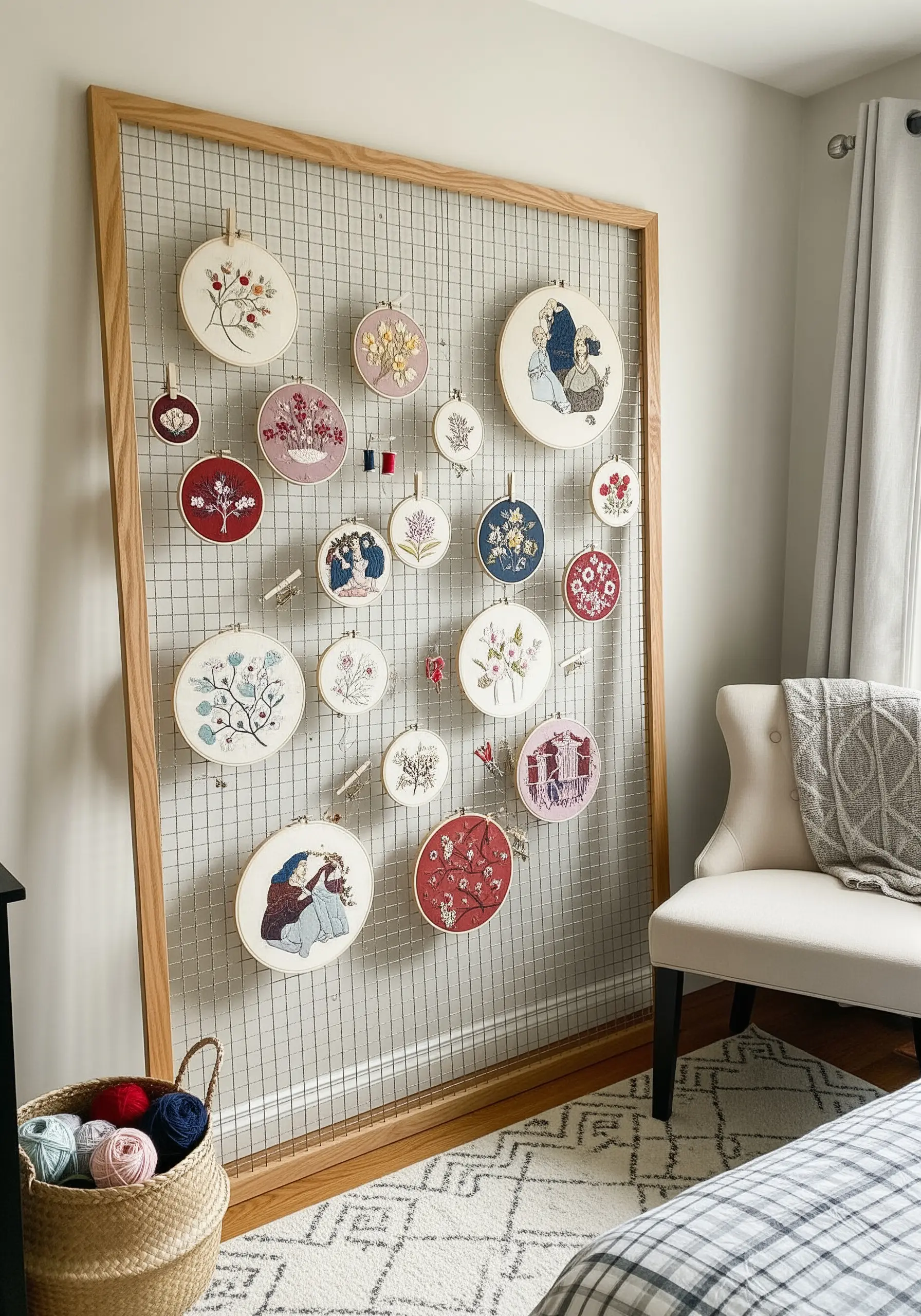
Build a massive wooden frame with wire mesh backing to clip up an entire collection of hoops.
This creates a ‘wall within a wall,’ allowing you to organize dozens of pieces without drilling dozens of holes.
Arrangements like this function as fiber art installations, turning your collection into a single, cohesive masterpiece.
25. Mixed media mandala spacing
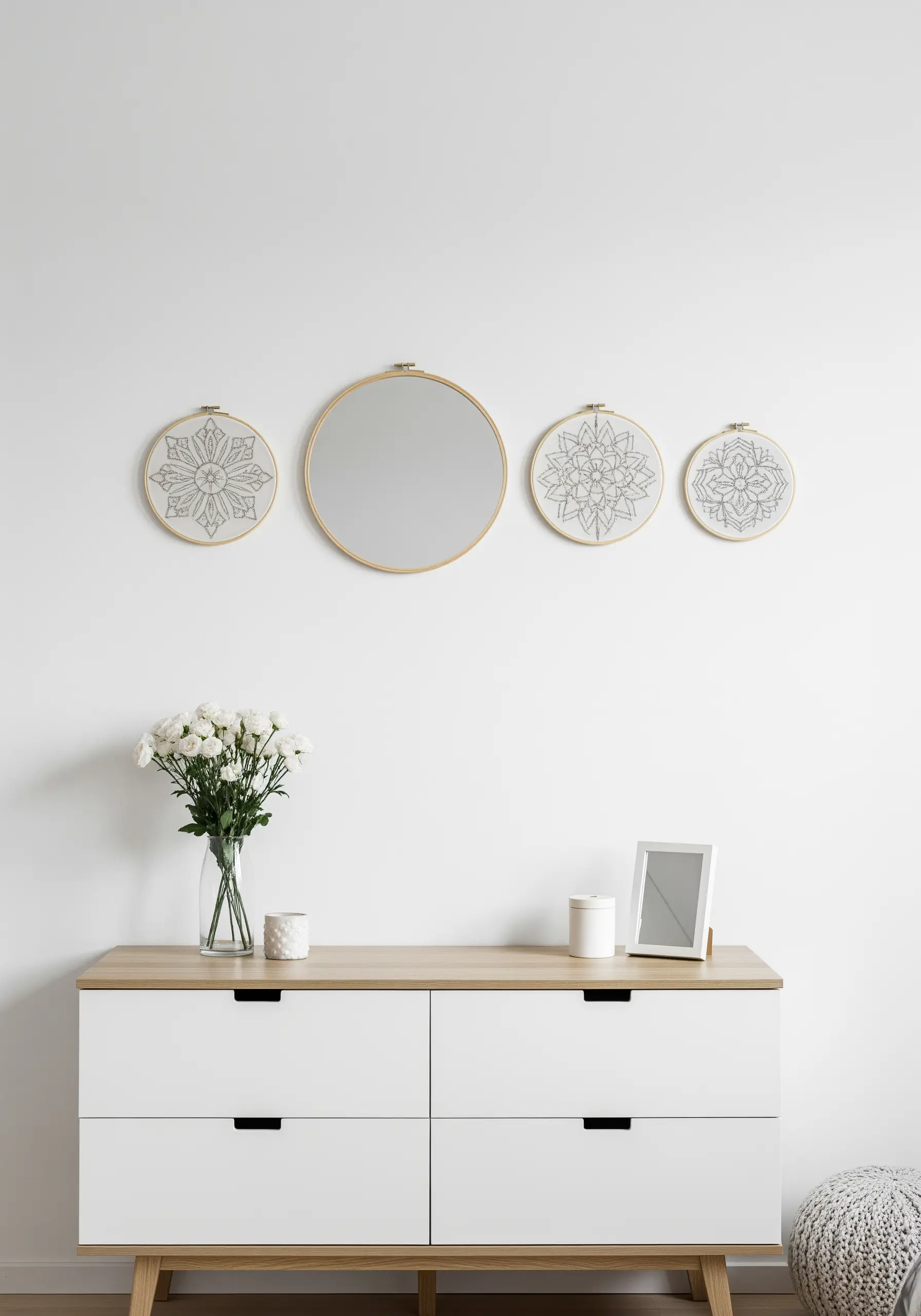
Create a horizontal focal point by alternating embroidery hoops with round mirrors or woven baskets.
Stitch geometric mandalas in black thread to contrast with the reflective surfaces of the mirrors.
Use modern mandala stitch patterns to ensure your thread work has the same radial balance as the other circular objects.
26. Ledge styling on wainscoting
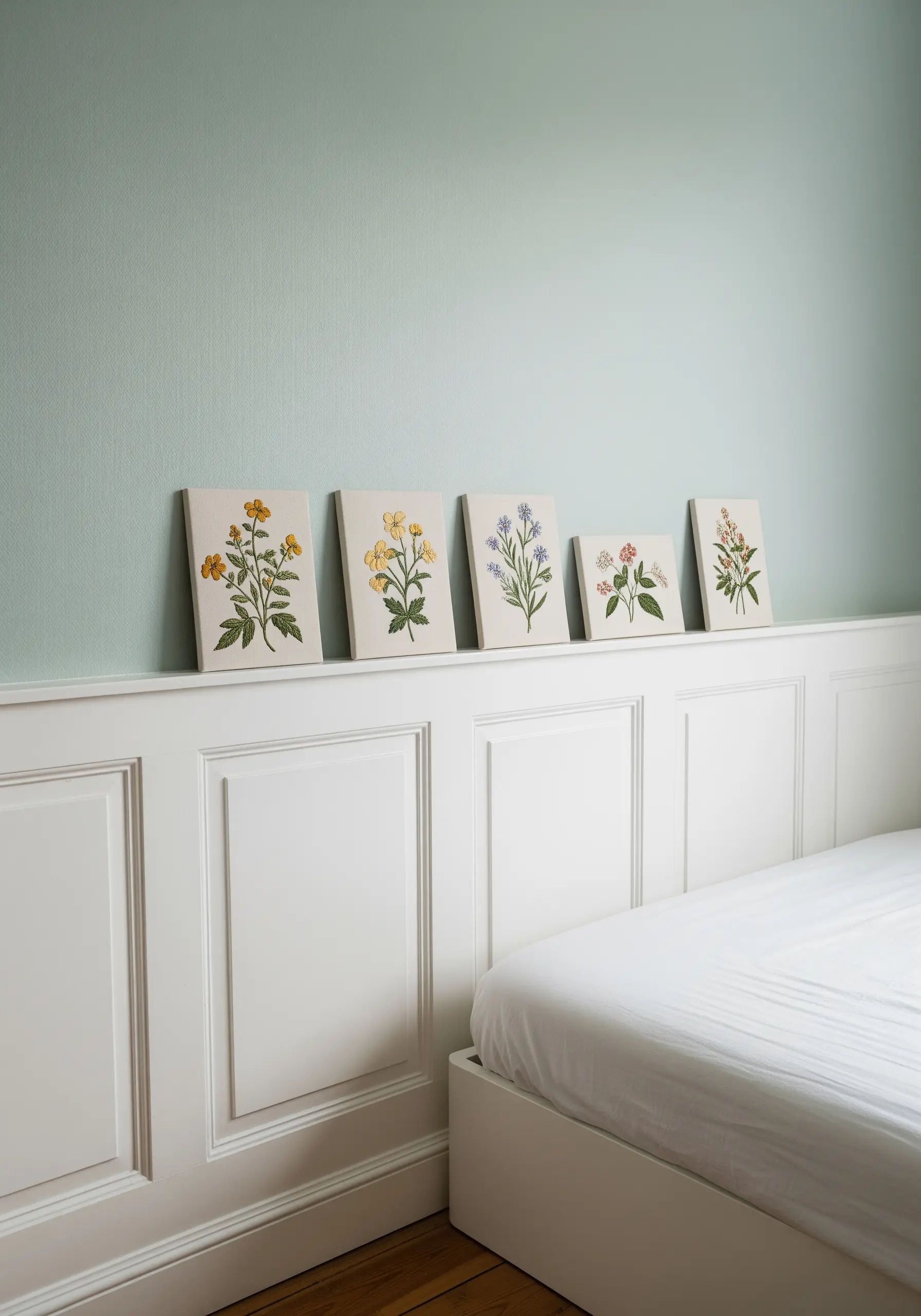
If you have wainscoting, use the top ledge to lean a series of botanical canvases.
Keep the background fabric consistent—like a raw linen—so the colorful floral subjects stand out.
These are essentially wildflower hoop art projects adapted for square stretchers to sit stably on the trim.
27. Appliqué felt banners
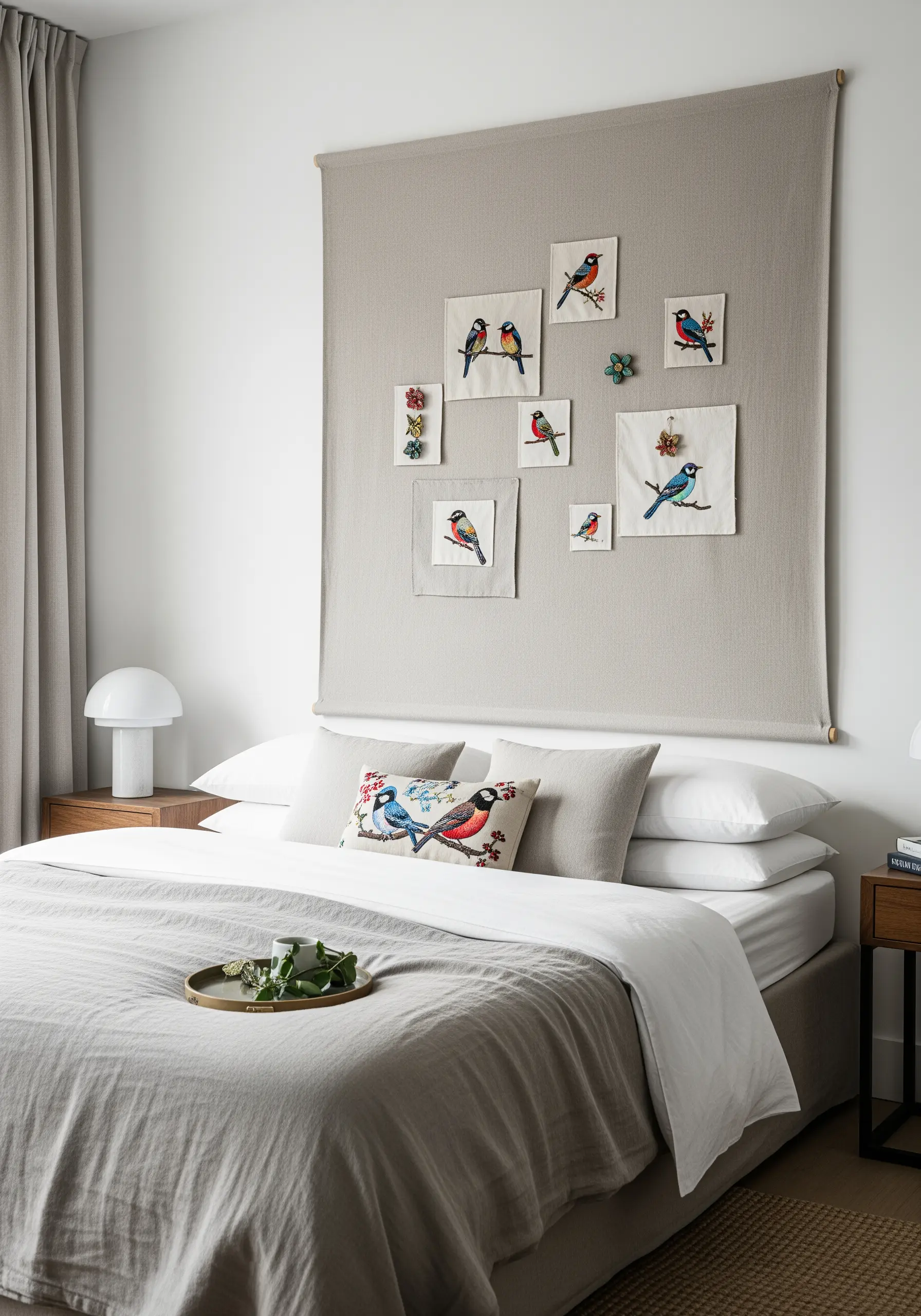
Softness is key in a bedroom; try a fabric banner where felt cutouts are appliquéd down with embroidery.
Use the blanket stitch to secure the felt edges and add decorative details to the birds or branches.
This technique mirrors fabric collage embroidery animals, adding 3D tactile elements that feel warmer than flat stitching.
28. Vertical pocket organizers
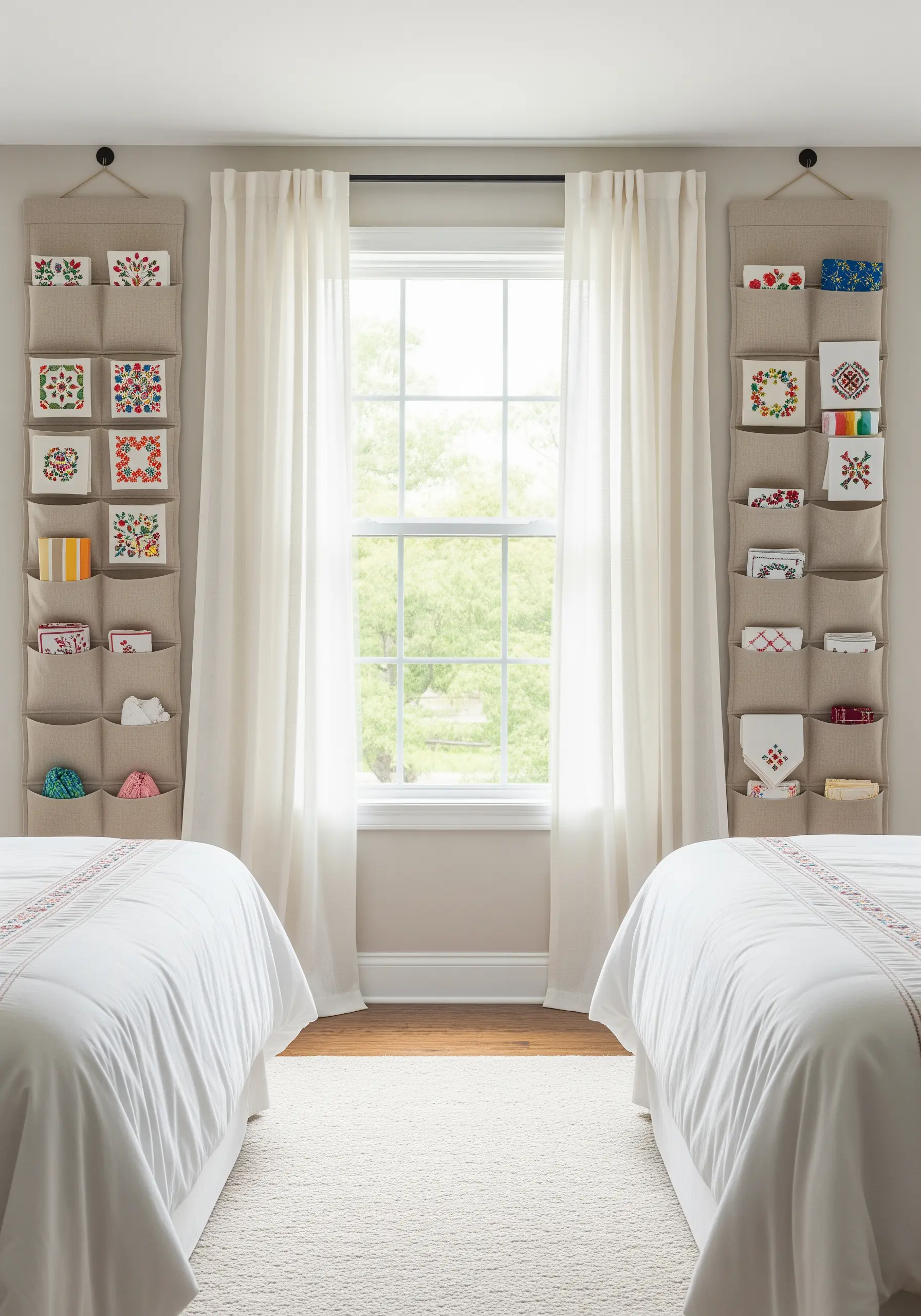
Turn storage into a display by stitching motifs onto the front of hanging fabric pockets.
Use durable stitches like the chain stitch to ensure the design holds up to the fabric stretching.
Look into creative embroidery projects that focus on utility, proving that practical items can still be beautiful.
29. Modern acrylic framing
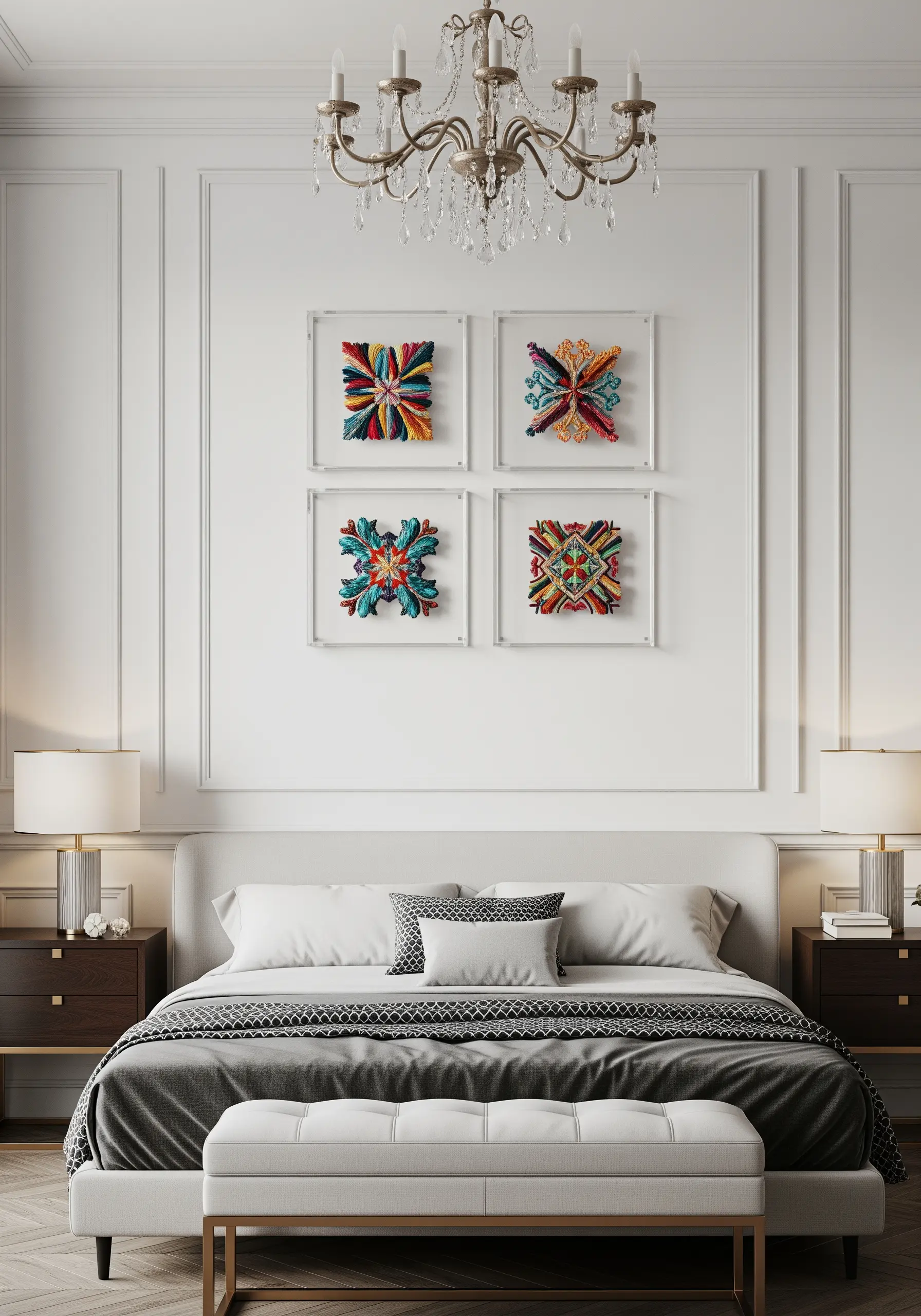
Sandwich your vibrant thread work between sheets of clear acrylic for a floating, museum-quality look.
The lack of a visible frame allows the intense colors of radial patterns to interact directly with the wall color.
This is perfect for bold color-pop embroidery wall frames, creating a sharp, contemporary edge.
30. Natural branch suspensions
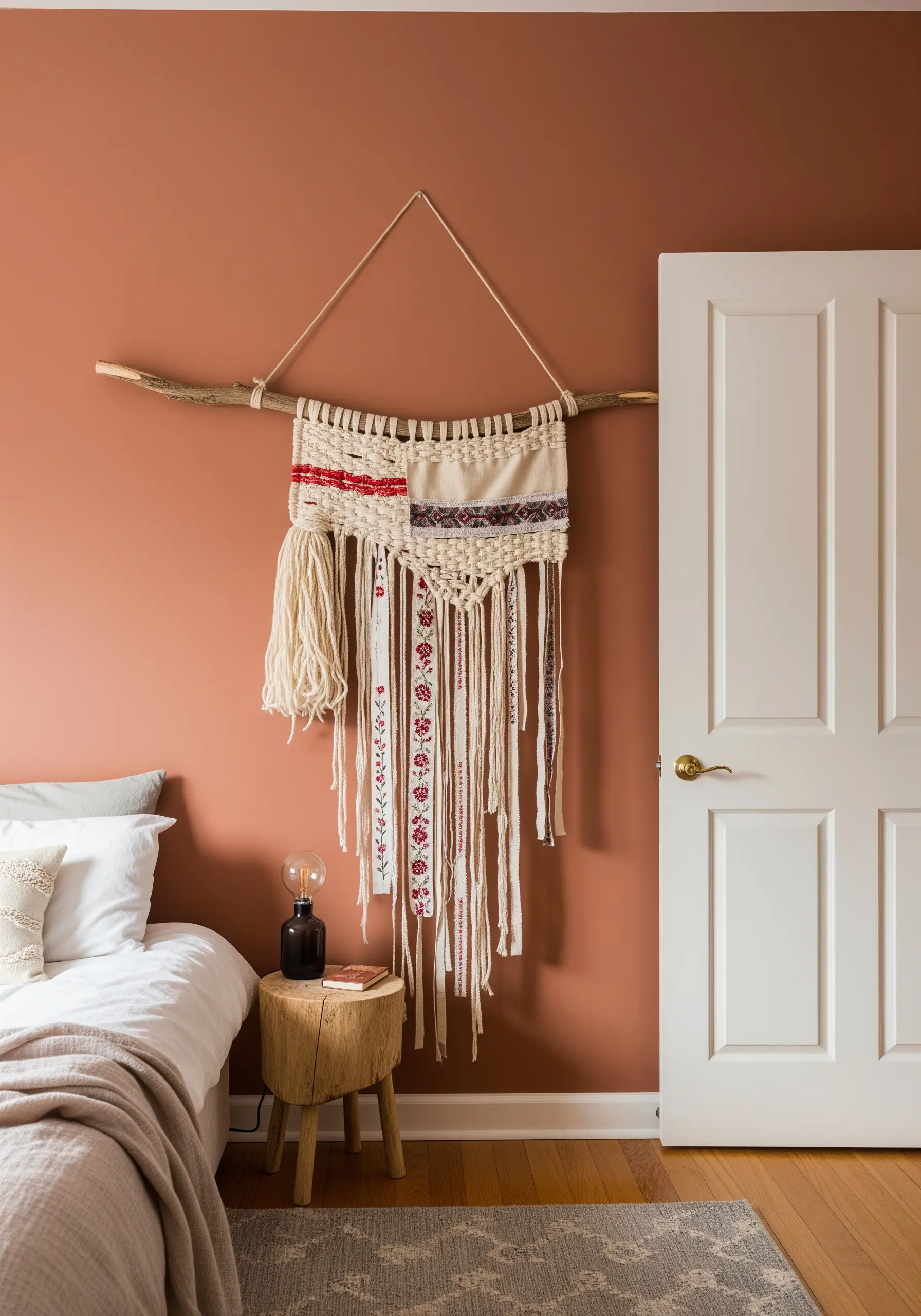
For a boho-chic finish, loop macrame cords over a natural branch to suspend an embroidered tapestry.
Incorporate woven sections and hanging ribbons to mix textures with your stitched patterns.
These eye-catching mixed fiber wall hangings bring an organic, grounded energy to your sleeping sanctuary.